Showing posts with label matrix. Show all posts

Sunday, April 21, 2024

20.11 - Minors And Cofactors

In the previous section, we saw area of triangles. In this section, we will see Minors and Cofactors.

Minors

Some basics about Minors can be written in 6 steps:
1. Consider a determinant.
2. Pick any element aij from that determinant.
3. Delete one row and one column:
   ♦ Delete the row in which aij is situated (the ith row)
   ♦ Delete the column in which aij is situated (the jth column)
4. After deleting the above row and column, we get a new determinant.
• This new determinant is called the Minor of aij
5. Minor of aij is denoted by Mij.
6. Since one row and one column are being deleted from the original determinant, we can write a useful point. It can be written in 2 steps:
(i) Consider any determinant of order n, where n≥2.
(ii) We know how to write the Minor of any element of that determinant. All those Minors will be of the order (n-1).
(iii) We cannot consider determinants whose order is less than 2. This is because, in such determinants, there will be only one element. It is not possible to find the Minor of that single element.


Now we will see a solved example:

Solved example 20.15
Find the Minor of the element 8 in the determinant:
$\Delta~=~\left |\begin{array}{r}                           
3    &{    5    }    &{    9    }    \\
6    &{    11    }    &{    8    }    \\
7    &{    15    }    &{    12    }    \\
\end{array}\right |$
Solution:
1. The element 8 is in the second row and third column.
2. So we delete the second row and third column.
3. The new determinant thus obtained is:
$\left |\begin{array}{r}                           
3      &{    5    }    \\
7      &{    15    }    \\
\end{array}\right |$ 
3. The value of this new determinant is:
(3 × 15 - 7 × 5) = (45 - 35) = 10
4. So we can write:
• In the original determinant,
The Minor of element 8 = M23 = 10


Cofactors

This can be explained in 2 steps:
1. If Mij is the Minor of the element aij, then
the Cofactor of aij can be obtained simply by multiplying (-1)i+j and Mij.
2. The Cofactor of aij is denoted by Aij.
• So we can write:
Aij = (−1)i+j Mij


Let us see some solved examples:

Solved example 20.16
Find the Minors and Cofactors of all the elements of the determinant:
$\left |\begin{array}{r}                           
1      &{    -2    }    \\
4      &{    3    }    \\
\end{array}\right |$ 
Solution:
1. M11 = 3
• So A11 = (−1)1+1 M11 = (−1)2 (3) = 3

2. M12 = 4
• So A12 = (−1)1+2 M12 = (−1)3 (4) = −4

3. M21 = −2
• So A12 = (−1)2+1 M12 = (−1)3 (−2) = 2

4. M22 = 1
• So A22 = (−1)2+2 M22 = (−1)4 (1) = 1

Solved example 20.17
Find the Minors and Cofactors of a11 and a21 in the determinant:
$\left |\begin{array}{r}                           
a_{11}      &{    a_{12}    } &{    a_{13}    }    \\
a_{21}      &{    a_{22}    } &{    a_{23}    }    \\
a_{31}      &{    a_{32}    } &{    a_{33}    }    \\
\end{array}\right |$ 
Solution:
1. M11 =
$\left |\begin{array}{r}                           
a_{22}      &{    a_{23}    }    \\
a_{32}      &{    a_{33}    }    \\
\end{array}\right |~=~a_{22} a_{33} \,-\, a_{23} a_{32}$ 
• So A11 = (−1)1+1 M11 =
$(-1)^2 (a_{22} a_{33} \,-\, a_{23} a_{32})~=~a_{22} a_{33} \,-\, a_{23} a_{32}$

2. M21 =
$\left |\begin{array}{r}                           
a_{12}      &{    a_{13}    }    \\
a_{32}      &{    a_{33}    }    \\
\end{array}\right |~=~a_{12} a_{33} \,-\, a_{13} a_{32}$ 
• So A21 = (−1)2+1 M21 =
$(-1)^3 (a_{12} a_{33} \,-\, a_{13} a_{32})~=~- a_{12} a_{33} \,+\, a_{13} a_{32}$


Now we know the basics about Minors and Cofactors. So we can learn about a method which will help us to write the determinant in a compact form. It can be written in 7 steps:

1. Consider the determinant:
$\Delta ~=~\left |\begin{array}{r}                           
a_{11}      &{    a_{12}    } &{    a_{13}    }    \\
a_{21}      &{    a_{22}    } &{    a_{23}    }    \\
a_{31}      &{    a_{32}    } &{    a_{33}    }    \\
\end{array}\right |$

2. We know that:
$\Delta = a_{11} \times (-1)^{1+1} \times \left |\begin{array}{r}                           
a_{22}      &{    a_{23}    }    \\
a_{32}      &{    a_{33}    }    \\
\end{array}\right |~+~a_{12} \times (-1)^{1+2} \times \left |\begin{array}{r}                           
a_{21}      &{    a_{23}    }    \\
a_{31}      &{    a_{33}    }    \\
\end{array}\right |~+~a_{13} \times (-1)^{1+3} \times \left |\begin{array}{r}                           
a_{21}      &{    a_{22}    }    \\
a_{31}      &{    a_{32}    }    \\
\end{array}\right |$

3. We can write this in terms of Cofactors.
• Consider the first term in the R.H.S of (2). This term is: a11  × A11
• Consider the second term in the R.H.S of (2). This term is: a12  × A12
• Consider the third term in the R.H.S of (2). This term is: a13  × A13

4. So the result in (2) becomes:
$\Delta~=~a_{11} A_{11}~+~a_{12} A_{12}~+~a_{13} A_{13}$
• Thus we are able to write Δ in a compact form.

5. The method used in (4) is applicable for any row or any column. For example:
• Expanding along the second row, we can write:
$\Delta~=~a_{21} A_{21}~+~a_{22} A_{22}~+~a_{23} A_{23}$
• Expanding along the third column, we can write:
$\Delta~=~a_{13} A_{13}~+~a_{23} A_{23}~+~a_{33} A_{33}$

6. So the determinant can be calculated in 3 simple steps:
(i) Take any row (or any column)
(ii) Multiply each element of that row (or column) with the corresponding Cofactor.
(iii) Find the sum of the "products obtained in (ii)". This sum is the determinant.

7. Consider the step 6(ii) written above. It is important to use the corresponding Cofactors. If we use the Cofactors of any other row or column, the sum will become zero.

• Let us see an example. It can be written in 4 steps:
(i) Let us pick the first row for expansion. But the Cofactors used are from the second row.
(ii) Then the sum is:
$a_{11} A_{21}~+~a_{12} A_{22}~+~a_{13} A_{23}$
(iii) This can be expanded as:
$a_{11} (-1)^{2+1} (a_{12} a_{33} - a_{13} a_{32})$
$+~ a_{12} (-1)^{2+2} (a_{11} a_{33} - a_{13} a_{31})$
$+~ a_{13} (-1)^{2+3} (a_{11} a_{32} - a_{12} a_{31})$
(iv) This is same as:
$-a_{11} a_{12} a_{33} + a_{11} a_{13} a_{32}$
$+~ a_{12} a_{11} a_{33} - a_{12} a_{13} a_{31}$
$-~ a_{13} a_{11} a_{32} + a_{13} a_{12} a_{31}~=~0$


Solved example 20.18
Find the Minors and Cofactors of elements of the determinant:
$\left |\begin{array}{r}                           
8      &{    3    } &{    0    }    \\
-5      &{    11    } &{    -2    }    \\
6      &{    0    } &{    -7    }    \\
\end{array}\right |$
And verify that a11 A31 + a12 A32  + a13 A33 = 0   
Solution:

Method for calculating Minors and Cofactors of determinants.

• Now we can verify the given statement:
a11 A31 + a12 A32  + a13 A33
= 8(-6) + 3(16) + 0(-47)
= -48 + 48 + 0
= 0


The link below gives a few more solved examples:

Exercise 20.4


In the next section, we will see adjoint and inverse of a matrix.

Previous

Contents

Next

Copyright©2024 Higher secondary mathematics.blogspot.com

Wednesday, April 17, 2024

20.10 - Area of A Triangle

In the previous section, we saw some solved examples related to properties of determinants. In this section, we will see area of triangles.

Some basics can be written in 3 steps:
1. In our earlier coordinate geometry classes, we have seen an expression to find the area of any triangle:

$\text{Area} = \frac{1}{2} |x_1(y_2 - y_3) + x_2(y_3 - y_1) + x_3(y_1 - y_2)|$
(Details here)

2. Now consider the determinant:

$\Delta = \frac{1}{2} \left|\begin{array}{r}      
x_1    &{    y_1    }    &{    1    }    \\
x_2    &{    y_2    }    &{    1    }    \\
x_3    &{    y_3    }    &{    1    }    \\
\end{array}\right|$
• If we expand this determinant along the first column, we will get the same expression as in (1).

3. That means, area of a triangle can be written in "determinant form" also.
• But it is important to take the absolute value of the determinant. This is because, area cannot be a negative quantity.


Now we will see some solved examples.

Solved example 20.13
Find the area of the triangle whose vertices are (-1.5,2), (-2.5,-2), (4,1.5)
Solution:


◼ Remarks:
• 3: Here we apply two operations:
   ♦ R1 → R1 − R3.
   ♦ R2 → R2 − R3.
4: Here we expand the determinant along C3.

Solved example 20.14
Find the equation of the line joining A(1,3) and B(0,0) using determinants and find k if D(k,0) is a point such that area of triangle ABD is 3 sq units.
Solution:
Part (i):
1. Let P(x,y) be any point on the line AB.
Then area of the triangle APB = 0. This is because, three collinear points cannot form a triangle.
2. So we can write:


◼ Remarks:
• 2 (magenta color): Here we expand the determinant along the second row.
• 3 (magenta color): Here we use the index (2+3). This is because, '1' is the a23th element.

3. Since the area is zero, we can write:
-(1/2)(y-3x) = 0
• From this we get: -y + 3x = 0
• Which is same as: y = 3x

4. The line y=3x will pass through both A(1,3) and B(0,0).

Part (ii):


◼ Remarks:
• 2 (magenta color): Here we write $\pm 3$ because, the value of the determinant can be either +3 or -3. We can ignore the -ve sign only when we write it as an area.
• 3 (magenta color): Here we expand the determinant along the second row.
• 3 (magenta color): Here we use the index (2+3). This is because, '1' is the a23th element.

◼ We can write:
• Area of the triangle formed by the three points A(1,3), B(0,0) and D(2,0) is 3 units.
• Area of the triangle formed by the three points A(1,3), B(0,0) and D(-2,0) is also 3 units. 


The link below gives a few more solved examples:

Exercise 20.3


In the next section, we will see Minors and Cofactors.

Previous

Contents

Next

Copyright©2024 Higher secondary mathematics.blogspot.com

Monday, April 8, 2024

20.9 - Solved Examples

In the previous section, we completed the discussion on properties of determinants. In this section, we will see some solved examples.

Solved example 20.8
Without expanding, prove that

Solution:


◼ Remarks:
• 2 (magenta color): Here we apply property VI
• 3(magenta color):
   ♦ Consider R1 and R3. Take any two corresponding elements from them.
   ♦ The element from R1 will be proportional to the element from R3 in the ratio (x+y+z) : 1.
   ♦ So value of the determinant is zero.

Solved example 20.9
Evaluate


Solution:


◼ Remarks:
• 2 and 3 (magenta color): Here we apply property VI
• 5(magenta color): Here we expand along C1.

Solved example 20.10
Prove that


Solution:

1. Split the given determinant as |A| + |B| by applying property V.


◼ Remarks:
• 2 (magenta color): Here we apply property V and split Δ into |A| and |B|.
• 3 (magenta color): Here we apply property V and split |A|.
• 5(magenta color): Line 4 has four determinants.
   ♦ First is expanded along R1.
   ♦ Second is expanded along R3.
   ♦ Third is expanded along R2.
   ♦ Fourth is expanded along C1.

2. Evaluate |B|:


◼ Remarks:

• 2 (magenta color): Here we apply property V and split |B|.
• 3 (magenta color): Line 2 has two determinants.
   ♦ First is expanded along R1.
   ♦ Second is expanded along R1.

3. Find the sum:
Δ = |A| + |B|
= 3abc - a2c - ac2 + ac2 + a2c + abc
= 4abc

Solved example 20.11
If x, y, z are different and

then show that 1 + xyz = 0
Solution:
1. Split the given determinant as |A| + |B| by applying property V.


◼ Remarks:
• 2 (magenta color): Here we apply property V and split Δ into |A| and |B|.
• 3 (magenta color): Here we simplify |A|.
• 6(magenta color): Here we expand the determinant along C3.

2. Evaluate |B|:

◼ Remarks:

• 2 (magenta color): Here we apply property IV and take out the common factors x, y and z.
• 3 (magenta color): Here we apply property II and interchange C1 and C2. So the sign of the determinant will change.
• 4 (magenta color): Here we apply property II and interchange C2 and C3. So the sign of the determinant will change again.
• 5 (magenta color):
Line 4 has a determinant on the R.H.S. This determinant is |A|.

3. Find the sum:
Δ = |A| + |B|
= |A| + xyz |A|
= (1+xyz)|A|
= (1+xyz)(x−z)(y−z)(y−x)

4. Given that Δ = 0.
• So we can write: (1+xyz)(x−z)(y−z)(y−x) = 0
• Also given that, x, y, z are different.
• So (x−z) ≠ 0, (y−z) ≠ 0, (y−x) ≠ 0
• Thus we get: 1+xyz = 0

Solved example 20.12
Show that


Solution:
1. Split the given determinant as |A| + |B| by applying property V.
◼ Remarks:

• 2 (magenta color): Here we apply property V and split Δ into |A| and |B|.
• 3 (magenta color): Here we apply property V and split |A|.
• 4 (magenta color): Line 3 has two determinants.
   ♦ The first has two identical columns. So by applying property III, it becomes zero.
• 5 (magenta color): Line 4 has a determinant. It is expanded along the second row.
• 8 (magenta color): |B| is expanded along the first row.

3. Find the sum:


◼ Remarks:
• 4 (magenta color): Here we take out abc as a common factor.


A few more Solved examples can be seen in the following video:

Exercise 20.2


In the next section, we will see Area of a triangle.

Previous

Contents

Next

Copyright©2024 Higher secondary mathematics.blogspot.com

Friday, April 5, 2024

20.8 - Property VI

In the previous section, we saw the fifth property of determinants. In this section, we will see the sixth property.

Property VI
This can be written in 6 steps:
1. Let Δ = $\left |\begin{array}{c}                           
a_1     &{    a_2     }    &{    a_3     }    \\
b_1    &{    b_2    }    &{    b_3    }    \\
c_1    &{    c_2    }    &{    c_3    }    \\
\end{array}\right | $.
2. Pick any two rows, say R2 and R3.
Apply R2 → R2 + k R3

• Then we get a new determinant Δ1

Δ1 = $\left |\begin{array}{c}                           
a_1     &{    a_2     }    &{    a_3     }    \\
b_1 + k c_1    &{    b_2 + k c_2    }    &{    b_3 + k c_2    }    \\
c_1    &{    c_2    }    &{    c_3    }    \\
\end{array}\right | $.

• Note that, when we apply R2 → R2 + k R3, the row R2 is affected. The other row R3 remains the same.

3. We can apply property 5. That is., we can split Δ1 and write it as the sum of two determinants:

$\left |\begin{array}{c}                           
a_1     &{    a_2     }    &{    a_3     }    \\
b_1 + k c_1    &{    b_2 + k c_2    }    &{    b_3 + k c_2    }    \\
c_1    &{    c_2    }    &{    c_3    }    \\
\end{array}\right | ~=~\left |\begin{array}{c}                           
a_1     &{    a_2     }    &{    a_3    }    \\
b_1    &{    b_2    }    &{    b_3    }    \\
c_1    &{    c_2    }    &{    c_3    }    \\
\end{array}\right |~+~\left |\begin{array}{c}                           
a_1     &{    a_2     }    &{    a_3    }    \\
k c_1    &{    k c_2    }    &{    k c_3    }    \\
c_1    &{    c_2    }    &{    c_3    }    \\
\end{array}\right |$

4. In the above equation, consider the second determinant in the R.H.S. All the elements of R2 are proportional to the corresponding elements in R3 in the same ratio k:1. So by applying property IV, this determinant is zero.

5. So the equation in (3) becomes:
$\left |\begin{array}{c}                           
a_1     &{    a_2     }    &{    a_3     }    \\
b_1 + k c_1    &{    b_2 + k c_2    }    &{    b_3 + k c_2    }    \\
c_1    &{    c_2    }    &{    c_3    }    \\
\end{array}\right | ~=~\left |\begin{array}{c}                           
a_1     &{    a_2     }    &{    a_3    }    \\
b_1    &{    b_2    }    &{    b_3    }    \\
c_1    &{    c_2    }    &{    c_3    }    \\
\end{array}\right |~+~0$

• That is: Δ1 = Δ

6. We can write:
If we apply the operation Ri → Ri + k Rj, the value of the determinant remains same.
7. This is true for columns also. We can write:
If we apply the operation Ci → Ci + k Cj, the value of the determinant remains same.
8. When we apply Ri → Ri + k Rj, the row affected is Ri . The row Rj is not affected.
• In one step, we must not use Ri in another operation.
9. A rule similar to (8) can be written for columns also.


Now we have a clear understanding about property VI. Let us see an example.

• Show that $\left|\begin{array}{r}                           
a    &{    a+b    }    &{    a+b+c    }    \\
2a    &{    3a+2b    }    &{    4a+3b+2c    }    \\
3a    &{    6a+3b    }    &{    10a+6b+3c    }    \\
\end{array}\right|~=~a^3$.
Solution:


◼ Remarks:
• 2, 3 and 4 (magenta color): Here we apply property VI
• 5(magenta color): Here we expand along C1

In the next section, we will see some solved examples.

Previous

Contents

Next

Copyright©2024 Higher secondary mathematics.blogspot.com

Thursday, April 4, 2024

20.7 - Property V

In the previous section, we saw the fourth property of determinants. In this section, we will see the fifth property.

Property V
This can be written in 6 steps:
1. Let Δ = $\left |\begin{array}{c}                           
a_1 + \lambda_1    &{    a_2 + \lambda_2    }    &{    a_3 + \lambda_3    }    \\
b_1    &{    b_2    }    &{    b_3    }    \\
c_1    &{    c_2    }    &{    c_3    }    \\
\end{array}\right | $.
2. We can split this determinant and write it as the sum of two determinants:

$\left |\begin{array}{c}                          
a_1 + \lambda_1    &{    a_2 + \lambda_2    }    &{    a_3 + \lambda_3    }    \\
b_1    &{    b_2    }    &{    b_3    }    \\
c_1    &{    c_2    }    &{    c_3    }    \\
\end{array}\right | ~=~\left |\begin{array}{c}                           
a_1     &{    a_2     }    &{    a_3    }    \\
b_1    &{    b_2    }    &{    b_3    }    \\
c_1    &{    c_2    }    &{    c_3    }    \\
\end{array}\right |~+~\left |\begin{array}{c}                           
 \lambda_1    &{ \lambda_2    }    &{ \lambda_3    }    \\
b_1    &{    b_2    }    &{    b_3    }    \\
c_1    &{    c_2    }    &{    c_3    }    \\
\end{array}\right |$

3. This can be verified by evaluating the L.H.S. For that, we will expand along R1.


4. In the same way, the reader may check the result for other rows and columns.

5. Based on the above steps, we can write:
If some or all elements of a row or column of a determinant are expressed as sum of two (or more) terms, then the determinant can be expressed as sum of two (or more) determinants.

6. Let us see a simple demonstration prepared using a spreadsheet program:

◼ Remarks:
• 1(magenta color): Here elements of the second column are written as the sum of two numbers. 
• 2(magenta color): Here we apply property V to split the given determinant and write it as the sum of two determinants.
• 3(magenta color): Here each of the three determinants are calculated individually using a spreadsheet program. We see that, L.H.S is equal to the R.H.S.

Now we have a clear understanding about property V. Let us see an example. It can be written in 2 steps:

1. Show that $\left |\begin{array}{c}                           
a    &{    b    }    &{    c    }    \\
a+2x    &{    b+2y    }    &{    c+2z    }    \\
x    &{    y    }    &{    z    }    \\
\end{array}\right | ~=~0$.
 

2. We can write:


◼ Remarks:
• 1(magenta color): Here we apply property V to split the given determinant and write it as the sum of two determinants.
• 2(magenta color):
    ♦ Consider the first determinant in the R.H.S. The rows R1 and R2 are identical. So by property III, the value of this determinant is zero
    ♦ Consider the second determinant in the R.H.S. Every element of R2 is proportional to the corresponding elements of R3 by the same ratio 2:1. So by property IV, the value of this determinant is zero.


In the next section, we will see Property VI.

Previous

Contents

Next

Copyright©2024 Higher secondary mathematics.blogspot.com

Wednesday, April 3, 2024

20.6 - Property IV

In the previous section, we saw the third property of determinants. In this section, we will see the fourth property.

Property IV
This can be written in 8 steps:
1. Let Δ = $\left |\begin{array}{r}                           
a_1    &{    a_2    }    &{    a_3    }    \\
b_1    &{    b_2    }    &{    b_3    }    \\
c_1    &{    c_2    }    &{    c_3    }    \\
\end{array}\right | $.
2. We can write a new determinant Δ1 by multiplying any row (or column) by a constant k. For example, by multiplying the second row by k, we get:
Δ1 = $\left |\begin{array}{r}                           
a_1    &{    a_2    }    &{    a_3    }    \\
k b_1    &{    k b_2    }    &{    k b_3    }    \\
c_1    &{    c_2    }    &{    c_3    }    \\
\end{array}\right |$.
3. We have already evaluated Δ in the previous sections: Δ =
a1b2c3 − a1b3c2
− a2b1c3 + a2b3c1
+ a3b1c2 − a3b2c1


4. Let us evaluate Δ1. We will expand along R1.


5. In the same way, the reader may check the result by multiplying any column by k.

6. Based on the above steps, we can write:
If each element of a row (or any column) of a determinant is multiplied by a constant k, then the value of the determinant gets multiplied by k.

7. Suppose that, a row (or a column) is present in such a way that, the elements in that row (or column) has a common factor.
• Then we can take out that common factor. The elements will become smaller numerically, thereby making the calculations easier.

8. Now we will see an interesting case. It can be written in 5 steps:
(i) Let Δ = $\left |\begin{array}{r}                           
a_1    &{    a_2    }    &{    a_3    }    \\
b_1    &{    b_2    }    &{    b_3    }    \\
k a_1    &{    k a_2    }    &{    k a_3    }    \\
\end{array}\right | $.

• Here, R3 is kR1. That is., corresponding elements of R1 and R3 are proportional.

(ii) By applying property IV, we can write:
Δ = $ k \left |\begin{array}{r}                           
a_1    &{    a_2    }    &{    a_3    }    \\
b_1    &{    b_2    }    &{    b_3    }    \\
a_1    &{    a_2    }    &{    a_3    }    \\
\end{array}\right | $

(iii) But by applying property III, we can write:
$ \left |\begin{array}{r}                           
a_1    &{    a_2    }    &{    a_3    }    \\
b_1    &{    b_2    }    &{    b_3    }    \\
a_1    &{    a_2    }    &{    a_3    }    \\
\end{array}\right | ~=~0$

(iv) So from (ii), we get: Δ = k × 0 = 0

(v) We can write:
If corresponding elements of any two rows (or two columns) of a determinant are proportional (in the same ratio), then it's value is zero.

• In the above example, all ratios are same because:
$\frac{k a_1}{a_1}~=~\frac{k a_2}{a_2}~=~\frac{k a_3}{a_3}~=~k$


Now we have a clear understanding about property IV. Let us see an example. It can be written in 5 steps:

1. Let Δ = $\left |\begin{array}{r}                           
102    &{    18    }    &{    36    }    \\
1    &{    3    }    &{    4    }    \\
17    &{    3    }    &{    6    }    \\
\end{array}\right | $.
 

2. We can write:
Δ = $\left |\begin{array}{r}                           
6(17)    &{    6(3)    }    &{    6(6)    }    \\
1    &{    3    }    &{    4    }    \\
17    &{    3    }    &{    6    }    \\
\end{array}\right | $.

3. By applying property IV, we get:
Δ = $6 \left |\begin{array}{r}                           
17    &{    3    }    &{    6    }    \\
1    &{    3    }    &{    4    }    \\
17    &{    3    }    &{    6    }    \\
\end{array}\right | $.

4. We see that, R1 and R3 are identical. So by applying property III, we get:
Δ = 6 × 0 = 0


In the next section, we will see Property V.

Previous

Contents

Next

Copyright©2024 Higher secondary mathematics.blogspot.com

Tuesday, April 2, 2024

20.5 - Property III

In the previous section, we saw the second property of determinants. In this section, we will see the third property.

Property III
This can be written in 9 steps:
1. Let Δ = $\left |\begin{array}{r}                           
a_1    &{    a_2    }    &{    a_3    }    \\
b_1    &{    b_2    }    &{    b_3    }    \\
a_1    &{    a_2    }    &{    a_3    }    \\
\end{array}\right | $.
• We see that, R1 and R3 are identical.
2. Let us evaluate Δ. We will expand along R1.


◼ Remarks:
• In 3(magenta color),
    ♦ First term = -1 × sixth term 
    ♦ Second term = -1 × fourth term 
    ♦ Third term = -1 × fifth term

• So the sum is zero. 

3. In the same way, the reader may check the result when any two columns are identical. It will be zero.

4. Based on the above steps, we can write:
If any two rows (or columns) of a determinant are identical, then the value of that determinant will be zero.

5. The proof can be written in 6 steps:
(i) Suppose that, two rows of a matrix A are identical.
(ii) Calculate det(A)
(iii) Interchange the identical rows and write a new matrix A1.
(iii) Calculate det(A1)
(iv) Applying property II, we can write: -det(A) = det(A1)
(v) In the matrix A, we interchanged identical rows.
So A = A1
(vi) Since A = A1, the determinants will also be equal.
That is., det(A) = det(A1)
(vii) Substituting the above value of det(A1) into (iv), we get:
-det(A) = det(A)
• This is possible only if det(A) = 0


Now we have a clear understanding about property III. Let us see an example. It can be written in 5 steps:

1. Let Δ = $\left |\begin{array}{r}                           
5    &{    6    }    &{    5    }    \\
-4    &{    3    }    &{   -4    }    \\
1    &{    9    }    &{    1    }    \\
\end{array}\right | $.
2. Let us evaluate Δ. We will expand along R1.


4. In this example, C1 and C3 are identical.


In the next section, we will see Property IV.

Previous

Contents

Next

Copyright©2024 Higher secondary mathematics.blogspot.com
20.4 - Property II

In the previous section, we saw the first property of determinants. In this section, we will see the second property.

Property II
This can be written in 9 steps:
1. Let Δ = $\left |\begin{array}{r}                           
a_1    &{    a_2    }    &{    a_3    }    \\
b_1    &{    b_2    }    &{    b_3    }    \\
c_1    &{    c_2    }    &{    c_3    }    \\
\end{array}\right | $.
2. We can write a new determinant Δ1 by interchanging any two rows (or columns). For example, by interchanging the second and third rows, we get:
Δ1 = $\left |\begin{array}{r}                           
a_1    &{    a_2    }    &{    a_3    }    \\
c_1    &{    c_2    }    &{    c_3    }    \\
b_1    &{    b_2    }    &{    b_3    }    \\
\end{array}\right |$.
3. Let us evaluate Δ. We will expand along R1.

4. Let us evaluate Δ1. We will expand along R1.


5. Let us compare Δ and Δ1. Both are written together below:


• Identical terms are given the same number. It is easy to see that, all six terms are identical. But the signs are opposite.

6. Let us compare (−Δ) and Δ1. Both are written together below:


• Identical terms are given the same number. It is easy to see that, all six terms are identical. The signs are also identical.
• So we get: −Δ = Δ1.

7. In the same way, the reader may check the result by interchanging any two columns.

8. Based on the above steps, we can write:
If any two rows (or columns) of a determinant are interchanged, then the sign of the determinant changes.

9. Suppose that:
    ♦ Ri and Rj represent the ith and jth rows respectively.
    ♦ Ci and Cj represent the ith and jth columns respectively.

• Then the process of interchanging the two rows can be represented as Ri ↔ Rj.
• Also, the process of interchanging the two columns can be represented as Ci ↔ Cj.


Now we have a clear understanding about property II. Let us see an example. It can be written in 5 steps:

1. Let Δ = $\left |\begin{array}{r}                           
2    &{    -3    }    &{    5    }    \\
6    &{    0    }    &{    4    }    \\
1    &{    5    }    &{    7    }    \\
\end{array}\right | $.
2. Let us do C1 ↔ C3. We get:
Δ1 = $\left |\begin{array}{r}                           
5    &{    -3    }    &{    2    }    \\
4    &{    0    }    &{    6    }    \\
7    &{    5    }    &{    1    }    \\
\end{array}\right |$.
3. Let us evaluate Δ. We will expand along R2.


4. Let us evaluate Δ1. We will expand along C2.


5. Comparing the results in (3) and (4), we see that:
−Δ = Δ1

In the next section, we will see Property III.

Previous

Contents

Next 

Copyright©2024 Higher secondary mathematics.blogspot.com

Monday, April 1, 2024

20.3 - Property I

In the previous section, we saw how to obtain the determinant of order 3. In this section, we will see some properties of determinants.

• The properties will help us to obtain maximum number of zeroes in a row/column.
• When zeroes are obtained in this way, the evaluation of the determinant will become easier.
• The properties are applicable to determinants of any order. But for our present discussion, we will consider order 3 only.

Property I
This can be written in 8 steps:
1. Let Δ = $\left |\begin{array}{r}                           
a_1    &{    a_2    }    &{    a_3    }    \\
b_1    &{    b_2    }    &{    b_3    }    \\
c_1    &{    c_2    }    &{    c_3    }    \\
\end{array}\right | $.
2. We can write a new determinant Δ1 by interchanging rows and columns. That is.,
Δ1 = $\left |\begin{array}{r}                           
a_1    &{    b_1    }    &{    c_1    }    \\
a_2    &{    b_2    }    &{    c_2    }    \\
a_3    &{    b_3    }    &{    c_3    }    \\
\end{array}\right |$.
3. Let us evaluate Δ. We will expand along R1.

4. Let us evaluate Δ1. We will expand along R1.


5. Let us compare Δ and Δ1. Both are written together below:


• Identical terms are given the same number. It is easy to see that, all six terms are identical. The signs are also identical.
• So we get: Δ = Δ1.

6. Based on the above steps, we can write:
The determinant remains unchanged if it's rows and columns are interchanged.

7. Recall that, transpose of a matrix is obtained by interchanging rows and columns of that matrix. So we can write:
If A is a square matrix, then det(A) = det(A')

8. If Ri and Ci represent the ith row and ith column respectively, then the process of interchanging the rows and columns can be represented as Ri ↔ Ci.


Now we have a clear understanding about property I. Let us see an example. It can be written in 5 steps:

1. Let Δ = $\left |\begin{array}{r}                           
2    &{    -3    }    &{    5    }    \\
6    &{    0    }    &{    4    }    \\
1    &{    5    }    &{    7    }    \\
\end{array}\right | $.
2. By interchanging rows and columns, we get:
Δ1 = $\left |\begin{array}{r}                           
2    &{    6    }    &{    1    }    \\
-3    &{   0    }    &{    5    }    \\
5    &{    4    }    &{    7    }    \\
\end{array}\right |$.
3. Let us evaluate Δ. We will expand along R2.


4. Let us evaluate Δ1. We will expand along R2.


5. Comparing the results in (3) and (4), we see that:
Δ = Δ1


In the next section, we will see Property II.

Previous

Contents

Next

Copyright©2024 Higher secondary mathematics.blogspot.com

Saturday, March 30, 2024

20.2 - Solved Examples

In the previous section, we saw how to obtain the determinant of order 3. In this section, we will see some solved examples.

Solved example 20.3
Evaluate the determinant $\Delta \;=\; \left|\begin{array}{r}                1    &{    2    }    &{    4    }    \\
-1    &{    3    }    &{    0    }    \\
4    &{    1    }    &{    0    }    \\
\end{array}\right|$
Solution:
We will expand along C3 because, it has the maximum number of zeroes. We get:


Solved example 20.4
Evaluate $\Delta \;=\; \left|\begin{array}{r}                0    &{    \sin \alpha    }    &{    -\cos \alpha    }    \\
-\sin \alpha    &{    0    }    &{    \sin \beta    }    \\
\cos \alpha    &{    -\sin \beta    }    &{    0    }    \\
\end{array}\right|$
Solution:
Expanding along R1, we get:

Solved example 20.5
Find the values of x for which $\left|\begin{array}{r}           3    &{    x    }    \\
x    &{    1    }    \\
\end{array}\right|~=~\left|\begin{array}{r}                
3    &{    2    }    \\
4    &{    1    }    \\
\end{array}\right|$
Solution:


Solved example 20.6
Find the values of x if
(i) $\left|\begin{array}{r}           2    &{    4    }    \\
5    &{    1    }    \\
\end{array}\right|~=~\left|\begin{array}{r}                
2x    &{    4    }    \\
6    &{    x    }    \\
\end{array}\right|$
(ii) $\left|\begin{array}{r}           2    &{    3    }    \\
4    &{    5    }    \\
\end{array}\right|~=~\left|\begin{array}{r}                
x    &{    3    }    \\
2x    &{    5    }    \\
\end{array}\right|$
Solution:
Part (i):


Part (ii):


Solved example 20.7
If $\left|\begin{array}{r}           x    &{    2    }    \\
18    &{    x    }    \\
\end{array}\right|~=~\left|\begin{array}{r}                
6    &{    2    }    \\
18    &{    6    }    \\
\end{array}\right|$, then x is equal to
(A) 6        (B) ∓ 6        (C) -6        (D) 0
Solution:


A few more solved examples can be seen here:

Exercise 20.1


In the next section, we will see properties of determinants.

Previous

Contents

Next

Copyright©2024 Higher secondary mathematics.blogspot.com

Wednesday, March 27, 2024

20.1 - Determinant of order 3

In the previous section, we saw how to obtain the determinant by expansion along the first row R1. In this section, we will see expansion along the second row.

Expansion along R2

Step 1:
• Take the first element of R2, which is a21.
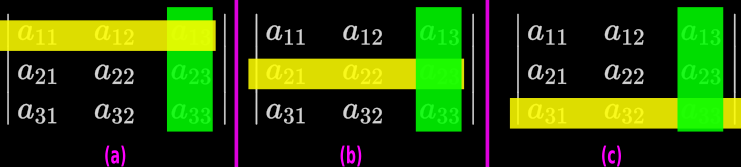
• Delete the row in which a21 is situated. This is indicated by the yellow rectangle in fig,20.3(a) below:

Fig.20.3

• Delete the column in which a21 is situated. This is indicated by the green rectangle in fig,20.3(a) above.
• Now write the following three items:
(i) The 2 × 2 determinant obtained by deleting the row and column.
(ii) Element which is under consideration. Here it is a21.
(iii) (-1)s, where s is the sum of the suffices of a21.
So (-1)s = (-1)2+1.
• Finally, multiply the three items together. We get:
$(-1)^{2+1} \times a_{21} \times \left|\begin{array}{r}               
a_{12}    &{    a_{13}    }    \\
a_{32}    &{    a_{33}    }    \\
\end{array}\right|$   

Step 2:
• Take the second element of R2, which is a22.
• Delete the row in which a22 is situated. This is indicated by the yellow rectangle in fig.20.3(b) above.
• Delete the column in which a22 is situated. This is indicated by the green rectangle in fig.20.3(b) above.
• Now write the following three items:
(i) The 2 × 2 determinant obtained by deleting the row and column.
(ii) Element which is under consideration. Here it is a22.
(iii) (-1)s, where s is the sum of the suffices of a22.
So (-1)s = (-1)2+2.
• Finally, multiply the three items together. We get:
$(-1)^{2+2} \times a_{22} \times \left|\begin{array}{r}               
a_{11}    &{    a_{13}    }    \\
a_{31}    &{    a_{33}    }    \\
\end{array}\right|$   

Step 3:
• Take the third element of R2, which is a23.
• Delete the row in which a23 is situated. This is indicated by the yellow rectangle in fig,20.3(c) above.
• Delete the column in which a23 is situated. This is indicated by the green rectangle in fig,20.3(c) above.
• Now write the following three items:
(i) The 2 × 2 determinant obtained by deleting the row and column.
(ii) Element which is under consideration. Here it is a23.
(iii) (-1)s, where s is the sum of the suffices of a23.
So (-1)s = (-1)2+3.
• Finally, multiply the three items together. We get:
$(-1)^{2+3} \times a_{23} \times \left|\begin{array}{r}               
a_{11}    &{    a_{12}    }    \\
a_{31}    &{    a_{32}    }    \\
\end{array}\right|$

Step 4:
• This is the final step. Here we add the results obtained in the above three steps.
• The sum thus obtained is the determinant of A. We can write:


◼ The process by which we apply the above four steps to find the determinant of order 3, is known as expansion along R2.


• We saw two expansions:
   ♦ Expansion along R1
   ♦ Expansion along R2
Both gave the same result.

• In fact, there is a total of six expansions (corresponding to the three rows and three columns):
   ♦ Expansion along R1
   ♦ Expansion along R2
   ♦ Expansion along R3
   ♦ Expansion along C1
   ♦ Expansion along C2
   ♦ Expansion along C3

• All six will give the same result.


Let us try one more:

Expansion along C3

Step 1:
• Take the first element of C3, which is a13.
• Delete the column in which a13 is situated. This is indicated by the green rectangle in fig,20.4(a) below:

Fig.20.4

• Delete the row in which a13 is situated. This is indicated by the yellow rectangle in fig,20.3(a) above.
• Now write the following three items:
(i) The 2 × 2 determinant obtained by deleting the column and row.
(ii) Element which is under consideration. Here it is a13.
(iii) (-1)s, where s is the sum of the suffices of a13.
So (-1)s = (-1)1+3.
• Finally, multiply the three items together. We get:
$(-1)^{1+3} \times a_{13} \times \left|\begin{array}{r}               
a_{21}    &{    a_{22}    }    \\
a_{31}    &{    a_{32}    }    \\
\end{array}\right|$   

Step 2:
• Take the second element of C3, which is a23.
• Delete the column in which a23 is situated. This is indicated by the green rectangle in fig,20.4(b) above.
• Delete the row in which a23 is situated. This is indicated by the yellow rectangle in fig,20.4(b) above.
• Now write the following three items:
(i) The 2 × 2 determinant obtained by deleting the row and column.
(ii) Element which is under consideration. Here it is a23.
(iii) (-1)s, where s is the sum of the suffices of a23.
So (-1)s = (-1)2+3.
• Finally, multiply the three items together. We get:
$(-1)^{2+3} \times a_{23} \times \left|\begin{array}{r}               
a_{11}    &{    a_{12}    }    \\
a_{31}    &{    a_{32}    }    \\
\end{array}\right|$   

Step 3:
• Take the third element of C3, which is a33.
• Delete the column in which a33 is situated. This is indicated by the green rectangle in fig,20.3(c) above.
• Delete the row in which a33 is situated. This is indicated by the yellow rectangle in fig,20.3(c) above.
• Now write the following three items:
(i) The 2 × 2 determinant obtained by deleting the row and column.
(ii) Element which is under consideration. Here it is a33.
(iii) (-1)s, where s is the sum of the suffices of a33.
So (-1)s = (-1)3+3.
• Finally, multiply the three items together. We get:
$(-1)^{3+3} \times a_{33} \times \left|\begin{array}{r}               
a_{11}    &{    a_{12}    }    \\
a_{21}    &{    a_{22}    }    \\
\end{array}\right|$

Step 4:
• This is the final step. Here we add the results obtained in the above three steps.
• The sum thus obtained is the determinant of A. We can write:


◼ The process by which we apply the above four steps to find the determinant of order 3, is known as expansion along C3.


• We saw three expansions:
   ♦ Expansion along R1
   ♦ Expansion along R2
   ♦ Expansion along C3
All of then gave the same result.

• We can use any one of the six expansions that we mentioned earlier. The reader may write the 4 steps for R3, C1, C2 and become convinced about this fact.


• Based on the above discussion, we can write two points:
(i) We must always use the expansion along that row/column which has the maximum number of zeroes.
(ii) Consider the term (-1)s. Instead of calculating (-1)s, we can put:
   ♦ 1 in the place of (-1)s, if s is even   
   ♦ -1 in the place of (-1)s, if s is odd.


Now we will see a special case. It can be written in steps:
1. Consider two matrices A = $\left[\begin{array}{r}        3    &{    3    }    \\
6    &{    0    }    \\
\end{array}\right]               
$ and B = $\left[\begin{array}{r}                
1    &{    1    }    \\
2    &{    0    }    \\
\end{array}\right]$               
 
• We see that A = 3B
2. Let us calculate the two determinants:
   ♦ |A| = 3(0) − 6(3) = −18
   ♦ |B| = 1(0) − 2(1) = −2
3. We see that:
|A| = 9(-2) = 32|B|
• Note that, the exponent of 3 is 2. This 2 is the order of both A and B.
4. This can be written in general form as:
If A = kB, then |A| = kn|B|, where n is the order of the two matrices A and B.
5. The formula written in (4) is applicable for the following three cases:
(i) When both A and B are matrices of order 1. 
(ii) When both A and B are matrices of order 2. 
(iii) When both A and B are matrices of order 3.


• We have seen the method for calculating determinant, when the given matrix is of the order 2 or 3.
• What about the determinant of a matrix, whose order is 1?
• Answer is simple:
For a 1 × 1 matrix [a], the determinant is a. 


In the next section, we will see some solved examples related to determinants.

Previous

Contents

Next

Copyright©2024 Higher secondary mathematics.blogspot.com