Showing posts with label determinant. Show all posts

Monday, May 6, 2024

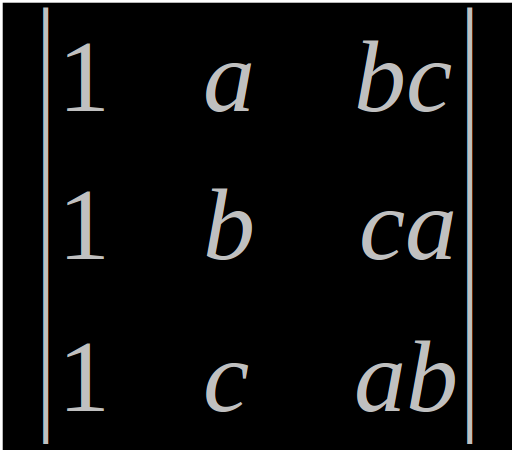
20.16 - Miscellaneous Examples

In the previous section, we completed a discussion on determinants. We saw a solved example also. In this section, we will see some miscellaneous examples.

Solved example 20.27
If a, b, c are positive and unequal, show that the value of the determinant $\Delta ~=~\left |\begin{array}{r}                           
a    &{    b    }    &{    c    }    \\
b    &{    c    }    &{    a    }    \\
c    &{    a    }    &{    b    }    \\
\end{array}\right |
$ is negative.
Solution:
1. First we will simplify the given determinant:


◼ Remarks:
• 2 (magenta color): Apply R1 → R1 + R2.
• 3 (magenta color): Apply R1 → R1 + R3.
• 4 (magenta color): Apply C3 → C3 − C1.
• 5 (magenta color): Apply C2 → C2 − C1.
• 6 (magenta color): Expand along R1.

2. Consider the above result. There are three terms:
(i) −(1/2)
(ii) (a+b+c)
(iii) (a−b)2 + (a−c)2 + (b−c)2.

• Given that: a, b, c are +ve and unequal.
• So (ii) and (iii) cannot become -ve.
• Therefore, due to the presence of −(1/2), the result as a whole will become -ve.

Solved example 20.28
If a, b, c are in A.P, find the value of
$\Delta ~=~\left |\begin{array}{r}                           
2y+4    &{    5y+7    }    &{    8y+a    }    \\
3y+5    &{    6y+8    }    &{    9y+b    }    \\
4y+6    &{    7y+9    }    &{    10y+c    }    \\
\end{array}\right |
$.
Solution:


◼ Remarks:
• 2 (magenta color): Apply R3 → R3 − R2.
• 3 (magenta color): Apply R2 → R2 − R1.
• 4 (magenta color): Apply R3 → R3 − R2.
• 5 (magenta color): Since, a, b, c are in A.P, we can put 2b = a+c.
• 6 (magenta color): All elements of R3 are zeroes. So the value of the determinant is zero.

Solved example 20.29
Show that
$\Delta ~=~\left |\begin{array}{r}                         
(y+z)^2    &{    xy    }    &{    zx    }    \\
xy    &{    (x+z)^2    }    &{    yz    }    \\
xz    &{    yz    }    &{    (x+y)^2    }    \\
\end{array}\right | ~=~2xyz (x+y+z)^3
$.
Solution:


◼ Remarks:
• 2 (magenta color):
    ♦ Multiply R1 by x
    ♦ Multiply R2 by y
    ♦ Multiply R3 by z
To balance these multiplications, the whole determinant should be multiplied by (1/xyz)
• 3 (magenta color):
Take out the common factors:
    ♦ x from C1
    ♦ y from C2
    ♦ z from C3
• 4 (magenta color):
Apply two operations:
    ♦ C2 → C2 − C1
    ♦ C3 → C3 − C1
• 5 (magenta color):
    ♦ Apply the identity: a2 − b2 = (a+b)(a-b).
    ♦ This is applied to C2 and C3.
• 6 (magenta color): Take out (x+y+z) from C1 and C2.
• 7 (magenta color):
Apply R1 → R1 − R2
• 8 (magenta color):
Apply R1 → R1 − R3
• 9 (magenta color):
Apply C2 → C2 + (1/y)C1
• 10 (magenta color):
Apply C3 → C3 + (1/z)C1
• 11 (magenta color):
Expand along R1.

Solved example 20.30
Use product
$\left [\begin{array}{r}                         
1    &{    -1    }    &{    2    }    \\
0    &{    2    }    &{    -3    }    \\
3    &{    -2    }    &{   4    }    \\
\end{array}\right ] \left [\begin{array}{r}                         
-2    &{    0    }    &{    1    }    \\
9    &{    2    }    &{    -3    }    \\
6    &{    1    }    &{   -2    }    \\
\end{array}\right ]$
to solve the system of equations
x - y + 2z = 1
2y − 3z = 1
3x − 2y + 4z = 2
Solution:
1. Use matrix multiplication to find the product.
• We get:
$\left [\begin{array}{r}                         
1    &{    -1    }    &{    2    }    \\
0    &{    2    }    &{    -3    }    \\
3    &{    -2    }    &{   4    }    \\
\end{array}\right ] \left [\begin{array}{r}                         
-2    &{    0    }    &{    1    }    \\
9    &{    2    }    &{    -3    }    \\
6    &{    1    }    &{   -2    }    \\
\end{array}\right ]~ = \left [\begin{array}{r}                         
1    &{    0    }    &{   0    }    \\
0    &{    1    }    &{   0    }    \\
0    &{    0    }    &{   1    }    \\
\end{array}\right ]
$

2. The product is an identity matrix. So it is clear that:
Inverse of $\left [\begin{array}{r}                         
1    &{    -1    }    &{    2    }    \\
0    &{    2    }    &{    -3    }    \\
3    &{    -2    }    &{   4    }    \\
\end{array}\right ]$ is $\left [\begin{array}{r}                         
-2    &{    0    }    &{    1    }    \\
9    &{    2    }    &{    -3    }    \\
6    &{    1    }    &{   -2    }    \\
\end{array}\right ]$


3. The given system can be written in the form AX = B.
$A = \left [\begin{array}{r}                         
1    &{    -1    }    &{    2    }    \\
0    &{    2    }    &{    -3    }    \\
3    &{    -2    }    &{   4    }    \\
\end{array}\right ],~X = \left[\begin{array}{r}       
x        \\
y        \\
z        \\
\end{array}\right]~~ \text{and}~~B = \left[\begin{array}{r}                           
1        \\
1        \\
2        \\
\end{array}\right]
$

4. So X = A−1 B.
• Check whether A−1 exists:
We have already obtained the inverse. Therefore, A−1 exists.

5. Use matrix multiplication to find A−1B.
• We get: X = A−1 B =
$\left [\begin{array}{r}                         
-2    &{    0    }    &{    1    }    \\
9    &{    2    }    &{    -3    }    \\
6    &{    1    }    &{   -2    }    \\
\end{array}\right ]~\left[\begin{array}{r}                           
1        \\
1        \\
2        \\
\end{array}\right]~ = \left[\begin{array}{r}                        0        \\
5        \\
3        \\
\end{array}\right]
$

6. So the solution is: x = 0, y = 5 and z = 3

Solved example 20.31
Prove that
$ \Delta ~=~ \left |\begin{array}{r}                         
a+bx    &{    c+dx    }    &{    p+qx    }    \\
ax+b    &{    cx+d    }    &{    px+q    }    \\
u    &{    v    }    &{   w    }    \\
\end{array}\right | ~=~ (1 - x^2) \left |\begin{array}{r}                         
a    &{    c    }    &{    p    }    \\
b    &{    d    }    &{    q    }    \\
u    &{    v    }    &{   w    }    \\
\end{array}\right |$
Solution:
1. First we will split the given matrix by applying property V.

◼ Remarks:
• 2 (magenta color):
We split R1 so that, a, c and p are obtained in the first row. These are the elements that we want in the R1 of the final result.

2. Now we simplify |A|:


◼ Remarks:
• 2 (magenta color): We split R2 of |A|.
• 3 (magenta color): Consider the first determinant in (2). Every element in R2 is proportional to the corresponding elements in R1, by the same ratio 'x'. So this determinant becomes zero.

3. Next we simplify |B|:

◼ Remarks:
• 2 (magenta color): We split R2 of |B|.
• 3 (magenta color): Consider the second determinant in (2). Every element in R1 is proportional to the corresponding elements in R2, by the same ratio 'x'. So this determinant becomes zero.
• 4 (magenta color): We take out the common factor 'x' from R1 and R2.
• 5 (magenta color): We want the elements a, c and p in R1. So we interchange R1 and R2. The sign of the determinant will change when the two rows are interchanged.

4. Finally we add |A| and |B|. We get:


The link below gives a few more examples:

Miscellaneous Examples


In the next section, we will see Continuity and Differentiability.

Previous

Contents

Next

Copyright©2024 Higher secondary mathematics.blogspot.com

Monday, April 29, 2024

20.15 - Solved Examples on Matrix Method

In the previous section, we saw the matrix method for solving systems of linear equations. We saw a solved example also. In this section, we will see a few more solved examples.

Solved example 20.24
Solve the system of equations:
2x + 5y = 1
3x + 2y = 7
Solution:
1. The given system can be written in the form AX = B.
$A = \left[\begin{array}{r}                           
2        &{    5    }    \\
3        &{    2    }    \\
\end{array}\right],~X = \left[\begin{array}{r}       
x        \\
y        \\
\end{array}\right]~~ \text{and}~~B = \left[\begin{array}{r}                           
1        \\
7        \\
\end{array}\right]
$

2. So X = A−1 B.
• Check whether A−1 exists:
   ♦ |A| = (4 − 15) = −11
   ♦ |A| ≠ 0
   ♦ So A is a non-singular matrix. Therefore, A−1 exists.

3. Use the method in Solved example 20.21 to find A−1.
We get: $A^{-1} = \left[\begin{array}{r}                           
-2/11        &{    5/11    }    \\
3/11        &{    -2/11    }    \\
\end{array}\right]$

4. Use matrix multiplication to find A−1B.
• We get: X = A−1 B =
$\left[\begin{array}{r}                           
-2/11        &{    5/11    }    \\
3/11        &{    -2/11    }    \\
\end{array}\right]~\left[\begin{array}{r}                           
1        \\
7        \\
\end{array}\right]~ = \left[\begin{array}{r}                        3        \\
-1        \\
\end{array}\right]
$

5. So the solution is: x = 3 and y = -1

Solved example 20.25
Solve the system of equations:
3x − 2y + 3z = 8
2x + y − z = 1
4x − 3y + 2z = 4
Solution:
1. The given system can be written in the form AX = B.
$A = \left[\begin{array}{r}                           
3        &{    -2    } &{    3    }    \\
2        &{    1    } &{    -1    }    \\
4        &{    -3    } &{   2    }    \\
\end{array}\right],~X = \left[\begin{array}{r}       
x        \\
y        \\
z        \\
\end{array}\right]~~ \text{and}~~B = \left[\begin{array}{r}                           
8        \\
1        \\
4        \\
\end{array}\right]
$

2. So X = A−1 B.
• Check whether A−1 exists:
   ♦ |A| = −17 (by expansion along any row or column)
   ♦ |A| ≠ 0
   ♦ So A is a non-singular matrix. Therefore, A−1 exists.

3. Use the method in Solved example 20.20 to find A−1.
We get: $A^{-1} = - \frac{1}{17} \left[\begin{array}{r}                           
-1        &{    -5    } &{    -1    }    \\
-8        &{    -6    } &{    9    }    \\
-10        &{    1    } &{   7    }    \\
\end{array}\right]$

4. Use matrix multiplication to find A−1B.
• We get: X = A−1 B =
$- \frac{1}{17} \left[\begin{array}{r}                           
-1        &{    -5    } &{    -1    }    \\
-8        &{    -6    } &{    9    }    \\
-10        &{    1    } &{   7    }    \\
\end{array}\right]~\left[\begin{array}{r}                           
8        \\
1        \\
4        \\
\end{array}\right]~ = \left[\begin{array}{r}                        1        \\
2        \\
3        \\
\end{array}\right]
$

5. So the solution is: x = 1, y = 2 and z = 3

Solved example 20.26
Sum of three numbers is 6. If we multiply third number by 3 and add second number to it, we get 11. By adding first and third numbers, we get double of second number. Represent it algebraically and find the numbers by matrix method.
Solution:
1. Let the numbers be x, y and z.
2. Given: Sum is 6.
• So we can write: x + y + z = 6
3. Given: If we multiply third number by 3 and add second number to it, we get 11.
• So we can write: 3z + y = 11.
• This is same as 0x + y + 3z = 11
4. Given: By adding first and third numbers, we get double of second number.
• So we can write: x + z = 2y
• This is same as: x − 2y + z = 0
5. From (2), (3) and (4), we get three equations:
x + y + z = 6
0x + y + 3z = 11
x − 2y + z = 0
6. The given system can be written in the form AX = B.
$A = \left[\begin{array}{r}                           
1        &{    1    } &{    1    }    \\
0        &{    1    } &{    3    }    \\
1        &{    -2    } &{   1    }    \\
\end{array}\right],~X = \left[\begin{array}{r}       
x        \\
y        \\
z        \\
\end{array}\right]~~ \text{and}~~B = \left[\begin{array}{r}                           
6        \\
11        \\
0        \\
\end{array}\right]
$

7. So X = A−1 B.
• Check whether A−1 exists:
   ♦ |A| = 9 (by expansion along any row or column)
   ♦ |A| ≠ 0
   ♦ So A is a non-singular matrix. Therefore, A−1 exists.

8. Use the method in Solved example 20.20 to find A−1.
We get: $A^{-1} =  \frac{1}{9} \left[\begin{array}{r}                           
7        &{    -3    } &{    2    }    \\
3        &{    0    } &{    -3    }    \\
-1        &{    3    } &{   1    }    \\
\end{array}\right]$

9. Use matrix multiplication to find A−1B.
• We get: X = A−1 B =
$ \frac{1}{9} \left[\begin{array}{r}                           
7        &{    -3    } &{    2    }    \\
3        &{    0    } &{    -3    }    \\
-1        &{    3    } &{   1    }    \\
\end{array}\right]~\left[\begin{array}{r}                           
6        \\
11        \\
0        \\
\end{array}\right]~ = \left[\begin{array}{r}                        1        \\
2        \\
3        \\
\end{array}\right]
$

10. So the solution is: x = 1, y = 2 and z = 3


The link below gives a few more solved examples:

Exercise 20.6


In the next section, we will see some miscellaneous examples.

Previous

Contents

Next

Copyright©2024 Higher secondary mathematics.blogspot.com

Wednesday, April 24, 2024

20.13 - Solved Examples

In the previous section, we saw adjoint and inverse of a matrix. In this section, we will see some solved examples.

Solved example 20.20
If $A~=~\left [\begin{array}{r}   
1       &{    3    } &{    3    }    \\
1       &{    4    } &{    3    }    \\
1       &{    3    } &{    4    }    \\
\end{array}\right ]$, then verify that A(adj A) = |A| I. Also find A−1.
Solution:
Part (i):
1. First we will find the Minors and Cofactors of A.


2. So the Cofactor matrix of A is: $\left [\begin{array}{r}   
7       &{    -1    } &{    -1    }    \\
-3       &{    1    } &{    0    }    \\
-3       &{    0    } &{    1    }    \\
\end{array}\right ]$

3. Transpose of the Cofactor matrix will give the adjoint matrix. So we get:

adj A = $\left [\begin{array}{r}   
7       &{    -3    } &{    -3    }    \\
-1       &{    1    } &{    0    }    \\
-1       &{    0    } &{    1    }    \\
\end{array}\right ]$

4. Use matrix multiplication to find A(adj A). We get:

$\left [\begin{array}{r}   
1       &{    3    } &{    3    }    \\
1       &{    4    } &{    3    }    \\
1       &{    3    } &{    4    }    \\
\end{array}\right ] \left [\begin{array}{r}   
7       &{    -3    } &{    -3    }    \\
-1       &{    1    } &{    0    }    \\
-1       &{    0    } &{    1    }    \\
\end{array}\right ] ~=~\left [\begin{array}{r}   
1       &{    0    } &{    0    }    \\
0       &{    1    } &{    0    }    \\
0       &{    0    } &{    1    }    \\
\end{array}\right ]$

5. Let us calculate |A|:

|A| = 1(16 − 9) − 3(4 − 3) + 3(3 − 4)
= 7 − 3 − 3 = 1

6. Now we can calculate |A|I:

$(1) \left [\begin{array}{r}   
1       &{    0    } &{    0    }    \\
0       &{    1    } &{    0    }    \\
0       &{    0    } &{    1    }    \\
\end{array}\right ] ~=~\left [\begin{array}{r}   
1       &{    0    } &{    0    }    \\
0       &{    1    } &{    0    }    \\
0       &{    0    } &{    1    }    \\
\end{array}\right ]$

7. From (4) and (6), we see that: A(adj A) = |A| I

Part (ii):
We have already calculated |A| and (adj A) in part (i). So we can calculate A−1 as follows:

$A^{-1} = \frac{1}{|A|}(\text{adj A}) = \frac{1}{1} \left [\begin{array}{r}   
7       &{    -3    } &{    -3    }    \\
-1       &{    1    } &{    0    }    \\
-1       &{    0    } &{    1    }    \\
\end{array}\right ]= \left [\begin{array}{r}   
7       &{    -3    } &{    -3    }    \\
-1       &{    1    } &{    0    }    \\
-1       &{    0    } &{    1    }    \\
\end{array}\right ]$

Solved example 20.21
If $A~=~\left [\begin{array}{r}   
2        &{    3    }    \\
1        &{    -4    }    \\
\end{array}\right ]$ and $B~=~\left [\begin{array}{r}   
1        &{    -2    }    \\
-1        &{    3    }    \\
\end{array}\right ]$, then verify that (AB)−1 = B−1A−1.
Solution:
1. First we will test whether A and B are invertible.
(i) |A| = −8 − 3 = −11
|A| ≠ 0. So A is invertible.
(ii) |B| = 3-2 = 1
|B| ≠ 0. So B is invertible.

2. Next we will find A−1.
• adj A =  $\left [\begin{array}{r}   
-4        &{    -3    }    \\
-1        &{    2    }    \\
\end{array}\right ]$
(Recall the shortcut method explained in fig.20.5 of the previous section)

• So we get:
$A^{-1} = \frac{1}{|A|}(\text{adj A}) = -{\frac{1}{11}} \left [\begin{array}{r}   
-4        &{    -3    }    \\
-1        &{    2    }    \\
\end{array}\right ]$   

3. Next we will find B−1.
• adj B =  $\left [\begin{array}{r}   
3        &{    2    }    \\
1        &{    1    }    \\
\end{array}\right ]$
(Recall the shortcut method explained in fig.20.5 of the previous section)
• So we get:
$B^{-1} = \frac{1}{|B|}(\text{adj B}) = \frac{1}{1} \left [\begin{array}{r}   
3        &{    2    }    \\
1        &{    1    }    \\
\end{array}\right ]= \left [\begin{array}{r}   
3        &{    2    }    \\
1        &{    1    }    \\
\end{array}\right ]$

4. Use matrix multiplication to find B−1A−1. We get:
$B^{-1} A^{-1} = \left [\begin{array}{r}   
3        &{    2    }    \\
1        &{    1    }    \\
\end{array}\right ]~\times~ -{\frac{1}{11}} \left [\begin{array}{r}   
-4        &{    -3    }    \\
-1        &{    2    }    \\
\end{array}\right ] = {\frac{1}{11}} \left [\begin{array}{r}   
14        &{    5    }    \\
5        &{    1    }    \\
\end{array}\right ]$

5. Use matrix multiplication to find AB. We get:
$AB = \left [\begin{array}{r}   
2        &{    3    }    \\
1        &{    -4    }    \\
\end{array}\right ]~\left [\begin{array}{r}   
1        &{    -2    }    \\
-1        &{    3    }    \\
\end{array}\right ] = \left [\begin{array}{r}   
-1        &{    5    }    \\
5        &{    -14    }    \\
\end{array}\right ]$

6. Next we will find |(AB)|.
|(AB)| = 14 − 25 = -11

7. Now we can calculate (AB)−1.
• adj (AB) =  $\left [\begin{array}{r}   
-14        &{    -5    }    \\
-5        &{    -1    }    \\
\end{array}\right ]$
(Recall the shortcut method explained in fig.20.5 of the previous section)

• So we get:
$(AB)^{-1} = \frac{1}{|(AB)|}(\text{adj (AB)}) = \frac{1}{(-11)} \left [\begin{array}{r}   
-14        &{    -5    }    \\
-5        &{    -1    }    \\
\end{array}\right ] = \frac{1}{11} \left [\begin{array}{r}   
14        &{    5    }    \\
5        &{    1    }    \\
\end{array}\right ]$

8. Comparing the results in (4) and (7), we can write:
(AB)−1 = B−1A−1.

Solved example 20.22
Show that the matrix   $A~=~\left [\begin{array}{r}   
2        &{    3    }    \\
1        &{    2    }    \\
\end{array}\right ]$ satisfies the equation A2 − 4A + I = O, where I is 2 × 2 identity matrix and O is 2 × 2 zero matrix. Using this equation, find A−1.
Solution:
Part (i): To prove that, A2 − 4A + I = O
1. Use matrix multiplication to find A2. We get:
$A^2 = AA = \left [\begin{array}{r}   
2        &{    3    }    \\
1        &{    2    }    \\
\end{array}\right ]~\left [\begin{array}{r}   
2        &{    3    }    \\
1        &{    2    }    \\
\end{array}\right ] = \left [\begin{array}{r}   
7        &{    12    }    \\
4        &{    7    }    \\
\end{array}\right ]$

2. Next we will find 4A.
$4A = 4 \left [\begin{array}{r}   
2        &{    3    }    \\
1        &{    2    }    \\
\end{array}\right ]= \left [\begin{array}{r}   
8        &{    12    }    \\
4        &{    8    }    \\
\end{array}\right ]$

3. Substituting the above matrices in the given equation, we get:


• We see that, L.H.S = R.H.S.
• So matrix A satisfies the given equation.

Part (ii): To find A−1.
1. First we need to test whether A is invertible.
• We have: |A| = (4-3) = 1.
• Since |A| ≠ 0, A is invertible.

2. To find A−1, we rearrange the equation that was proved in part (i).


◼ Remarks:
• 3 (magenta color): In this line, we post multiply the whole equation by A−1.
• 4 (magenta color): In this line, we apply the fact that, AA−1 = I.


The link below gives a few more solved examples:

Exercise 20.5


In the next section, we will see the applications of determinants and matrices.

Previous

Contents

Next

Copyright©2024 Higher secondary mathematics.blogspot.com

Tuesday, April 23, 2024

20.12 - Adjoint And Inverse of A Matrix

In the previous section, we saw Minors and Cofactors. In this section, we will see adjoint and inverse of a matrix.

Adjoint of a Matrix

Some basics can be written in 6 steps:
1. Consider a square matrix A = [aij]n.
2. We know how to write the Cofactor Aij of any element aij of the matrix A.
3. So we can write a new matrix which contains the Cofactors.
• For example, if the original matrix is
$A ~=~\left [\begin{array}{r}                           
a_{11}      &{    a_{12}    } &{    a_{13}    }    \\
a_{21}      &{    a_{22}    } &{    a_{23}    }    \\
a_{31}      &{    a_{32}    } &{    a_{33}    }    \\
\end{array}\right ]$,
then the corresponding matrix of Cofactors will be:
$\left [\begin{array}{r}                           
A_{11}      &{    A_{12}    } &{    A_{13}    }    \\
A_{21}      &{    A_{22}    } &{    A_{23}    }    \\
A_{31}      &{    A_{32}    } &{    A_{33}    }    \\
\end{array}\right ]$

4. Now, the transpose of the matrix of Cofactors will be:
$\left [\begin{array}{r}                           
A_{11}      &{    A_{21}    } &{    A_{31}    }    \\
A_{12}      &{    A_{22}    } &{    A_{32}    }    \\
A_{13}      &{    A_{23}    } &{    A_{33}    }    \\
\end{array}\right ]$
• This matrix obtained by transposing, is called adjoint matrix.
5. Adjoint of matrix A is denoted by adj A.
6. For the example matrix A mentioned in (3),
adj A = $\left [\begin{array}{r}                           
A_{11}      &{    A_{21}    } &{    A_{31}    }    \\
A_{12}      &{    A_{22}    } &{    A_{32}    }    \\
A_{13}      &{    A_{23}    } &{    A_{33}    }    \\
\end{array}\right ]$

Solved example 20.19
Find adj A for $A~=~\left [\begin{array}{r}   
2       &{    5    }    \\
-3       &{    7    }    \\
\end{array}\right ]$
Solution:
1. First we will find the Minors and Cofactors:


2. So the matrix of Cofactors is:
$\left [\begin{array}{r}   
7       &{    3    }    \\
-5       &{    2    }    \\
\end{array}\right ]$

3. The transpose of the above matrix, is the required adjoint matrix. So we get:

$\text{adj A}~=~\left [\begin{array}{r}   
7       &{    -5    }    \\
3       &{    2    }    \\
\end{array}\right ]$


For any square matrix of order 2, there is a direct method to find the adjoint. It can be written in 4 steps:
1. Fig.20.5(a) below shows the original matrix A.

To find the adjoint of a square matrix of order 2, interchange the elements alonfg the first diagonal and change signs of the elements in the second diagonal.
Fig.20.5

2. Consider the yellow diagonal, which is drawn from left-top to right-bottom. We need to interchange the elements in this diagonal.   
3. Consider the red diagonal, which is drawn from right-top to left-bottom. We should not interchange the elements in this diagonal. But we must change the signs of those elements.
4. The resulting new matrix is the adj A. It is shown in fig.20.5(b) above.


Now we will see four theorems related to adjoint matrices.

Theorem I
• If A is any given square matrix of order n, then
A(adj A) = (adj A)A = |A|I
    ♦ Where I is the identity matrix of the same order n.

Verification can be written in steps:
1. Let $A ~=~\left [\begin{array}{r}                           
a_{11}      &{    a_{12}    } &{    a_{13}    }    \\
a_{21}      &{    a_{22}    } &{    a_{23}    }    \\
a_{31}      &{    a_{32}    } &{    a_{33}    }    \\
\end{array}\right ]$.
• Then adj A will be: $\left [\begin{array}{r}       
A_{11}      &{    A_{21}    } &{    A_{31}    }    \\
A_{12}      &{    A_{22}    } &{    A_{32}    }    \\
A_{13}      &{    A_{23}    } &{    A_{33}    }    \\
\end{array}\right ]$
2. We know how to write the product A(adj A).
• Let us write the first element (intersection of R1 and C1):
a11 A11 + a12 A12 + a13 A13
• We see that:
    ♦ First term is the product of a11 and it’s Cofactor.
    ♦ Second term is the product of a12 and it’s Cofactor.
    ♦ Third term is the product of a13 and it’s Cofactor.            
    ♦ Also, we are taking the sum of the three terms.
3. So we can write:
The first element in A(adj a) is: The determinant |A|
4. All diagonal elements of A(adj a), will be similar to the form written in (2).
• So all diagonal elements in A(adj a), will become |A|
5. Let us write the second element (intersection of R1 and C2) of A(adj a):
a11 A21 + a12 A22 + a13 A23
• We see that:
    ♦ First term is the product of a11 and a different Cofactor.
    ♦ Second term is the product of a12 and a different Cofactor.
    ♦ Third term is the product of a13 and a different Cofactor.
    ♦ Also, we are taking the sum of the three terms.
6. So we can write:
The second element in A(adj a) is: zero
7. All non-diagonal elements of A(adj a), will be similar to the form written in (5).
• So all non-diagonal elements in A(adj a), will become zero.
8. Thus we get:
$A(\text{adj A})~=~\left[\begin{array}{r}   
|A|    &{    0    }    &{    0    }    \\
0    &{    |A|    }    &{    0    }    \\
0    &{    0    }    &{    |A|    }    \\
\end{array}\right]
~=~|A|\left[\begin{array}{r}                           
1    &{    0    }    &{    0    }    \\
0    &{    1    }    &{    0    }    \\
0    &{    0    }    &{    1    }    \\
\end{array}\right]~=~|A|I$
9. Similarly, we can show that (adj A)A = |A|I
10. Based on (8) and (9), we can write:
A(adj A) = (adj A) A = |A|I

Theorem II
If A and B are non-singular matrices of the same order, then AB and BA are also non-singular matrices of the same order.
(We will see the proof of this theorem in higher classes)
    ♦ A square matrix A is said to be singular if |A| = 0
    ♦ A square matrix A is said to be non-singular if |A| ≠ 0

Theorem III
If A and B are square matrices of the same order, then |AB| = |A| |B|.
(We will see the proof of this theorem in higher classes)


Now we can write about an interesting result. It can be written in 4 steps:

1. Let A be a square matrix of order 3.
2. Let us try to simplify (adj A)A

◼ Remarks:
• 1 (magenta color): Here we use theorem I
• 2 (magenta color): In the R.H.S, the unit matrix is multiplied by a constant value. So all non-diagonal elements of the resulting matrix will be zeroes.
• 3 (magenta color): Here we take determinants on both sides.
• 5 (magenta color): Here we apply theorem III in the L.H.S.

3. We see that:
• We started the calculations with a square matrix A of order 3.
• In the final result, the determinant of A has a power of 2.
4. So we can write the general form:
If A is a square matrix of order n, then
|(adj a)| = |A|n-1.
(We will see the actual proof in higher classes)


Theorem IV
A square matrix A is invertible if and only if A is a non-singular matrix.
• Proof can be written in 3 steps:
1. Let A be a invertible matrix of order n. Also, let I be an identity matrix of the same order n.
• Then, from the discussion that we had on matrices in the previous chapter, we can write: AB = BA = I.
    ♦ Where B is a square matrix of order n.
2. Consider the equation AB = I
• Writing determinants of matrices on both sides, we get:
|AB| = |I|
• This is same as |AB| = 1
3. Applying theorem III on the L.H.S, we get: |A| |B| = 1.
• |A| and |B| are numbers. If their product is 1, it means that, none of them can be zero.
• So we get: |A| ≠ 0.
• That means, A is a non-singular matrix.

Converse of Theorem IV
If A is a non-singular square matrix, then it is invertible.
• Proof can be written in 3 steps:
1. Consider theorem I:
A(adj A) = (adj A) A = |A|I
2. |A| is a number. So we can use it to divide the whole equation. We get:
$A \left(\frac{1}{|A|}(\text{adj A}) \right)~=~ \left(\frac{1}{|A|}(\text{adj A}) \right)A~=~I$
3. We can rearrange this equation into a familiar form, if we put 'B' in the place of $\frac{1}{|A|}(\text{adj A})$.
• We get: AB = BA = I
4. The above result implies that, matrix B is the inverse of matrix A.
• So we can write:
A is invertible and the inverse is $\frac{1}{|A|}(\text{adj A})$


In the next section, we will see some solved examples.

Previous

Contents

Next

Copyright©2024 Higher secondary mathematics.blogspot.com

Sunday, April 21, 2024

20.11 - Minors And Cofactors

In the previous section, we saw area of triangles. In this section, we will see Minors and Cofactors.

Minors

Some basics about Minors can be written in 6 steps:
1. Consider a determinant.
2. Pick any element aij from that determinant.
3. Delete one row and one column:
   ♦ Delete the row in which aij is situated (the ith row)
   ♦ Delete the column in which aij is situated (the jth column)
4. After deleting the above row and column, we get a new determinant.
• This new determinant is called the Minor of aij
5. Minor of aij is denoted by Mij.
6. Since one row and one column are being deleted from the original determinant, we can write a useful point. It can be written in 2 steps:
(i) Consider any determinant of order n, where n≥2.
(ii) We know how to write the Minor of any element of that determinant. All those Minors will be of the order (n-1).
(iii) We cannot consider determinants whose order is less than 2. This is because, in such determinants, there will be only one element. It is not possible to find the Minor of that single element.


Now we will see a solved example:

Solved example 20.15
Find the Minor of the element 8 in the determinant:
$\Delta~=~\left |\begin{array}{r}                           
3    &{    5    }    &{    9    }    \\
6    &{    11    }    &{    8    }    \\
7    &{    15    }    &{    12    }    \\
\end{array}\right |$
Solution:
1. The element 8 is in the second row and third column.
2. So we delete the second row and third column.
3. The new determinant thus obtained is:
$\left |\begin{array}{r}                           
3      &{    5    }    \\
7      &{    15    }    \\
\end{array}\right |$ 
3. The value of this new determinant is:
(3 × 15 - 7 × 5) = (45 - 35) = 10
4. So we can write:
• In the original determinant,
The Minor of element 8 = M23 = 10


Cofactors

This can be explained in 2 steps:
1. If Mij is the Minor of the element aij, then
the Cofactor of aij can be obtained simply by multiplying (-1)i+j and Mij.
2. The Cofactor of aij is denoted by Aij.
• So we can write:
Aij = (−1)i+j Mij


Let us see some solved examples:

Solved example 20.16
Find the Minors and Cofactors of all the elements of the determinant:
$\left |\begin{array}{r}                           
1      &{    -2    }    \\
4      &{    3    }    \\
\end{array}\right |$ 
Solution:
1. M11 = 3
• So A11 = (−1)1+1 M11 = (−1)2 (3) = 3

2. M12 = 4
• So A12 = (−1)1+2 M12 = (−1)3 (4) = −4

3. M21 = −2
• So A12 = (−1)2+1 M12 = (−1)3 (−2) = 2

4. M22 = 1
• So A22 = (−1)2+2 M22 = (−1)4 (1) = 1

Solved example 20.17
Find the Minors and Cofactors of a11 and a21 in the determinant:
$\left |\begin{array}{r}                           
a_{11}      &{    a_{12}    } &{    a_{13}    }    \\
a_{21}      &{    a_{22}    } &{    a_{23}    }    \\
a_{31}      &{    a_{32}    } &{    a_{33}    }    \\
\end{array}\right |$ 
Solution:
1. M11 =
$\left |\begin{array}{r}                           
a_{22}      &{    a_{23}    }    \\
a_{32}      &{    a_{33}    }    \\
\end{array}\right |~=~a_{22} a_{33} \,-\, a_{23} a_{32}$ 
• So A11 = (−1)1+1 M11 =
$(-1)^2 (a_{22} a_{33} \,-\, a_{23} a_{32})~=~a_{22} a_{33} \,-\, a_{23} a_{32}$

2. M21 =
$\left |\begin{array}{r}                           
a_{12}      &{    a_{13}    }    \\
a_{32}      &{    a_{33}    }    \\
\end{array}\right |~=~a_{12} a_{33} \,-\, a_{13} a_{32}$ 
• So A21 = (−1)2+1 M21 =
$(-1)^3 (a_{12} a_{33} \,-\, a_{13} a_{32})~=~- a_{12} a_{33} \,+\, a_{13} a_{32}$


Now we know the basics about Minors and Cofactors. So we can learn about a method which will help us to write the determinant in a compact form. It can be written in 7 steps:

1. Consider the determinant:
$\Delta ~=~\left |\begin{array}{r}                           
a_{11}      &{    a_{12}    } &{    a_{13}    }    \\
a_{21}      &{    a_{22}    } &{    a_{23}    }    \\
a_{31}      &{    a_{32}    } &{    a_{33}    }    \\
\end{array}\right |$

2. We know that:
$\Delta = a_{11} \times (-1)^{1+1} \times \left |\begin{array}{r}                           
a_{22}      &{    a_{23}    }    \\
a_{32}      &{    a_{33}    }    \\
\end{array}\right |~+~a_{12} \times (-1)^{1+2} \times \left |\begin{array}{r}                           
a_{21}      &{    a_{23}    }    \\
a_{31}      &{    a_{33}    }    \\
\end{array}\right |~+~a_{13} \times (-1)^{1+3} \times \left |\begin{array}{r}                           
a_{21}      &{    a_{22}    }    \\
a_{31}      &{    a_{32}    }    \\
\end{array}\right |$

3. We can write this in terms of Cofactors.
• Consider the first term in the R.H.S of (2). This term is: a11  × A11
• Consider the second term in the R.H.S of (2). This term is: a12  × A12
• Consider the third term in the R.H.S of (2). This term is: a13  × A13

4. So the result in (2) becomes:
$\Delta~=~a_{11} A_{11}~+~a_{12} A_{12}~+~a_{13} A_{13}$
• Thus we are able to write Δ in a compact form.

5. The method used in (4) is applicable for any row or any column. For example:
• Expanding along the second row, we can write:
$\Delta~=~a_{21} A_{21}~+~a_{22} A_{22}~+~a_{23} A_{23}$
• Expanding along the third column, we can write:
$\Delta~=~a_{13} A_{13}~+~a_{23} A_{23}~+~a_{33} A_{33}$

6. So the determinant can be calculated in 3 simple steps:
(i) Take any row (or any column)
(ii) Multiply each element of that row (or column) with the corresponding Cofactor.
(iii) Find the sum of the "products obtained in (ii)". This sum is the determinant.

7. Consider the step 6(ii) written above. It is important to use the corresponding Cofactors. If we use the Cofactors of any other row or column, the sum will become zero.

• Let us see an example. It can be written in 4 steps:
(i) Let us pick the first row for expansion. But the Cofactors used are from the second row.
(ii) Then the sum is:
$a_{11} A_{21}~+~a_{12} A_{22}~+~a_{13} A_{23}$
(iii) This can be expanded as:
$a_{11} (-1)^{2+1} (a_{12} a_{33} - a_{13} a_{32})$
$+~ a_{12} (-1)^{2+2} (a_{11} a_{33} - a_{13} a_{31})$
$+~ a_{13} (-1)^{2+3} (a_{11} a_{32} - a_{12} a_{31})$
(iv) This is same as:
$-a_{11} a_{12} a_{33} + a_{11} a_{13} a_{32}$
$+~ a_{12} a_{11} a_{33} - a_{12} a_{13} a_{31}$
$-~ a_{13} a_{11} a_{32} + a_{13} a_{12} a_{31}~=~0$


Solved example 20.18
Find the Minors and Cofactors of elements of the determinant:
$\left |\begin{array}{r}                           
8      &{    3    } &{    0    }    \\
-5      &{    11    } &{    -2    }    \\
6      &{    0    } &{    -7    }    \\
\end{array}\right |$
And verify that a11 A31 + a12 A32  + a13 A33 = 0   
Solution:

Method for calculating Minors and Cofactors of determinants.

• Now we can verify the given statement:
a11 A31 + a12 A32  + a13 A33
= 8(-6) + 3(16) + 0(-47)
= -48 + 48 + 0
= 0


The link below gives a few more solved examples:

Exercise 20.4


In the next section, we will see adjoint and inverse of a matrix.

Previous

Contents

Next

Copyright©2024 Higher secondary mathematics.blogspot.com

Wednesday, April 17, 2024

20.10 - Area of A Triangle

In the previous section, we saw some solved examples related to properties of determinants. In this section, we will see area of triangles.

Some basics can be written in 3 steps:
1. In our earlier coordinate geometry classes, we have seen an expression to find the area of any triangle:

$\text{Area} = \frac{1}{2} |x_1(y_2 - y_3) + x_2(y_3 - y_1) + x_3(y_1 - y_2)|$
(Details here)

2. Now consider the determinant:

$\Delta = \frac{1}{2} \left|\begin{array}{r}      
x_1    &{    y_1    }    &{    1    }    \\
x_2    &{    y_2    }    &{    1    }    \\
x_3    &{    y_3    }    &{    1    }    \\
\end{array}\right|$
• If we expand this determinant along the first column, we will get the same expression as in (1).

3. That means, area of a triangle can be written in "determinant form" also.
• But it is important to take the absolute value of the determinant. This is because, area cannot be a negative quantity.


Now we will see some solved examples.

Solved example 20.13
Find the area of the triangle whose vertices are (-1.5,2), (-2.5,-2), (4,1.5)
Solution:


◼ Remarks:
• 3: Here we apply two operations:
   ♦ R1 → R1 − R3.
   ♦ R2 → R2 − R3.
4: Here we expand the determinant along C3.

Solved example 20.14
Find the equation of the line joining A(1,3) and B(0,0) using determinants and find k if D(k,0) is a point such that area of triangle ABD is 3 sq units.
Solution:
Part (i):
1. Let P(x,y) be any point on the line AB.
Then area of the triangle APB = 0. This is because, three collinear points cannot form a triangle.
2. So we can write:


◼ Remarks:
• 2 (magenta color): Here we expand the determinant along the second row.
• 3 (magenta color): Here we use the index (2+3). This is because, '1' is the a23th element.

3. Since the area is zero, we can write:
-(1/2)(y-3x) = 0
• From this we get: -y + 3x = 0
• Which is same as: y = 3x

4. The line y=3x will pass through both A(1,3) and B(0,0).

Part (ii):


◼ Remarks:
• 2 (magenta color): Here we write $\pm 3$ because, the value of the determinant can be either +3 or -3. We can ignore the -ve sign only when we write it as an area.
• 3 (magenta color): Here we expand the determinant along the second row.
• 3 (magenta color): Here we use the index (2+3). This is because, '1' is the a23th element.

◼ We can write:
• Area of the triangle formed by the three points A(1,3), B(0,0) and D(2,0) is 3 units.
• Area of the triangle formed by the three points A(1,3), B(0,0) and D(-2,0) is also 3 units. 


The link below gives a few more solved examples:

Exercise 20.3


In the next section, we will see Minors and Cofactors.

Previous

Contents

Next

Copyright©2024 Higher secondary mathematics.blogspot.com

Monday, April 8, 2024

20.9 - Solved Examples

In the previous section, we completed the discussion on properties of determinants. In this section, we will see some solved examples.

Solved example 20.8
Without expanding, prove that

Solution:


◼ Remarks:
• 2 (magenta color): Here we apply property VI
• 3(magenta color):
   ♦ Consider R1 and R3. Take any two corresponding elements from them.
   ♦ The element from R1 will be proportional to the element from R3 in the ratio (x+y+z) : 1.
   ♦ So value of the determinant is zero.

Solved example 20.9
Evaluate


Solution:


◼ Remarks:
• 2 and 3 (magenta color): Here we apply property VI
• 5(magenta color): Here we expand along C1.

Solved example 20.10
Prove that


Solution:

1. Split the given determinant as |A| + |B| by applying property V.


◼ Remarks:
• 2 (magenta color): Here we apply property V and split Δ into |A| and |B|.
• 3 (magenta color): Here we apply property V and split |A|.
• 5(magenta color): Line 4 has four determinants.
   ♦ First is expanded along R1.
   ♦ Second is expanded along R3.
   ♦ Third is expanded along R2.
   ♦ Fourth is expanded along C1.

2. Evaluate |B|:


◼ Remarks:

• 2 (magenta color): Here we apply property V and split |B|.
• 3 (magenta color): Line 2 has two determinants.
   ♦ First is expanded along R1.
   ♦ Second is expanded along R1.

3. Find the sum:
Δ = |A| + |B|
= 3abc - a2c - ac2 + ac2 + a2c + abc
= 4abc

Solved example 20.11
If x, y, z are different and

then show that 1 + xyz = 0
Solution:
1. Split the given determinant as |A| + |B| by applying property V.


◼ Remarks:
• 2 (magenta color): Here we apply property V and split Δ into |A| and |B|.
• 3 (magenta color): Here we simplify |A|.
• 6(magenta color): Here we expand the determinant along C3.

2. Evaluate |B|:

◼ Remarks:

• 2 (magenta color): Here we apply property IV and take out the common factors x, y and z.
• 3 (magenta color): Here we apply property II and interchange C1 and C2. So the sign of the determinant will change.
• 4 (magenta color): Here we apply property II and interchange C2 and C3. So the sign of the determinant will change again.
• 5 (magenta color):
Line 4 has a determinant on the R.H.S. This determinant is |A|.

3. Find the sum:
Δ = |A| + |B|
= |A| + xyz |A|
= (1+xyz)|A|
= (1+xyz)(x−z)(y−z)(y−x)

4. Given that Δ = 0.
• So we can write: (1+xyz)(x−z)(y−z)(y−x) = 0
• Also given that, x, y, z are different.
• So (x−z) ≠ 0, (y−z) ≠ 0, (y−x) ≠ 0
• Thus we get: 1+xyz = 0

Solved example 20.12
Show that


Solution:
1. Split the given determinant as |A| + |B| by applying property V.
◼ Remarks:

• 2 (magenta color): Here we apply property V and split Δ into |A| and |B|.
• 3 (magenta color): Here we apply property V and split |A|.
• 4 (magenta color): Line 3 has two determinants.
   ♦ The first has two identical columns. So by applying property III, it becomes zero.
• 5 (magenta color): Line 4 has a determinant. It is expanded along the second row.
• 8 (magenta color): |B| is expanded along the first row.

3. Find the sum:


◼ Remarks:
• 4 (magenta color): Here we take out abc as a common factor.


A few more Solved examples can be seen in the following video:

Exercise 20.2


In the next section, we will see Area of a triangle.

Previous

Contents

Next

Copyright©2024 Higher secondary mathematics.blogspot.com