Showing posts with label Venn diagrams. Show all posts

Friday, September 15, 2023

16.8 Solved Examples on Axiomatic Probability

In the previous section, we saw how to calculate the Probability of the event "not A". We saw two solved examples also. In this section, we will see two more solved examples.

Solved example 16.12
Two students Anil and Ashima appeared in an examination. The probability that Anil will qualify the examination is 0.05 and that Ashima will qualify the examination is 0.10. The probability that both will qualify the examination is 0.02. Find the probability that
(a) Both Anil and Ashima will not qualify the examination.
(b) Atleast one of them will not qualify the examination and
(c) Only one of them will qualify the examination.
Solution:
First we will write two basic points. We will number them as 𝛼 and Ξ²:
Point 𝛼:
This can be written in 6 steps:
1. Consider the Venn diagram shown in fig.16.2(a) below. It is already familiar to us.

Fig.6.2

2. (Red ∪ Blue) gives set A.
In our present case, A is the event: Anil qualifies in the examination.
3. (Green ∪ Blue) gives set B.
In our present case, B is the event: Ashima qualifies in the examination.
4. Blue is the set (A∩B).
In our present case, (A∩B) is the event: Both Anil and Ashima qualify in the examination.
5. (Red ∪ Blue ∪ Green) gives the set (A∪B).
In our present case, (A∪B) is the event: Anil or Ashima qualifies in the examination.
6. Consider the portion outside (A∪B), but inside the rectangle. That portion gives the set (A∪B)’. It is the portion shown in yellow color in fig.16.2(b) above.
In our present case, (A∪B)’ is the event: Both Anil and Ashima does not qualify in the examination.

Point Ξ²:
This can be written in 6 steps:
1. Consider the rectangle S. Imagine that, there are a large number of elements dispersed inside the rectangle. Each of those elements is an outcome.
2. Consider all the outcomes in S. Some of those outcomes are present within (Red ∪ Blue).
• If the outcome of the experiment is from this region, we say that:
Anil has qualified.
• The probability for the outcome to be from this region is given in the question. P(A) = 0.05
3. Consider all the outcomes in S. Some of those outcomes are present within (Green ∪ Blue).
• If the outcome of the experiment is from this region, we say that:
Ashima has qualified.
• The probability for the outcome to be from this region is given in the question. P(B) = 0.1
4. Consider all the outcomes in S. Some of those outcomes are present within Blue.
• If the outcome of the experiment is from this region, we say that:
Both Anil and Ashima have qualified.
• The probability for the outcome to be from this region is given in the question. P(A∩B) = 0.02
5. A and B are not disjoint sets. This can be proved in 3 steps:
(i) If A and B are disjoint sets, (A∩B) = Ξ¦
(ii) Probability of Ξ¦ is zero.
(iii) But according to the question, P(A∩B) is not zero. It is 0.02
6. We said that, a large number of outcomes are dispersed within the rectangle S.
• In our present case,
    ♦ we do not know how many such outcomes are there.
    ♦ we do not know the probabilities of each of those outcomes.
• If we knew the number of outcomes and their probabilities, we could calculate P(A), P(B) etc.,
• But as the reader may have already noted, in our present case, we do not need them because, P(A), P(B) and P(A∩B) are already given.  


Now we can answer the questions.
Part (i): Both Anil and Ashima will not qualify.
1. Consider the region (A∪B). It is made up of three regions: red, blue and green.
• If the outcome is from the red region, Anil qualifies. So “Both Anil and Ashima will not qualify” is not satisfied.
• If the outcome is from the blue region, Anil and Ashima qualifies. So “Both Anil and Ashima will not qualify” is not satisfied.
• If the outcome is from the green region, Ashima qualifies. So “Both Anil and Ashima will not qualify” is not satisfied.
• It is clear that, we must discard (A∪B).
2. Consider the region outside (A∪B), but inside the rectangle.
• We know that, such a region is the compliment of set (A∪B). We denote it as (A∪B)’. It is the yellow region of the Venn diagram in fig.16.2(b) above.
• If the outcome is from (A∪B)', we say that:
Both Anil and Ashima will not qualify.
3. The probability for the outcome to be from (A∪B)' is: P(A∪B)'
• So our aim is to find P(A∪B)'
4. It is clear that, (A∪B) and (A∪B)’ are mutually exclusive and exhaustive events.
• We can write:
(A∪B)∪(A∪B)' = S.
• Based on this, we can write the calculations as follows:
$\begin{array}{ll}
{}&{\rm{(A \cup B) \cup (A \cup B)'}}
& {~=~}& {\rm{S}}
&{} \\

{\Rightarrow}&{\rm{P \Bigl((A \cup B) \cup (A \cup B)' \Bigr)}}
& {~=~}& {\rm{P(S)}}
&{} \\

{\Rightarrow}&{\rm{P(A \cup B) + P(A \cup B)'}}
& {~=~}& {\rm{P(S)~\color{green}{\text{- - - I}}}}
&{} \\

{\Rightarrow}&{\rm{P(A) + P(B) - P(A \cap B) + P(A \cup B)'}}
& {~=~}& {\rm{P(S)~\color{green}{\text{- - - II}}}}
&{} \\

{\Rightarrow}&{\rm{0.05 + 0.1 - 0.02 + P(A \cup B)'}}
& {~=~}& {\rm{1}}
&{} \\

{\Rightarrow}&{\rm{0.13 + P(A \cup B)'}}
& {~=~}& {\rm{1}}
&{} \\

{\Rightarrow}&{\rm{P(A \cup B)'}}
& {~=~}& {\rm{1 - 0.13}}
&{} \\

{\Rightarrow}&{\rm{P(A \cup B)'}}
& {~=~}& {\rm{0.87}}
&{} \\

\end{array}$

◼ Remarks:
• Line marked as I:
In this line we use the formula:
P(E∪F) = P(E) + P(F)
Where E and F are disjoint sets.
• Line marked as II:
In this line we use the formula:
P(E∪F) = P(E) + P(F) - P(E∩F)
Where E and F are not disjoint sets.

Part (ii): Atleast one of them will not qualify the examination
1. Consider the blue region.
If the outcome is from this region, it means that both Anil and Ashima qualifies for the examination. So we have to discard this region.
2. Consider the region outside blue but inside the rectangle. This region is (A∩B)’
• This (A∩B)’ is made up of three regions:
(i) Red region (ii) Green region (iii) yellow region.
3. Let us examine each of the three regions.
(i) If the outcome is from the red region, then Anil qualifies but Ashima does not qualify. So “atleast one of them will not qualify” is satisfied.
(ii) If the outcome is from the green region, then Ashima qualifies but Anil does not qualify. So “atleast one of them will not qualify” is satisfied.
(iii) If the outcome is from yellow region, then both do not qualify. So “atleast one of them will not qualify” is satisfied.
4. So (A∩B)’ is our required region.
• The probability for the outcome to be from this region is: P(A∩B)’
5. We have:

$\begin{array}{ll}
{}&{\rm{P(A \cap B)'}}
& {~=~}& {\rm{1 - P(A \cap B)}} &{} \\

{}&{}
& {~=~}& {\rm{1 - 0.02}} &{} \\

{}&{}
& {~=~}& {\rm{0.98}} &{} \\

\end{array}$

Part (iii): Only one of them will qualify the examination.
1. Let us examine each region in fig.16.2 above.
(i) The red region.
If the outcome is from red, then only Anil qualifies. So this region can be considered for our answer.
(ii) The blue region.
If the outcome is from blue, then both qualify. So this region cannot be considered for our answer.
(iii) Green region.
If the outcome is from green, then only Ashima qualifies. So this region can be considered for our answer.
(iv) Yellow region.
If the outcome is from yellow , then neither Anil nor Ashima qualifies. So this region cannot be considered for our answer.
2. Based on the above step, we can write:
The only regions than can be considered are: red and green.
3. We can create a new set: (red ∪ green)
If the outcome is from this union, there are two possibilities:
(i) outcome is from red.
Then only Anil qualifies. So “only one of them will qualify” is satisfied.
(ii) outcome is from green.
Then only Ashima qualifies. So “only one of them will qualify” is satisfied.
4. So (red ∪ green) is our required region.
    ♦ Red is (A-B)
    ♦ Green is (B-A)
• So (A-B)∪(B-A) is our required region.
5. Probability for the outcome to be from this region is: $P \Bigl((A-B) \cup (B-A) \Bigr)$
• (A-B) and (B-A) are disjoint sets. So we can write:
$P \Bigl((A-B) \cup (B-A) \Bigr) = P \Bigl((A-B)\Bigr) + P \Bigl((B-A)\Bigr)$
• So we have to calculate $P \Bigl((A-B)\Bigr) ~\text{and}~ P \Bigl((B-A)\Bigr)$
6. First we will calculate $P \Bigl((A-B)\Bigr)$

$\begin{array}{ll}
{}&{\rm{A}}
& {~=~}& {\rm{(A-B) \cup (A \cap B)~\color{green}{\text{- - - I}}}}
&{} \\

{\Rightarrow}&{\rm{P(A)}}
& {~=~}& {\rm{P \Bigl((A-B) \cup (A \cap B)\Bigr)}}
&{} \\

{\Rightarrow}&{\rm{P(A)}}
& {~=~}& {\rm{P \Bigl((A-B)\Bigr) ~+~ P \Bigl((A \cap B)\Bigr)~\color{green}{\text{- - - II}}}}
&{} \\

{\Rightarrow}&{\rm{0.05}}
& {~=~}& {\rm{P \Bigl((A-B)\Bigr) ~+~ 0.02}}
&{} \\

{\Rightarrow}&{\rm{P \Bigl((A-B)\Bigr)}}
& {~=~}& {\rm{0.05~-~ 0.02}}
&{} \\

{\Rightarrow}&{\rm{P \Bigl((A-B)\Bigr)}}
& {~=~}& {\rm{0.03}}
&{} \\

\end{array}$

◼ Remarks:
• Line marked as I:
Set A is the union of red and blue.
• Line marked as II:
We are able to simply add the individual probabilities because, (A-B) and (A∩B) are disjoint sets.

7. Next we will calculate $P \Bigl((B-A)\Bigr)$

$\begin{array}{ll}
{}&{\rm{B}}
& {~=~}& {\rm{(B-A) \cup (A \cap B)~\color{green}{\text{- - - I}}}}
&{} \\

{\Rightarrow}&{\rm{P(B)}}
& {~=~}& {\rm{P \Bigl((B-A) \cup (A \cap B)\Bigr)}}
&{} \\

{\Rightarrow}&{\rm{P(B)}}
& {~=~}& {\rm{P \Bigl((B-A)\Bigr) ~+~ P \Bigl((A \cap B)\Bigr)~\color{green}{\text{- - - II}}}}
&{} \\

{\Rightarrow}&{\rm{0.1}}
& {~=~}& {\rm{P \Bigl((B-A)\Bigr) ~+~ 0.02}}
&{} \\

{\Rightarrow}&{\rm{P \Bigl((B-A)\Bigr)}}
& {~=~}& {\rm{0.1~-~ 0.02}}
&{} \\

{\Rightarrow}&{\rm{P \Bigl((B-A)\Bigr)}}
& {~=~}& {\rm{0.08}}
&{} \\

\end{array}$

◼ Remarks:
• Line marked as I:
Set B is the union of green and blue.
• Line marked as II:
We are able to simply add the individual probabilities because, (B-A) and (A∩B) are disjoint sets. 

8. Substituting the results from (6) and (7) in (5), we get:
$P \Bigl((A-B) \cup (B-A) \Bigr) = 0.03 + 0.08 = 0.11$


Solved example 16.13
A committee of two persons is selected from two men and two women. What is the probability that the committee will have (a) no man? (b) one man? (c) two men?
Solution:
◼ There are two men (M1 & M2) and two women (W1 & W2)
    ♦ So there is a total of four persons
◼ From that four, two persons can be selected in $\rm{{}^4 C_2}$ ways.
    ♦ So the number of possible outcomes = $\rm{{}^4 C_2}$
    ♦ We can write: n(S) = $\rm{{}^4 C_2}$
    ♦ All the $\rm{{}^4 C_2}$ outcomes are equally likely.
    ♦ Some of those outcomes are: (M1, W1), (W2, M1), etc.,
• Now we can do the calculations:
Part (i):
1. Let A be the event: Getting an outcome with no man.  
2. Since there is to be no man, we must not consider M1 and M2 while making the selections.
• That means, we must consider W1 and W2 only.
• Two women can be selected from two women in $\rm{{}^2 C_2}$ ways.
• So n(A) = $\rm{{}^2 C_2}$
3. Since all outcomes are equally likely, we get:
$\rm{P(A) = \frac{n(A)}{n(S)} = \frac{{}^2 C_2}{{}^4 C_2} = \frac{1}{6}}$

Part (ii):
1. Let B be the event: Getting an outcome with one man.
2. Since there is to be exactly one man, the other person in the committee will be woman.
• One man can be selected from two men in $\rm{{}^2 C_1}$ ways.
• One woman can be selected from two women in $\rm{{}^2 C_1}$ ways.
• Together, they can be selected in $\rm{{}^2 C_1 \times {}^2 C_1}$ ways.
• So n(B) = $\rm{{}^2 C_1 \times {}^2 C_1}$
3. Since all outcomes are equally likely, we get:
$\rm{P(B) = \frac{n(B)}{n(S)} = \frac{{}^2 C_1 \times {}^2 C_1}{{}^4 C_2} = \frac{2 \times 2}{6} = \frac{2}{3}}$

Part (iii):
1. Let C be the event: Getting an outcome with two men.  
2. Since there is to be two men, we must not consider W1 and W2 while making the selections.
• That means, we must consider M1 and M2 only.
• Two men can be selected from two men in $\rm{{}^2 C_2}$ ways.
• So n(C) = $\rm{{}^2 C_2}$
3. Since all outcomes are equally likely, we get:
$\rm{P(C) = \frac{n(C)}{n(S)} = \frac{{}^2 C_2}{{}^4 C_2} = \frac{1}{6}}$


Link to a few more solved examples is given below:

Exercise 16.3


In the next section, we will see some miscellaneous examples.

Previous

Contents

Next

Copyright©2023 Higher secondary mathematics.blogspot.com

Sunday, September 10, 2023

16.6 - Probability of The Event "A or B"

In the previous section, we saw how to calculate the Probability of an event. In this section, we will see probability of the event "A or B".

Probability of the event “A or B”

• Suppose that, we have two events: Event A and Event B. We have seen that, a new event (A∪B) can be created.
   ♦ If any outcome in A occurs, we say that A∪B has also occurred.
   ♦ If any outcome in B occurs, then also we say that A∪B has also occurred.
• So A∪B indicates “A or B”.
• If we know P(A) and P(B), can we find P(A∪B)?
We have already seen axiom 3 which says:
P(A∪B) = P(A) + P(B)
• But this axiom is valid only if A and B are disjoint sets (mutually exclusive events).
• When A and B are not disjoint sets, we need a method to calculate P(A∪B).

Let us see an example. It can be written in 9 steps:

1. Consider the experiment of tossing a coin thrice.
2. We know that, S = {(H,H,H), (H,H,T), (H,T,H), (H,T,T), (T,H,H), (T,H,T), (T,T,H), (T,T,T)}  
• We see that, there are eight possible outcomes.
3. Next step is to assign probabilities for each of these outcomes.
• Let the probabilities be as shown below:

$\begin{array}{cc}
{\textbf{Outcomes}}&{\textbf{HHH}}
& {\textbf{HHT}}& {\textbf{HTH}} & {\textbf{HTT}} & {\textbf{THH}} & {\textbf{THT}} & {\textbf{TTH}} & {\textbf{TTT}}\\

{\textbf{Probabilities}}&{\frac{1}{8}} &{\frac{1}{8}} &{\frac{1}{8}} &{\frac{1}{8}} &{\frac{1}{8}} &{\frac{1}{8}} &{\frac{1}{8}} &{\frac{1}{8}}\\

\end{array}$

• Note that, we put 8 in the denominator because, the total number of outcomes is 8.
• The reader may verify that, the above assigned probabilities satisfy both condition 1 and condition 2. that we saw in the previous section.
(The reader must keep in mind that, 1/8 is only a theoretical value. In actual practice, we will get “values close to 1/8” only when the experiment is repeated a very large number of times)  
4. Suppose that an event A is such that:
A = {HHT, HTH, THH}
• Now we use result 4:
$\rm{P(A)~=~\sum{P \left(\lbrace \omega_i \rbrace \right)}}$
• So in our present case, we get:

$\begin{array}{ll}
{}&{\rm{P(A)}}
& {~=~}& {\rm{P \left(\lbrace HHT \rbrace \right) + P \left(\lbrace HTH \rbrace \right) + P \left(\lbrace THH \rbrace \right)}} &{} \\

{}&{}
& {~=~}& {\frac{1}{8}~+~\frac{1}{8}~+~\frac{1}{8}} &{} \\

{}&{}
& {~=~}& {\frac{3}{8}} &{} \\

\end{array}$

5. Suppose that an event B is such that:
B = {HTH, THH, HHH}
• Now we use result 4 again:
$\rm{P(B)~=~\sum{P \left(\lbrace \omega_i \rbrace \right)}}$
• So in our present case, we get:

$\begin{array}{ll}
{}&{\rm{P(B)}}
& {~=~}& {\rm{P \left(\lbrace HTH \rbrace \right) + P \left(\lbrace THH \rbrace \right) + P \left(\lbrace HHH \rbrace \right)}} &{} \\

{}&{}
& {~=~}& {\frac{1}{8}~+~\frac{1}{8}~+~\frac{1}{8}} &{} \\

{}&{}
& {~=~}& {\frac{3}{8}} &{} \\

\end{array}$

6. Also we have:
A∪B = {HHT, HTH, THH} ∪ {HTH, THH, HHH}
= {HHT, HTH, THH, HHH}

• Now we use result 4 one more time:
$\rm{P(B)~=~\sum{P \left(\lbrace \omega_i \rbrace \right)}}$
• So in our present case, we get:

$\begin{array}{ll}
{}&{\rm{P(A \cup B)}}
& {~=~}& {\rm{P \left(\lbrace HHT \rbrace \right) + P \left(\lbrace HTH \rbrace \right) + P \left(\lbrace THH \rbrace \right) + P \left(\lbrace HHH \rbrace \right)}} &{} \\

{}&{}
& {~=~}& {\frac{1}{8}~+~\frac{1}{8}~+~\frac{1}{8}~+~\frac{1}{8}} &{} \\

{}&{}
& {~=~}& {\frac{4}{8}} &{} \\

{}&{}
& {~=~}& {\frac{1}{2}} &{} \\

\end{array}$

7. Now we can check whether P(A∪B) is equal to [P(A) + P(B)]
   ♦ From (6) we have: P(A∪B) = ½
   ♦ From (4) and (5), we have: P(A) + P(B) = 3/8 + 3/8 = 6/8 = 3/4.
• We see that, they are not equal.
8. So what happened?
Answer can be written in 4 steps:
(i) In our present case, A and B are not disjoint sets.
• Two outcomes appear in both A and B. They are: HTH and THH
(ii) So when we calculate [P(A) + P(B)], the probabilities of those two events will be taken twice.
• But for calculating P(A∪B), we must take the probabilities of each outcome only once.
(iii) So we must make the following deductions from P(A) + P(B):
   ♦ P({HTH}) must be deducted once.
   ♦ P({THH}) must be deducted once.
• That means:
For each element in A∩B, we must deduct it’s probability once.
(iv) Let us write it as a formula:
P(A∪B) = P(A) + P(B) - P(A∩B)
9. Let us check the above formula:
(i) We have: A∩B = {HTH, THH}
(ii) So we get:

$\begin{array}{ll}
{}&{\rm{P(A \cap B)}}
& {~=~}& {\rm{P \left(\lbrace HTH \rbrace \right) + P \left(\lbrace THH \rbrace \right)}} &{} \\

{}&{}
& {~=~}& {\frac{1}{8}~+~\frac{1}{8}} &{} \\

{}&{}
& {~=~}& {\frac{1}{4}} &{} \\

\end{array}$

(iii) Substituting the values in the formula, we get:

$\begin{array}{ll}
{}&{\rm{P(A \cup B)}}
& {~=~}& {\rm{P(A)~+~P(B)~-~P(A \cap B)}} &{} \\

{}&{}
& {~=~}& {\frac{3}{8}~+~\frac{3}{8}~-~\frac{1}{4}} &{} \\

{}&{}
& {~=~}& {\frac{4}{8}} &{} \\

{}&{}
& {~=~}& {\frac{1}{2}} &{} \\

\end{array}$

• This is the same result that we obtained in (6). So the formula seems to be working. However, we must write the general proof.


The general proof can be written in 4 steps:
1. Consider the Venn diagram shown below:

Explanation for the Probability of the event "A or B" using Venn diagram.
Fig.16.1

• We see three sets:
   ♦ A-B, (Red color)
   ♦ A∩B (Blue color)
   ♦ B-A (Green color)
• From the diagram, it is clear that:
The three are disjoint sets.
• From the diagram, it also is clear that:
A∪B = (A-B) ∪ (A∩B) ∪ (B-A)
2. Since the three are disjoint sets, we can apply axiom 3 (see section 16.4). We get:
$\begin{array}{ll}
{}&{\rm{P(A \cup B)}}
& {~=~}& {\rm{P \left[(A-B)~ \cup ~ (A \cap B)~ \cup ~(B-A) \right]}} &{} \\

{}&{}
& {~=~}& {\rm{P \left[(A-B)\right]~ \cup ~ P \left[(A \cap B)\right]~ \cup ~P \left[(B-A) \right]}} &{} \\

{}&{}
& {~=~}& {\rm{\left[\sum{P(\{\omega_i\})}~\forall \omega_i \in (A-B)\right]~+~\left[\sum{P(\{\omega_i\})}~\forall \omega_i \in (A \cap B)\right]~+~\left[\sum{P(\{\omega_i\})}~\forall \omega_i \in (B-A)\right]}~\color{green}{\text{- - - I}}} &{} \\

\end{array}$

◼ Remarks:
• Line marked as I:
In this line, there are three terms in the RHS. At a first glance, all three terms may appear to be the same. But on close inspection, we will see the differences:
   ♦ In the first term, we add the probabilities for all elements in (A-B)     
(The symbol ‘∀’ stands for ‘for all’)
   ♦ In the second term, we add the probabilities for all elements in (A∩B)     
   ♦ In the third term, we add the probabilities for all elements in (B-A)

3. In the above step (2), we have derived an important result. We will be using it soon.
• Now we will add the probabilities of events A and B. We get:

$\begin{array}{ll}
{}&{\rm{P(A)~+~P(B)}}
& {~=~}& {\rm{\Bigl[\sum{P(\{\omega_i\})}~\forall \omega_i \in A \Bigr]~+~\Bigl[\sum{P(\{\omega_i\})}~\forall \omega_i \in (B) \Bigr]}} &{} \\

{}&{}
& {~=~}& {\rm{\Bigl[\sum{P(\{\omega_i\})}~\forall \omega_i \in [(A-B) \cup (A \cap B)]\Bigr]~+~\Bigl[\sum{P(\{\omega_i\})}~\forall \omega_i \in [(B-A) \cup (A \cap B)] \Bigr]}~\color{green}{\text{- - - I}}} &{} \\

{}&{}
& {~=~}& {\rm{
\Bigl[\sum{P(\{\omega_i\})}~\forall \omega_i \in (A-B) \Bigr]
~+~\Bigl[\sum{P(\{\omega_i\})}~\forall \omega_i \in  (A \cap B) \Bigr]
~+~\Bigl[\sum{P(\{\omega_i\})}~\forall \omega_i \in (B-A) \Bigr]
~+~\Bigl[\sum{P(\{\omega_i\})}~\forall \omega_i \in  (A \cap B) \Bigr]}~\color{green}{\text{- - - II}}} &{} \\

{}&{}
& {~=~}& {\rm{
P(A \cup B)
~+~\Bigl[\sum{P(\{\omega_i\})}~\forall \omega_i \in  (A \cap B) \Bigr]}~\color{green}{\text{- - - III}}} &{} \\

{}&{}
& {~=~}& {\rm{
P(A \cup B)
~+~P(A \cap B)}} &{} \\

\end{array}$

◼ Remarks:
• Line marked as I:
In this line,
   ♦ We replace A by (A-B)∪(A∩B)
   ♦ We replace B by (B-A)∪(A∩B)
• Line marked as II:
In this line, there are four terms in the RHS.
This is because, each of the two terms in I, is split into two terms.
• Line marked as III:
The first three terms in II, are replaced using the result in (2)

4. Let us write the above result again:
P(A) + P(B) = P(A∪B) + P(A∩B)
• Rearranging the terms, we get:
P(A∪B) = P(A) + P(B) - P(A∩B)

• Thus the formula is proved.


Alternate method:
This can be written in 5 steps:
1. Consider the Venn diagram in fig.16.1 above.
2. Suppose that, we want (A∪B).
• The union of the following two sets will give A∪B:
(i) Set A, which is (red + blue)
(ii) Set B-A, which is green.
• So we can write:
A∪B = A ∪ (B-A)
2. Set A and set (B-A) are disjoint sets. So we can apply axiom 3. We get:
P(A∪B) = P(A) + P(B-A)
3. Now consider set B.
• It is the union of two sets:
(i) Set A∩B, which is blue.
(ii) Set B-A, which is green
• So we can write:
B = (A∩B) ∪ (B-A)
4. Set (A∩B) and set (B-A) are disjoint sets. So we can apply axiom 3. We get:
P(B) = P(A∩B) + P(B-A)
• From this we get:
P(B-A) = P(B) – P(A∩B)
5. Substituting this value of P(B-A) in (2), we get:
P(A∪B) = P(A) + P(B) – P(A∩B)
• Thus the formula is proved.


Let us see an interesting case. It can be written in 3 steps:
1. Consider the two formulas:
(i) P(A∪B) = P(A) + P(B)
• We obtained this formula from axiom 3. We use this formula when A and B are disjoint sets.
(ii) P(A∪B) = P(A) + P(B) – P(A∩B)
• We use this formula when A and B are not disjoint sets.
2. However, the second formula can be used even if A and B are disjoint sets. The reason can be explained in 4 steps:
(i) When A and B are disjoint sets, (A∩B) = Ξ¦.
(ii) Substituting this in the second formula, we get:
P(A∪B) = P(A) + P(B) – P(Ξ¦)
(iii) But we have seen result 1 in a previous section (see section 16.4):
P(Ξ¦) = 0
(iv) So we get:
P(A∪B) = P(A) + P(B) – 0
⇒ P(A∪B) = P(A) + P(B)
3. We can write:
The formula in 1(ii) is valid even if A and B are disjoint sets.


In the next section, we will see Probability of event "not A".

Previous

Contents

Next

Copyright©2023 Higher secondary mathematics.blogspot.com

Tuesday, November 9, 2021

Chapter 2.1 - Relations

In the previous section, we saw Cartesian product. In this section, we will see relations.

We will see the basics about relations using three examples.
Example 1:
This can be written in 7 steps:
1. Consider two sets A and B
   ♦ A is a set of four students: Student 1, Student 2, Student 3, Student 4.
         ✰ A = {1, 2, 3, 4}
   ♦ B is a set of five available courses.
         ✰ B = {Maths, Physics, Chemistry, Biology, Geography}
2. The students have the liberty to learn one or more of the available courses.
• So there are twenty possible combinations. They are:
(1, Maths),           (2, Maths),         (3, Maths),         (4, Maths),
(1, Physics),         (2, Physics),       (3, Physics),        (4, Physics),
(1, Chemistry),    (2, Chemistry),   (3, Chemistry),   (4, Chemistry),
(1, Biology),         (2, Biology),       (3, Biology),        (4, Biology),
(1, Geography),   (2, Geography),  (3, Geography),   (4, Geography).
• They are the 20 ordered pairs.
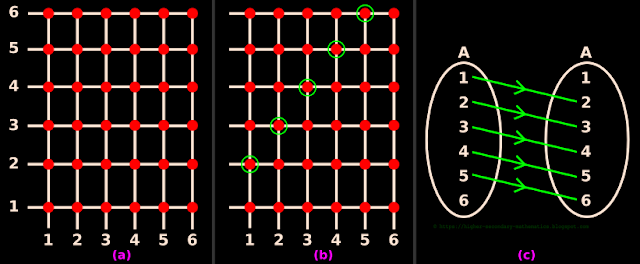
3. Using the method that we saw in the previous section, the above twenty ordered pairs can be denoted by red dots. This is shown in fig.2.4(a) below:

Diagram showing the derivation of Relation set from Cartesian product of two sets.
Fig.2.4
4. The red dots only give us the various possibilities. For example, (3, Biology) indicates that, the student 3 can choose to do Biology.
• So the red dots are useful during the admission processes. They help students and authorities to select and allocate various courses.
• Once the admission processes are complete, the red dots have not much value. At that stage, we will be wanting to know which student chose which course.
5. So we need to pick the appropriate red dots from among the total 20 red dots. This is shown in fig.2.4(b) above. The selected dots are marked with green circles.
• Consider any one green circle. Say the one at the intersection of student 2 line and Chemistry line.
• This green circle indicates that, student 2 chose to do the chemistry course.
6. The ordered pairs with green circle are:
(1, Maths), (2, Maths), (2, Chemistry), (3, Chemistry), (3, Biology), and (4, Geography)
• These pairs give us the following information:
   ♦ Student 1 chose to do Maths.
   ♦ Student 2 chose to do Maths.
   ♦ Student 2 chose to do Chemistry.
   ♦ Student 3 chose to do Chemistry.
   ♦ Student 3 chose to do Biology.
   ♦ Student 4 chose to do Geography.
7. This information can be shown in an arrow diagram also. It is shown in fig.2.4(c) above.
• Note that:
   ♦ The number of green circles in fig.b is 6
   ♦ The number of green arrows in fig.c is also 6
• This is because, both the figs. b and c convey the same information.

• Let us write this example in terms of sets and ordered pairs. The 8 steps given below will help us:
1. A is the set of students and B is the set of courses.
2. All the ‘possible combinations’ is given by the red dots in fig.2.4(a)
• As we saw in the previous section, all those red dots will be included in the set A × B
3. The green circles in fig.2.4(b) shows the relation between students and their chosen courses.
• We can make a set R which contains all the green circles in fig.2.4(b)
4. All the green circles are obtained from the red dots. So the set R will be a subset of A × B
• We can write: R ⊂ (A × B)
5. In the previous section, we saw that all elements of A × B are ordered pairs.
• Since R is a subset of A × B, all the elements of R will also be ordered pairs.
• In our present case,
R = {(1, Maths), (2, Maths), (2, Chemistry), (3, Chemistry), (3, Biology), and (4, Geography)}
6. The green circles in fig.b can be better visualized using the arrow diagram in fig.c
   ♦ The green circles in fig.b give us the ordered pairs in R.
   ♦ The green arrows in fig.c give us the same ordered pairs in R.
7. The usefulness of the arrow diagram will be clear from the following 3 steps:
(i) Take any ordered pair in R. Look at the corresponding green arrow in the arrow diagram.
(ii) The tail end of the arrow will be the first element of that ordered pair.
(iii) The head end of the arrow will be the second element of that ordered pair.
• We can work in the reverse also. It can be written in 4 steps:
(i) Take any green arrow in the arrow diagram. Corresponding to that arrow, there will be an ordered pair in R.
(ii) The tail end of the arrow will be the first element of that ordered pair.
(iii) The head end of the arrow will be the second element of that ordered pair.
(iv) All the green arrows must be included as ordered pairs in the set R.
8. In step (5), we wrote R in the roster form. We must be able to write it in the set builder form also. The following 3 steps will enable us to do so:
(i) We know that, set R contains ordered pairs. Let the general form of those ordered pairs be (x,y)
(ii) Then x will be the student and y will be the course chosen by that student.
(iii) So the set builder form will be:
R = {(x,y) : y is the course chosen by student x, x ∈ A, y ∈ B}


Example 2:
This can be written in 6 steps:
1. Consider two sets A and B
   ♦ A = {5, 6, 7}
   ♦ B = {3, 4, 5}
2. n(A) = 3 and n(B) = 3
• So there are nine possible combinations. They are:
(5, 3),            (6, 3),           (7, 3),
(5, 4),            (6, 4),           (7, 4),
(5, 5),            (6, 5),           (7, 5).
• They are the 9 ordered pairs.
3. Using the method that we saw in the previous section, the above nine ordered pairs can be denoted by red dots. This is shown in fig.2.5(a) below:

Fig.2.5
4. The red dots give us the various possible combinations.
Suppose that, we want only those combinations in which:
   ♦ The element taken from B
   ♦ is 2 less than
   ♦ The element taken from A.
• Then we need to pick the appropriate red dots from among the total 9 red dots.
• The appropriate red dots can be determined using 2 steps:
(i) Let x be the element (which satisfies the relation) from A. Let y be the corresponding element (which satisfies the relation) from B
• Then the algebraic form of the relation is: x - 2 = y
(ii) Let us take each possible value for x from set A:
• When x = 5,
   ♦ y = (x-2) = (5-2) = 3
   ♦ '3' is available in B
   ♦ So the ordered pair (5, 3) satisfies the given relation.
         ✰ Note that (5, 3) is one among the red dots in fig.a
• When x = 6,
   ♦ y = (x-2) = (6-2) = 4
   ♦ '4' is available in B
   ♦ So the ordered pair (6, 4) satisfies the given relation.
         ✰ Note that (6, 4) is one among the red dots in fig.a
• When x = 7,
   ♦ y = (x-2) = (7-2) = 5
   ♦ '5' is available in B
   ♦ So the ordered pair (7, 5) satisfies the given relation.
         ✰ Note that (7, 5) is one among the red dots in fig.a
5. We need to select the above three ordered pairs from among the 9 ordered pairs. This is shown in fig.2.5(b) above. The selected dots are marked with green circles.
• The ordered pairs with green circle are:
(5, 3), (6, 4) and (7, 5)
6. This information can be shown in an arrow diagram also. It is shown in fig.2.5(c) above.
• Note that:
   ♦ The number of green circles in fig.b is 3
   ♦ The number of green arrows in fig.c is also 3
• This is because, both the figs. b and c convey the same information.

• Let us write this example in terms of sets and ordered pairs. The 8 steps given below will help us:
1. A = {5, 6, 7} and B = {3, 4, 5}
2. All the ‘possible combinations’ is given by the red dots in fig.2.5(a)
• As we saw in the previous section, all those red dots will be included in the set A × B
3. The green circles in fig.2.5(b) shows those ordered pairs which satisfy a particular relation.
• The relation is this:
   ♦ The element taken from B
   ♦ is 2 less than
   ♦ The element taken from A.
• We can make a set R which contains all the green circles in fig.2.4(b)
4. All the green circles are obtained from the red dots. So the set R will be a subset of A × B
• We can write: R ⊂ (A × B)
5. In the previous section, we saw that all elements of A × B are ordered pairs.
• Since R is a subset of A × B, all the elements of R will also be ordered pairs.
• In our present case,
R = {(5, 3), (6, 4), (7, 5)}
6. The green circles in fig.b can be better visualized using the arrow diagram in fig.c
   ♦ The green circles in fig.b give us the ordered pairs in R.
   ♦ The green arrows in fig.c give us the same ordered pairs in R.
7. The usefulness of the arrow diagram will be clear from the following 3 steps:
(i) Take any ordered pair in R. Look at the corresponding green arrow in the arrow diagram.
(ii) The tail end of the arrow will be the first element of that ordered pair.
(iii) The head end of the arrow will be the second element of that ordered pair.
• We can work in the reverse also. It can be written in 4 steps:
(i) Take any green arrow in the arrow diagram. Corresponding to that arrow, there will be an ordered pair in R.
(ii) The tail end of the arrow will be the first element of that ordered pair.
(iii) The head end of the arrow will be the second element of that ordered pair.
(iv) All the green arrows must be included as ordered pairs in the set R.
8. In step (5), we wrote R in the roster form. We must be able to write it in the set builder form also. The following 3 steps will enable us to do so:
(i) We know that, set R contains ordered pairs. Let the general form of those ordered pairs be (x,y)
(ii) Then x will be the element from A and y will be the element from B.
(iii) So the set builder form will be:
R = {(x,y) : y = x - 2, x ∈ A, y ∈ B}


Example 3:
This can be written in 6 steps:
1. Consider the set A
   ♦ A = {1, 2, 3, 4, 5, 6}
2. We want the possible combinations of A with itself.
n(A) = 6
• So there are 36 possible combinations. They are:
(1, 1),            (2, 1),           (3, 1),         (4, 1),            (5, 1),           (6, 1),
(1, 2),            (2, 2),           (3, 2),         (4, 2),            (5, 2),           (6, 2),
(1, 3),            (2, 3),           (3, 3),         (4, 3),            (5, 3),           (6, 3),
(1, 4),            (2, 4),           (3, 4),         (4, 4),            (5, 4),           (6, 4),
(1, 5),            (2, 5),           (3, 5),         (4, 5),            (5, 5),           (6, 5),
(1, 6),            (2, 6),           (3, 6),         (4, 6),            (5, 6),           (6, 6).
• They are the 36 ordered pairs.
3. Using the method that we saw in the previous section, the above 36 ordered pairs can be denoted by red dots. This is shown in fig.2.6(a) below:

Diagramatic representation of Relation in mathematics using arrow diagram.
Fig.2.6
4. The red dots give us the various possible combinations.
Suppose that, we want only those combinations in which:
   ♦ The element taken from B
   ♦ is 1 greater than
   ♦ The element taken from A.
• Then we need to pick the appropriate red dots from among the total 36 red dots.
• The appropriate red dots can be determined using 2 steps:
(i) Let x be the element (which satisfies the relation) from A. Let y be the corresponding element (which satisfies the relation) from B
• Then the algebraic form of the relation is: x + 1 = y
(ii) Let us take each possible value for x from set A:
• When x = 1,
   ♦ y = (x+1) = (1+1) = 2
   ♦ '2' is available in A
   ♦ So the ordered pair (1, 2) satisfies the given relation.
         ✰ Note that (1, 2) is one among the red dots in fig.a
• When x = 2,
   ♦ y = (x+1) = (2+1) = 3
   ♦ '3' is available in A
   ♦ So the ordered pair (2, 3) satisfies the given relation.
         ✰ Note that (2, 3) is one among the red dots in fig.a
• When x = 3,
   ♦ y = (x+1) = (3+1) = 4
   ♦ '4' is available in A
   ♦ So the ordered pair (3, 4) satisfies the given relation.
         ✰ Note that (3, 4) is one among the red dots in fig.a
• When x = 4,
   ♦ y = (x+1) = (4+1) = 5
   ♦ '5' is available in A
   ♦ So the ordered pair (4, 5) satisfies the given relation.
         ✰ Note that (4, 5) is one among the red dots in fig.a
• When x = 5,
   ♦ y = (x+1) = (5+1) = 6
   ♦ '6' is available in A
   ♦ So the ordered pair (5, 6) satisfies the given relation.
         ✰ Note that (5, 6) is one among the red dots in fig.a
• When x = 6,
   ♦ y = (x+1) = (6+1) = 7
   ♦ '7' is not available in A
   ♦ So the ordered pair (6, 7) does not satisfy the given relation.
         ✰ Note that (6, 7) is not among the red dots in fig.a
5. We need to select the above five ordered pairs from among the 36 ordered pairs. This is shown in fig.2.6(b) above. The selected dots are marked with green circles.
• The ordered pairs with green circle are:
(1, 2), (2, 3), (3, 4), (4, 5) and (5, 6)
6. This information can be shown in an arrow diagram also. It is shown in fig.2.6(c) above.
• Note that:
   ♦ The number of green circles in fig.c is 5
   ♦ The number of green arrows in fig.c is also 5
• This is because, both the figs. b and c convey the same information.

• Let us write this example in terms of sets and ordered pairs. The 8 steps given below will help us:
1. A = {1, 2, 3, 4, 5, 6}
2. All the ‘possible combinations’ from A to A is given by the red dots in fig.2.6(a)
• As we saw in the previous section, all those red dots will be included in the set A × A
3. The green circles in fig.2.6(b) shows those ordered pairs which satisfy a particular relation.
• The relation is this:
   ♦ The element taken from A
   ♦ is 1 greater than
   ♦ The element taken from A.
• We can make a set R which contains all the green circles in fig.2.6(b)
4. All the green circles are obtained from the red dots. So the set R will be a subset of A × A
• We can write: R ⊂ (A × A)
5. In the previous section, we saw that all elements of A × A are ordered pairs.
• Since R is a subset of A × A, all the elements of R will also be ordered pairs.
• In our present case,
R = {(1, 2), (2, 3), (3, 4), (4, 5), (5, 6)}
6. The green circles in fig.b can be better visualized using the arrow diagram in fig.c
   ♦ The green circles in fig.b give us the ordered pairs in R.
   ♦ The green arrows in fig.c give us the same ordered pairs in R.
7. The usefulness of the arrow diagram will be clear from the following 3 steps:
(i) Take any ordered pair in R. Look at the corresponding green arrow in the arrow diagram.
(ii) The tail end of the arrow will be the first element of that ordered pair.
(iii) The head end of the arrow will be the second element of that ordered pair.
• We can work in the reverse also. It can be written in 4 steps:
(i) Take any green arrow in the arrow diagram. Corresponding to that arrow, there will be an ordered pair in R.
(ii) The tail end of the arrow will be the first element of that ordered pair.
(iii) The head end of the arrow will be the second element of that ordered pair.
(iv) All the green arrows must be included as ordered pairs in the set R.
8. In step (5), we wrote R in the roster form. We must be able to write it in the set builder form also. The following steps will enable us to do so:
(i) We know that, set R contains ordered pairs. Let the general form of those ordered pairs be (x,y)
(ii) Then x will be the element from A and y will be the element from A.
(iii) So the set builder form will be:
R = {(x,y) : y = x + 1, x ∈ A, y ∈ A}


• The above three examples help us to understand the basics about relations.
• We will now see some important terms involved with relations. The important terms are:
(a) image
(b) domain
(c) range
(d) Codomain

(a) image:
This can be explained in 3 steps:
1. We know that, the set R will contain one or more ordered pairs.
2. Each of those ordered pairs will have two elements.
3. The second element is called the image of the first element.
◼ Consider the ordered pairs in R of our first example. We can write:
    ♦ Maths is the image of student 1
    ♦ Maths is the image of student 2
    ♦ Chemistry is the image of student 2
    ♦ Chemistry is the image of student 3
    ♦ Biology is the image of student 3
    ♦ Geography is the image of student 4
◼ Consider the ordered pairs in R of our second example. We can write:
    ♦ 3 is the image of 5
    ♦ 4 is the image of 6
    ♦ 5 is the image of 7
◼ Consider the ordered pairs in R of our third example. We can write:
    ♦ 2 is the image of 1
    ♦ 3 is the image of 2
    ♦ 4 is the image of 3
    ♦ 5 is the image of 4
    ♦ 6 is the image of 5


(b) domain:
This can be explained in 5 steps:
1. We know that, the set R will contain one or more ordered pairs.
2. Each of those ordered pairs will have two elements.
3. Pick out all the first elements.
4. Make a set using those first elements.
5. This set is called the domain of the relation R.
◼ Consider the ordered pairs in R of our first example. We can write:
    ♦ The first elements are: 1, 2, 2, 3, 3, 4
    ♦ When we write them as a set, repeating elements should appear only once.
    ♦ So we get: domain = {1, 2, 3, 4}
◼ Consider the ordered pairs in R of our second example. We can write:
    ♦ The first elements are: 5, 6, 7
    ♦ Here there are no repeating elements.
    ♦ So we get: domain = {5, 6, 7}
◼ Consider the ordered pairs in R of our third example. We can write:
    ♦ The first elements are: 1, 2, 3, 4, 5
    ♦ Here there are no repeating elements.
    ♦ So we get: domain = {1, 2, 3, 4, 5}


(c) range:
This can be explained in 5 steps:
1. We know that, the set R will contain one or more ordered pairs.
2. Each of those ordered pairs will have two elements.
3. Pick out all the second elements.
4. Make a set using those second elements.
5. This set is called the range of the relation R.
◼ Consider the ordered pairs in R of our first example. We can write:
    ♦ The second elements are: maths, maths, chemistry, chemistry, biology, geography.
    ♦ When we write them as a set, repeating elements should appear only once.
    ♦ So we get: range = {maths, chemistry, biology, geography}
◼ Consider the ordered pairs in R of our second example. We can write:
    ♦ The second elements are: 3, 4, 5
    ♦ Here there are no repeating elements.
    ♦ So we get: range = {3, 4, 5}
◼ Consider the ordered pairs in R of our third example. We can write:
    ♦ The second elements are: 2, 3, 4, 5, 6
    ♦ Here there are no repeating elements.
    ♦ So we get: domain = {2, 3, 4, 5, 6}


(d) codomain:
We know that, the relation R is defined from set A to set B.
• The set B is also known as codomain of the relation R.
◼ Consider the relation R of our first example.
   ♦ The set B for this relation is: {Maths, Physics, Chemistry, Biology, Geography}
   ♦ So codomain of this R is : {Maths, Physics, Chemistry, Biology, Geography}
◼ Consider the relation R of our second example.
   ♦ The set B for this relation is: {3, 4, 5}
   ♦ So codomain of this R is : {3, 4, 5}
◼ Consider the relation R of our third example.
   ♦ The set B for this relation is: {1, 2, 3, 4, 5, 6}
   ♦ So codomain of this R is : {1, 2, 3, 4, 5, 6}


From the above four definitions, following 4 points can be noted:
(i) domain will contain only those elements belonging to Set A.
    ♦ all elements of A may not be present in domain.
(ii) codomain will contain only those elements belonging to Set B.
    ♦ all elements of B will be present in codomain.
(iii) range will contain only those elements belonging to Set B.
    ♦ all elements of B may not be present in range.
(iv) From (ii) and (iii), it is clear that:
range ⊂ codomain.


• Once we understand the basics, there will not be any need to write all the lengthy steps. We will be able to obtain the results using minimum steps.
• The solved examples given below will demonstrate the process

Solved example 2.15
Let A = {1, 2, 3,...,14}. Define a relation R from A to A by
R = {(x, y) : 3x – y = 0, where x, y ∈ A}. Write down its domain, codomain and
range.
Solution:
1. The relation R is a set which contains ordered pairs of the form (x, y)
   ♦ 'x' should be from set A
   ♦ Since the relation is from A to A, 'y' should also be from set A
• The x and y in each ordered pair in R should satisfy the condition: 3x - y = 0
2. The given condition can be rearranged as: 3x = y
Let us take each possible value for x from set A:
• When x = 1,
   ♦ y = 3x = (3 × 1) = 3
   ♦ '3' is available in A
   ♦ So the first ordered pair in R is (1, 3)
• When x = 2,
   ♦ y = 3x = (3 × 2) = 6
   ♦ '6' is available in A
   ♦ So the second ordered pair in R is (2, 6)
• When x = 3,
   ♦ y = 3x = (3 × 3) = 9
   ♦ '9' is available in A
   ♦ So the third ordered pair in R is (3, 9)
• When x = 4,
   ♦ y = 3x = (3 × 4) = 12
   ♦ '12' is available in A
   ♦ So the fourth ordered pair in R is (4, 12)
• When x = 5,
   ♦ y = 3x = (3 × 5) = 15
   ♦ '15' is not available in A
   ♦ So the ordered pair (5, 15) does not satisfy the given relation.
         ✰ Note that (5, 15) will not be available in A × A also.
3. The set R will contain the four ordered pairs that we determined above. We can write:
R = {(1,3), (2,6), (3,9), (4,12)}
4. Domain is the set containing all the first elements in the ordered pairs of R. So we get:
Domain of R = {1, 2, 3, 4}
5. Codomain is the set from which we take the second elements of the ordered pairs in R. In effect, co domain is the set B.
• In our present case, since the relation is from A to A, we have A in place of B.
• So we get: codomain of R = {1, 2, 3,...,14}
6. Range is the set containing all the second elements in the ordered pairs of R.
• So we get: Range of R = {3, 6, 9, 12}


• We know that, a relation is defined from one set A to another set B
• But some times, the relation is defined from one set A to the same set A
• In such situations, we can use any one of the two statements below:
   ♦ Relation R from A to A
   ♦ Relation R on A


More solved examples are given at the link below:

Solved examples 2.16 to 2.25


In the next section, we will see functions.

Previous

Contents

Next

Copyright©2021 Higher secondary mathematics.blogspot.com

Chapter 2.2 - Functions

In the previous section, we saw relations. In this section, we will see functions.

Some basics about functions can be written in 3 steps:
1. We have seen the method to define a relation from set A to set B. All we need to do is this:
    ♦ Find the ordered pairs which satisfy the relation.
    ♦ Write those ordered pairs as a set.
2. Now, to define a function, we need to check two conditions:
(i) We know that the first elements in R, will be from set A.
• We need to make sure that, every element of A is present as first elements in the R. No element of A should be left out.
(ii) Next we need to make sure that no element in A is present more than once in R.
3. If both the conditions in (2) are satisfied, that relation is a function.


Let us examine some of the relations that we saw in the previous section.
◼ In Example 1, we have:
R = {(1, Maths), (2, Maths), (2, Chemistry), (3, Chemistry), (3, Biology), and (4, Geography)}
• All the four students are present in R. So it may be a function.
• But student 2 appears more than once. So it is not a function.
(We agree that student 3 also appears more than once. But a single instance is sufficient to confirm that the R is not a function)
◼ In Example 2, we have:
R = {(5, 3), (6, 4), (7, 5)}
• All the three elements in A are present in R. So it may be a function.
• Each of those elements appear only once. So it is a function.
◼ In Example 3, we have:
R = {(1, 2), (2, 3), (3, 4), (4, 5), (5, 6)}
• The element ‘6’ is present in set A. But it is not present in R. So it is not a function.
(If the first condition is not satisfied, we can confirm that it is not a function. There is no need to check the second condition)
◼ In solved example 2.15, we have:
R = {(1,3), (2,6), (3,9), (4,12)}
• The element ‘5’ is present in A. But it is not present in R. So it is not a function.
(We agree that, none of the elements coming after 4, are present in R. But a single instance is sufficient to confirm that the R is not a function.
◼ In solved example 2.16, (file available here) we have:
R = {(1,6), (2,7), (3,8)}
• This relation is on N. But all elements of N are not present in R. So it is not a function.
◼ In solved example 2.17, we have:
R = {(9,3), (9,-3), (4,2), (4,-2), (25,5), (25,-5)}
• All elements of P are present in R. So it may be a function.
• But ‘9’ appears more than once. So it is not a function.
(We agree that ‘4’ and ‘25’ also appear more than once. But a single instance is sufficient to confirm that the R is not a function)
◼ In solved example 2.21, we have:
R = {(1,1), (1,2), (1,3), (1,4), (1,6), (2,2), (2,4), (2,6), (3,3), (3,6), (4,4),
(6,6)}
• All elements of A are present in R. So it may be a function.
• But ‘1’ appears more than once. So it is not a function.
(We agree that ‘2’ and ‘3’ also appear more than once. But a single instance is sufficient to confirm that the R is not a function)
◼ In solved example 2.22, we have:
R = {(0,5), (1,6), (2,7), (3,8), (4,9), (5,10)}
• All the elements in the given set are present in R. So it may be a function.
• Each of those elements appear only once. So it is a function.
◼ In solved example 2.25, we have:
R is a relation from Z to Z
• We found out that, domain of R is the set Z
    ♦ That means, all the elements in Z are present as first elements in R
• Since all elements of Z are present, it may be a function.
• But there will be many repetitions of the first element.
    ♦ For example, we can put 1 in the place of ‘a’
    ♦ and put infinite different integers for b.
    ♦ Every result will be an integer.
• Since the first elements in R appear more than once, it is not a function.


Let us see a solved example:
Solved example 2.26
Let N be the set of natural numbers and the relation R be defined on N such that R = {(x, y) : y = 2x, x, y ∈ N}.
What is the domain, codomain and range of R? Is this relation a function?
Solution:
1. In our present case, the relation R is a set which contains ordered pairs of
the form (x, y)
♦ 'x' should be from set N
♦ Since the relation is on N, 'y' should also be from set N
• The x and y in each ordered pair in R should satisfy the condition:
y = 2x
2. Recall that natural numbers are 1, 2, 3, 4, . . . (Details here)
• Let us take each possible value for ‘x’ from set N:
• Let x = 1
    ♦ Then y = 2x = (2 × 1) = 2
    ♦ So the first ordered pair in R is (1, 2)
• Let x = 2
    ♦ Then y = 2x = (2 × 2) = 4
    ♦ So the second ordered pair in R is (2, 4)
• Let x = 3
    ♦ Then y = 2x = (2 × 3) = 6
    ♦ So the third ordered pair in R is (3, 6)
3. In this way, we can obtain infinite number of ordered pairs in R.
• We will be using all the natural numbers as 'x'. That means, all elements of N will appear in R. So this may be a function
• What happens if we use a natural number (in the place of x) more than once?
Ans: we will be getting the same ordered pair more than once.
• There cannot be repetition of ordered pairs in R. So we will be using every natural number (in the place of x) only once. So this is a function.

Solved example 2.27
Examine each of the following relations given below and state in each case, giving reasons whether it is a function or not?
(i) R = {(2,1),(3,1),(4,2)}
(ii) R = {(2,2),(2,4),(3,3),(4,4)}
(iii) R = {(1,2),(2,3),(3,4),(4,5),(5,6),(6,7)}
Solution:
• Usually, a relation is defined from a set A to set B. Or from a set A to itself.
• But here, we are not given A or B. So we will assume that, all the elements of A are present as first elements in R.
• If all elements are not present, we will be able to straight away say that, they are not functions.
• Thus in all the three questions, we need to check the second condition only.
Part (i):
All the first elements appear only once. So it is a function.
Part (ii):
The first element '2' appear more than once. So it is not a function.
Part (iii):
All the first elements appear only once. So it is a function.


◼ From the above discussion, it is clear that:
   ♦ All functions are relations.
   ♦ But all relations are not functions.


• We have seen how to confirm whether a relation is a function or not. Now we will see some technical terms related to functions. Use of technical terms will help us to describe the functions using minimum words. They can be written in 14 steps:
1. If a relation is a function, we use the letter ‘f’ instead of ‘R’.
2. We know that, a relation is defined from one set A to another set B.
• If that relation is a function, we write: f: A→B
3. Some times a relation is defined from one set A to itself.
• If that relation is a function, we write: f: A→A
4. We saw that all functions are relations.
• So the terms domain, codomain, range and image that we saw for relations are applicable to functions also.
• For example,
   ♦ We write domain of a relation.
   ♦ We can write domain of a function also.
5. We saw that, if it is to be a function, every element of A should be present as first elements.
   ♦ The set containing the first elements is the domain.
• So if it is a function, the domain will contain all the elements of A
• Thus it is clear that, if it is a function, the domain will be same as set A.
6. We know that, like R, the f is also a set of ordered pairs.
• If we denote those ordered pairs as (x,y), then:
   ♦ y is called the image of x under f.
   ♦ x is called the image of y under f.
7. Consider a relation that we saw in the previous section:
y = x + 1
• We input various values of x and calculated the corresponding 'y values'. Then we wrote them as ordered pairs in the form (x,y).
8. Note that, the 'y values' are obtained by inputting various 'x values'.
• The input x values are 'processed' according to the rule given by the relation y = x + 1
   ♦ Here, the rule says that, we must add '1' to the input value of x
9. If the relation is a function, we can write:
The 'x values' are 'processed' according to the rule given by the function.
10. Or we can simply write:
The 'x values' are 'processed' according to the function.
11. So we can write:
   ♦ 'y values' are obtained
   ♦ when the 'x values' are processed
   ♦ according to the function.
• This can be schematically represented as in fig.2.9 below:

f(x) is used to denote a function. An x value is processed according to the rule given by the function.
Fig.2.9

12. We have done this type of 'processing' in our earlier classes. There we denoted the output as 'y'.
• For example, in y = x +1, if we add various values of x to '1', we will get various y values.
    ♦ Here, [addition of '1' to x] is the processing.
    ♦ So it is obvious that y is same as f(x).
    ♦ Then we can write: f(x) = x + 1
13. A function is a relation. So just like R, for f also, there will be a set of ordered pairs.
   ♦ The first values in that ordered pairs will form the domain of that function.
   ♦ The second values in that ordered pairs will form the range of that function.
◼ If all the elements in the range set are real numbers, then that function is called a real valued function.
◼ If in a real valued function, all the elements in the domain set are real numbers, then that function is called a real function.
14. Let us see an example:
Let N be the set of natural numbers. Define a real valued function
f : N→N by f (x) = 2x + 1.
Solution:
(i) Given that, it is a real valued function. That means, all values obtained after processing, must be real values.
• The function can be defined by writing the ordered pairs which satisfy that function.
• So our next task is to find those ordered pairs.
(ii) It is given that, f : N→N
• This indicates that,
   ♦ the first elements of the ordered pairs (input x values) should be taken from the set N.
   ♦ the second elements (resulting y values) must be present in the set N
         ✰ N is a subset of R. So indeed, it will be a real valued function
(iii) The set N is the set of natural numbers. That is., N = {1, 2, 3, 4, . . .}
• Let x = 1
   ♦ This x is processed as follows:
   ♦ f(1) = (2 × 1 + 1) = (2 + 1) = 3
   ♦ f(1) is the 'y value' when 'x value' is 1
   ♦ So the first ordered pair (x,y) is (1,3)
• Let x = 2
   ♦ This x is processed as follows:
   ♦ f(2) = (2 × 2 + 1) = (4 + 1) = 5
   ♦ f(2) is the 'y value' when 'x value' is 2
   ♦ So the second ordered pair (x,y) is (2,5)
• Let x = 3
   ♦ This x is processed as follows:
   ♦ f(3) = (2 × 3 + 1) = (6 + 1) = 7
   ♦ f(3) is the 'y value' when 'x value' is 3
   ♦ So the third ordered pair (x,y) is (3,7)
(iv) Proceeding like this, we will get infinite number of ordered pairs. All those ordered pairs should be included in the set f.
• So we can write: f = {(1,3), (2,5), (3,7), (4,9), (5,11), (6,13), (7,15), . . .}
(v) We can make a table using the x and y values in the set f. Such a table is convenient to draw the graph of the function.

f(x) values can be shown in a table.
Table 2.1

Let us see some common functions and their graphs
A. Identity function
This is a real valued function f: R→R defined by y = f (x) = x
Details can be written in 10 steps:
1. Given that, it is a real valued function. That means, all values obtained after processing, must be real values.
• The function can be defined by writing the ordered pairs which satisfy that function.
• So our next task is to find those ordered pairs.
2. It is given that, f : R→R
• This indicates that,
   ♦ the first elements of the ordered pairs (input x values) should be taken from the set R.
   ♦ the second elements (resulting y values) should be present in the set R
3. The set R is the set of real numbers. It will include integers, negative values, positive values, fractions, decimals, recurring decimals, numbers like √2, √5, Ο€ etc.,. In short, R will contain every value which can be plotted on a number line. Recall that we plotted √2, √5, Ο€ etc., in our previous classes.
• Since different types of numbers are present in R, we will choose some convenient numbers at random.
• Let x = -7
   ♦ This x is processed as follows:
   ♦ f(-7) = x = -7
   ♦ f(-7) is the 'y value' when 'x value' is -7
   ♦ So we get an ordered pair (x,y) as: (-7,-7)
• Let x = -3
   ♦ This x is processed as follows:
   ♦ f(-3) = x = -3
   ♦ f(-3) is the 'y value' when 'x value' is -3
   ♦ So we get another ordered pair (x,y) as: (-3,-3)
• Let x = 1.414
   ♦ This x is processed as follows:
   ♦ f(1.414) = x = 1.414
   ♦ f(1.414) is the 'y value' when 'x value' is 1.414
   ♦ So we get another ordered pair (x,y) as: (1.414,1.414)
• We see that, whatever be the value of x, the value of y will also be the same.
4. Proceeding like this, we will get infinite number of ordered pairs. All those ordered pairs should be included in the set f.
• So we can write: f = {. . . , (-7,-7), (-3,-3), (1.414,1.414), (5,5), . . .}
5. The above set f is written in roster form. But we have to remember an important point. It can be written in 3 steps:
(i) Both elements of the ordered pairs are real numbers.
(ii) Since they are real numbers, there will be integers, negative values, positive values, fractions, decimals, recurring decimals, numbers like √2, √5, Ο€ etc.,. We cannot think of a definite sequence to write them.
(iii) So it is better to use set builder form to write f.
6. In the set builder form, we can write:
f = {(x,y) : x ∈ R, y = x}
• That means:
    ♦ The set f contains all ordered pairs such that,
    ♦ x is a real number,
    ♦ y is equal to x.
7. Once we write the set f, we can write the domain and range of f.
(i) First we will write the domain:
• Domain of f is the set containing all the first elements of the ordered pairs in f.
• In our present case, there are infinite number of ordered pairs. So there will be infinite number of first elements.
• We saw that all the first elements are real numbers. Since they are real numbers, there will be integers, negative values, positive values, fractions, decimals, recurring decimals, numbers like √2, √5, Ο€ etc.,. We cannot think of a definite sequence to write them. So it is better to use set builder form rather than the roster form.
• We can write:
    ♦ Domain of f = {x : x ∈ R}
• That means:
    ♦ The domain of f is the set of all x such that,
    ♦ x is a real number.
(ii) Next we will write the range:
• Range of f is the set containing all the second elements of the ordered pairs in f.
• In our present case, there are infinite number of ordered pairs. So there will be infinite number of second elements.
• We saw that all the first elements are real numbers. Since the second elements are equal to first elements, they are also real numbers.
• We can write:
    ♦ Range of f = {y : y ∈ R}
• That means:
    ♦ The range of f is the set of all y such that,
    ♦ y is a real number.
8. We can make a table using the x and y values in the set f. Such a table is convenient to draw the graph of the function.
• Note that, to input for x, we choose convenient numbers from the set R.
• It is better not to choose numbers with recurring decimals. They will be difficult to plot.

Table 2.2

9. The red line in fig.2.10(a) below, is the graph of this function.

Graph of Identity Function is a straight line inclined at 45 degrees to the x-axis. If both x and y axis are drawn to the same scale.
Fig.2.10

• We can write some peculiarities of this red line. They can be written in 5 steps:
(i) The red line always passes through the origin (0,0)
(ii) If x axis and y axis are drawn to the same scale (Details here), the red line will make 45o degrees with the x axis.
• In other words, if the two axes are drawn to the same scale, the red line will bisect the angle between the two axes.
(iii) Mark any point on the red line. Note the coordinates of that point.
   ♦ The x coordinate will be same as the y coordinate.
   ♦ This is shown in fig.b
(iv) Mark any point on the x axis. For example, let us mark 3.5.
• Draw a vertical line through that point.
    ♦ Here, it is the green vertical dotted line in fig.b.
• That vertical line will meet the red line at a point.
• Through that meeting point, draw a horizontal line.
    ♦ Here, it is the green horizontal dotted line.
• This horizontal line will meet the y axis at a point which have the same x value (here it is 3.5) from where we started off.
• We will get this result even if the two axes are drawn in different scales.
(v) We see arrows at both ends of the red line.
• The arrow at the top end of the red line indicates that, the line can extend up to the point where x = +∞ and y = +∞.
• The arrow at the bottom end of the red line indicates that, the line can extend up to the point where x = -∞ and y = -∞.
10. The identity function has many applications in science and engineering.


In the next section, we will see a few more common functions.

Previous

Contents

Next

Copyright©2021 Higher secondary mathematics.blogspot.com

Saturday, August 14, 2021

Chapter 1.12 - Practical Problems Involving Three Sets

In the previous section, we saw some interesting relations between three sets. In this section, we will see some practical problems involving three sets.

In a previous section 1.9, we saw the practical problems involving two sets. We saw that some students wanted to be in both cricket team and football team.
We derived Eq.1.1: n(A ∪ B) = n(A) + n(B) - n(A ∩ B)
Using the equation, we solved the situation effectively.

• Now suppose that, a hockey coach also wants to make a team.
   ♦ Some students will want to be in both cricket team and football team.
   ♦ Some students will want to be in both cricket team and hockey team.
   ♦ Some students will want to be in both football team and hockey team.
   ♦ Some students will want to be in all three teams.
• Here also, we can derive an equation similar to the Eq.1.1
   ♦ It can be derived in 7 steps:
1. We want to find n(A ∪ B ∪ C)
• Let us treat B ∪ C as one unit. Then we can write:
n(A ∪ B ∪ C) = n[A ∪ (B ∪ C)]
   ♦ Recall that A ∪ (B ∪ C) = (A ∪ B) ∪ C = A ∪ B ∪ C
   ♦ See figs.1.7 and 1.8 in section 1.5 for proof
2. Now (B ∪ C) occupies a position similar to 'B' in Eq.1.1
• So we can write:
n[A ∪ (B ∪ C)] = n(A) + n(B ∪ C) - n[A ∩ (B ∪ C)]
3. The right side has three terms. We apply Eq.1.1 to the second term. We get:
n[A ∪ (B ∪ C)] = n(A) + n(B) + n(C) - n(B ∩ C) - n[A ∩ (B ∪ C)]
4. Now the right side has 5 terms. We apply the 'distributive law of intersection' to the fifth term.
• Then the fifth term becomes:
n[(A ∩ B) ∪ (A ∩ C)]
5. We apply Eq.1.1 to this modified fifth term. We get:
n[(A ∩ B) ∪ (A ∩ C)] = n(A ∩ B) + n(A ∩ C) - n[(A ∩ B) ∩ (A ∩ C)]
6. The last term on the right side is simply: n(A ∩ B ∩ C)
• So we can write:
n[(A ∩ B) ∪ (A ∩ C)] = n(A ∩ B) + n(A ∩ C) - n(A ∩ B ∩ C)
7. So the fifth term in (3) can be replaced. The modified equation is:
n[A ∪ (B ∪ C)] = n(A) + n(B) + n(C) - n(B ∩ C) - n(A ∩ B) - n(A ∩ C) + n(A ∩ B ∩ C)
• Rearranging this, we get Eq.1.2:
n[A ∪ B ∪ C] = n(A) + n(B) + n(C) - n(A ∩ B) - n(B ∩ C) - n(A ∩ C) + n(A ∩ B ∩ C)
• There is a definite pattern in this equation:
    ♦ The individual numbers n(A), n(B) and n(C) are added.
    ♦ The intersecting pairs n(A ∩ B), n(B ∩ C) and n(A ∩ C) are subtracted.
    ♦ The overall intersection n(A ∩ B ∩ C) is added.

Let us see a solved example
Solved example 1.69
A college awarded 38 medals in football, 15 in basketball and 20 in cricket. If these medals went to a total of 58 men and only three men got medals in all the three sports, how many received medals in exactly two of the three sports ?
Solution:
1. Given that: n(F) = 38, n(B) = 15 and n(C) = 20
• Also given that: n(F ∪ B ∪ C) = 58 and n(F ∩ B ∩ C) = 3
2. Applying Eq.1.2, we get:
n(F ∪ B ∪ C) = n(F) + n(B) + n(C) - n(F ∩ B) - n(B ∩ C) - n(F ∩ C) + n(F ∩ B ∩ C)
3. Substituting the known values, we get:
58 = 38 + 15 + 20 - n(F ∩ B) - n(B ∩ C) - n(F ∩ C) + 3
⇒ 58 = 76 - n(F ∩ B) - n(B ∩ C) - n(F ∩ C)
⇒ n(F ∩ B) + n(B ∩ C) + n(F ∩ C) = 18
4. The intersection pairs are added three times in the above result in (3)
• That sum in the Venn diagram below is: (a+d) + (b+d) + (c+d)

Fig.1.30

5. We want (a+b+c)
• It can be obtained as:
a+b+c = (a+d) + (b+d) + (c+d) -3d
6. Thus we get:
a+b+c = n(F ∩ B) + n(B ∩ C) + n(F ∩ C) - 3d
⇒ a+b+c = 18 - (3 × 3) = 9

Solved example 1.70
In a survey of 60 people, it was found that 25 people read newspaper H, 26 read
newspaper T, 26 read newspaper I, 9 read both H and I, 11 read both H and T,
8 read both T and I, 3 read all three newspapers. Find:
(i) the number of people who read at least one of the newspapers.
(ii) the number of people who read exactly one newspaper.
Solution:
1. Given that: n(H) = 25, n(T) = 26 and n(I) = 26
• Also given that: n(H ∩ I) = 9, n(H ∩ T) = 11, n(T ∩ I) = 8 and n(H ∩ T ∩ I) = 3
2. This problem can be easily solved using Venn diagrams. The various portions in the Venn Venn diagram can be filled up in 7 steps:
I. Given n(H ∩ T ∩ I) = 3
• So 3 comes in the central portion. This is marked as I in fig.1.31(a) below:

Solving practical problems involving 3 sets using Venn diagrams.
Fig.1.31

II. Given n(H ∩ I) = 9
• So the overlap between H and I is 9
• But 3 is already present in this overlap.
    ♦ So the remaining portion of the overlap is (9 - 3) = 6
• This is marked as II in fig.1.31(a) above. 

III. Given n(H ∩ T) = 11
• So the overlap between H and T is 11
• But 3 is already present in this overlap.
    ♦ So the remaining portion of the overlap is (11 - 3) = 8
• This is marked as III in fig.1.31(a) above. 

IV. Given n(T ∩ I) = 8
• So the overlap between T and I is 8
• But 3 is already present in this overlap.
    ♦ So the remaining portion of the overlap is (8 - 3) = 5
• This is marked as IV in fig.1.31(a) above. 

V. Given n(H) = 25
• So the circle H will enclose 25
• But 8, 3 and 6 are already present inside H.
    ♦ So the extra needed is: [25 - (8+3+6)] = 8
• This is marked as V in fig.1.31(b) above. 

VI. Given n(T) = 26
• So the circle T will enclose 26
• But 8, 3 and 5 are already present inside T.
    ♦ So the extra needed is: [26 - (8+3+5)] = 10
• This is marked as VI in fig.1.31(b) above.  

VII. Given n(I) = 26
• So the circle I will enclose 26
• But 6, 3 and 5 are already present inside I.
    ♦ So the extra needed is: [26 - (6+3+5)] = 12
• This is marked as VII in fig.1.31(b) above.  

3. Now the Venn diagram is completely filled up. We can answer the questions.
(i) the number of people who read at least one of the newspapers.
• The answer will be n(H ∪ T ∪ I)
   ♦ To find this number, we have to add all items inside the three circles.
   ♦ So we get: n(H ∪ T ∪ I)  = (8+8+6+3+10+5+12) = 52
(ii) the number of people who read exactly one newspaper.
• For this, we need to add the non-intersecting portions of the three circles
   ♦ We get: (8+12+10) = 30

Solved example 1.71
In a survey it was found that 21 people liked product A, 26 liked product B and 29 liked product C. If 14 people liked products A and B, 12 people liked products C and A, 14 people liked products B and C and 8 liked all the three products. Find how many liked product C only.
Solution:
1. Given that: n(A) = 21, n(B) = 26 and n(C) = 29
• Also given that: n(A ∩ B) = 14, n(C ∩ A) = 12, n(B ∩ C) = 14 and n(A ∩ B ∩ C) = 8
2. This problem can be easily solved using Venn diagrams. The various portions in the Venn Venn diagram can be filled up in 7 steps:
I. Given n(A ∩ B ∩ C) = 8
• So 8 comes in the central portion. This is marked as I in fig.1.32(a) below:

Fig.1.32
II. Given n(A ∩ B) = 14
• So the overlap between A and B is 14
• But 8 is already present in this overlap.
    ♦ So the remaining portion of the overlap is (14 - 8) = 6
• This is marked as II in fig.1.32(a) above. 

III. Given n(C ∩ A) = 12
• So the overlap between C and A is 12
• But 8 is already present in this overlap.
    ♦ So the remaining portion of the overlap is (12 - 8) = 4
• This is marked as III in fig.1.32(a) above. 

IV. Given n(B ∩ C) = 14
• So the overlap between B and C is 14
• But 8 is already present in this overlap.
    ♦ So the remaining portion of the overlap is (14 - 8) = 6
• This is marked as IV in fig.1.32(a) above. 

V. Given n(A) = 21
• So the circle A will enclose 21
• But 8, 4 and 6 are already present inside A.
    ♦ So the extra needed is: [21 - (8+4+6)] = 3
• This is marked as V in fig.1.32(b) above. 

VI. Given n(B) = 26
• So the circle B will enclose 26
• But 6, 8 and 6 are already present inside B.
    ♦ So the extra needed is: [26 - (6+8+6)] = 6
• This is marked as VI in fig.1.31(b) above.  

VII. Given n(C) = 29
• So the circle C will enclose 29
• But 4, 8 and 6 are already present inside C.
    ♦ So the extra needed is: [29 - (4+8+6)] = 11
• This is marked as VII in fig.1.32(b) above.  

3. Now the Venn diagram is completely filled up. We can answer the question.
How many like product C only?
• The answer will be the non-intersecting portion of C. It is equal to 11


In the next chapter, we will see the Relations and Functions.

Previous

Contents

Next

Copyright©2021 Higher secondary mathematics.blogspot.com

Wednesday, August 11, 2021

Chapter 1.11 - Some Interesting Relations Between Three Sets

In the previous section, we saw some interesting relations between two sets. In this section, we will see such relations between three sets. We will see them in the form of solved examples.

Solved example 1.64
Let A, B, and C be the sets such that A ∪ B = A ∪ C and A ∩ B = A ∩ C. Show that B = C.
Solution:
• We will solve this problem in two parts (a) and (b).
   ♦ In part (a), we will prove that B ⊂ C
   ♦ In part (b), we will prove that C ⊂ B
Part (a):
1. Let x be an element of B
• Using symbols, we write this as: x ∈ B
2. Then x will be an element of A ∪ B also.
• Using symbols, we write this as: x ∈ B ⇒ x ∈ (A ∪ B)
3. Given that, A ∪ B = A ∪ C
• So x must be an element of A ∪ C also.
• Using symbols, we write this as:
x ∈ (A ∪ B) ⇒ x ∈ (A ∪ C)
4. If x is an element of A ∪ C, it can be an element of A or C
• Using symbols, we write this as:
x ∈ (A ∪ C) ⇒ x ∈ A or x ∈ C
5. Let us assume that, x is an element of A
• In (1), we have already said that x is an element of B
   ♦ So x is an element of both A and B
   ♦ In that case, x will be an element of A ∩ B
• Using symbols, we write this as: x ∈ (A ∩ B)
6. Given that, A ∩ B = A ∩ C
   ♦ So x must be an element of A ∩ C also.
• Using symbols, we write this as:
x ∈ (A ∩ B) ⇒ x ∈ (A ∩ C)
7. If x is an element of A ∩ C, it must be an element of both A and C
• Using symbols, we write this as:
x ∈ (A ∩ C) ⇒ x ∈ A and x ∈ C
• That means, if an element x which belongs to B, is present in A also, it will be present in C also
8. In step (5), instead of assuming A, let us assume that, x belongs to C
• Then we can write:
The element x, which belongs to B, is present in C also
9. So whatever be the assumption that we make in (5), the element x, which belongs to B, will be present in C
◼ Thus we get: B ⊂ C

Part (b):
1. Let y be an element of C
• Using symbols, we write this as: y ∈ C
2. Then y will be an element of A ∪ C also.
• Using symbols, we write this as: y ∈ C ⇒ y ∈ (A ∪ C)
3. Given that, A ∪ B = A ∪ C
• So x must be an element of A ∪ B also.
• Using symbols, we write this as:
y ∈ (A ∪ C) ⇒ y ∈ (A ∪ B)
4. If y is an element of A ∪ B, it can be an element of A or B
• Using symbols, we write this as:
y ∈ (A ∪ B) ⇒ y ∈ A or y ∈ B
5. Let us assume that, y is an element of A
• In (1), we have already said that y is an element of C
   ♦ So y is an element of both A and C
   ♦ In that case, y will be an element of A ∩ C
• Using symbols, we write this as: y ∈ (A ∩ C)
6. Given that, A ∩ B = A ∩ C
   ♦ So y must be an element of A ∩ B also.
• Using symbols, we write this as:
y ∈ (A ∩ C) ⇒ y ∈ (A ∩ B)
7. If y is an element of A ∩ B, it must be an element of both A and B
• Using symbols, we write this as:
y ∈ (A ∩ B) ⇒ y ∈ A and y ∈ B
• That means, if an element y which belongs to C, is present in A also, it will be present in B also
8. In step (5), instead of assuming A, let us assume that, y belongs to B
• Then we can write:
The element y, which belongs to C, is present in B also
9. So whatever be the assumption that we make in (5), the element y, which belongs to C, will be present in B
◼ Thus we get: C ⊂ B

◼ In part (a), we proved: B ⊂ C
◼ In part (b), we proved: C ⊂ B
◼ So we get: B = C

Solved example 1.65
Show that if A ⊂ B, then C – B ⊂ C – A
Solution:
1. Let x be an element of C - B
• Using symbols, we write this as: x ∈ (C - B)
2. C - B will not contain any element of B
• So we can write:
    ♦ x will be an element of C.
    ♦ But x will not be an element of B
• Using symbols, we write this as:
x ∈ (C - B) ⇒ x ∈ C and x ∉ B
3. Given that A is a subset of B
• So all elements of A will be present in B
• In (2), we saw that x is not present in B
    ♦ If x is not present in B, x will not be present in A either.
4. If x is not present in A,
   ♦ x will not be deleted from C when (C - A) is formed
• That means, x will be present in (C - A)
5. So we can write:
x, which is an element of C - B, is an element of C - A also
◼ Thus we get: C - B ⊂ C - A

Solved example 1.66
Show that A ∩ B = A ∩ C need not imply B = C.
Solution:
We can show this using an example. It can be written in 3 steps:
1. Let A = {1, 2, 3, 4}, B = {3, 4, 5, 6}, C = {3, 4, 7, 8}
2. We get: A ∩ B = {3, 4} and A ∩ C = {3, 4}
3. Here A ∩ B = A ∩ C but A ≠ C

Solved example 1.67
Let A and B be sets. If A ∩ X = B ∩ X = ΙΈ and A ∪ X = B ∪ X for some set X, show that A = B.
(Hints A = A ∩ (A ∪ X), B = B ∩ (B ∪ X) and use Distributive law)
Solution:
• We will solve this problem in two parts (a) and (b)
Part (a):
1. We have: A = A ∩ (A ∪ X)
• (A ∪ X) can be replaced by (B ∪ X) because, it is given that they are equal.
• So we get: A =  A ∩ (B ∪ X)
2. The RHS can be expanded using the distributive law of intersection. We get:
A = (A ∩ B) ∪ (A ∩ X)
⇒ A = (A ∩ B) ∪ ΙΈ [(A ∩ X) = ΙΈ]
⇒ A = (A ∩ B)

Part (b):
1. We have: B = B ∩ (B ∪ X)
• (B ∪ X) can be replaced by (A ∪ X) because, it is given that they are equal.
• So we get: B =  B ∩ (A ∪ X)
2. The RHS can be expanded using the distributive law of intersection. We get:
B = (B ∩ A) ∪ (B ∩ X)
⇒ B = (B ∩ A) ∪ ΙΈ [(B ∩ X) = ΙΈ]
⇒ B = (A ∩ B)

• From part (a), we have A = (A ∩ B)
• From part (b), we have B = (A ∩ B)
◼ So we can write: A = B

Solved example 1.68
Find sets A, B and C such that A ∩ B, B ∩ C and A ∩ C are non-empty sets and A ∩ B ∩ C = ΙΈ.
Solution:
1. A ∩ B should be non-empty. That means, there must be at least one common element in A and B.
• So let A = {1, 2} and B = {2, 3}
2. B ∩ C should be non-empty. That means, there must be at least one common element in B and C.
3. A ∩ C should be non-empty. That means, there must be at least one common element in A and C.
• So let C = {1, 3}
4. So we get:
   ♦ A ∩ B = {2}
   ♦ B ∩ C = {3}
   ♦ A ∩ C = {1}
• They are all non-empty sets
5. Now, there is not even a single element which is common in all three sets.
◼ So we get: A ∩ B ∩ C = ΙΈ.


In the next section, we will see the practical problems which involves three sets.

Previous

Contents

Next

Copyright©2021 Higher secondary mathematics.blogspot.com