Showing posts with label relations. Show all posts

Monday, January 1, 2024

17.13 - More Miscellaneous Examples

In the previous section, we saw some miscellaneous examples. In this section, we will see a few more miscellaneous examples.

Solved example 17.47
Let A = {1,2,3}. Then show that the number of relations containing (1,2) and (2,3) which are reflexive and transitive but not symmetric is three.
Solution:
1. The fig.17.12 below shows all the 9 possible pairs.

Fig.17.12

2. We need to pick suitable pairs from the above nine and form various relations.
• The relations thus formed should:
    ♦ be reflexive
    ♦ be transitive
    ♦ contain (1,2) and (2,3)
    ♦ not be symmetric.

3. The pairs in the diagonal yellow cells are to be included because, the relation should be reflexive.
4. The relation should be transitive. Also (1,2) and (2,3) must be present. So (1,3) also must be present. Thus the three red cells will be present.
5. The relation should not be symmetric. So all green cells must be avoided. If we include the green cells, then:
(1,2) will get the symmetric pair (2,1)
(1,3) will get the symmetric pair (3,1)
(2,3) will get the symmetric pair (3,2)
6. So the smallest relation possible is obtained by including yellow and red.
We get: R1 = {(1,1),(2,2),(3,3),(1,2),(1,3),(2,3)}
7. In (5), we wrote that, all greens must be avoided.
In fact, it is true that, we must not include the three greens together. But we can pick (2,1) and (3,2) one by one.
8. Picking (2,1) and adding it to R1, we get:
R2 = {(1,1),(2,2),(3,3),(1,2),(1,3),(2,3),(2,1)}
9. Picking (3,2) and adding it to R1, we get:
R3 = {(1,1),(2,2),(3,3),(1,2),(1,3),(2,3),(3,2)}
10. We cannot add (3,1) to R1. This is because, it will group with (1,2). So we will be forced to add (3,2) to maintain transitivity. This will give:
R4 = {(1,1),(2,2),(3,3),(1,2),(1,3),(2,3),(3,1),(3,2)}
11. Now, (2,3) will group with (3,1) and force us to include (2,1)
This will give:
R5 = {(1,1),(2,2),(3,3),(1,2),(1,3),(2,3),(3,1),(3,2),(2,1)}
This contain all greens.
So R4 and R5 are not possible.
12. In (10), we wrote that, the green (3,1) must never be added.
Can we add the remaining two greens together?
We get: R6q = {(1,1),(2,2),(3,3),(1,2),(1,3),(2,3),(2,1),(3,2)}
Here, (3,2) will group with (2,1) and force us to add (3,1).
So R6q is also not possible.
13. Thus the only possible relations are: R1, R2 and R3.
We can write:
The number of relations which satisfy the given conditions is three.

Solved example 17.48
Show that the number of equivalence relation in the set {1,2,3} containing (1,2) and (2,1) is two.
Solution:
1. The fig.17.13 below shows all the 9 possible pairs.

Fig.17.13

2. We need to pick suitable pairs from the above nine and form various relations.
• The relations thus formed should:
    ♦ be equivalence relations
    ♦ contain (1,2) and (2,1).
3. The pairs in the diagonal yellow cells are to be included because, the relation should be reflexive.
4. The pairs (1,2) and (2,1) in the red cells are to be included because, it is a given condition.
5. So the smallest relation is R1 = {(1,1), (2,2),(3,3),(1,2),(2,1)}
This is an equivalence relation.
6. Now there are four pairs remaining. If we add any one of those remaining pairs, we will be forced to add all of them.
For example, if we add (1,3), we get the group: (2,1), (1,3). Then we have to add (2,3) to make it transitive.
As a consequence, we are forced to add (3,2) to make it symmetric.
Also, when (1,3) is added, we have to add (3,1)
7. When the remaining four pairs are added, we get the universal relation.
It is an equivalence relation.
8. So there are two relations which satisfy the given conditions.
R1 and the universal relation.

Solved example 17.49
Show that the number of binary operations on {1,2} having 1 as identity and having 2 as the inverse of 2 is exactly one.
Solution:
1. A binary operation is a function.
• In our present case, the domain is {1,2} × {1,2}.
 ♦ That means, the domain is {(1,1),(1,2),(2,1),(2,2)}
 ♦ That means, the only possible input pairs are (1,1),(1,2),(2,1) and (2,2)
• The range is {1,2}
 ♦ That means, the output will be either 1 or 2
2. Let us see what happens when each of the pairs mentioned in (1) are given as input.
(i) First we input (1,1)
• So the operation is 1∗1
• Given that, 1 is the identity (e).
• Recall that, if e is the identity, then:
a∗e = a = e∗a for all a ∈{1,2}
• So we can write:
1∗1 = 1 = 1∗1 (Here we apply e to the element 1)
• That means:
For the input (1,1), the output is 1
(ii) Next we input (1,2)
• So the operation is 1∗2
Here also, since ‘1’ is the identity, we can write:
2∗1 = 1 = 1∗2 (Here we apply e to the element 2)
• That means:
For the input (1,2), the output is 1
(iii) Next we input (2,1)
• So the operation is 2∗1
We already saw that, for this operation, the result is 1
• That means:
For the input (2,1), the output is 1
(iv) Finally, we input (2,2)
So the operation is 2∗2
• Here we cannot use the property of identity because, identity is ‘1’. This operation does not involve ‘1’.
• So we use the property of inverse.
• Given that, 2 is the inverse of 2.
• Recall that, if b is the inverse of a, then:
a∗b = e = b∗a for all a ∈{1,2}
• So we can write:
2∗2 = 1 = 2∗2 (Here we apply the inverse ‘2’  to the element 2)
• That means:
For the input (2,2), the output is 1
3. Now consider the given operation:
The operation has ‘1’ as identity and ‘2’ as the inverse of 2.
• We will denote this operation as '∗'. We used this operation and found out the outputs for all possible inputs.
4. Our next task is to prove that, ∗ is unique. It can be done in steps.
(i) In step (2), we saw the inputs and the corresponding outputs. We can write them as a set:
∗ = {[(1,1),1], [(1,2),1], [(2,1),1], [(2,2),1]}
(ii) Suppose that, ∗' is another operation having 1 as identity and having 2 as the inverse of 2.
• Here also, we will get the same set. That means:
∗' = {[(1,1),1], [(1,2),1], [(2,1),1], [(2,2),1]}
• The same set is obtained because, all possible inputs are already present in ∗.
(iii) Since both sets are same, we can write: ∗ = ∗'.
Therefore, ∗is unique.

Solved example 17.50
Consider the identity function IN : N → N defined as IN(x) = x ∀ x ∈ N.
Show that although IN is onto but IN + IN : N → N defined as
(IN + IN ) (x) = IN (x) + IN (x) = x + x = 2x is not onto.
Solution:
1. Consider the function
IN : N → N defined as IN(x) = x ∀ x ∈ N.
• Let y be any element in the codomain N
Then we can write: IN(x) = x = y
• So it is clear that:
   ♦ If we want any ‘y’ (in the codomain N) to be an image,
   ♦ we need to pick an ‘x’ (from the domain N) in such a way that,
   ♦ that ‘x’ is equal to 'y'.
• In this way, all y in the codomain can become an image. So this function is an onto function.

2. Consider the function
IN + IN : N → N defined as
(IN + IN ) (x) = IN (x) + IN (x) = x + x = 2x.
• Let y be any element in the codomain N
Then we can write: (IN + IN )(x) = 2x = y
• So it is clear that:
   ♦ If we want any ‘y’ (in the codomain N) to be an image,
   ♦ we need to pick an ‘x’ (from the domain N) in such a way that,
   ♦ that ‘x’ is equal to 'y/2'.
• Suppose that, y = 3. Then y/2 = 1.5.
• This 1.5 is not present in the domain N. So all elements in the codomain N cannot become images. That means, this function is not an onto function.

Solved example 17.51
Consider a function $f:~\left[0,\frac{\pi}{2} \right] \to R$ given by f(x) = sin x and another function $g:~\left[0,\frac{\pi}{2} \right] \to R$ given by g(x) = cos x. Show that f and g are one-one. But (f+g) is not one-one.
Solution:
1. Both f and g have the same domain.
• We can use any real number from 0 to $\frac{\pi}{2}$ (both included) as the input.
2. First consider f.
• In a one-one function, if f(x1) is to be equal to f(x2), then x1 must be equal to x2. This condition can be used to prove that, a given function is a one-one function.
• In our present case, suppose that, f(x1) is equal to f(x2). Then we can write:
$\begin{array}{ll}{}    &{f(x_1)}    & {~=~}    &{f(x_2)}    &{} \\
{\Rightarrow}    &{\sin x_1}    & {~=~}    &{\sin x_2}    &{} \\
{\Rightarrow}    &{x_1}    & {~=~}    &{x_2}    &{} \\
\end{array}$

• So f is a one-one function.

◼ Let us see an example:
• We know that $\frac{\pi}{6}$ lies between 0 and $\frac{\pi}{2}$.
• If we use $\frac{\pi}{6}$ as the input, we will get:
output = $f \left(\frac{\pi}{6} \right) ~=~\sin \left(\frac{\pi}{6} \right)~=~\frac{1}{2}$
• Only the input $\frac{\pi}{6}$ will give $\frac{1}{2}$ as the output. We will never find another input value (from 0 to $\frac{\pi}{2}$) which will give $\frac{1}{2}$ as the output.

3. Next, consider g.
• In a one-one function, if g(x1) is to be equal to g(x2), then x1 must be equal to x2. This condition can be used to prove that, a given function is a one-one function.
• In our present case, suppose that, g(x1) is equal to g(x2). Then we can write:
$\begin{array}{ll}{}    &{g(x_1)}    & {~=~}    &{g(x_2)}    &{} \\
{\Rightarrow}    &{\cos x_1}    & {~=~}    &{\cos x_2}    &{} \\
{\Rightarrow}    &{x_1}    & {~=~}    &{x_2}    &{} \\
\end{array}$

• So g is a one-one function.

◼ Let us see an example:
• We know that $\frac{\pi}{6}$ lies between 0 and $\frac{\pi}{2}$.
• If we use $\frac{\pi}{6}$ as the input, we will get:
output = $g \left(\frac{\pi}{6} \right) ~=~\cos \left(\frac{\pi}{6} \right)~=~\frac{\sqrt{3}}{2}$
• Only the input $\frac{\pi}{6}$ will give $\frac{\sqrt{3}}{2}$ as the output. We will never find another input value (from 0 to $\frac{\pi}{2}$) which will give $\frac{\sqrt{3}}{2}$ as the output.

4. Finally, we consider (f+g).
• We have: (f+g)(x) = sin x + cos x
• We want to prove that, (f+g) is not a one-one function.
• Let us use 0 as the input. We get:
(f+g)(0) = sin 0 + cos 0 = (0+1) = 1  
• Let us use $\frac{\pi}{2}$ as the input. We get:
$(f+g) \left(\frac{\pi}{2} \right)~=~\sin \left(\frac{\pi}{2} \right)~+~ \cos \left(\frac{\pi}{2} \right)~=~ (1+0)~=~1$
• So ‘1’ is the image of both 0 and $\frac{\pi}{2}$
Therefore, (f+g) is not a one-one function.


The link below gives a few more solved examples

Miscellaneous Exercise 17 


In the next chapter, we will see inverse trigonometric functions.

Previous

Contents

Next

Copyright©2023 Higher secondary mathematics.blogspot.com

Tuesday, December 26, 2023

17.12 - Miscellaneous Examples

In the previous section, we saw identity element and inverse element. In this section, we will see some miscellaneous examples.

Solved example 17.41
If R1 and R2 are equivalence relations in a set A, show that R1∩R2 is also an equivalence relation.
Solution:
Let us assume that, the set A = {a1, a2, a3, a4, . . . , an}
Part (i): Proving that, the intersection is reflexive.
1. R1 is an equivalence relation in set A.
• So all reflexive pairs like (a1,a1), (a2,a2), (a3,a3), . . .(an,an) will be present in the set R1.
2. R2 is also an equivalence relation in set A.
• So all reflexive pairs like (a1,a1), (a2,a2), (a3,a3), . . .(an,an) will be present in the set R2 also.
3. The same reflexive pairs are present in both R1 and R2.
• So those reflexive pairs will be present in R1∩R2 also.
Therefore, R1∩R2 is reflexive.

Part (ii): Proving  that, the intersection is symmetric.
1. Suppose that, a random pair (a3,a7) is present in the intersection.
   ♦ Then this (a3,a7) will be present in the set R1.
   ♦ This (a3,a7) will be present in the set R2 also.
2. (a3,a7) is present in R1.
• But R1 is an equivalence relation. So the symmetric pair (a7,a3) will be present in R1.
3. (a3,a7) is present in R2.
• But R2 is an equivalence relation. So the symmetric pair (a7,a3) will be present in R2.
4. From (2) and (3), we see that:
(a7,a3) is present in both R1 and R2.
5. From (1) and (4) we see that:
The symmetric pairs (a3,a7) and (a7,a3) are present in the intersection.
6. In this way, all symmetric pairs will be present in the intersection.
So the intersection is a symmetric relation.

Part (iii): Proving that, the intersection is transitive.
1. Suppose that, two random pairs (a3,a7) and (a7,a2) are present in the intersection.
   ♦ Then these two pairs will be present in R1.
   ♦ These two pairs will be present in R2 also.
2. (a3,a7) and (a7,a2) are present in R1.
• But R1 is a symmetric relation. So the transitive pair (a3,a2) will be present in R1.   
3. (a3,a7) and (a7,a2) are present in R2.
• But R2 is a symmetric relation. So the transitive pair (a3,a2) will be present in R2.
4. From (2) and (3), we see that:
• (a3,a2) will be present in both R1 and R2.
• So it will be present in the intersection also.
5. From (1) and (4),we see that:
• The intersection contains (a3,a7), (a7,a2) and (a3,a2)
Therefore, the intersection is transitive.     
◼ From parts (i), (ii) and (iii), we see that, the intersection is reflexive, symmetric and transitive. So the intersection is an equivalence relation.

Solved example 17.42
Let R be the relation on set A of ordered pairs of positive integers defined by (x,y)R(u,v) if and only if xv = yu. Show that R is an equivalence relation.
Solution:
1. Set A is a set of ordered pairs.
• Each of those ordered pairs will contain +ve integers.
For example: (3,5), (1,2), (7,11) etc.,

2. The given relation is on A.
• That means, we need to consider the set A × A
• Each element in A × A will be a pair of ordered pairs.
For example: [(11,3),(5,4)], [(7,5),(8,2)], [(14,8),(9,3)] etc.,
• In general, we can write:
Each element in A × A will be a pair of ordered pairs in the form [(x,y),(u,v)]

3. The set R will contain those elements from A × A, which satisfy the condition: xv = yu.
• We need to prove that R is an equivalence relation.

4. First we check whether R is reflexive.
(i) If R is reflexive, then a possible random element in R is: [(a3,a7),(a3,a7)].
(ii) Let us check whether this element satisfies the condition xv = yu.
• Here, x = u = a3 and y = v = a7
• We can write:
xv = a3 a7  and  yu = a7 a3 = a3 a7
(iii) We see that xv = yu.
• So all reflexive elements are eligible to be included in R.
Therefore, R is a reflexive relation.   

5. Next we check whether R is symmetric.
(i) Suppose that a random element [(a3,a7),(a2,a9)] is present in R.
• It's symmetric element is [(a2,a9),(a3,a7)]. Is this symmetric element present in R? Let us check.
(ii) [(a3,a7),(a2,a9)] is present in R.
• That means, this element satisfies the condition: xv = yu
• That means, a3 a9 = a7 a2.
(iii) If the symmetric element is to be present in R, it must also satisfy the condition xv = yu.
• That means, a2 a7 must be equal to a9 a3.
• From (ii), we see that, they are indeed equal.
(iv) So we can write:
• If [(a3,a7),(a2,a9)] is present in R, then the symmetric element [(a2,a9),(a3,a7)] will also be present in R.
• So all symmetric elements are eligible to be included in R.
Therefore, R is a symmetric relation.

6. Finally, we check whether R is transitive.
(i) Suppose that two random elements [(a3,a7),(a2,a9)] and [(a2,a9),(a8,a11)] are present in R.
• Then the transitive element is [(a3,a7),(a8,a11)]. Is this transitive element present in R? Let us check.
(ii) [(a3,a7),(a2,a9)] is present in R.
• That means, this element satisfies the condition: xv = yu
• That means, a3 a9 = a7 a2.
(iii) Similarly, [(a2,a9),(a8,a11)] is present in R.
• That means, this element satisfies the condition: xv = yu
• That means, a2 a11 = a9 a8.
(iv) If the transitive element written in (i) is to be present in R, then it should also satisfy the condition xv = yu.
• That means, a3 a11 must be equal to a7 a8
• That means, $\frac{a_3}{a_7}~\text{must be equal to}~\frac{a_8}{a_{11}}$
(v) From (ii) we get: $\frac{a_3}{a_7}~=~\frac{a_2}{a_9}$
(vi) From (iii) we get: $\frac{a_2}{a_9}~=~\frac{a_8}{a_{11}}$
(vii) Combining the results in (v) and (vi), we get:
$\frac{a_2}{a_9}~=~\frac{a_8}{a_{11}}~=~\frac{a_3}{a_7}$
• So the condition mentioned in (iv) is satisfied.
(vii) That means, all transitive elements will be present in R.
Therefore, R is a transitive relation.

◼ Based on the above 6 steps, we see that, R is reflexive, symmetric and transitive. So R is an equivalence relation.

Solved example 17.43
Let X = {1,2,3,4,5,6,7,8,9}. Let R1 be a relation in X given by R1 = {(x,y): x-y is divisible by 3} and R2 be another relation on X given by R2 ={(x,y): {x,y}⊂{1,4,7} or {x,y}⊂{2,5,8} or {x,y}⊂{3,6,9}}. Show that R1 = R2.
Solution:
1. We can write set R1 easily. Ordered pairs like (1,4), (4,1), (5,8), are some of the elements of R1.
• But in this problem, we do not have to write the elements of R1. We just need to know the nature of the elements. We see that, for all those elements, (x-y) will be divisible by 3.
2. Next we consider R2
(i) Any ordered pair (x,y) for which, {x,y} is a subset of {1,4,7}, will be an element of R2.
(ii) Any ordered pair (x,y) for which, {x,y} is a subset of {2,5,8}, will be an element of R2.
(iii) Any ordered pair (x,y) for which, {x,y} is a subset of {3,6,9}, will be an element of R2.
3. Consider the sets {1,4,7}.
• We can take any two elements from this set. The difference between those two elements will be divisible by 3.
• Similar is the case with the other two sets {2,5,8} and {3,6,9}
• Union of the three sets will give X.
• So R1 will be a subset of R2
4. While writing the ordered pairs of R2, we see that, difference between the members of each ordered pair is divisible by 3.
• So R2 will be a subset of R1.
5. Now we can compare the results.
   ♦ In (3), we see that: R1 ⊂ R2.
   ♦ In (4), we see that: R2 ⊂ R1.
• So we can write: R1 = R2

Solved example 17.44
Let f: X→Y be a function. Define a relation R in X given by R = {(a,b): f(a) = f(b)}. Examine whether R is an equivalence relation or not.
Solution:
1. Let X = {x1, x2, x3, . . . } and Y = {y1, y2, y3, . . .}
2. Then a possible example set for f is {(x1, y5), (x2, y8), (x3, y11), . . .}
• This means:
    ♦ When x1 is the input, the function f gives y5 as the output.
    ♦ When x2 is the input, the function f gives y8 as the output.
    ♦ When x3 is the input, the function f gives y11 as the output.
so on . . .
3. Now we can write the set R.
• Set R will contain ordered pairs of the form (a,b).
• Consider any one ordered pair (a,b). That ordered pair is eligible to be in R because, f(a) = f(b).
• So both a and b will be from set X. This is because, all inputs of f are taken from X.
4. So R is a relation on X.
• That means, the elements of R are taken from the set X×X.
• So a random ordered pair taken from R will be (x5,x9)
• This ordered pair is eligible to be in R because, f(x5) = f(x9)
5. Now we check whether R is reflexive.
• A possible random element in X×X is (x5,x5)
• This element will satisfy the condition f(a) = f(b).
This is because, f(x5) = f(x5)
• So all reflexive pairs will be present in R.
Therefore, R is reflexive.
6. Next we check whether R is symmetric.
• If a random pair (x5,x9) is present in R, then the symmetric pair (x9,x5) will also be present in R.
This is because:
f(x5) = f(x9) ⇒ f(x9) = f(x5)
• So all symmetric pairs will be present in R.
Therefore, R is symmetric.
7. Finally we check whether R is transitive.
• Consider two random pairs from R: (x5,x9) and (x9,x2)
• Will the transitive pair (x5,x2) be present in R?
• Since both (x5,x9) and (x9,x2) are present in R, we can write:
f(x5) = f(x9) = f(x2)
• So it is clear that, the transitive pair (x5,x2) will be present in R
Therefore, R is transitive.
◼ Since R is reflexive, symmetric and, transitive, it is an equivalence relation.


Solved example 17.45
Determine which of the following binary operations on the set N are associative and which are commutative.
$(a)~a * b = 1 ~ \forall ~ a,b \in N~~~~~(b)~a * b = \frac{a+b}{2} ~ \forall ~ a,b \in N$
Solution
:
Part (i):
1. Checking whether commutative or not.
• For an operation to be commutative, the condition which should be satisfied is:
(a∗b) = (b∗a)
• For our present case, a and b should be natural numbers.
• It is given that, if we perform the operation '*' between any two natural numbers a and b, then the result will be 1.
• So the same operation between b and a will also give 1.
• That means, (a∗b) = (b∗a)
• So the given ∗ is a commutative binary operation.
2. Checking whether associative or not.
• For an operation to be associative, the condition which should be satisfied is:
(a∗b)∗c = a∗(b∗c)
• For our present case, a, b and c should be natural numbers.
• First we calculate (a∗b)∗c:
(a ∗ b) = 1
So (a∗b)∗c = (1∗c) = 1
• Next we calculate a∗(b∗c):
(b ∗ c) = 1
So a∗(b∗c) = (a∗1) = 1
• We see that: (a∗b)∗c = a∗(b∗c)
So the given ∗ is an associative binary operation.
◼ Based on the above 2 steps, we can write:
The given ∗ is both commutative and associative.

Part (ii):
1. Checking whether commutative or not.
• For an operation to be commutative, the condition which should be satisfied is:
(a∗b) = (b∗a)
• For our present case, a and b should be natural numbers.
• For any two natural numbers, $\frac{a+b}{2}$ will be equal to $\frac{b+a}{2}$ .
• That means, (a∗b) = (b∗a)
• So the given ∗ is a commutative binary operation.
2. Checking whether associative or not.
• For an operation to be associative, the condition which should be satisfied is:
(a∗b)∗c = a∗(b∗c)
• For our present case, a, b and c should be natural numbers.
• First we calculate (a∗b)∗c:
$(a*b)~=~\frac{a+b}{2}$
$\text{So}~(a*b)*c~=~\left(\frac{a+b}{2}\right) * c~=~\frac{\frac{a+b}{2}~+~c}{2}~=~\frac{a+b+2c}{4}$
• Next we calculate a∗(b∗c):
$(b*c)~=~\frac{b+c}{2}$
$\text{So}~a*(b*c)~=~a * \left(\frac{b+c}{2}\right)~=~\frac{a~+~\frac{b+c}{2}}{2}~=~\frac{2a+b+c}{4}$
• We see that: (a∗b)∗c ≠ a∗(b∗c)
So the given ∗ is not an associative binary operation.
◼ Based on the above 2 steps, we can write:
The given ∗ is commutative but not associative.

Solved example 17.46
Find the number of all one-one functions from set A = {1,2,3} to itself.
Solution:
1. Take any one element from the domain. It can be mapped to the codomain in 3 different ways.
2. Take a second element from the domain. It can be mapped to the codomain in 2 ways. This is because, the way chosen in step 1 should not be repeated. For example, (1,2) and (2,2) cannot be selected. Then it would not be a one-one function.
3. Take the third element from the domain. It can be mapped to the codomain in one way.
4. So the total number of ways = 3 × 2 × 1 = 3! = 6


In the next section,we will see a few more solved examples.


Previous

Contents

Next

Copyright©2023 Higher secondary mathematics.blogspot.com

Saturday, October 21, 2023

Chapter 17 - Relations And Functions

In the previous section, we completed appendix B. With that, we have completed all topics in class 11. In this chapter, we will see Relations and Functions which is the first chapter in class 12.

• In class 11, we saw some basic details about relations and functions. See chapter 2.
• Let us recall five important points:
(i) A and B are two sets.
(ii) A × B is a new set formed from A and B. This new set will contain all possible ordered pairs between the elements of A and B.
(iii) The ordered pairs are written in the form (a,b).
   ♦ a is from set A
   ♦ b is from set B
(iv) We pick out some of those ordered pairs and form a new set R.
(v) Take any ordered pair from R. There will be a definite relation between the a and the b of that ordered pair.
• For example,
   ♦ a is the brother of b.
   ♦ a is 2 less than b.
• We write this as a R b.


In this section, we will learn more details about relations and functions.

Types of relations

First we will see empty relation. It can be explained in 4 steps:
1. We have seen the relation from set A to itself. It is written as R in A.
2. Relation in A will be a subset of A × A
• But Φ (empty set) is a subset of any set. So there exists a relation R in A such that R is a empty set.
3. Let us see an example. It can be written in 4 steps:
(i) Let A = {1,2,3,4}
(ii) R in A in set builder form is:
R = {(a,b): a-b = 10}
(iii) a-b = 10 is same as b = a-10
• Take the first element 1. Ten subtracted from 1 is -9. This -9 is not present in A. So when a = 1, we cannot write b. In other words, no ordered pair in R can have a = 1.
• Take the second element 2. Ten subtracted from 2 is -8. This -8 is not present in A. So when a = 2, we cannot write b. In other words, no ordered pair in R can have a = 2.
• Similarly, we will find that:
   ♦ No ordered pair in R can have a = 3
   ♦ No ordered pair in R can have a = 4
(iv) None of the elements in A can become 'a' of the ordered pairs in R. So there will be no element in R. In other words, R is an empty set.
4. If R = Φ, then that relation is called an empty relation.


Now we will see universal relation. It can be explained in 4 steps:
1. We have seen the relation from set A to itself. It is written as R in A.
2. Relation in A will be a subset of A × A
• But a set itself is a subset of any set. So there exists a relation R in A such that R is A × A.
3. Let us see an example. It can be written in 4 steps:
(i) Let A = {1,2,3,4}
(ii) R' in A in set builder form is:
R' = {(a,b): |a-b| ≥ 0}
(iii) A has four elements. So A × A will have 16 elements.
• Take the first element (1,1). Here a = 1 and b = 1
|a-b| = |1-1| = |0| = 0
So (1,1) is eligible to be included in the set R'.
• Take the second element (1,2). Here a = 1 and b = 2
|a-b| = |1-2| = |-1| = 1 ≥ 0
So (1,2) is eligible to be included in the set R'.
• Take the third element (1,3). Here a = 1 and b = 3
|a-b| = |1-3| = |-2| = 2 ≥ 0
So (1,3) is eligible to be included in the set R'.   
• Take any one of the 16 elements, say (4,1). Here a = 4 and b = 1
|a-b| = |4-1| = |3| = 3 ≥ 0
So (4,1) is eligible to be included in the set R'
• In this way we can check all the 16 elements. We will see that, all of them are eligible to be included in the set R'.
(iv) We can write: R' = A × A
4. If R' = A × A, then that relation is called a universal relation.
• Here every element in A has the relation R' with every other element of A.


Both the empty relation and the universal relation are some times called trivial relations.


Solved example 17.1
A is the set of all students of a boys school. Show that the relation R in A given by R={(a,b) : a is sister of b} is the empty relation and R’ = {(a,b) : the difference between heights of a and b is less than 3 meters} is the universal relation.
Solution:
Part (i):
1. We can try to write the elements in R. Those elements will be in the form (a,b)
‘a’ will be from set A. ‘b’ will also be from set A.
2. Set A contains only boys.
So ‘a’ can never be the sister of ‘b’.
3. As a consequence, we will not be able to write a single element of the form (a,b). That means, R is an empty set.
• So the relation R is an empty relation.
Part (ii):
1. Heights greater than 2 m are very rare. We can safely assume that, the tallest student has a height of 2.5 m.
2. Heights smaller than 1.5 are very rare. We can safely assume that, the shortest student has a height of 1 m.
3. So the maximum possible difference between the heights is (2.5 – 1) = 1.5 m.
• None of the “differences” will be greater than 1.5 m.
• Consequently, none of the “differences” will be greater than 3 m.
• In other words, all differences will be less than 3 m.
4. We can take any (a,b) from A × A.
• The difference in that pair will be less than 3 m.
• So all elements in A × A are eligible to be included in R`
• Thus we get R` = A × A.
• That means, R` is a universal relation.


Next we will see reflexive relation. It can be explained in 3 steps:
1. Let A = {1,2,3,4}
• We know that there will be 16 elements in A × A.
• (1,1), (2,2), (3,3) and (4,4) will be among those 16 elements.
2. Suppose that, there is a relation R in A in such a way that, (1,1), (2,2), (3,3) and (4,4) are elements of R.
• Then that relation is called a reflexive relation.
3. We can write the definition in two steps:
(i) R is a relation in A
(ii) For every a ∈ A, if (a,a) ∈ R, then R is a reflexive relation.


Next we will see symmetric relation. It can be explained in 3 steps:
1. Let A = {1,2,3,4}
• We know that there will be 16 elements in A × A.
• (1,2), (2,1), (1,3), (3,1) etc., will be among those 16 elements.
2. Suppose that, there is a relation R in A which satisfies the following conditions:
• If (1,2) is an element of R, then (2,1) is also an element of R.
• If (1,3) is an element of R, then (3,1) is also an element of R.

- - - - 

• If (2,4) is an element of R, then (4,2) is also an element of R.

so on . . .

• If this is true for all such pairs, then that relation is called a symmetric relation.
3. We can write the definition in two steps:
(i) R is a relation in A
(ii) For all a1, a2 ∈ A, if (a1,a2) ∈ R ⇒ (a2,a1) ∈ R, then R is a symmetric relation.


Next we will see transitive relation. It can be explained in 3 steps:
1. Let A = {1,2,3,4}
• We know that there will be 16 elements in A × A.
• (1,2), (2,3), (1,3), (3,4) etc., will be among those 16 elements.
2. Suppose that, there is a relation R in A which satisfies the following conditions:
• If (1,2) and (2,3) are elements of R, then (1,3) is also an element of R.
• If (1,3) and (3,4) are elements of R, then (1,4) is also an element of R.

- - - - 

• If (2,4) and (4,3) are elements of R, then (2,3) is also an element of R.

so on . . .

• If this is true for all such pairs, then that relation is called a transitive relation.
3. We can write the definition in two steps:
(i) R is a relation in A
(ii) For all a1, a2, a3∈ A,
if (a1,a2) ∈ R and (a2,a3) ∈ R ⇒ (a1,a3) ∈ R, then R is a transitive relation.


Now we can write the definition of an equivalence relation. It can be written in 2 steps:
1. R is a relation in A.
2. This R is an equivalence relation if all three conditions below are satisfied.
(i) R is a reflexive relation.
(ii) R is a symmetric relation.
(iii) R is a transitive relation.


Solved example 17.2
Let T be the set of all triangles in a plane. R is a relation in T.
R = {(T1,T2) : T1 is congruent to T2}. Show that R is an equivalence relation.
Solution:
• Congruent triangles are those triangles which have the same sides and same corresponding angles.
• Given that, T is the set of all triangles in a plane. There will be infinite number of triangles in that set. Let us number them as: 1, 2, 3, 4, . . .
All those triangles will be present in T.
• R is a relation in T. So we must consider T × T
• (1,1), (1,2), (1,3), (1,4), . . . , (2,1), (2,2), (2,3), . . .  are all elements of T × T.
There will be infinite elements in T × T
1. First we check whether R is reflexive. It can be written in 3 steps:
(i) (1,1) is eligible to be included in R. This is because, the first triangle is congruent to itself. In fact, any triangle is congruent to itself.
(ii) In this way, (2,2), (3,3), (4,4), . . . are eligible to be included in R.
(iii) Therefore, R is a reflexive function.
2. Now we check whether R is symmetric. It can be written in 3 steps:
(i) Suppose that (3,9) is eligible to be included in R.
• Then it means that, the third triangle is congruent to the ninth triangle.
(ii) Now, (9,3) is an element of T × T.
• The element (9,3) is eligible to be included in R. This is because:
If third triangle is congruent to the ninth triangle, then ninth triangle will be congruent to the third.
(iii) So in general, if (T1, T2) is an element of R, then (T2,T1) will also be an element of R
• Therefore, R is a symmetric relation.
3. Now we check whether R is transitive. It can be written in 4 steps:
(i) Suppose that (4,7) is eligible to be included in R.
• Then it means that, the fourth triangle is congruent to the seventh triangle.
(ii) Also suppose that (7,10) is eligible to be included in R.
• Then it means that, the seventh triangle is congruent to the tenth triangle.
(iii) It is clear that, fourth, seventh and tenth triangles are congruent.
Then fourth triangle is congruent to the tenth triangle.
So (4,10) is eligible to be included in R.
(iv) In general, if both (T1,T2) and (T2,T3) are elements of R, then (T1,T3) will also be an element of R.
Therefore R is a transitive relation.
4. We see that:
R is reflexive, symmetric and transitive. So R is an equivalence relation.   


In the next section, we will see a few more solved examples.

Previous

Contents

Next

Copyright©2023 Higher secondary mathematics.blogspot.com

Tuesday, November 9, 2021

Chapter 2.1 - Relations

In the previous section, we saw Cartesian product. In this section, we will see relations.

We will see the basics about relations using three examples.
Example 1:
This can be written in 7 steps:
1. Consider two sets A and B
   ♦ A is a set of four students: Student 1, Student 2, Student 3, Student 4.
         ✰ A = {1, 2, 3, 4}
   ♦ B is a set of five available courses.
         ✰ B = {Maths, Physics, Chemistry, Biology, Geography}
2. The students have the liberty to learn one or more of the available courses.
• So there are twenty possible combinations. They are:
(1, Maths),           (2, Maths),         (3, Maths),         (4, Maths),
(1, Physics),         (2, Physics),       (3, Physics),        (4, Physics),
(1, Chemistry),    (2, Chemistry),   (3, Chemistry),   (4, Chemistry),
(1, Biology),         (2, Biology),       (3, Biology),        (4, Biology),
(1, Geography),   (2, Geography),  (3, Geography),   (4, Geography).
• They are the 20 ordered pairs.
3. Using the method that we saw in the previous section, the above twenty ordered pairs can be denoted by red dots. This is shown in fig.2.4(a) below:

Diagram showing the derivation of Relation set from Cartesian product of two sets.
Fig.2.4
4. The red dots only give us the various possibilities. For example, (3, Biology) indicates that, the student 3 can choose to do Biology.
• So the red dots are useful during the admission processes. They help students and authorities to select and allocate various courses.
• Once the admission processes are complete, the red dots have not much value. At that stage, we will be wanting to know which student chose which course.
5. So we need to pick the appropriate red dots from among the total 20 red dots. This is shown in fig.2.4(b) above. The selected dots are marked with green circles.
• Consider any one green circle. Say the one at the intersection of student 2 line and Chemistry line.
• This green circle indicates that, student 2 chose to do the chemistry course.
6. The ordered pairs with green circle are:
(1, Maths), (2, Maths), (2, Chemistry), (3, Chemistry), (3, Biology), and (4, Geography)
• These pairs give us the following information:
   ♦ Student 1 chose to do Maths.
   ♦ Student 2 chose to do Maths.
   ♦ Student 2 chose to do Chemistry.
   ♦ Student 3 chose to do Chemistry.
   ♦ Student 3 chose to do Biology.
   ♦ Student 4 chose to do Geography.
7. This information can be shown in an arrow diagram also. It is shown in fig.2.4(c) above.
• Note that:
   ♦ The number of green circles in fig.b is 6
   ♦ The number of green arrows in fig.c is also 6
• This is because, both the figs. b and c convey the same information.

• Let us write this example in terms of sets and ordered pairs. The 8 steps given below will help us:
1. A is the set of students and B is the set of courses.
2. All the ‘possible combinations’ is given by the red dots in fig.2.4(a)
• As we saw in the previous section, all those red dots will be included in the set A × B
3. The green circles in fig.2.4(b) shows the relation between students and their chosen courses.
• We can make a set R which contains all the green circles in fig.2.4(b)
4. All the green circles are obtained from the red dots. So the set R will be a subset of A × B
• We can write: R ⊂ (A × B)
5. In the previous section, we saw that all elements of A × B are ordered pairs.
• Since R is a subset of A × B, all the elements of R will also be ordered pairs.
• In our present case,
R = {(1, Maths), (2, Maths), (2, Chemistry), (3, Chemistry), (3, Biology), and (4, Geography)}
6. The green circles in fig.b can be better visualized using the arrow diagram in fig.c
   ♦ The green circles in fig.b give us the ordered pairs in R.
   ♦ The green arrows in fig.c give us the same ordered pairs in R.
7. The usefulness of the arrow diagram will be clear from the following 3 steps:
(i) Take any ordered pair in R. Look at the corresponding green arrow in the arrow diagram.
(ii) The tail end of the arrow will be the first element of that ordered pair.
(iii) The head end of the arrow will be the second element of that ordered pair.
• We can work in the reverse also. It can be written in 4 steps:
(i) Take any green arrow in the arrow diagram. Corresponding to that arrow, there will be an ordered pair in R.
(ii) The tail end of the arrow will be the first element of that ordered pair.
(iii) The head end of the arrow will be the second element of that ordered pair.
(iv) All the green arrows must be included as ordered pairs in the set R.
8. In step (5), we wrote R in the roster form. We must be able to write it in the set builder form also. The following 3 steps will enable us to do so:
(i) We know that, set R contains ordered pairs. Let the general form of those ordered pairs be (x,y)
(ii) Then x will be the student and y will be the course chosen by that student.
(iii) So the set builder form will be:
R = {(x,y) : y is the course chosen by student x, x ∈ A, y ∈ B}


Example 2:
This can be written in 6 steps:
1. Consider two sets A and B
   ♦ A = {5, 6, 7}
   ♦ B = {3, 4, 5}
2. n(A) = 3 and n(B) = 3
• So there are nine possible combinations. They are:
(5, 3),            (6, 3),           (7, 3),
(5, 4),            (6, 4),           (7, 4),
(5, 5),            (6, 5),           (7, 5).
• They are the 9 ordered pairs.
3. Using the method that we saw in the previous section, the above nine ordered pairs can be denoted by red dots. This is shown in fig.2.5(a) below:

Fig.2.5
4. The red dots give us the various possible combinations.
Suppose that, we want only those combinations in which:
   ♦ The element taken from B
   ♦ is 2 less than
   ♦ The element taken from A.
• Then we need to pick the appropriate red dots from among the total 9 red dots.
• The appropriate red dots can be determined using 2 steps:
(i) Let x be the element (which satisfies the relation) from A. Let y be the corresponding element (which satisfies the relation) from B
• Then the algebraic form of the relation is: x - 2 = y
(ii) Let us take each possible value for x from set A:
• When x = 5,
   ♦ y = (x-2) = (5-2) = 3
   ♦ '3' is available in B
   ♦ So the ordered pair (5, 3) satisfies the given relation.
         ✰ Note that (5, 3) is one among the red dots in fig.a
• When x = 6,
   ♦ y = (x-2) = (6-2) = 4
   ♦ '4' is available in B
   ♦ So the ordered pair (6, 4) satisfies the given relation.
         ✰ Note that (6, 4) is one among the red dots in fig.a
• When x = 7,
   ♦ y = (x-2) = (7-2) = 5
   ♦ '5' is available in B
   ♦ So the ordered pair (7, 5) satisfies the given relation.
         ✰ Note that (7, 5) is one among the red dots in fig.a
5. We need to select the above three ordered pairs from among the 9 ordered pairs. This is shown in fig.2.5(b) above. The selected dots are marked with green circles.
• The ordered pairs with green circle are:
(5, 3), (6, 4) and (7, 5)
6. This information can be shown in an arrow diagram also. It is shown in fig.2.5(c) above.
• Note that:
   ♦ The number of green circles in fig.b is 3
   ♦ The number of green arrows in fig.c is also 3
• This is because, both the figs. b and c convey the same information.

• Let us write this example in terms of sets and ordered pairs. The 8 steps given below will help us:
1. A = {5, 6, 7} and B = {3, 4, 5}
2. All the ‘possible combinations’ is given by the red dots in fig.2.5(a)
• As we saw in the previous section, all those red dots will be included in the set A × B
3. The green circles in fig.2.5(b) shows those ordered pairs which satisfy a particular relation.
• The relation is this:
   ♦ The element taken from B
   ♦ is 2 less than
   ♦ The element taken from A.
• We can make a set R which contains all the green circles in fig.2.4(b)
4. All the green circles are obtained from the red dots. So the set R will be a subset of A × B
• We can write: R ⊂ (A × B)
5. In the previous section, we saw that all elements of A × B are ordered pairs.
• Since R is a subset of A × B, all the elements of R will also be ordered pairs.
• In our present case,
R = {(5, 3), (6, 4), (7, 5)}
6. The green circles in fig.b can be better visualized using the arrow diagram in fig.c
   ♦ The green circles in fig.b give us the ordered pairs in R.
   ♦ The green arrows in fig.c give us the same ordered pairs in R.
7. The usefulness of the arrow diagram will be clear from the following 3 steps:
(i) Take any ordered pair in R. Look at the corresponding green arrow in the arrow diagram.
(ii) The tail end of the arrow will be the first element of that ordered pair.
(iii) The head end of the arrow will be the second element of that ordered pair.
• We can work in the reverse also. It can be written in 4 steps:
(i) Take any green arrow in the arrow diagram. Corresponding to that arrow, there will be an ordered pair in R.
(ii) The tail end of the arrow will be the first element of that ordered pair.
(iii) The head end of the arrow will be the second element of that ordered pair.
(iv) All the green arrows must be included as ordered pairs in the set R.
8. In step (5), we wrote R in the roster form. We must be able to write it in the set builder form also. The following 3 steps will enable us to do so:
(i) We know that, set R contains ordered pairs. Let the general form of those ordered pairs be (x,y)
(ii) Then x will be the element from A and y will be the element from B.
(iii) So the set builder form will be:
R = {(x,y) : y = x - 2, x ∈ A, y ∈ B}


Example 3:
This can be written in 6 steps:
1. Consider the set A
   ♦ A = {1, 2, 3, 4, 5, 6}
2. We want the possible combinations of A with itself.
n(A) = 6
• So there are 36 possible combinations. They are:
(1, 1),            (2, 1),           (3, 1),         (4, 1),            (5, 1),           (6, 1),
(1, 2),            (2, 2),           (3, 2),         (4, 2),            (5, 2),           (6, 2),
(1, 3),            (2, 3),           (3, 3),         (4, 3),            (5, 3),           (6, 3),
(1, 4),            (2, 4),           (3, 4),         (4, 4),            (5, 4),           (6, 4),
(1, 5),            (2, 5),           (3, 5),         (4, 5),            (5, 5),           (6, 5),
(1, 6),            (2, 6),           (3, 6),         (4, 6),            (5, 6),           (6, 6).
• They are the 36 ordered pairs.
3. Using the method that we saw in the previous section, the above 36 ordered pairs can be denoted by red dots. This is shown in fig.2.6(a) below:
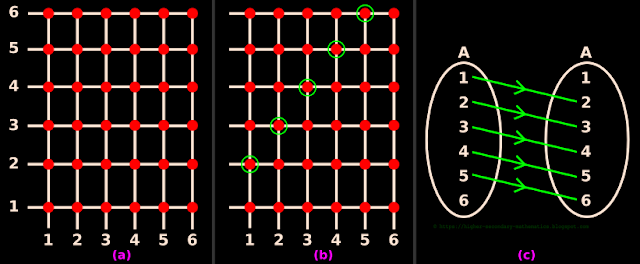
Diagramatic representation of Relation in mathematics using arrow diagram.
Fig.2.6
4. The red dots give us the various possible combinations.
Suppose that, we want only those combinations in which:
   ♦ The element taken from B
   ♦ is 1 greater than
   ♦ The element taken from A.
• Then we need to pick the appropriate red dots from among the total 36 red dots.
• The appropriate red dots can be determined using 2 steps:
(i) Let x be the element (which satisfies the relation) from A. Let y be the corresponding element (which satisfies the relation) from B
• Then the algebraic form of the relation is: x + 1 = y
(ii) Let us take each possible value for x from set A:
• When x = 1,
   ♦ y = (x+1) = (1+1) = 2
   ♦ '2' is available in A
   ♦ So the ordered pair (1, 2) satisfies the given relation.
         ✰ Note that (1, 2) is one among the red dots in fig.a
• When x = 2,
   ♦ y = (x+1) = (2+1) = 3
   ♦ '3' is available in A
   ♦ So the ordered pair (2, 3) satisfies the given relation.
         ✰ Note that (2, 3) is one among the red dots in fig.a
• When x = 3,
   ♦ y = (x+1) = (3+1) = 4
   ♦ '4' is available in A
   ♦ So the ordered pair (3, 4) satisfies the given relation.
         ✰ Note that (3, 4) is one among the red dots in fig.a
• When x = 4,
   ♦ y = (x+1) = (4+1) = 5
   ♦ '5' is available in A
   ♦ So the ordered pair (4, 5) satisfies the given relation.
         ✰ Note that (4, 5) is one among the red dots in fig.a
• When x = 5,
   ♦ y = (x+1) = (5+1) = 6
   ♦ '6' is available in A
   ♦ So the ordered pair (5, 6) satisfies the given relation.
         ✰ Note that (5, 6) is one among the red dots in fig.a
• When x = 6,
   ♦ y = (x+1) = (6+1) = 7
   ♦ '7' is not available in A
   ♦ So the ordered pair (6, 7) does not satisfy the given relation.
         ✰ Note that (6, 7) is not among the red dots in fig.a
5. We need to select the above five ordered pairs from among the 36 ordered pairs. This is shown in fig.2.6(b) above. The selected dots are marked with green circles.
• The ordered pairs with green circle are:
(1, 2), (2, 3), (3, 4), (4, 5) and (5, 6)
6. This information can be shown in an arrow diagram also. It is shown in fig.2.6(c) above.
• Note that:
   ♦ The number of green circles in fig.c is 5
   ♦ The number of green arrows in fig.c is also 5
• This is because, both the figs. b and c convey the same information.

• Let us write this example in terms of sets and ordered pairs. The 8 steps given below will help us:
1. A = {1, 2, 3, 4, 5, 6}
2. All the ‘possible combinations’ from A to A is given by the red dots in fig.2.6(a)
• As we saw in the previous section, all those red dots will be included in the set A × A
3. The green circles in fig.2.6(b) shows those ordered pairs which satisfy a particular relation.
• The relation is this:
   ♦ The element taken from A
   ♦ is 1 greater than
   ♦ The element taken from A.
• We can make a set R which contains all the green circles in fig.2.6(b)
4. All the green circles are obtained from the red dots. So the set R will be a subset of A × A
• We can write: R ⊂ (A × A)
5. In the previous section, we saw that all elements of A × A are ordered pairs.
• Since R is a subset of A × A, all the elements of R will also be ordered pairs.
• In our present case,
R = {(1, 2), (2, 3), (3, 4), (4, 5), (5, 6)}
6. The green circles in fig.b can be better visualized using the arrow diagram in fig.c
   ♦ The green circles in fig.b give us the ordered pairs in R.
   ♦ The green arrows in fig.c give us the same ordered pairs in R.
7. The usefulness of the arrow diagram will be clear from the following 3 steps:
(i) Take any ordered pair in R. Look at the corresponding green arrow in the arrow diagram.
(ii) The tail end of the arrow will be the first element of that ordered pair.
(iii) The head end of the arrow will be the second element of that ordered pair.
• We can work in the reverse also. It can be written in 4 steps:
(i) Take any green arrow in the arrow diagram. Corresponding to that arrow, there will be an ordered pair in R.
(ii) The tail end of the arrow will be the first element of that ordered pair.
(iii) The head end of the arrow will be the second element of that ordered pair.
(iv) All the green arrows must be included as ordered pairs in the set R.
8. In step (5), we wrote R in the roster form. We must be able to write it in the set builder form also. The following steps will enable us to do so:
(i) We know that, set R contains ordered pairs. Let the general form of those ordered pairs be (x,y)
(ii) Then x will be the element from A and y will be the element from A.
(iii) So the set builder form will be:
R = {(x,y) : y = x + 1, x ∈ A, y ∈ A}


• The above three examples help us to understand the basics about relations.
• We will now see some important terms involved with relations. The important terms are:
(a) image
(b) domain
(c) range
(d) Codomain

(a) image:
This can be explained in 3 steps:
1. We know that, the set R will contain one or more ordered pairs.
2. Each of those ordered pairs will have two elements.
3. The second element is called the image of the first element.
◼ Consider the ordered pairs in R of our first example. We can write:
    ♦ Maths is the image of student 1
    ♦ Maths is the image of student 2
    ♦ Chemistry is the image of student 2
    ♦ Chemistry is the image of student 3
    ♦ Biology is the image of student 3
    ♦ Geography is the image of student 4
◼ Consider the ordered pairs in R of our second example. We can write:
    ♦ 3 is the image of 5
    ♦ 4 is the image of 6
    ♦ 5 is the image of 7
◼ Consider the ordered pairs in R of our third example. We can write:
    ♦ 2 is the image of 1
    ♦ 3 is the image of 2
    ♦ 4 is the image of 3
    ♦ 5 is the image of 4
    ♦ 6 is the image of 5


(b) domain:
This can be explained in 5 steps:
1. We know that, the set R will contain one or more ordered pairs.
2. Each of those ordered pairs will have two elements.
3. Pick out all the first elements.
4. Make a set using those first elements.
5. This set is called the domain of the relation R.
◼ Consider the ordered pairs in R of our first example. We can write:
    ♦ The first elements are: 1, 2, 2, 3, 3, 4
    ♦ When we write them as a set, repeating elements should appear only once.
    ♦ So we get: domain = {1, 2, 3, 4}
◼ Consider the ordered pairs in R of our second example. We can write:
    ♦ The first elements are: 5, 6, 7
    ♦ Here there are no repeating elements.
    ♦ So we get: domain = {5, 6, 7}
◼ Consider the ordered pairs in R of our third example. We can write:
    ♦ The first elements are: 1, 2, 3, 4, 5
    ♦ Here there are no repeating elements.
    ♦ So we get: domain = {1, 2, 3, 4, 5}


(c) range:
This can be explained in 5 steps:
1. We know that, the set R will contain one or more ordered pairs.
2. Each of those ordered pairs will have two elements.
3. Pick out all the second elements.
4. Make a set using those second elements.
5. This set is called the range of the relation R.
◼ Consider the ordered pairs in R of our first example. We can write:
    ♦ The second elements are: maths, maths, chemistry, chemistry, biology, geography.
    ♦ When we write them as a set, repeating elements should appear only once.
    ♦ So we get: range = {maths, chemistry, biology, geography}
◼ Consider the ordered pairs in R of our second example. We can write:
    ♦ The second elements are: 3, 4, 5
    ♦ Here there are no repeating elements.
    ♦ So we get: range = {3, 4, 5}
◼ Consider the ordered pairs in R of our third example. We can write:
    ♦ The second elements are: 2, 3, 4, 5, 6
    ♦ Here there are no repeating elements.
    ♦ So we get: domain = {2, 3, 4, 5, 6}


(d) codomain:
We know that, the relation R is defined from set A to set B.
• The set B is also known as codomain of the relation R.
◼ Consider the relation R of our first example.
   ♦ The set B for this relation is: {Maths, Physics, Chemistry, Biology, Geography}
   ♦ So codomain of this R is : {Maths, Physics, Chemistry, Biology, Geography}
◼ Consider the relation R of our second example.
   ♦ The set B for this relation is: {3, 4, 5}
   ♦ So codomain of this R is : {3, 4, 5}
◼ Consider the relation R of our third example.
   ♦ The set B for this relation is: {1, 2, 3, 4, 5, 6}
   ♦ So codomain of this R is : {1, 2, 3, 4, 5, 6}


From the above four definitions, following 4 points can be noted:
(i) domain will contain only those elements belonging to Set A.
    ♦ all elements of A may not be present in domain.
(ii) codomain will contain only those elements belonging to Set B.
    ♦ all elements of B will be present in codomain.
(iii) range will contain only those elements belonging to Set B.
    ♦ all elements of B may not be present in range.
(iv) From (ii) and (iii), it is clear that:
range ⊂ codomain.


• Once we understand the basics, there will not be any need to write all the lengthy steps. We will be able to obtain the results using minimum steps.
• The solved examples given below will demonstrate the process

Solved example 2.15
Let A = {1, 2, 3,...,14}. Define a relation R from A to A by
R = {(x, y) : 3x – y = 0, where x, y ∈ A}. Write down its domain, codomain and
range.
Solution:
1. The relation R is a set which contains ordered pairs of the form (x, y)
   ♦ 'x' should be from set A
   ♦ Since the relation is from A to A, 'y' should also be from set A
• The x and y in each ordered pair in R should satisfy the condition: 3x - y = 0
2. The given condition can be rearranged as: 3x = y
Let us take each possible value for x from set A:
• When x = 1,
   ♦ y = 3x = (3 × 1) = 3
   ♦ '3' is available in A
   ♦ So the first ordered pair in R is (1, 3)
• When x = 2,
   ♦ y = 3x = (3 × 2) = 6
   ♦ '6' is available in A
   ♦ So the second ordered pair in R is (2, 6)
• When x = 3,
   ♦ y = 3x = (3 × 3) = 9
   ♦ '9' is available in A
   ♦ So the third ordered pair in R is (3, 9)
• When x = 4,
   ♦ y = 3x = (3 × 4) = 12
   ♦ '12' is available in A
   ♦ So the fourth ordered pair in R is (4, 12)
• When x = 5,
   ♦ y = 3x = (3 × 5) = 15
   ♦ '15' is not available in A
   ♦ So the ordered pair (5, 15) does not satisfy the given relation.
         ✰ Note that (5, 15) will not be available in A × A also.
3. The set R will contain the four ordered pairs that we determined above. We can write:
R = {(1,3), (2,6), (3,9), (4,12)}
4. Domain is the set containing all the first elements in the ordered pairs of R. So we get:
Domain of R = {1, 2, 3, 4}
5. Codomain is the set from which we take the second elements of the ordered pairs in R. In effect, co domain is the set B.
• In our present case, since the relation is from A to A, we have A in place of B.
• So we get: codomain of R = {1, 2, 3,...,14}
6. Range is the set containing all the second elements in the ordered pairs of R.
• So we get: Range of R = {3, 6, 9, 12}


• We know that, a relation is defined from one set A to another set B
• But some times, the relation is defined from one set A to the same set A
• In such situations, we can use any one of the two statements below:
   ♦ Relation R from A to A
   ♦ Relation R on A


More solved examples are given at the link below:

Solved examples 2.16 to 2.25


In the next section, we will see functions.

Previous

Contents

Next

Copyright©2021 Higher secondary mathematics.blogspot.com

Chapter 2.2 - Functions

In the previous section, we saw relations. In this section, we will see functions.

Some basics about functions can be written in 3 steps:
1. We have seen the method to define a relation from set A to set B. All we need to do is this:
    ♦ Find the ordered pairs which satisfy the relation.
    ♦ Write those ordered pairs as a set.
2. Now, to define a function, we need to check two conditions:
(i) We know that the first elements in R, will be from set A.
• We need to make sure that, every element of A is present as first elements in the R. No element of A should be left out.
(ii) Next we need to make sure that no element in A is present more than once in R.
3. If both the conditions in (2) are satisfied, that relation is a function.


Let us examine some of the relations that we saw in the previous section.
◼ In Example 1, we have:
R = {(1, Maths), (2, Maths), (2, Chemistry), (3, Chemistry), (3, Biology), and (4, Geography)}
• All the four students are present in R. So it may be a function.
• But student 2 appears more than once. So it is not a function.
(We agree that student 3 also appears more than once. But a single instance is sufficient to confirm that the R is not a function)
◼ In Example 2, we have:
R = {(5, 3), (6, 4), (7, 5)}
• All the three elements in A are present in R. So it may be a function.
• Each of those elements appear only once. So it is a function.
◼ In Example 3, we have:
R = {(1, 2), (2, 3), (3, 4), (4, 5), (5, 6)}
• The element ‘6’ is present in set A. But it is not present in R. So it is not a function.
(If the first condition is not satisfied, we can confirm that it is not a function. There is no need to check the second condition)
◼ In solved example 2.15, we have:
R = {(1,3), (2,6), (3,9), (4,12)}
• The element ‘5’ is present in A. But it is not present in R. So it is not a function.
(We agree that, none of the elements coming after 4, are present in R. But a single instance is sufficient to confirm that the R is not a function.
◼ In solved example 2.16, (file available here) we have:
R = {(1,6), (2,7), (3,8)}
• This relation is on N. But all elements of N are not present in R. So it is not a function.
◼ In solved example 2.17, we have:
R = {(9,3), (9,-3), (4,2), (4,-2), (25,5), (25,-5)}
• All elements of P are present in R. So it may be a function.
• But ‘9’ appears more than once. So it is not a function.
(We agree that ‘4’ and ‘25’ also appear more than once. But a single instance is sufficient to confirm that the R is not a function)
◼ In solved example 2.21, we have:
R = {(1,1), (1,2), (1,3), (1,4), (1,6), (2,2), (2,4), (2,6), (3,3), (3,6), (4,4),
(6,6)}
• All elements of A are present in R. So it may be a function.
• But ‘1’ appears more than once. So it is not a function.
(We agree that ‘2’ and ‘3’ also appear more than once. But a single instance is sufficient to confirm that the R is not a function)
◼ In solved example 2.22, we have:
R = {(0,5), (1,6), (2,7), (3,8), (4,9), (5,10)}
• All the elements in the given set are present in R. So it may be a function.
• Each of those elements appear only once. So it is a function.
◼ In solved example 2.25, we have:
R is a relation from Z to Z
• We found out that, domain of R is the set Z
    ♦ That means, all the elements in Z are present as first elements in R
• Since all elements of Z are present, it may be a function.
• But there will be many repetitions of the first element.
    ♦ For example, we can put 1 in the place of ‘a’
    ♦ and put infinite different integers for b.
    ♦ Every result will be an integer.
• Since the first elements in R appear more than once, it is not a function.


Let us see a solved example:
Solved example 2.26
Let N be the set of natural numbers and the relation R be defined on N such that R = {(x, y) : y = 2x, x, y ∈ N}.
What is the domain, codomain and range of R? Is this relation a function?
Solution:
1. In our present case, the relation R is a set which contains ordered pairs of
the form (x, y)
♦ 'x' should be from set N
♦ Since the relation is on N, 'y' should also be from set N
• The x and y in each ordered pair in R should satisfy the condition:
y = 2x
2. Recall that natural numbers are 1, 2, 3, 4, . . . (Details here)
• Let us take each possible value for ‘x’ from set N:
• Let x = 1
    ♦ Then y = 2x = (2 × 1) = 2
    ♦ So the first ordered pair in R is (1, 2)
• Let x = 2
    ♦ Then y = 2x = (2 × 2) = 4
    ♦ So the second ordered pair in R is (2, 4)
• Let x = 3
    ♦ Then y = 2x = (2 × 3) = 6
    ♦ So the third ordered pair in R is (3, 6)
3. In this way, we can obtain infinite number of ordered pairs in R.
• We will be using all the natural numbers as 'x'. That means, all elements of N will appear in R. So this may be a function
• What happens if we use a natural number (in the place of x) more than once?
Ans: we will be getting the same ordered pair more than once.
• There cannot be repetition of ordered pairs in R. So we will be using every natural number (in the place of x) only once. So this is a function.

Solved example 2.27
Examine each of the following relations given below and state in each case, giving reasons whether it is a function or not?
(i) R = {(2,1),(3,1),(4,2)}
(ii) R = {(2,2),(2,4),(3,3),(4,4)}
(iii) R = {(1,2),(2,3),(3,4),(4,5),(5,6),(6,7)}
Solution:
• Usually, a relation is defined from a set A to set B. Or from a set A to itself.
• But here, we are not given A or B. So we will assume that, all the elements of A are present as first elements in R.
• If all elements are not present, we will be able to straight away say that, they are not functions.
• Thus in all the three questions, we need to check the second condition only.
Part (i):
All the first elements appear only once. So it is a function.
Part (ii):
The first element '2' appear more than once. So it is not a function.
Part (iii):
All the first elements appear only once. So it is a function.


◼ From the above discussion, it is clear that:
   ♦ All functions are relations.
   ♦ But all relations are not functions.


• We have seen how to confirm whether a relation is a function or not. Now we will see some technical terms related to functions. Use of technical terms will help us to describe the functions using minimum words. They can be written in 14 steps:
1. If a relation is a function, we use the letter ‘f’ instead of ‘R’.
2. We know that, a relation is defined from one set A to another set B.
• If that relation is a function, we write: f: A→B
3. Some times a relation is defined from one set A to itself.
• If that relation is a function, we write: f: A→A
4. We saw that all functions are relations.
• So the terms domain, codomain, range and image that we saw for relations are applicable to functions also.
• For example,
   ♦ We write domain of a relation.
   ♦ We can write domain of a function also.
5. We saw that, if it is to be a function, every element of A should be present as first elements.
   ♦ The set containing the first elements is the domain.
• So if it is a function, the domain will contain all the elements of A
• Thus it is clear that, if it is a function, the domain will be same as set A.
6. We know that, like R, the f is also a set of ordered pairs.
• If we denote those ordered pairs as (x,y), then:
   ♦ y is called the image of x under f.
   ♦ x is called the image of y under f.
7. Consider a relation that we saw in the previous section:
y = x + 1
• We input various values of x and calculated the corresponding 'y values'. Then we wrote them as ordered pairs in the form (x,y).
8. Note that, the 'y values' are obtained by inputting various 'x values'.
• The input x values are 'processed' according to the rule given by the relation y = x + 1
   ♦ Here, the rule says that, we must add '1' to the input value of x
9. If the relation is a function, we can write:
The 'x values' are 'processed' according to the rule given by the function.
10. Or we can simply write:
The 'x values' are 'processed' according to the function.
11. So we can write:
   ♦ 'y values' are obtained
   ♦ when the 'x values' are processed
   ♦ according to the function.
• This can be schematically represented as in fig.2.9 below:

f(x) is used to denote a function. An x value is processed according to the rule given by the function.
Fig.2.9

12. We have done this type of 'processing' in our earlier classes. There we denoted the output as 'y'.
• For example, in y = x +1, if we add various values of x to '1', we will get various y values.
    ♦ Here, [addition of '1' to x] is the processing.
    ♦ So it is obvious that y is same as f(x).
    ♦ Then we can write: f(x) = x + 1
13. A function is a relation. So just like R, for f also, there will be a set of ordered pairs.
   ♦ The first values in that ordered pairs will form the domain of that function.
   ♦ The second values in that ordered pairs will form the range of that function.
◼ If all the elements in the range set are real numbers, then that function is called a real valued function.
◼ If in a real valued function, all the elements in the domain set are real numbers, then that function is called a real function.
14. Let us see an example:
Let N be the set of natural numbers. Define a real valued function
f : N→N by f (x) = 2x + 1.
Solution:
(i) Given that, it is a real valued function. That means, all values obtained after processing, must be real values.
• The function can be defined by writing the ordered pairs which satisfy that function.
• So our next task is to find those ordered pairs.
(ii) It is given that, f : N→N
• This indicates that,
   ♦ the first elements of the ordered pairs (input x values) should be taken from the set N.
   ♦ the second elements (resulting y values) must be present in the set N
         ✰ N is a subset of R. So indeed, it will be a real valued function
(iii) The set N is the set of natural numbers. That is., N = {1, 2, 3, 4, . . .}
• Let x = 1
   ♦ This x is processed as follows:
   ♦ f(1) = (2 × 1 + 1) = (2 + 1) = 3
   ♦ f(1) is the 'y value' when 'x value' is 1
   ♦ So the first ordered pair (x,y) is (1,3)
• Let x = 2
   ♦ This x is processed as follows:
   ♦ f(2) = (2 × 2 + 1) = (4 + 1) = 5
   ♦ f(2) is the 'y value' when 'x value' is 2
   ♦ So the second ordered pair (x,y) is (2,5)
• Let x = 3
   ♦ This x is processed as follows:
   ♦ f(3) = (2 × 3 + 1) = (6 + 1) = 7
   ♦ f(3) is the 'y value' when 'x value' is 3
   ♦ So the third ordered pair (x,y) is (3,7)
(iv) Proceeding like this, we will get infinite number of ordered pairs. All those ordered pairs should be included in the set f.
• So we can write: f = {(1,3), (2,5), (3,7), (4,9), (5,11), (6,13), (7,15), . . .}
(v) We can make a table using the x and y values in the set f. Such a table is convenient to draw the graph of the function.

f(x) values can be shown in a table.
Table 2.1

Let us see some common functions and their graphs
A. Identity function
This is a real valued function f: R→R defined by y = f (x) = x
Details can be written in 10 steps:
1. Given that, it is a real valued function. That means, all values obtained after processing, must be real values.
• The function can be defined by writing the ordered pairs which satisfy that function.
• So our next task is to find those ordered pairs.
2. It is given that, f : R→R
• This indicates that,
   ♦ the first elements of the ordered pairs (input x values) should be taken from the set R.
   ♦ the second elements (resulting y values) should be present in the set R
3. The set R is the set of real numbers. It will include integers, negative values, positive values, fractions, decimals, recurring decimals, numbers like √2, √5, π etc.,. In short, R will contain every value which can be plotted on a number line. Recall that we plotted √2, √5, π etc., in our previous classes.
• Since different types of numbers are present in R, we will choose some convenient numbers at random.
• Let x = -7
   ♦ This x is processed as follows:
   ♦ f(-7) = x = -7
   ♦ f(-7) is the 'y value' when 'x value' is -7
   ♦ So we get an ordered pair (x,y) as: (-7,-7)
• Let x = -3
   ♦ This x is processed as follows:
   ♦ f(-3) = x = -3
   ♦ f(-3) is the 'y value' when 'x value' is -3
   ♦ So we get another ordered pair (x,y) as: (-3,-3)
• Let x = 1.414
   ♦ This x is processed as follows:
   ♦ f(1.414) = x = 1.414
   ♦ f(1.414) is the 'y value' when 'x value' is 1.414
   ♦ So we get another ordered pair (x,y) as: (1.414,1.414)
• We see that, whatever be the value of x, the value of y will also be the same.
4. Proceeding like this, we will get infinite number of ordered pairs. All those ordered pairs should be included in the set f.
• So we can write: f = {. . . , (-7,-7), (-3,-3), (1.414,1.414), (5,5), . . .}
5. The above set f is written in roster form. But we have to remember an important point. It can be written in 3 steps:
(i) Both elements of the ordered pairs are real numbers.
(ii) Since they are real numbers, there will be integers, negative values, positive values, fractions, decimals, recurring decimals, numbers like √2, √5, π etc.,. We cannot think of a definite sequence to write them.
(iii) So it is better to use set builder form to write f.
6. In the set builder form, we can write:
f = {(x,y) : x ∈ R, y = x}
• That means:
    ♦ The set f contains all ordered pairs such that,
    ♦ x is a real number,
    ♦ y is equal to x.
7. Once we write the set f, we can write the domain and range of f.
(i) First we will write the domain:
• Domain of f is the set containing all the first elements of the ordered pairs in f.
• In our present case, there are infinite number of ordered pairs. So there will be infinite number of first elements.
• We saw that all the first elements are real numbers. Since they are real numbers, there will be integers, negative values, positive values, fractions, decimals, recurring decimals, numbers like √2, √5, π etc.,. We cannot think of a definite sequence to write them. So it is better to use set builder form rather than the roster form.
• We can write:
    ♦ Domain of f = {x : x ∈ R}
• That means:
    ♦ The domain of f is the set of all x such that,
    ♦ x is a real number.
(ii) Next we will write the range:
• Range of f is the set containing all the second elements of the ordered pairs in f.
• In our present case, there are infinite number of ordered pairs. So there will be infinite number of second elements.
• We saw that all the first elements are real numbers. Since the second elements are equal to first elements, they are also real numbers.
• We can write:
    ♦ Range of f = {y : y ∈ R}
• That means:
    ♦ The range of f is the set of all y such that,
    ♦ y is a real number.
8. We can make a table using the x and y values in the set f. Such a table is convenient to draw the graph of the function.
• Note that, to input for x, we choose convenient numbers from the set R.
• It is better not to choose numbers with recurring decimals. They will be difficult to plot.

Table 2.2

9. The red line in fig.2.10(a) below, is the graph of this function.

Graph of Identity Function is a straight line inclined at 45 degrees to the x-axis. If both x and y axis are drawn to the same scale.
Fig.2.10

• We can write some peculiarities of this red line. They can be written in 5 steps:
(i) The red line always passes through the origin (0,0)
(ii) If x axis and y axis are drawn to the same scale (Details here), the red line will make 45o degrees with the x axis.
• In other words, if the two axes are drawn to the same scale, the red line will bisect the angle between the two axes.
(iii) Mark any point on the red line. Note the coordinates of that point.
   ♦ The x coordinate will be same as the y coordinate.
   ♦ This is shown in fig.b
(iv) Mark any point on the x axis. For example, let us mark 3.5.
• Draw a vertical line through that point.
    ♦ Here, it is the green vertical dotted line in fig.b.
• That vertical line will meet the red line at a point.
• Through that meeting point, draw a horizontal line.
    ♦ Here, it is the green horizontal dotted line.
• This horizontal line will meet the y axis at a point which have the same x value (here it is 3.5) from where we started off.
• We will get this result even if the two axes are drawn in different scales.
(v) We see arrows at both ends of the red line.
• The arrow at the top end of the red line indicates that, the line can extend up to the point where x = +∞ and y = +∞.
• The arrow at the bottom end of the red line indicates that, the line can extend up to the point where x = -∞ and y = -∞.
10. The identity function has many applications in science and engineering.


In the next section, we will see a few more common functions.

Previous

Contents

Next

Copyright©2021 Higher secondary mathematics.blogspot.com