Showing posts with label trigonometric equations. Show all posts

Sunday, January 30, 2022

Chapter 3.22 - Solved Examples Related to Sine Rule and Cosine Rule

In the previous section, we completed a discussion on cosine formula. In this section we will see Napiers' Analogies.

• The list of trigonometric identities can be seen here.

◼ In any triangle, the following three relations are applicable:
$\begin{eqnarray}
&\text{(i)}\;\tan \frac{B-C}{2}&=\frac{b-c}{b+c}\, \cot \frac{A}{2} \\
&\text{(ii)}\;\tan \frac{C-A}{2}&=\frac{c-a}{c+a}\, \cot \frac{B}{2} \\
&\text{(iii)}\;\tan \frac{A-B}{2}&=\frac{a-b}{a+b}\, \cot \frac{C}{2} \
\end{eqnarray}$

Proof for (i) can be written in 3 steps:
1. Consider the three ratios in the sin formula.
• Each of those three ratios will give the same value for a triangle under consideration.
• So we can say that, any triangle will have it's own unique constant value 'k' which will be equal to each of the ratio in the sine formula.
• We can write: $\frac{a}{\sin A}=\frac{b}{\sin B}=\frac{c}{\sin C}=k$
• From this we get: a = k sin A, b = k sin B, c = k sin C
2. Consider the first analogy. $\frac{b-c}{b+c}$ can be modified as:
$\begin{eqnarray}
&\frac{b-c}{b+c}& =\frac{k \sin B-k \sin C}{k \sin B+k \sin C} \\
&{}& =\frac{k (\sin B- \sin C)}{k(\sin B+ \sin C)}\;=\frac{\sin B- \sin C}{\sin B+ \sin C} \\
&{}& =\frac{2\cos \frac{B+C}{2} \sin \frac{B-C}{2}}{2\sin \frac{B+C}{2} \cos \frac{B-C}{2}} \\
&{}& \text{(Using identity 20.d)} \\
&{}& =\cot \frac{B+C}{2} \tan \frac{B-C}{2} \\
&{}& =\cot \left(\frac{\pi}{2}-\frac{A}{2} \right) \tan \left(\frac{B-C}{2} \right) \\
&{}& \left[ \because \frac{\pi}{2}=\frac{A}{2}+\frac{B}{2}+\frac{C}{2}\right] \\
&{}& =\tan \left(\frac{A}{2} \right) \tan \left(\frac{B-C}{2} \right) \\
&{}& \left[ \because \text{using identities 5 and 6, }\cot \left(\frac{\pi}{2}-\frac{A}{2} \right)=\tan \left(\frac{A}{2} \right)\right] \\
&{}& =\frac{\tan \frac{B-C}{2} }{\cot \frac{A}{2}} \
\end{eqnarray}$
3. Thus we get: $\tan \frac{B-C}{2}=\frac{b-c}{b+c}\, \cot \frac{A}{2}$
• In the same way, we can prove (ii) and (iii) also.


Let us see the application of the above analogies. It can be written in steps:
1. Suppose that, we are given two sides b and c, and the included angle A
• Then we can easily calculate the RHS of (i)
2. That means, we can easily obtain $\tan \frac{B-C}{2}$
• From that, we can obtain $\frac{B-C}{2}$
• From that, we can obtain (B-C)
3. We are already given A.
• Using that A, we can find (B+C)
   ♦ Because, (B+C) = 180 - A
4. Thus we have two equations:
   ♦ One involving B+C
   ♦ The other involving B-C
• Using those equations, we can calculate B and C


Let us see some solved examples:

Solved example 3.97
In any triangle ABC, prove that
$a \sin(B-C)+b \sin(C-A)+c \sin(A-B)=0$
Solution:
1. We have: $\frac{a}{\sin A}=\frac{b}{\sin B}=\frac{c}{\sin C}=k$
• From this we get: a = k sin A, b = k sin B, c = k sin C
2. So we can modify the LHS of the given equation as:
k sin A sin(B-C) + k sin B sin(C-A) + k sin C sin(A-B)
3. Now we apply identity 8 to each of the three terms. We get:
k sin A [sin B cos C - cos B sin C] + k sin B [sin C cos A - cos c sin A] + k sin C [sin A cos B - cos A sin B]
4. Expanding this, we get:
k sin A sin B cos C - k sin A cos B sin C + k sin B sin C cos A - k sin B cos C sin A + k sin C sin A cos B - k sin C cos A sin B
• This is same as:
k [sin A sin B cos C - sin A cos B sin C + sin B sin C cos A - sin B cos C sin A + sin C sin A cos B - sin C cos A sin B]
5. There are identical terms in the above expansion. The first set is underlined below:
k [sin A sin B cos C - sin A cos B sin C + sin B sin C cos A - sin B cos C sin A + sin C sin A cos B - sin C cos A sin B]
• Being opposite in signs, they will cancel each other.
• The second set is under lined below:
k [- sin A cos B sin C + sin B sin C cos A + sin C sin A cos B - sin C cos A sin B]
• Being opposite in signs, they will cancel each other.
• The remaining set is:
k [+ sin B sin C cos A - sin C cos A sin B]
• Clearly, they will also cancel each other
6. In effect, the LHS becomes: k[0] = 0
• Thus we get LHS = RHS

Solved example 3.98
The angle of elevation of the top point P of the vertical tower PQ of height h from a point A is 45o and from a point B, the angle of elevation is 60o, where B is a point at a distance of d from the point A measured along the line AB which makes an angle 30o with AQ. Prove that d = h(√3-1)
Solution:
1. First, the instrument (used for measuring angles) is placed at A.
• When measured from A, the angle is 45o. This is shown in fig.3.45(i) below:
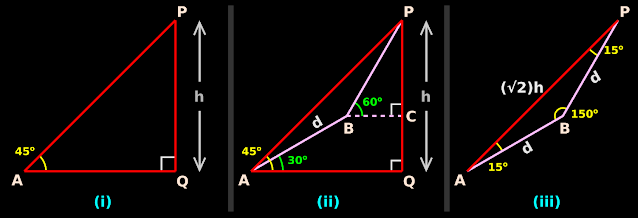
Fig.3.45

2. Then the instrument is taken to a point B.
• The distance of B from A is d. Also, AB makes an angle of 30o with PQ.
• When measured from B, the angle is 60o.
• These details must be added to the first fig. The modified fig. is fig.3.45(ii) above. 
3. Let us calculate some important angles and sides:
(i) In  ◺APQ, we have: ∠APQ = (180 - 90 - 45) = 45o
So it is an isosceles right triangle. We get: AQ = PQ = h
(ii) Since APQ is a right triangle, we get: $AP=\sqrt{AQ^2+PQ^2}=\sqrt{h^2+h^2}=\sqrt{2h^2}=\sqrt{2}\,h$
(iii) Inside  ◺APQ, we have: ∠PAB = (45 - 30) = 15o
(iv) In ◺ PBC, we have: ∠BPC = (180 - 90 - 60) = 30o
(v) Inside ◺APQ,  ∠APB = (45 - 30) = 15o
(vi) From (ii) and (iv), it is clear that    ⃤⃤  APB is an isosceles triangle.
We have: AB = PB = d
(vii) Also in    ⃤⃤  APB, we get: ABP = (180 - 15 -15) = 150o
4. So from 3(ii), (iii), (v), (vi) and (vii), we have all the angles and sides of    ⃤⃤  APB.
This is shown in fig.3.45(iii).
• Now we can apply sine rule. We get:
$\frac{AP}{\sin B}=\frac{BP}{\sin A} \Rightarrow \frac{\sqrt{2}\,h}{\sin 150}=\frac{d}{\sin 15} \Rightarrow d=\frac{\sqrt{2}\,h \times \sin 15}{\sin 150}$
5. We need sin 15 and sin 150:
• We know that: sin 150 = sin (180 - 150) = sin 30 = $\frac{1}{2}$
• We have calculated sin 15 in an earlier section. (Solved example 3.30 in section 3.13)
   ♦ We got: $\sin 15 = \frac{\sqrt{3} - 1}{2 \sqrt 2}$
6. So the result in (4) becomes:
$\begin{eqnarray}
&{}& d=\frac{\sqrt{2}\,h \times \sin 15}{\sin 150} \\
&\Rightarrow& d=\frac{\sqrt{2}\,h \times \frac{\sqrt{3} - 1}{2 \sqrt 2}}{\frac{1}{2}} \\
&\Rightarrow& d=\frac{h \times \frac{\sqrt{3} - 1}{2}}{\frac{1}{2}} \\
&\Rightarrow& d=h(\sqrt{3} - 1) \
\end{eqnarray}$

Solved example 3.99
A lamp post is situated at the middle point M of the side AC of a triangular plot ABC with BC = 7 m, CA = 8 m and AB = 9 m. Lamp post subtends an angle 15o at the point B. Determine the height of the lamp post.
Solution:
1. In fig.3.46(i), the triangular plot ABC is lying on the ground. The plot is shown in red color.
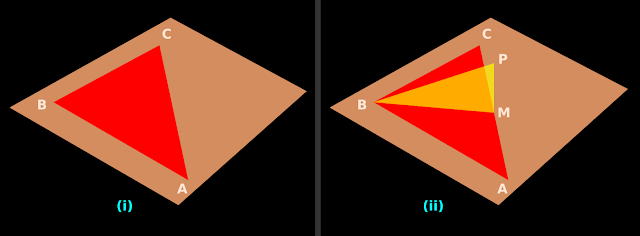
Fig.3.46
2. Mark M, the midpoint of AC. Erect a perpendicular PM at M.
• PM is the post. This is shown in fig.(ii). Given that: ∠PBM = 15o
• We are asked to find the height PM.
3. First we need to find ∠BAM
• This can be easily calculated by solving    ⃤⃤ ABC. Since only the sides of     ⃤⃤ ABC are given, we need to apply cosine rule. We get:
BC2` = AB2` + AC2` - 2 AB.AC cos (∠BAC)
• Substituting the known values, we get:
72` = 92` + 82` - 2 × 9 × 8 × cos (∠BAC)
• Thus we get: cos (∠BAC) = cos A = 0.6667
    ♦ Then A = 48.19o
• Consider the identity: cos x = cos (360-x)
    ♦ We get: cos 48.19 = cos (360-48.19) = cos 311.81 = 0.6667
    ♦ That means, A can be 48.19 or 311.81
    ♦ 311.81 is not acceptable because, it is greater than 180
• Thus we get: A = 48.19o
4. Now consider    ⃤⃤ BAM.
• In this triangle, we have the measurements of two sides AB and AM, and the included angle A.
• So we can apply the cosine rule and find BM.
• We get: BM2` = AB2` + AM2` - 2 AB × AM × cos A
• Substituting the known values, we get:
BM2` = 92` + 42` - 2 × 9 × 8 × cos 48.19
• Thus we get: BM = 7 m
5. Finally, consider    ⃤⃤ PBM
• We have: tan (∠PBM) = $\frac{PM}{BM}=\frac{PM}{BM}$
• Given that: ∠PBM = 15o
• Thus we get: tan 15 = $\frac{PM}{7}$
6. We have calculated tan 15 earlier as: $\frac{\sqrt{3}-1}{\sqrt{3}+1}$
• We can write: $\frac{\sqrt{3}-1}{\sqrt{3}+1}=\frac{PM}{7}$
• Thus we get: PM = $\frac{7(\sqrt{3}-1)}{\sqrt{3}+1}$
⇒ PM = $\frac{7(\sqrt{3}-1)}{\sqrt{3}+1}\times \frac{\sqrt{3}-1}{\sqrt{3}-1}$
⇒ PM = $\frac{7(\sqrt{3}-1)^2}{2}$
⇒ PM = $\frac{7(3+1-2 \sqrt{3})}{2}=\frac{7(4-2 \sqrt{3})}{2}$
⇒ PM = $\frac{7\times 2(2- \sqrt{3})}{2}=7(2- \sqrt{3})$ m

Link to some more solved examples is given below:

Solved example 3.100 to 3.114


We have completed the discussion in this chapter. In the next chapter, we will see mathematical induction.

Previous

Contents

Next

Copyright©2021 Higher secondary mathematics.blogspot.com

Wednesday, January 19, 2022

Chapter 3.18 - More Solved Examples on Trigonometric Equations

In the previous section, we saw some solved examples on trigonometric equations. In this section, we will see a few more solved examples.

The list of trigonometric identities can be seen here.

Solved example 3.69
Find the principal solutions and general solution of the equation: sin 2x - sin 4x + sin 6x = 0
Solution:
1. Given that: sin 2x - sin 4x + sin 6x = 0
• Note that, (2+6)/2 = 4. So we will add sin 2x and sin 6x
2. Using identity 20.c, we get:
$\begin{eqnarray}
&{}& \sin 2x + \sin 6x - \sin 4x = 0 \nonumber \\
&\Rightarrow& 2 \sin \left(\frac{2x+6x}{2} \right) \cos \left(\frac{2x-6x}{2} \right) -\sin 4x = 0 \nonumber \\
&\Rightarrow& 2 \sin 4x \cos (-2x) -\sin 4x = 0 \nonumber \\
&\Rightarrow& \sin 4x [2 \cos (-2x) -1] = 0 \nonumber \\
&\Rightarrow& \sin 4x(2 \cos 2x -1) = 0 \nonumber \
\end{eqnarray}$
• We can write:
sin 4x = 0 or (2cos 2x - 1) = 0
3. We will solve this in two parts A and B.
    ♦ In Part A, we will solve sin 4x = 0
    ♦ In Part B, we will solve (2cos 2x - 1) = 0
Part A: sin 4x = 0
• First we will find the principal solutions.
1. Given that: sin 4x = 0
2. We know that 0 is a principal solution.
• That means, we can put '0' in place of x.
3. We will now find another principal solution. It can be done in 4 steps:
(i) We have seen that, x = 0 is a principal solution.
• When the input x is 0, the left side becomes sin 0
• This gives us: sin 4x = sin 0 = 0
(ii) We want another angle such that, it's sine is also 0
• Such an angle can be calculated using identity 9.d: sin (π-x) = sin x
• We get:
$\sin 0 = \sin (\pi - 0) = \sin \pi$
(iii) Using the results in (i) and (ii), we get:
$\sin 4x = \sin 0 = 0=\sin \pi$
(iv) Picking the first and last items in (iii), we get:
$\sin 4x=\sin \pi$
⇒ $4x=\pi$
⇒ $x=\frac{\pi}{4}$
• Thus we get another value for x
• $0 \leq \frac{\pi}{4} < 2\pi$. So $\frac{\pi}{4}$ (45o) is a principal solution.

• Now we will write the general solution:
1. Given that: sin 4x = 0
• We have to convert this equation into the form: sin x = sin y
• Just now, we saw that: sin 4x = sin 0
2. This is of the form sin x = sin y
   ♦ In the place of 'x', we have 4x
   ♦ In the place of 'y', we have 0
• Now we can apply theorem 1:
sin x = sin y implies x = n𝞹 + (-1)ny, where n ∈ Z
• We get: $4x=n\pi + (-1)^n \times 0$, where n ∈ Z
⇒ $x=\frac{n\pi}{4}$, where n ∈ Z
3. By putting different values for n, we can obtain different values of x. All 'values of x' thus obtained will satisfy the equation sin 4x = 10
• Table 3.10 below shows some of the solutions:

Table 3.10

• The principal solutions are shown in red color.
• Let us see a sample calculation for the above table:
    ♦ When n = -3,
    ♦ x = $\frac{-3 \times 180}{4}=-135$

Part B: (2cos 2x - 1) = 0
1. This can be rearranged as: 2cos 2x = 1
⇒ cos 2x = $\frac{1}{2}$
2. We know that $\frac{\pi}{6}$ is a principal solution.
• That means, we can put '$\frac{\pi}{6}$' in place of x.
3. We will now find another principal solution. It can be done in 4 steps:
(i) We have seen that, $x=\frac{\pi}{6}$ is a principal solution.
• When the input x is $\frac{\pi}{6}$, the left side becomes $\cos \frac{\pi}{3}$
• This gives us: cos 2x = $\cos \frac{\pi}{3}=\frac{1}{2}$
(ii) We want another angle such that, it's cosine is also $\frac{1}{2}$
• Such an angle can be calculated using identity 9.g: cos (2π-x) = cos x
• We get:
$\cos \frac{\pi}{3} = \cos \left(2\pi - \frac{\pi}{3}\right) = \cos \frac{5\pi}{3}$
(iii) Using the results in (i) and (ii), we get:
$\cos 2x = \cos \frac{\pi}{3} = \frac{1}{2} = \cos \left(2\pi - \frac{\pi}{3}\right) = \cos \frac{5\pi}{3}$
(iv) Picking the first and last items in (iii), we get:
$\cos 2x=\cos \frac{5\pi}{3}$
⇒ $2x=\frac{5\pi}{3}$
⇒ $x=\frac{5\pi}{6}$
• Thus we get another value for x
• $0 \leq \frac{5\pi}{6} < 2\pi$. So $\frac{5\pi}{6}$ (150o) is a principal solution.

• Now we will write the general solution:
1. Given that: cos 2x = $\frac{1}{2}$
• We have to convert this equation into the form: cos x = cos y
• Just now, we saw that: cos 2x = cos $\frac{\pi}{3}$
2. This is of the form cos x = cos y
   ♦ In the place of 'x', we have 2x
   ♦ In the place of 'y', we have $\frac{\pi}{3}$
• Now we can apply theorem 2:
cos x = cos y implies x = 2n𝞹 ± y, where n ∈ Z
• We get: $2x=2n\pi ± \frac{\pi}{3}$, where n ∈ Z
⇒ $x=n\pi ± \frac{\pi}{6}$, where n ∈ Z
3. By putting different values for n, we can obtain different values of x. All 'values of x' thus obtained will satisfy the equation cos 2x = $\frac{1}{2}$
• Tables 3.11 below shows some of the solutions:

Table 3.11

• The principal solutions are shown in red color.
• Let us see a sample calculation for the -ve table above:
    ♦ When n = -3,
    ♦ x = (-3 × 180) - 30
    ♦    = -540 - 30
    ♦    = -570
4. We have in total, three tables in this problem. We can choose any one x value from those tables. If we input that x, in the LHS of the given equation sin 2x - sin 4x + sin 6x = 0. It will reduce to zero.
An example:
• Let us input x = -135. We get:
• LHS = sin (2 × -135) - sin (4 × -135) + sin (6 × -135)
        = sin (-270) - sin (-540) + sin (-810)
        = -sin 270 - -sin 540 + -sin 810
        = - -1 + 0 - 1
        = +1 + 0 - 1
        = 0 = RHS

Solved example 3.70
Find the principal solutions and general solution of the equation: 2cos2 x+ 3 sin x = 0
Solution:
1. The given equation can be rearranged as follows:
2(1 - sin2x) + 3 sin x = 0
⇒ 2 - 2sin2x + 3 sin x = 0
⇒ 2sin2x - 3 sin x - 2 = 0
2. Let us put a variable 'u' in place of sin x.
• We will get: 2u2 - 3u - 2 = 0
• This is a quadratic equation in u. Solving it, we get:
u = $-\frac{1}{2}$ or u = 2
3. So we can write: sin x = $-\frac{1}{2}$ or sin x = 2
• But sin x cannot be '2' because, the maximum possible value of sin x is '1'
• So we need to consider only sin x = $-\frac{1}{2}$
4. We know that $\sin \frac{\pi}{6}=\frac{1}{2}$
• We have identity 9.f: sin (𝞹+x) = -sin x
• Using this identity, we can write: $\sin \left(\pi + \frac{\pi}{6} \right)=-\sin \frac{\pi}{6}$
⇒ $\sin \frac{7\pi}{6} =-\sin \frac{\pi}{6}$
• But $\sin \frac{\pi}{6}\;\text{is}\;\frac{1}{2}$
• So we get: $\sin \frac{7\pi}{6} =-\frac{1}{2}$
⇒ $\sin \frac{7\pi}{6} =-\frac{1}{2}=\sin x$
⇒ $x= \frac{7\pi}{6}$
• $0 \leq \frac{7\pi}{6} < 2\pi$. So $\frac{7\pi}{6}$ (210o) is a principal solution.
5. We will now find the other principal solution. It can be done in 6 steps:
(i) We have seen that, x=$\frac{7\pi}{6}$ is a principal solution.
• When the input x is $\frac{7\pi}{6}$, the left side becomes sin $\frac{7\pi}{6}$
• This gives us: sin x = sin $\frac{7\pi}{6} = -\frac{1}{2}$
(ii) We want another angle such that, it's sine is also $-\frac{1}{2}$
• Such an angle can be calculated using identities:
    ♦ 9.d: sin (π-x) = sin x
    ♦ 9.h: sin (2π - x) = - sin x
(iii) Using 9.d, we get: $\sin \frac{7\pi}{6}=\sin \left(\pi - \frac{7\pi}{6} \right) = \sin \frac{-1\pi}{6}$
(iv) From (iii), we get: $\sin \frac{7\pi}{6} = \sin \frac{-1\pi}{6}$
• But $\frac{-1\pi}{6}$ is a -ve angle. We want an angle which lies between 0 and 2π.
• So we apply identity 9.h. We get:
$\sin \left(2\pi - \frac{\pi}{6} \right) = -\sin \frac{\pi}{6}$
⇒ $\sin \frac{11\pi}{6} = -\sin \frac{\pi}{6}$
(v) Using (iii) and (iv), we can write:
$\sin \frac{7\pi}{6}=-\sin \frac{\pi}{6}=\sin \frac{11\pi}{6}$
(vi) Thus we get:
$\sin \frac{7\pi}{6}=\sin \frac{11\pi}{6}=\sin x$
⇒ $x=\frac{11\pi}{6}$
• $0 \leq \frac{11\pi}{6} < 2\pi$. So $\frac{11\pi}{6}$ (330o) is the other principal solution.

• Now we will write the general solution:
1. Given that: sin x = $-\frac{1}{2}$
• We have to convert this equation into the form: sin x = sin y
• Just now, we saw that: sin x = sin $\frac{7\pi}{6}$
2. This is of the form sin x = sin y
   ♦ In the place of 'x', we have x
   ♦ In the place of 'y', we have $\frac{7\pi}{6}$
• Now we can apply theorem 1:
sin x = sin y implies x = n𝞹 + (-1)ny, where n ∈ Z
• We get: $x=n\pi + (-1)^n \times \frac{7\pi}{6}$, where n ∈ Z
• By putting different values for n, we can obtain different values of x. All 'values of x' thus obtained will satisfy the equation sin x = $-\frac{1}{2}$
• Table 3.12 below shows some of the solutions:

Table 3.12

 • The principal solutions are shown in red color.
• Let us see a sample calculation for the table above:
    ♦ When n = -3,
    ♦ x = (-3 × 180) + (-1)-3 × 210
    ♦    = -540 - 210
    ♦    = -750
3. We can choose any one x value from the above table. If we input that x, in the LHS of the given equation 2cos2 x+ 3 sin x = 0. It will reduce to zero.
An example:
• Let us input x = -150. We get:
• LHS = 2 cos2(-150) + 3 sin (-150)
        = $2 \times \left(\frac{\sqrt 3}{2} \right)^2 + 3 \times -\frac{1}{2}$
        = $2 \times \frac{3}{4} + 3 \times -\frac{1}{2}$
        = $\frac{3}{2} - \frac{3}{2}$
        = 0 = RHS

Solved example 3.71
Find the principal solutions and general solution of the equation: sin2 x - cos x = $\frac{1}{4}$
Solution:
1. The given equation can be rearranged as follows:
1 - cos2x - cos x = $\frac{1}{4}$
⇒ cos2x + cos x - $\frac{3}{4}$ = 0
2. Let us put a variable 'u' in place of cos x.
• We will get: u2 + u - $\frac{3}{4}$ = 0
• This is a quadratic equation in u. Solving it, we get:
u = $\frac{1}{2}$ or u = $-\frac{3}{2}$
3. So we can write: cos x = $\frac{1}{2}$ or cos x = $-\frac{3}{2}$
• But cos x cannot be '$-\frac{3}{2}$' because, the least possible value of cos x is '-1'
• So we need to consider only cos x = $\frac{1}{2}$
4. We know that $\cos \frac{\pi}{3}=\frac{1}{2}$
• So we get:
$\cos \frac{\pi}{3} =\frac{1}{2}=\cos x$
⇒ $x= \frac{\pi}{3}$
• $0 \leq \frac{\pi}{3} < 2\pi$. So $\frac{\pi}{3}$ (60o) is a principal solution.
5. We will now find the other principal solution. It can be done in 4 steps:
(i) We have seen that, x = $\frac{\pi}{3}$ is a principal solution.
If we input x = $\frac{\pi}{3}$, the left side becomes: cos $\frac{\pi}{3}$
• This gives us: cos 2x = $\cos \frac{\pi}{3}=\frac{1}{2}$
(ii) We want another angle such that, it's cosine is also $\frac{1}{2}$
• Such an angle can be calculated using identitiy 9.g: cos (2π-x) = cos x
• We get:
$\cos \frac{\pi}{3} = \cos \left(2\pi - \frac{\pi}{3}\right) = \cos \frac{5\pi}{3}$
(iii) Using the results in (i) and (ii), we get:
$\cos x = \cos \frac{\pi}{3} = \frac{1}{2} = \cos \left(2\pi - \frac{\pi}{3}\right) = \cos \frac{5\pi}{3}$
(iv) Picking the first and last items in (iii), we get:
$\cos x=\cos \frac{5\pi}{3}$
⇒ $x=\frac{5\pi}{3}$
• Thus we get another value for x
• $0 \leq \frac{5\pi}{3} < 2\pi$. So $\frac{5\pi}{3}$ (300o) is a principal solution.

• Now we will write the general solution:
1. Given that: cos x = $\frac{1}{2}$
• We have to convert this equation into the form: cos x = cos y
• Just now, we saw that: cos x = cos $\frac{\pi}{3}$
2. This is of the form cos x = cos y
   ♦ In the place of 'x', we have x
   ♦ In the place of 'y', we have $\frac{\pi}{3}$
• Now we can apply theorem 2:
cos x = cos y implies x = 2n𝞹 ± y, where n ∈ Z
• We get: $x=2n\pi ± \frac{\pi}{3}$, where n ∈ Z
• By putting different values for n, we can obtain different values of x. All 'values of x' thus obtained will satisfy the equation cos x = $\frac{1}{2}$
• Tables 3.13 below shows some of the solutions:

Table 3.13

• The principal solutions are shown in red color.
• Let us see a sample calculation for the -ve table above:
    ♦ When n = -3,
    ♦ x = (2 × -3 × 180) - 60
    ♦    = -1080 - 60
    ♦    = -1140
3. We can choose any one x value from the above tables. If we input that x, in the LHS of the given equation sin2 x - cos x = $\frac{1}{4}$, It will reduce to $\frac{1}{4}$.
An example:
• Let us input x = -300. We get:
• LHS = sin2 (-300) - cos (-300)
        = [sin (-300) × sin (-300)] - cos (-300)
        = [-sin 300 × -sin 300] - cos 300
        = [-sin 300 × -sin 300] - cos 300
        = $\left[\frac{\sqrt 3}{2} \times \frac{\sqrt 3}{2} \right]-\frac{1}{2}$
        = $\left[\frac{3}{4}\right]-\frac{1}{2}$
        = $\frac{1}{4}$ = RHS

Link to some more solved examples is given below:

Solved examples 3.72 to 3.80


In the next section, we will see some miscellaneous examples.

Previous

Contents

Next

Copyright©2021 Higher secondary mathematics.blogspot.com

Tuesday, January 18, 2022

Chapter 3.17 - Solved Examples on Trigonomeric Equations

In the previous section, we completed a discussion on the three theorems. In this section, we will see how they can be used to solve trigonometric equations.

• The list of trigonometric identities can be seen here.

Solved example 3.63
Find the solution of the trigonometric equation: sin x = $\frac{1}{2}$
Solution:
1. First we have to convert this equation into the form: sin x = sin y
• So we must find a 'y' such that sin y = $\frac{1}{2}$
• We have: $\sin \frac{\pi}{6} = \frac{1}{2}$
   ♦ So we can write $\sin \frac{\pi}{6}$ in the place of $\frac{1}{2}$
• Thus the given equation becomes:
$\sin x=\sin \frac{\pi}{6}$
2. This is of the form sin x = sin y
   ♦ In the place of 'y', we have $\frac{\pi}{6}$
• Now we can apply theorem 1:
sin x = sin y implies x = nπ + (-1)n y, where n ∈ Z
• We get: $x=n\pi+(-1)^n \frac{\pi}{6}$, where n ∈ Z
3. By putting different values for n, we can obtain different values of x. All 'values of x' thus obtained will satisfy the equation sin x = $\frac{1}{2}$
Let us see some random examples:
(i) Let us put n = 5
• We get:
$\begin{eqnarray}
&{}& x=5\pi+(-1)^{5} \times \frac{\pi}{6} \nonumber \\
&\Rightarrow& x=5\pi+(-1)^{5} \times \frac{\pi}{6} \nonumber \\
&\Rightarrow& x=5\pi+(-1) \times \frac{\pi}{6} \nonumber \\
&\Rightarrow& x=5\pi - \frac{\pi}{6} \nonumber \\
&\Rightarrow& x=\frac{29\pi}{6} \nonumber \
\end{eqnarray}$
• ${\frac{29\pi}{6}}^c \; \text{is}\; 870^o$
The reader may verify that, sin 870 is $\frac{1}{2}$
(ii) Let us put n = -2
• We get:
$\begin{eqnarray}
&{}& x=-2\pi+(-1)^{-2} \times \frac{\pi}{6} \nonumber \\
&\Rightarrow& x=-2\pi+\frac{1}{(-1)^2} \times \frac{\pi}{6} \nonumber \\
&\Rightarrow& x=-2\pi+\frac{1}{1} \times \frac{\pi}{6} \nonumber \\
&\Rightarrow& x=-2\pi+\frac{\pi}{6} \nonumber \\
&\Rightarrow& x=-\frac{11\pi}{6} \nonumber \
\end{eqnarray}$
• ${-\frac{11\pi}{6}}^c \; \text{is}\; -330^o$
The reader may verify that, sin (-330) is $\frac{1}{2}$
4. In this way, infinite number of x values are possible. All 'values of x' thus obtained will satisfy the equation sin x = $\frac{1}{2}$
• Often in scientific and engineering problems, we will want only those 'values of x' which lie in between 0 and 2π.
• For that, we put suitable values of n
5. Let us put suitable values of n in our present case.
We have: $x=n\pi+(-1)^n \frac{\pi}{6}$
(i) Let us put n = 0
• We get:
$\begin{eqnarray}
&{}& x=0 \times \pi+(-1)^{0} \times \frac{\pi}{6} \nonumber \\
&\Rightarrow& x=0+1 \times \frac{\pi}{6} \nonumber \\
&{}& \text{(Any number raised to zero is 1)} \nonumber \\
&\Rightarrow& x=\frac{\pi}{6} \nonumber \\
&{}& 0\leq\frac{\pi}{6}<2\pi \nonumber \
\end{eqnarray}$
• So $\frac{\pi}{6}$ (30o) is acceptable.
(ii) Let us put n = 1
• We get:
$\begin{eqnarray}
&{}& x=1 \times \pi+(-1)^{1} \times \frac{\pi}{6} \nonumber \\
&\Rightarrow& x=\pi -1 \times \frac{\pi}{6} \nonumber \\
&\Rightarrow& x=\frac{5\pi}{6} \nonumber \\
&{}& 0\leq\frac{5\pi}{6}<2\pi\nonumber \
\end{eqnarray}$
• So $\frac{5\pi}{6}$ (150o) is acceptable.
(iii) Let us put n = 2
• We get:
$\begin{eqnarray}
&{}& x=2 \times \pi+(-1)^{2} \times \frac{\pi}{6} \nonumber \\
&\Rightarrow& x=2\pi +1 \times \frac{\pi}{6} \nonumber \\
&\Rightarrow& x=\frac{13\pi}{6} \nonumber \\
&{}& \frac{13\pi}{6}>2\pi\nonumber \
\end{eqnarray}$
• So $\frac{13\pi}{6}$ (390o) is not acceptable.
6. Thus the values that lie between 0 and 2π are $\frac{\pi}{6} \; \text{and}\; \frac{5\pi}{6}$
◼ Solutions (values of x) that lie between 0 and 2π are called principal solutions.
• So in our present case, the principal solutions are $\frac{\pi}{6} \; \text{and}\; \frac{5\pi}{6}$
7. The table 3.4 below shows the values of x obtained for various values of n.

Table 3.4

• We see that:
    ♦ When n becomes more and more -ve, x also becomes more and more -ve.
    ♦ When n becomes more and more +ve, x also becomes more and more +ve.
    ♦ The principal solutions are obtained when n = 0 and n= 1
        ✰ They are shown in red color.
8. An easier method to find principal solutions:
• Once we find one of the principal solutions, the other can be calculated using a suitable identity. This can be demonstrated in 4 steps for our present problem:
(i) We have seen that, $x=\frac{\pi}{6}$ is a principal solution.
• When the input x is $\frac{\pi}{6}$, the left side of the given equation becomes: $\sin \frac{\pi}{6}$
• This gives us: $\sin x = \sin \frac{\pi}{6}=\frac{1}{2}$
(ii) We want another angle such that, it's sine is also $\frac{1}{2}$
• Such an angle can be calculated using identity 9.d: sin (𝞹-x) = sin x
• We get:
$\sin \frac{\pi}{6} = \sin \left(\pi - \frac{\pi}{6}\right) = \sin \frac{5\pi}{6}$
(iii) Using the results in (i) and (ii), we get:
$\sin x = \sin \frac{\pi}{6}=\frac{1}{2}=\sin \frac{5\pi}{6}$
(iv) Picking the first and last items in (iii), we get:
$\sin x=\sin \frac{5\pi}{6}$
⇒ $x=\frac{5\pi}{6}$
• Thus we get another value for x
• $0 \leq \frac{5\pi}{6} < 2\pi$. So $\frac{5\pi}{6}$ (150o) is the other principal solution.

Solved example 3.64
Find the principal solutions and general solution of the equation: $\sin x=\frac{\sqrt 3}{2}$
Solution:
• First we will find the principal solutions.
1. Given that $\sin x=\frac{\sqrt 3}{2}$
2. We know that $\frac{\pi}{3}$ (same as 60o) is a principal solution.
• That means, we can put $\frac{\pi}{3}$ in place of x.
3. We will now find the other principal solution. It can be done in 4 steps:
(i) We have seen that, $x=\frac{\pi}{3}$ is a principal solution.
• When the input x is $\frac{\pi}{3}$, the left side becomes $\sin \frac{\pi}{3}$
• This gives us: $\sin x = \sin \frac{\pi}{3}=\frac{\sqrt 3}{2}$
(ii) We want another angle such that, it's sine is also $\frac{\sqrt 3}{2}$
• Such an angle can be calculated using identity 9.d: sin (𝞹-x) = sin x
• We get:
$\sin \frac{\pi}{3} = \sin \left(\pi - \frac{\pi}{3}\right) = \sin \frac{2\pi}{3}$
(iii) Using the results in (i) and (ii), we get:
$\sin x = \sin \frac{\pi}{3}=\frac{\sqrt 3}{2}=\sin \frac{2\pi}{3}$
(iv) Picking the first and last items in (iii), we get:
$\sin x=\sin \frac{2\pi}{3}$
⇒ $x=\frac{2\pi}{3}$
• Thus we get another value for x
• $0 \leq \frac{2\pi}{3} < 2\pi$. So $\frac{2\pi}{3}$ (120o) is the other principal solution.

• Now we will write the general solution:
1. Given that: $\sin x=\frac{\sqrt 3}{2}$
• We have to convert this equation into the form: sin x = sin y
• So we must find a 'y' such that sin y = $\frac{\sqrt 3}{2}$
• We have: $\sin \frac{\pi}{3} = \frac{\sqrt 3}{2}$
   ♦ So we can write $\sin \frac{\pi}{3}$ in the place of $\frac{\sqrt 3}{2}$
• Thus the given equation becomes:
$\sin x=\sin \frac{\pi}{3}$
2. This is of the form sin x = sin y
   ♦ In the place of 'y', we have $\frac{\pi}{3}$
• Now we can apply theorem 1:
sin x = sin y implies x = nπ + (-1)n y, where n ∈ Z
• We get: $x=n\pi+(-1)^n \frac{\pi}{3}$, where n ∈ Z
3. By putting different values for n, we can obtain different values of x. All 'values of x' thus obtained will satisfy the equation sin x = $\frac{\sqrt 3}{2}$
• Table 3.5 below shows some of the solutions:

Table 3.5

• The principal solutions are shown in red color.
• Let us see a sample calculation for the above table:
   ♦ When n = -3,
   ♦ x = (-3 × 180) + (-1)-3 × 60
          = (-3 × 180) + (-1)-3 × 60
          = -540 + (-1) × 60
          = -540 + - 60
          = -600

Solved example 3.65
Find the principal solutions and general solution of the equation: $\tan x=-\frac{1}{\sqrt 3}$
Solution:
• First we will find the principal solutions.
1. Given that $\tan x=-\frac{1}{\sqrt 3}$
2. We know that $\tan \frac{\pi}{6}=\frac{1}{\sqrt 3}$
• Using identities 9.d and 9.c, we have: tan (π-x) = -tan x 
• So we can write: $\tan \left(\pi -\frac{\pi}{6}  \right)=-\tan \frac{\pi}{6}$
⇒ $\tan \frac{5\pi}{6}=-\tan \frac{\pi}{6}$
3. But $\tan \frac{\pi}{6}=\frac{1}{\sqrt 3}$
• So the result in (2) becomes: $\tan \frac{5\pi}{6}=-\frac{1}{\sqrt 3}$
• We can write: $\tan x = \tan \frac{5\pi}{6}=-\frac{1}{\sqrt 3}$
• Thus we get: $x=\frac{5\pi}{6}$
• $0 \leq \frac{5\pi}{6} < 2\pi$. So $\frac{5\pi}{6}$ (150o) is a principal solution.
4. We will now find the other principal solution. It can be done in 4 steps:
(i) We have seen that, $x=\frac{5\pi}{6}$ is a principal solution.
• When the input x is $\frac{5\pi}{6}$, the left side becomes $\tan \frac{5\pi}{6}$
• This gives us: $\tan x = \tan \frac{5\pi}{6}=-\frac{1}{\sqrt 3}$
(ii) We want another angle such that, it's tangent is also $-\frac{1}{\sqrt 3}$
• Such an angle can be calculated using identities 9.f and 9.e: tan (π+x) = tan x
• We get:
$\tan \frac{5\pi}{6} = \tan \left(\pi + \frac{5\pi}{6}\right) = \tan \frac{11\pi}{6}$
(iii) Using the results in (i) and (ii), we get:
$\tan x = \tan \frac{5\pi}{6}=-\frac{1}{\sqrt 3}=\tan \frac{11\pi}{6}$
(iv) Picking the first and last items in (iii), we get:
$\tan x=\tan \frac{11\pi}{6}$
⇒ $x=\frac{11\pi}{6}$
• Thus we get another value for x
• $0 \leq \frac{11\pi}{6} < 2\pi$. So $\frac{11\pi}{6}$ (330o) is a principal solution.
5. So the two principal solutions are:
$\frac{5\pi}{6}\;\; \text{and}\;\;\frac{11\pi}{6}$

• Now we will write the general solution:
1. Given that: $\tan x=-\frac{1}{\sqrt 3}$
• We have to convert this equation into the form: tan x = tan y
• So we must find a 'y' such that tan y = $-\frac{1}{\sqrt 3}$
• Just above, we saw that: $\tan \frac{5\pi}{6} =-\frac{1}{\sqrt 3}$
   ♦ So we can write $\tan \frac{5\pi}{6}$ in the place of $-\frac{1}{\sqrt 3}$
• Thus the given equation becomes:
$\tan x=\tan \frac{5\pi}{6}$
2. This is of the form tan x = tan y
   ♦ In the place of 'y', we have $\frac{5\pi}{6}$
• Now we can apply theorem 3:
tan x = tan y implies x = nπ + y, where n ∈ Z
• We get: $x=n\pi+ \frac{5\pi}{6}$, where n ∈ Z
3. By putting different values for n, we can obtain different values of x. All 'values of x' thus obtained will satisfy the equation $\tan x=-\frac{1}{\sqrt 3}$
• Table 3.6 below shows some of the solutions:

Table 3.6
 • The principal solutions are shown in red color.
• Let us see a sample calculation for the above table:
   ♦ When n = -3,
   ♦ x = (-3 × 180) + 150
          = -540 + 150
          = -540 + - 60
          = -390

Solved example 3.66
Find the principal solutions and general solution of the equation: $\cos x=\frac{1}{2}$
Solution:
• First we will find the principal solutions.
1. Given that $\cos x=\frac{1}{2}$
2. We know that $\frac{\pi}{3}$ (same as 60o) is a principal solution.
• That means, we can put $\frac{\pi}{3}$ in place of x.
3. We will now find the other principal solution. It can be done in 4 steps:
(i) We have seen that, $x=\frac{\pi}{3}$ is a principal solution.
• When the input x is $\frac{\pi}{3}$, the left side becomes $\cos \frac{\pi}{3}$
• This gives us: $\cos x = \cos \frac{\pi}{3}=\frac{1}{2}$
(ii) We want another angle such that, it's cosine is also $\frac{1}{2}$
• Such an angle can be calculated using identity 9.g: cos (2𝞹-x) = cos x
• We get:
$\cos \frac{\pi}{3} = \cos \left(2\pi - \frac{\pi}{3}\right) = \cos \frac{5\pi}{3}$
(iii) Using the results in (i) and (ii), we get:
$\cos x = \cos \frac{\pi}{3}=\frac{1}{2}=\cos \frac{5\pi}{3}$
(iv) Picking the first and last items in (iii), we get:
$\cos x=\cos \frac{5\pi}{3}$
⇒ $x=\frac{5\pi}{3}$
• Thus we get another value for x
• $0 \leq \frac{5\pi}{3} < 2\pi$. So $\frac{5\pi}{3}$ (300o) is the other principal solution.

• Now we will write the general solution:
1. Given that: $\cos x=\frac{1}{2}$
• We have to convert this equation into the form: cos x = cos y
• So we must find a 'y' such that cos y = $\frac{1}{2}$
• Just now, we saw that: $\cos \frac{\pi}{3} = \frac{1}{2}$
   ♦ So we can write $\cos \frac{\pi}{3}$ in the place of $\frac{1}{2}$
• Thus the given equation becomes:
$\cos x=cos \frac{\pi}{3}$
2. This is of the form cos x = cos y
   ♦ In the place of 'y', we have $\frac{\pi}{3}$
• Now we can apply theorem 2:
cos x = cos y implies x = 2nπ ± y, where n ∈ Z
• We get: $x=2n\pi \pm \frac{\pi}{3}$, where n ∈ Z
3. By putting different values for n, we can obtain different values of x. All 'values of x' thus obtained will satisfy the equation cos x = $\frac{1}{2}$
• Tables 3.7 below shows some of the solutions:

Table 3.7

• The principal solutions are shown in red color.
• Let us see a sample calculation for the first table:
   ♦ When n = -3,
   ♦ x = (2 × -3 × 180) + 60
          = -1080 + 60
          = -1020

Solved example 3.67
Find the principal solutions and general solution of the equation: tan 2x = 1
Solution:
• First we will find the principal solutions.
1. Given that: tan 2x = 1
2. We know that $\frac{\pi}{8}$ (same as 22.5o) is a principal solution.
• That means, we can put $\frac{\pi}{8}$ in place of x.
3. We will now find another principal solution. It can be done in 4 steps:
(i) We have seen that, $x=\frac{\pi}{8}$ is a principal solution.
• When the input x is $\frac{\pi}{8}$, the left side becomes $\tan \frac{\pi}{4}$
• This gives us: $\tan 2x = \tan \frac{\pi}{4}=1$
(ii) We want another angle such that, it's tangent is also 1
• Such an angle can be calculated using identities 9.f and 9.e: tan (π+x) = tan x
• We get:
$\tan \frac{\pi}{4} = \tan \left(\pi + \frac{\pi}{4}\right) = \tan \frac{5\pi}{4}$
(iii) Using the results in (i) and (ii), we get:
$\tan 2x = \tan \frac{\pi}{4}=1=\tan \frac{5\pi}{4}$
(iv) Picking the first and last items in (iii), we get:
$\tan 2x=\tan \frac{5\pi}{4}$
⇒ $2x=\frac{5\pi}{4}$
⇒ $x=\frac{5\pi}{8}$
• Thus we get another value for x
• $0 \leq \frac{5\pi}{8} < 2\pi$. So $\frac{5\pi}{8}$ (112.5o) is a principal solution.

• Now we will write the general solution:
1. Given that: tan 2x = 1
• We have to convert this equation into the form: tan x = tan y
• Just now, we saw that: tan 2x = tan $\frac{\pi}{4}$
2. This is of the form tan x = tan y
   ♦ In the place of 'x', we have 2x
   ♦ In the place of 'y', we have $\frac{\pi}{4}$
• Now we can apply theorem 3:
tan x = tan y implies x = nπ + y, where n ∈ Z
• We get: $2x=n\pi +\frac{\pi}{4}$, where n ∈ Z
⇒ $x=\frac{n\pi}{2} +\frac{\pi}{8}$, where n ∈ Z
3. By putting different values for n, we can obtain different values of x. All 'values of x' thus obtained will satisfy the equation tan 2x = 1
• Table 3.8 below shows some of the solutions:

Table 3.8

• The principal solutions are shown in red color.
• Let us see a sample calculation for the above table:
   ♦ When n = -3,
   ♦ x = (-3 × 90) + 22.5
          = -270 + 22.5
          = -247.5

Solved example 3.68
Find the principal solutions and general solution of the equation: $\tan 2x=-\cot\left(x+\frac{\pi}{3}\right)$
Solution:
• First we will find the principal solutions.
1. Given that: $\tan 2x=-\cot\left(x+\frac{\pi}{3}\right)$
• We will write the right side in terms of tan. It can be written as follows:
$\begin{eqnarray}
&{}& -\cot\left(x+\frac{\pi}{3}\right) \nonumber \\
&=& \frac{-\cos \left(x+\frac{\pi}{3}\right)}{\sin \left(x+\frac{\pi}{3}\right)} \nonumber \\
&=& \frac{-\;-\;\sin \left(\frac{\pi}{2}+x+\frac{\pi}{3}\right)\;\; \text{(Using identity 9.a)}}{\cos \left( \frac{\pi}{2}+x+\frac{\pi}{3}\right)\;\; \text{(Using identity 9.b)}} \nonumber \\
&=& \frac{\sin \left(x+\frac{5\pi}{6}\right)}{\cos \left(x+\frac{5\pi}{6}\right)} \nonumber \\
&=& \tan \left(x+\frac{5\pi}{6}\right) \nonumber \
\end{eqnarray}$
2. So the given equation becomes: $\tan 2x=\tan \left(x+\frac{5\pi}{6}\right)$
Thus we get: $2x=x+\frac{5\pi}{6}$
⇒ $x=\frac{5\pi}{6}$
$0 \leq \frac{5\pi}{6} < 2\pi$. So $\frac{5\pi}{6}$ (150o) is a principal solution
3. We will now find the other principal solution. It can be done in 4 steps:
(i) We have seen that, $x=\frac{5\pi}{6}$ is a principal solution.
• When the input x is $\frac{5\pi}{6}$, the left side becomes $\tan \frac{5\pi}{3}$
• This gives us: $\tan 2x = \tan \frac{5\pi}{3}=\tan \left(x+\frac{5\pi}{6}\right)$
(ii) We want another angle such that, it's tangent remains the same.
• Such an angle can be calculated using identities 9.f and 9.e: tan (π+x) = tan x
• We get:
$\tan \frac{5\pi}{3} = \tan \left(\pi + \frac{5\pi}{3}\right) = \tan \frac{8\pi}{3}$
(iii) Using the results in (i) and (ii), we get:
$\tan 2x = \tan \frac{5\pi}{3}=\tan \frac{8\pi}{3}=\tan \left(x+\frac{5\pi}{6}\right)$
(iv) Picking the third and last items in (iii), we get:
$\tan \frac{8\pi}{3}=\tan \left(x+\frac{5\pi}{6}\right)$
⇒ $x=\frac{8\pi}{3}-\frac{5\pi}{6}$
⇒ $x=\frac{11\pi}{6}$
• Thus we get another value for x
• $0 \leq \frac{11\pi}{6} < 2\pi$. So $\frac{11\pi}{6}$ (330o) is a principal solution.

• Now we will write the general solution:
1. Given that: $\tan 2x=-\cot\left(x+\frac{\pi}{3}\right)$
• We have to convert this equation into the form: tan x = tan y
• Just now, we saw that: $\tan 2x=\tan \left(x+\frac{5\pi}{6}\right)$
2. This is of the form tan x = tan y
   ♦ In the place of 'x', we have 2x
   ♦ In the place of 'y', we have $\left(x+\frac{5\pi}{6}\right)$
• Now we can apply theorem 3:
tan x = tan y implies x = nπ + y, where n ∈ Z
• We get: $2x=n\pi + x+\frac{5\pi}{6}$, where n ∈ Z
⇒ $x=n\pi +\frac{5\pi}{6}$, where n ∈ Z
3. By putting different values for n, we can obtain different values of x. All 'values of x' thus obtained will satisfy the equation $\tan 2x=-\cot\left(x+\frac{\pi}{3}\right)$
• Table 3.9 below shows some of the solutions:

Table 3.9


• The principal solutions are shown in red color.
• Let us see a sample calculation for the above table:
   ♦ When n = -3,
   ♦ x = (-3 × 180) + 150
          = -540 + 150
          = -390
4. We can choose any x value from the above table. That x value will satisfy the given equation $\tan 2x=-\cot\left(x+\frac{\pi}{3}\right)$
An example:
Let us input x = -570
• Then the LHS becomes: tan (2 × -570) = tan (-1140) = -tan 1140
= -tan (3 × 360 + 60) = -tan 60 = -√3
• RHS becomes: -cot (-570+60) = -cot (510) = -cot (360 + 150) = -cot 150
= -cot (90 + 60) [Using identities 9.a and 9.b] = -tan 60 = -√3
• Thus we get: LHS = RHS


In the next section, we will see a few more solved examples.

Previous

Contents

Next

Copyright©2021 Higher secondary mathematics.blogspot.com

Sunday, January 16, 2022

Chapter 3.16 - Trigonometric Equations - Theorem 2 and Theorem 3

In the previous section, we saw the basics about trigonometric equations. We saw theorem 1 also. In this section, we will see theorems 2 and 3.

Theorem 2
For any real numbers x and y
cos x = cos y implies x = 2n𝞹 ± y, where n ∈ Z

• First we will write an explanation for this theorem. After that, we will see the proof. The explanation can be written in 3 steps:
1. Given that x and y are any two real numbers.
• Consider the case when:
    ♦ cosine of x
    ♦ is equal to
    ♦ cosine of y
• We often come across such situations in Scientific and Engineering problems.
• For example: cos 30 is equal to cos 1830
    ♦ [cos 1830 = cos (5 × 360 + 30) = cos 30]
• Another example: cos 30 is equal to cos 2850
    ♦ [cos 2850 = cos (7 × 360 + 330) = cos 330]
    ♦ [cos 330 = cos (180 + 150) = -cos 150 (using identity 9.e)]
    ♦ [-cos 150 = -cos (180 - 30) = -(-cos 30) = cos 30 (using identity 9.c)]
2. When cos x = cos y, there will be a definite relationship between x and y.
• The relation is: x = 2n𝞹 ± y, where n ∈ Z
• This relation can be written in words. It can be written in 4 steps:
(i) First, 𝞹 is to be multiplied by 'two times an integer n'. The product is 2n𝞹
(ii) Then y is to be added to or subtracted from 2n𝞹
(iii) When steps (i) and (ii) are completed, we will get x
(iv) Each x and y, which satisfy the relation cos x = cos y will have a unique value of 'n'.
3. Let us check this relation:
• In the equation cos 30 = cos 1830, x = 30 and y = 1830
    ♦ Then the RHS of the relation will be: 2n × 180 ± 1830
    ♦ If we put n = -5, the RHS will become:
    ♦ (2 × -5 × 180 + 1830) = (-1800 + 1830) = 30 = LHS
    ♦ So when x = 30 and y = 1830, the unique value of n is -5 
• In the equation cos 30 = cos 2850, x = 30 and y = 2850
    ♦ Then the RHS of the relation will be: 2n × 180 ± 2850
    ♦ If we put n = 8, the RHS will become:
    ♦ (2 × 8 × 180 - 2850) = (2880 - 2850) = 30 = LHS
    ♦ So when x = 30 and y = 2850, the unique value of n is 8
(At present, we do not have to worry about how 'n' is calculated. All we need to know is that, there will be an unique 'n' for each case)


Now we have a basic idea about the theorem. Let us write the proof. It can be written in 7 steps:
1. If cos x = cos y, we can write: cos x - cos y = 0
• To this, we can apply identity 20.b. We get:
$\begin{eqnarray}
&{}&\cos x \;=\; \cos y \nonumber \\
&\Rightarrow & \cos x - \cos y = 0 \nonumber \\
&\Rightarrow & -2\sin \left( \frac{x+y}{2}\right)\,\sin \left( \frac{x-y}{2}\right) = 0 \nonumber \\
&{}&\text{(Applying identity 20.b)} \nonumber \
\end{eqnarray}$
2. If $-2\sin \left(\frac{x+y}{2}\right)\,\sin \left( \frac{x-y}{2}\right) = 0$,
Either $\sin \left( \frac{x+y}{2}\right) = 0$ or $\sin \left( \frac{x-y}{2}\right) = 0$
• That means:
If cos x = cos y,
Either $\sin \left( \frac{x+y}{2}\right) = 0$ or $\sin \left( \frac{x-y}{2}\right) = 0$
3. Let us check this.
(i) We have seen that cos 30 = cos 1830. Here x = 30 and y = 1830
• So (x+y)/ 2 = (30 + 1830)/2 = 1860/2 = 930
   ♦ Then sin (x+y)/2 = sin 930 = sin (2 × 360+210) = sin 210 = -1
• Also (x-y)/ 2 = (30 - 1830)/2 = -1800/2 = -900
   ♦ Then sin (x-y)/2 = sin (-900) = -sin 900 = -sin (2 × 360+180)
   ♦ = -sin 180 = 0
(ii) We have seen that cos 30 = cos 2850. Here x = 30 and y = 2850
• So (x+y)/ 2 = (30 + 2850)/2 = 2880/2 = 1440
   ♦ Then sin (x+y)/2 = sin 1440 = sin (4 × 360) = 0
• Also (x-y)/ 2 = (30 - 2850)/2 = -2820/2 = -1410 
   ♦ Then sin (x-y)/2 = sin (-1410) = -sin 1410 = -sin (4 × 360-30)
   ♦ = -sin [2 × 360+(2 × 360-30)] = -sin (2 × 360-30)
   ♦ = -(-sin 30) = sin 30 = 0.5
(iii) Let us compare the results:
• In step (i), we see that:
When cos 30 = cos 1830, sin (x-y)/2 becomes zero.  
• In step (ii), we see that:
When cos 30 = sin 2850, sin (x+y)/2 becomes zero.
(iv) So the result that we obtained in (2) is confirmed.
4. Consider the first result obtained in (2): $\sin \left( \frac{x+y}{2}\right) = 0$
It can be analyzed in 3 steps:
(i) We see that: sine of (x+y)/2 is zero.
• We know the situations when sine becomes zero:
The angle must be a multiple of 𝞹
• So we can write:
$\text{If}\;\sin \left( \frac{x+y}{2}\right) = 0,\;\;\text{Then}\; \left( \frac{x+y}{2}\right) = n \pi$, Where n ∈ Z
(ii) If $\frac{x+y}{2} = n \pi$, then (x+y) = 2n𝞹
Thus we get: x = 2n𝞹 - y
(iii) So we can write:
If $\sin \left( \frac{x+y}{2}\right) = 0$, then x = 2n𝞹 - y
5. Consider the second result obtained in (2): $\sin \left( \frac{x-y}{2}\right) = 0$
It can be analyzed in 3 steps:
(i) We see that: sine of (x-y)/2 is zero.
• We know the situations when sine becomes zero:
The angle must be a multiple of 𝞹
• So we can write:
$\text{If}\;\sin \left( \frac{x-y}{2}\right) = 0,\;\;\text{Then}\; \left( \frac{x-y}{2}\right) = n \pi$, Where n ∈ Z
(ii) If $\frac{x-y}{2} = n \pi$, then (x-y) = 2n𝞹
Thus we get: x = 2n𝞹 + y
(iii) So we can write:
If $\sin \left( \frac{x-y}{2}\right) = 0$, then x = 2n𝞹 + y
6. Let us compare the results in (4) and (5). The comparison can be done in steps:
(i) In (4), we have: x = 2n𝞹 - y
(ii) In (5), we have: x = 2n𝞹 + y
(iii) Multiplication of 𝞹:
   ♦ In (i) we see that, 𝞹 can be multiplied by two times any integer.
   ♦ In (ii) also, we see that, 𝞹 can be multiplied by two times any integer.
   ♦ Combining these, we get:
         ✰ 𝞹 can be multiplied by two times any integer n
         ✰ We get: 2n𝞹
(iv) Addition or subtraction of 'y'
   ♦ In (i) we see that, 'y' is to be subtracted.
   ♦ In (ii) we see that, 'y' is to be added.
   ♦ Combining these, we get: ±y
(v) So combining the results in (i) and (ii), we get: x = 2n𝞹 ± y
7. Let us write a summary. It can be written in 4 steps:
(i) If cos x = cos y,
Then either $\sin \left( \frac{x+y}{2}\right) = 0$ or $\sin \left( \frac{x-y}{2}\right) = 0$
(ii) Then either x = 2n𝞹 + y or x = 2n𝞹 - y
(iii) Combining the results in (ii), we get: x = 2n𝞹 ± y
(iv) Thus Theorem 2 is proved.


Theorem 3
For any real numbers x and y
tan x = tan y implies x = n𝞹 + y, where n ∈ Z

• First we will write an explanation for this theorem. After that, we will see the proof. The explanation can be written in 3 steps:
1. Given that x and y are any two real numbers.
• Consider the case when:
    ♦ tangent of x
    ♦ is equal to
    ♦ tangent of y
• We often come across such situations in Scientific and Engineering problems.
• For example: tan 30 is equal to tan 1830
    ♦ [tan 1830 = tan (5 × 360 + 30) = tan 30]
• Another example: tan 30 is equal to tan 2730
    ♦ [tan 2730 = tan (7 × 360 + 210) = tan 210]
    ♦ [tan 210 = tan (180 + 30) = tan 30 (using identities 9.e and 9.f)]
2. When tan x = tan y, there will be a definite relationship between x and y.
• The relation is: x = n𝞹 + y, where n ∈ Z
• This relation can be written in words. It can be written in 4 steps:
(i) First, 𝞹 is to be multiplied by an integer n. The product is n𝞹
(ii) Then y is to be added to n𝞹
(iii) When steps (i) and (ii) are completed, we will get x
(iv) Each x and y, which satisfy the relation tan x = tan y will have a unique value of 'n'.
3. Let us check this relation:
• In the equation tan 30 = tan 1830, x = 30 and y = 1830
    ♦ Then the RHS of the relation will be: n × 180 + 1830
    ♦ If we put n = -10, the RHS will become:
    ♦ (-10 × 180 + 1830) = (-1800 + 1830) = 30 = LHS
    ♦ So when x = 30 and y = 1830, the unique value of n is -10 
• In the equation tan 30 = tan 2730, x = 30 and y = 2730
    ♦ Then the RHS of the relation will be: n × 180 + 2730
    ♦ If we put n = -15, the RHS will become:
    ♦ (-15 × 180 + 2730) = (-2700 + 2730) = 30 = LHS
    ♦ So when x = 30 and y = 2730, the unique value of n is -15
(At present, we do not have to worry about how 'n' is calculated. All we need to know is that, there will be an unique 'n' for each case)


Now we have a basic idea about the theorem. Let us write the proof. It can be written in steps:
1. If tan x = tan y, we can write: tan x - tan y = 0
We can expand this as follows:
$\begin{eqnarray}
&{}&\tan x \;=\; \tan y \nonumber \\
&\Rightarrow & \tan x - \tan y = 0 \nonumber \\
&\Rightarrow & \frac{\sin x}{\cos x} - \frac{\sin y}{\cos y} = 0 \nonumber \\
&\Rightarrow & \frac{\sin x \, \cos y \;\;-\;\;\sin y \, \cos x}{\cos x \, \cos y} = 0 \nonumber \\
&\Rightarrow & \frac{\sin (x-y)}{\cos x \, \cos y} = 0 \nonumber \\
&{}& \text{(Applying identity 8 to the numerator)} \nonumber \
\end{eqnarray}$
2. Division by zero will give a number which does not exist. So (cos x cos y) cannot be zero.
• Only the numerator sin (x-y) can be zero.
• That means, if tan x = tan y, sin(x-y) = 0
3. Let us check this.
(i) We have seen that tan 30 = tan 1830. Here x = 30 and y = 1830
• So (x-y) = (30 - 1830) = -1800
   ♦ Then sin (x-y) = sin (-1800) = -sin 1800 = -sin (10 × 180) = 0
(ii) We have seen that tan 30 = tan 2730. Here x = 30 and y = 2730
• So (x-y) = (30 - 2730) = -2700
   ♦ Then sin (x-y) = sin (-2700) = -sin 2700
   ♦ = -sin (7 × 360 + 180) = -sin 180 = 0
(iii) Let us compare the results:
• In step (i), we see that:
When tan 30 = tan 1830, sin (x-y) becomes zero.  
• In step (ii), we see that:
When tan 30 = tan 2730, then also sin (x-y) becomes zero.
(iv) So the result that we obtained in (2) is confirmed.
4. Consider the result obtained in (2): sin (x-y) = 0
It can be analyzed in 3 steps:
(i) We see that: sine of (x-y) is zero.
• We know the situations when sine becomes zero:
The angle must be a multiple of 𝞹
• So we can write:
If sin (x-y) = 0, Then (x-y) = n𝞹, Where n ∈ Z
• Thus we get: x = n𝞹 + y
(ii) So we can write:
If sin (x-y) = 0, then x = n𝞹 + y
5. Let us write a summary. It can be written in 4 steps:
(i) If tan x = tan y,
Then sin (x-y) = 0
(ii) Then x = n𝞹 + y
(iv) Thus Theorem 3 is proved.


We have proved all the three theorems. In the next section, we will see how they can be used to solve trigonometric equations.

Previous

Contents

Next

Copyright©2021 Higher secondary mathematics.blogspot.com

Friday, January 7, 2022

Chapter 3.15 - Trigonometric Equations - Theorem 1

In the previous section, we completed a discussion on period of trigonometric functions. In this section, we will see trigonometric equations.

Some basics about trigonometric equations can be written in 3 steps:
1. We are familiar with simple algebraic equation.
• Let us see an example:
   ♦ x+4 = 7 is an algebraic equation.
   ♦ Here x will take an unique value ‘3’
   ♦ We say that:
         ✰ x+4 = 7 is an algebraic equation.
         ✰ The solution for this equation is: x = 3.
2. In a similar way, there are trigonometric equations also.
• Let us see an example:
   ♦ sin x = $\frac{1}{2}$ is a trigonometric equation.
   ♦ Here x can take two values: $\frac{\pi}{6}\;\;\text{and}\;\;\frac{5\pi}{6}$   ♦ We say that:
         ✰ sin x = $\frac{1}{2}$ is a trigonometric equation.
         ✰ The solution for this equation is: $\mathbf{x = \frac{\pi}{6}\;\;\text{and}\;\;\frac{5\pi}{6}}$
◼ It seems that, we have successfully solved the given trigonometric equation. But there is a problem. It can be explained in two steps:
(i) In the previous section, we saw the periodicity of the sine function. Based on that, we can write:
• Given that: sin x = $\frac{1}{2}$
   ♦ x = $\frac{\pi}{6}$ will satisfy this equation. x = $\frac{5\pi}{6}$ will also satisfy this equation
   ♦ But $x=\left(2\pi+\frac{\pi}{6}\right)\;\; \text{and} \;\;x=\left(2\pi+\frac{5\pi}{6}\right)$ will also satisfy this equation.   
   ♦ Similarly, $x=\left(4\pi+\frac{\pi}{6}\right)\;\; \text{and}\;\; x=\left(4\pi+\frac{5\pi}{6}\right)$ will also satisfy this equation.
   ♦ so on . . .
(ii) We see that, infinite number of solutions are possible for the trigonometric equation sin x = $\frac{1}{2}$. The problem is: Which one shall we choose?
3. Let us see another example:
   ♦ tan x = √3 is a trigonometric equation.
   ♦ Here x can take two values: $\frac{\pi}{3}\;\;\text{and}\;\;\frac{4\pi}{3}$ 
   ♦ We say that:
         ✰ tan x = √3 is a trigonometric equation.
         ✰ The solution for this equation is: $\mathbf{x = \frac{\pi}{3}\;\;\text{and}\;\;\frac{4\pi}{3}}$
◼ It seems that, we have successfully solved the given trigonometric equation. But there is a problem. It can be explained in two steps:
(i) In the previous section, we saw the periodicity of the tangent function. Based on that, we can write:
• Given that: tan x = √3
   ♦ x = $\frac{\pi}{3}$ will satisfy this equation. x = $\frac{4\pi}{3}$ will also satisfy this equation
   ♦ But $x=\left(\pi+\frac{\pi}{3}\right)\;\; \text{and} \;\;x=\left(\pi+\frac{4\pi}{3}\right)$ will also satisfy this equation.   
   ♦ Similarly, $x=\left(2\pi+\frac{\pi}{3}\right)\;\; \text{and}\;\; x=\left(2\pi+\frac{4\pi}{3}\right)$ will also satisfy this equation.
   ♦ Similarly, $x=\left(3\pi+\frac{\pi}{3}\right)\;\; \text{and}\;\; x=\left(3\pi+\frac{4\pi}{3}\right)$ will also satisfy this equation.
   ♦ so on . . .
(ii) We see that, infinite number of solutions are possible for the trigonometric equation tan x = √3. The problem is: Which one shall we choose?


• Equations involving sine, cosine and tangent will have this problem. They have infinite number of solutions.
• We know the reason: The values repeat after regular periods.
    ♦ The sine and cosine have a period of 2π.
    ♦ The tangent has a period of π.
(We have seen those details in the previous section)
• So what do we do?
The answer is: Give a general solution.
• The advantage of using a general solution is:
    ♦ All the possible solutions can be written in a single statement.
    ♦ From that statement, any solution can be obtained just by giving a suitable integer value.
• Three theorems will help us to write the general solution of any given trigonometric equation. So our next task is to learn about those theorems.

Theorem 1
For any real numbers x and y
sin x = sin y implies x = nπ + (-1)n × y, where n ∈ Z

• First we will write an explanation for this theorem. After that, we will see the proof. The explanation can be written in 3 steps:
1. Given that x and y are any two real numbers.
• Consider the case when:
    ♦ sine of x
    ♦ is equal to
    ♦ sine of y
• We often come across such situations in Scientific and Engineering problems.
• For example: sin 30 is equal to sin 1830
    ♦ [sin 1830 = sin (5 × 360 + 30) = sin 30]
• Another example: sin 30 is equal to sin 2670
    ♦ [sin 2670 = sin (7 × 360 + 150) = sin 150)
    ♦ [sin 150 = sin (180 - 30) = sin 30 (using identity 9.d)]
2. When sin x = sin y, there will be a definite relationship between x and y.
• Theorem 1 gives us this relation: x = nπ + (-1)n × y, where n ∈ Z
• This relation can be written in words. We can write it in 4 steps:
(i) First, π is to be multiplied by an integer n. The product is nπ
(ii) Then y is to be added to or subtracted from nπ
• Addition/subtraction will depend on whether n is odd or even
    ♦ If n is odd, (-1)n will be -1. Then y will be subtracted from nπ
    ♦ If n is even, (-1)n will be +1. Then y will be added to nπ
(iii) When steps (i) and (ii) are completed, we will get x
(iv) Each x and y, which satisfy the relation sin x = sin y will have a unique value of 'n'.
3. Let us check this relation:
• In the equation sin 30 = sin 1830, x = 30 and y = 1830
    ♦ Then the RHS of the relation will be: n × 180 + (-1)n × 1830
    ♦ If we put n = -10, the RHS will become:
    ♦ $-10 \times 180 + {(-1)^{-10}}\times 1820$ 
    ♦ = $-10 \times 180 + \frac{1}{(-1)^{10}}\times 1820$ 
    ♦ = $-1800 + \frac{1}{1}\times 1830\;=\;30$ = LHS
    ♦ So when x = 30 and y = 1830, the unique value of n is -10 
• In the equation sin 30 = sin 2670, x = 30 and y = 2670
    ♦ Then the RHS of the relation will be: n × 180 + (-1)n × 2670
    ♦ If we put n = 15, the RHS will become:
    ♦ $15 \times 180 + {(-1)^{15}}\times 2670$ 
    ♦ = $15 \times 180 + -1\times2670$ 
    ♦ = 2700 - 2670 = 30 = LHS
    ♦ So when x = 30 and y = 2760, the unique value of n is 15
(At present, we do not have to worry about how 'n' is calculated. All we need to know is that, there will be an unique 'n' for each case)


Now we have a basic idea about the theorem. Let us write the proof. It can be written in 7 steps:
1. If sin x = sin y, we can write: sin x - sin y = 0
To this, we can apply identity 20.d. We get:
$\begin{eqnarray}
&{}&\sin x \;=\; \sin y \nonumber \\
&\Rightarrow & \sin x - \sin y = 0 \nonumber \\
&\Rightarrow & 2\cos \left( \frac{x+y}{2}\right)\,\sin \left( \frac{x-y}{2}\right) = 0 \nonumber \\
&{}&\text{(Applying identity 20.d)} \nonumber \
\end{eqnarray}$
2. If $2\cos \left( \frac{x+y}{2}\right)\,\sin \left( \frac{x-y}{2}\right) = 0$,
Either $\cos \left( \frac{x+y}{2}\right) = 0$ or $\sin \left( \frac{x-y}{2}\right) = 0$
• That means:
If sin x = sin y,
either $\cos \left( \frac{x+y}{2}\right) = 0$ or $\sin \left( \frac{x-y}{2}\right) = 0$
3. Let us check this.
(i) We have seen that sin 30 = sin 1830. Here x = 30 and y = 1830
• So (x+y)/ 2 = (30 + 1830)/2 = 1860/2 = 930
   ♦ Then cos (x+y)/2 = cos 930 = cos (2 × 360+210) = cos 210
   ♦ = cos (180+30) = -cos 30 [using identity 9.e]
   ♦ = -0.8660
• Also (x-y)/ 2 = (30 - 1830)/2 = -1800/2 = -900
   ♦ Then sin (x-y)/2 = sin (-900) = -sin 900 = -sin (2 × 360+180)
   ♦ = -sin 180 = 0
(ii) We have seen that sin 30 = sin 2670. Here x = 30 and y = 2670
• So (x+y)/ 2 = (30 + 2670)/2 = 2700/2 = 1350
   ♦ Then cos (x+y)/2 = cos 1350 = cos (3 × 360+270) = cos 270 = 0
• Also (x-y)/ 2 = (30 - 2670)/2 = -2640/2 = -1320 
   ♦ Then sin (x-y)/2 = sin (-1320) = -sin 1320 = -sin (3 × 360+240)
   ♦ = -sin 240 = -sin (180+60) = - (-sin 60) [using identity 9.f]
   ♦ = -(-0.8660) = 0.86600
(iii) Let us compare the results:
• In step (i), we see that:
When sin 30 = sin 1830, sin (x-y)/2 becomes zero.  
• In step (ii), we see that:
When sin 30 = sin 3670, cos (x+y)/2 becomes zero.
(iv) So the result that we obtained in (2) is confirmed.
4. Consider the first result obtained in (2): $\cos \left( \frac{x+y}{2}\right) = 0$
It can be analyzed in 4 steps:
(i) We see that: cosine of (x+y)/2 is zero.
• We know the situations when cosine becomes zero:
The angle must be odd multiple of $\frac{\pi}{2}$
• So we can write:
$\text{If}\;\cos \left( \frac{x+y}{2}\right) = 0,\;\;\text{Then}\; \left( \frac{x+y}{2}\right) = (2n+1)\frac{\pi}{2}$, Where n ∈ Z
(ii) If $\frac{x+y}{2} = (2n+1)\frac{\pi}{2}$, then (x+y) = (2n+1)π
Thus we get: x = (2n+1)π - y
(iii) We see a -ve sign before 'y'. That means, 'y' is to be multiplied by '-1'
• We can write '-1' as: (-1)2n+1
   ♦ That means, '-1' is raised to the power (2n+1).
   ♦ We know that (2n+1) will be an odd integer. So (-1)2n+1 will always be '-1'.
• So (-1)2n+1 × y is same as -y.
• Thus the result in (ii) becomes: x = (2n+1)π + (-1)2n+1 y
(iv) So we can write:
If $\cos \left( \frac{x+y}{2}\right) = 0$, then x = (2n+1)π + (-1)2n+1 y
5. Consider the second result obtained in (2): $\sin \left( \frac{x-y}{2}\right) = 0$
It can be analyzed in 4 steps:
(i) We see that: sine of (x-y)/2 is zero.
• We know the situations when sine becomes zero:
The angle must be a multiple of π
• So we can write:
$\text{If}\;\sin \left( \frac{x-y}{2}\right) = 0,\;\;\text{Then}\; \left( \frac{x-y}{2}\right) = n \pi$, Where n ∈ Z
(ii) If $\frac{x-y}{2} = n \pi$, then (x-y) = 2nπ
Thus we get: x = 2nπ + y
(iii) We see a +ve sign before 'y'. That means, 'y' is to be multiplied by '+1'
• We can write '+1' as: (-1)2n
   ♦ That means, '-1' is raised to the power (2n).
   ♦ We know that (2n) will be an even integer. So (-1)2n will always be '+1'.
• So (-1)2n × y is same as +y.
• Thus the result in (ii) becomes: x = 2nπ + (-1)2n y
(iv) So we can write:
If $\sin \left( \frac{x-y}{2}\right) = 0$, then x = 2nπ + (-1)2n y
6. Let us compare the results in (4) and (5). The comparison can be done in 5 steps:
(i) In (4), we have: x = (2n+1)π + (-1)2n+1
(ii) In (5), we have: x = 2nπ + (-1)2n y
(iii) Multiplication of π:
   ♦ In (i) we see that, π can be multiplied by any odd integer.
   ♦ In (ii) we see that, π can be multiplied by any even integer.
   ♦ Combining these, we get:
         ✰ π can be multiplied by any integer n
         ✰ We get: nπ
(iv) Power of '-1'
   ♦ In (i) we see that, -1 can be raised to any odd integer.
   ♦ In (ii) we see that, -1 can be raised to any even integer.
   ♦ Combining these, we get:
         ✰ -1 can be raised to any integer n
         ✰ We get: (-1)n
(v) So combining the results in (i) and (ii), we get: x = nπ + (-1)n y
7. Let us write a summary. It can be written in 4 steps:
(i) If sin x = sin y,
Then either $\cos \left( \frac{x+y}{2}\right) = 0$ or $\sin \left( \frac{x-y}{2}\right) = 0$
(ii) Then either x = (2n+1)π + (-1)2n+1 y  or x = 2nπ + (-1)2n y
(iii) Combining the results in (ii), we get: x = nπ + (-1)n y
(iv) Thus Theorem 1 is proved.


In the next section, we will see theorem 2.

Previous

Contents

Next

Copyright©2021 Higher secondary mathematics.blogspot.com