Showing posts with label tangent. Show all posts

Wednesday, December 25, 2024

22.20 - Miscellaneous Examples on Applications of Derivatives - Part 2

In the previous section, we saw some miscellaneous examples. In this section, we will see a few more miscellaneous examples.

Solved example 22.70
Find the equation of the normal to the curve x2 = 4y which passes through the point (1,2).
Solution:
1. In the fig.22.71 below, the curve x2 = 4y is drawn in red color.

Fig.22.70

2. We have to draw a normal to this curve. That normal should pass through (1,2).
• Substituting x = 1 and y = 2 in the equation x2 = 4y, we find that, (1,2) does not lie in the given curve.
• We cannot draw "any line" from (1,2) towards the curve. The line must satisfy the following 2 conditions:
(i) The line must intersect the curve at (h,k)
(ii) The tangent of the curve at (h,k) should be perpendicular to the line.
3. So our first aim is to find h and k.
• The given equation is x2 = 4y. This can be written as y = x2 / 4
• So dy/dx = x/2. That means, the slope of tangent at any point x on the curve can be obtained using the equation:
slope = x/2
• Then the slope at (h,k) will be h/2
⇒ Slope of the normal passing through (1,2) and (h,k) will be -(2/h)
4. Now, slope of line passing through (1,2) and (h,k) is:
$\rm{\frac{k - 2}{h - 1}}$
5. Equating the results in (3) and (4), we get:
$\rm{\frac{k - 2}{h - 1}~=~\frac{-2}{h}}$
6. In the above step, there are two unknowns h and k. But there is only one equation.
• A second equation can be obtained based on the equation of the curve. Since (h,k) is a point on the curve x2 = 4y, we get: h2 = 4k
• Substituting this in (5), we get:
$\begin{array}{ll} {~\color{magenta}    1    }    &{{}}    &{\frac{k - 2}{h – 1}}    & {~=~}    &{\frac{-2}{h}}    \\
{~\color{magenta}    2    }    &{\implies}    &{\frac{(h^2 / 4) - 2}{h – 1}}    & {~=~}    &{\frac{-2}{h}}    \\
{~\color{magenta}    3    }    &{\implies}    &{h^3 / 4 ~-~ 2h}    & {~=~}    &{-2h + 2}    \\
{~\color{magenta}    4    }    &{\implies}    &{\frac{h^3}{4}}    & {~=~}    &{2}    \\
{~\color{magenta}    5    }    &{\implies}    &{h^3}    & {~=~}    &{8}    \\
{~\color{magenta}    6    }    &{\implies}    &{h}    & {~=~}    &{2}    \\
\end{array}$                           
7. Using the equation x2 = 4y again, we get:
22 = 4k ⇒ k = 1
8. So (h,k) is (2,1)
• Also, the slope of the normal = −(2/h) = −(2/2) = −1
9. Now, the normal passes through (h,k) and has a slope of −(2/h). The equation of such a line can be obtained as:
y − k = −(2/h)(x − h)
⇒ y − 1 = −1(x − 2)
⇒ y − 1 = −x + 2
⇒ x + y = 3

Solved example 22.71
Find the equation of tangents to the curve
y = cos (x+y), −2π ≤ x ≤ 2π that are parallel to the line x + 2y = 0.
Solution:
1. First we differentiate the given equation

$\begin{array}{ll} {~\color{magenta}    1    }    &{{}}    &{y}    & {~=~}    &{\cos(x+y)}    \\
{~\color{magenta}    2    }    &{\implies}    &{\frac{dy}{dx}}    & {~=~}    &{-\sin(x+y)[1 + \frac{dy}{dx}]}    \\
{~\color{magenta}    3    }    &{\implies}    &{\frac{dy}{dx}}    & {~=~}    &{-\sin(x+y) ~-~ \frac{dy}{dx} \sin(x+y)}    \\
{~\color{magenta}    4    }    &{\implies}    &{\frac{dy}{dx}~+~\frac{dy}{dx} \sin(x+y)}    & {~=~}    &{-\sin(x+y)}    \\
{~\color{magenta}    5    }    &{\implies}    &{\frac{dy}{dx}}    & {~=~}    &{\frac{-\sin(x+y)}{1 ~+~ \sin(x+y)}}    \\
\end{array}$

2. The above result in (1) can be used to find the slope of tangent at any point we want.
• We want those points where slope is same as the slope of the line x + 2y = 0.
    ♦ Slope of this line is -1/2.
• Equating this to the result in (1), we get:

$\begin{array}{ll} {~\color{magenta}    1    }    &{{}}    &{\frac{-\sin(x+y)}{1 ~+~ \sin(x+y)}}    & {~=~}    &{\frac{-1}{2}}    \\
{~\color{magenta}    2    }    &{\implies}    &{\frac{\sin(x+y)}{1 ~+~ \sin(x+y)}}    & {~=~}    &{\frac{1}{2}}    \\
{~\color{magenta}    3    }    &{\implies}    &{2 \sin(x+y)}    & {~=~}    &{1 ~+~ \sin(x+y)}    \\
{~\color{magenta}    4    }    &{\implies}    &{\sin(x+y)}    & {~=~}    &{1}    \\
\end{array}$

3. So we need to solve the equation sin(x+y) = 1
We can apply the first theorem (Details here)
• We know that sin(π/2) = 1.
• So we can write: $\rm{x+y~=~n\pi\,+\,(-1)^n \frac{\pi}{2}}$, where n is any integer.
• This is same as: $\rm{x+y~=~\left(n\,+\,(-1)^n \frac{1}{2}\right)\pi~=~u \pi}$
• Some of the possible values of u are tabulated below:
n = −4 ⇒ u = −3.5
n = −3 ⇒ u = −3.5
n = −2 ⇒ u = −1.5
n = −1 ⇒ u = −1.5
n =    0 ⇒ u = 0.5
n =    1 ⇒ u = 0.5
n =    2 ⇒ u = 2.5
n =    3 ⇒ u = 2.5
n =    4 ⇒ u = 4.5

• The given domain is [−2π,2π]. So the acceptable values of u are: −1.5 and 0.5.
• That means, (x+y) can have two values:
    ♦ −1.5π = −(3/2)π
    ♦    0.5π = (1/2)π.
• We can write two facts:
(i) At the point (x,y), where (x+y) = −(3/2)π, the tangent will be parallel to the given line.
(ii) At the point (x,y), where (x+y) = (1/2)π also, the tangent will be parallel to the given line.

4. We obtained the sum (x+y). If we can find x or y, we will be able to calculate the other.
• Let us calculate y. It can be done in 3 steps:
(i) Consider the two points that we determined in (3). At those two points, cos(x+y) will be zero. This is because, (x+y) is a multiple of (1/2)π.
(ii) So from the given equation of the curve, we get:
y = cos (x+y) = 0
(iii) That means, at both the points determined in (3), y will be zero

5. Now we can calculate the values of x:
• When (x + y) = −(3/2)π, we get (x+0) = −(3/2)π
⇒ x = −(3/2)π 
• When (x + y) = (1/2)π, we get (x+0) = (1/2)π
⇒ x = (1/2)π

6. So the two points are: [−(3/2)π, 0] and [(1/2)π, 0].
We can easily write the equation of the line passing through each of those points. The slope is −(1/2).
• Line through [−(3/2)π, 0]:
$\begin{array}{ll} {~\color{magenta}    1    }    &{{}}    &{y-0}    & {~=~}    &{\frac{-1}{2} \left(x - (-3/2)\pi \right)}    \\
{~\color{magenta}    2    }    &{\implies}    &{y}    & {~=~}    &{\frac{-1}{2} \left(x + \frac{3 \pi}{2} \right)}    \\
{~\color{magenta}    3    }    &{\implies}    &{2y}    & {~=~}    &{-x - \frac{3 \pi}{2}}    \\
{~\color{magenta}    4    }    &{\implies}    &{4y}    & {~=~}    &{-2x - 3 \pi}    \\
{~\color{magenta}    5    }    &{\implies}    &{2x + 4y + 3 \pi}    & {~=~}    &{0}    \\
\end{array}$

• Line through [(1/2)π, 0]:
$\begin{array}{ll} {~\color{magenta}    1    }    &{{}}    &{y-0}    & {~=~}    &{\frac{-1}{2} \left(x – (1/2)\pi \right)}    \\
{~\color{magenta}    2    }    &{\implies}    &{y}    & {~=~}    &{\frac{-1}{2} \left(x + \frac{\pi}{2} \right)}    \\
{~\color{magenta}    3    }    &{\implies}    &{2y}    & {~=~}    &{-x - \frac{\pi}{2}}    \\
{~\color{magenta}    4    }    &{\implies}    &{4y}    & {~=~}    &{-2x - \pi}    \\
{~\color{magenta}    5    }    &{\implies}    &{2x + 4y + \pi}    & {~=~}    &{0}    \\
\end{array}$

7. The graph is shown below:

Fig.22.71


• The given curve is drawn in red color.
• The given line is drawn in green color.
• We see that:
The two tangents (magenta color) are parallel to the green line.

Solved example 22.72
Show that the normal at any point 𝜃 to the curve
x = a cos 𝜃 + a 𝜃 sin 𝜃 , y = a sin 𝜃 − a 𝜃 cos 𝜃
is at a constant distance from the origin.
Solution:
1. First we differentiate the given equation

$\begin{array}{ll} {~\color{magenta}    1    }    &{{}}    &{x}    & {~=~}    &{a \cos \theta + a \theta \sin \theta}    \\
{~\color{magenta}    2    }    &{\implies}    &{\frac{dx}{d \theta}}    & {~=~}    &{a (-\sin \theta) + a \theta (\cos \theta) + a (1) \sin \theta}    \\
{~\color{magenta}    3    }    &{{}}    &{{}}    & {~=~}    &{a \theta \cos \theta}    \\
{~\color{magenta}    4    }    &{\implies}    &{y}    & {~=~}    &{a \sin \theta - a \theta \cos \theta}    \\
{~\color{magenta}    5    }    &{\implies}    &{\frac{dy}{d \theta}}    & {~=~}    &{a (\cos \theta) - [a \theta (-\sin \theta) + a (1) \cos \theta]}    \\
{~\color{magenta}    6    }    &{{}}    &{{}}    & {~=~}    &{a \cos \theta + a \theta \sin \theta - a \cos \theta}    \\
{~\color{magenta}    7    }    &{{}}    &{{}}    & {~=~}    &{a \theta \sin \theta}    \\
{~\color{magenta}    8    }    &{\implies}    &{\frac{dy}{dx}}    & {~=~}    &{\frac{dy}{d \theta} \div \frac{dx}{d \theta}}    \\
{~\color{magenta}    9    }    &{{}}    &{{}}    & {~=~}    &{\frac{a \theta \sin \theta}{a \theta \cos \theta}}    \\
{~\color{magenta}    10    }    &{{}}    &{{}}    & {~=~}    &{\tan \theta}    \\
\end{array}$

2. So the slope of tangent at any point 𝜃 is tan 𝜃.
⇒ slope of normal at any point is −(1/tan 𝜃)

3. For any point , the coordinates in terms of x and y can be written as:
[(a cos 𝜃 + a 𝜃 sin 𝜃), (a sin 𝜃 − a 𝜃 cos 𝜃)]

4. Now we have point and slope. The equation of the normal can be obtained as:

$\begin{array}{ll} {~\color{magenta}    1    }    &{{}}    &{y – y_1}    & {~=~}    &{m(x – x_1)}    \\
{~\color{magenta}    2    }    &{\implies}    &{y – (a \sin \theta – a \theta \cos \theta)}    & {~=~}    &{\frac{-1}{\tan \theta} \left(x - ( a \cos \theta + a \theta \sin \theta) \right)}    \\
{~\color{magenta}    3    }    &{\implies}    &{y \tan \theta – (a \sin \theta – a \theta \cos \theta) \tan \theta}    & {~=~}    &{\left(- x + ( a \cos \theta + a \theta \sin \theta) \right)}    \\
{~\color{magenta}    4    }    &{\implies}    &{x + y \tan \theta – (a \sin \theta – a \theta \cos \theta) \tan \theta - ( a \cos \theta + a \theta \sin \theta)}    & {~=~}    &{0}    \\
{~\color{magenta}    5    }    &{\implies}    &{x + y \tan \theta – \left[(a \sin \theta – a \theta \cos \theta) \tan \theta + ( a \cos \theta + a \theta \sin \theta) \right]}    & {~=~}    &{0}    \\
\end{array}$

• This is in the form Ax + By + C = 0
Where, A = 1, B = tan 𝜃 and
C = a sin 𝜃 − a 𝜃 cos 𝜃 + a cos 𝜃 + a 𝜃 sin 𝜃 , y =

5. Now we can write the distance:
• Distance d of any point (x1,y1) from Ax + By + C = 0, is given by:
$d~=~\frac{\left|A x_1~+~B y_1~+~C \right|}{\sqrt{A^2~+~B^2}}$
• So distance d of origin from Ax + By + C = 0, is given by:
$d~=~\frac{\left|C \right|}{\sqrt{A^2~+~B^2}}$

• Thus we get:
$\begin{array}{ll} {~\color{magenta}    1    }    &{{}}    &{d}    & {~=~}    &{\frac{(a \sin \theta – a \theta \cos \theta) \tan \theta + ( a \cos \theta + a \theta \sin \theta)}{\sqrt{1 + \tan^2 \theta}}}    \\
{~\color{magenta}    2    }    &{{}}    &{{}}    & {~=~}    &{\frac{a \frac{\sin^2 \theta}{\cos \theta} – a \theta \sin \theta + a \cos \theta + a \theta \sin \theta}{\sqrt{\sec^2 \theta}}}    \\
{~\color{magenta}    3    }    &{{}}    &{{}}    & {~=~}    &{\frac{a \frac{\sin^2 \theta}{\cos \theta}+ a \cos \theta }{\sec \theta}}    \\
{~\color{magenta}    4    }    &{{}}    &{{}}    & {~=~}    &{\frac{\frac{a \sin^2 \theta ~+~ a \cos^2 \theta}{\cos \theta}}{\sec \theta}}    \\
{~\color{magenta}    5    }    &{{}}    &{{}}    & {~=~}    &{\frac{a \sin^2 \theta ~+~ a \cos^2 \theta}{\cos \theta} \left(\frac{1}{\sec \theta} \right)}    \\
{~\color{magenta}    6    }    &{{}}    &{{}}    & {~=~}    &{\frac{a (\sin^2 \theta ~+~ \cos^2 \theta)}{1}}    \\
{~\color{magenta}    7    }    &{{}}    &{{}}    & {~=~}    &{a}    \\
\end{array}$

• So the distance is a constant.

6. The graph of the given function is shown in fig.22.72 below. Value of a is assumed as 30.

Fig.22.72

• The graph is drawn in pink color. Two random points are marked in yellow color. The normal at those points are drawn in green color.
• Both the normals have the same distance of 30 from the origin.

Solved example 22.73
The slope of the tangent to the curve
x = t2 + 3t −8, y = 2t2 − 2t − 5
at the point (2,−1) is
(A) 22/7    (B) 6/7    (C) 7/6    (D) −6/7.
Solution:
1. First we differentiate the given equation
• x = t2 + 3t −8
⇒ dx/dt = 2t + 3
• y = 2t2 − 2t − 5
⇒ dy/dt = 4t − 2
dy/dx = (dy/dt)(dt/dx) = (4t − 2)/(2t + 3)

2. Given that x = t2 + 3t −8
• So for the point (2, −1), we can write:
2 = t2 + 3t −8
⇒ t2 + 3t −10 = 0
Solving this quadratic equation, we get: t = 2 and t = −5

3. Let us check using y values:
Given that y = 2t2 − 2t − 5
• So for the point (2, −1), we can write:
−1 = 2t2 − 2t − 5
⇒ 2t2 − 2t − 4 = 0
⇒ t2 − t − 2 = 0
Solving this quadratic equation, we get: t = 2 and t = −1

4. (t = 2) is common for both x and y. So we can write:
The point (2, −1) is obtained when t = 2

5. So the slope at t = 2 can be written as:
(dy/dx)t = 2 = (4(2) − 2)/(2(2) + 3) = (8 − 2)/(4 + 3) = 6/7

So the correct option is (B)

Solved example 22.74
The line y = mx + 1 is a tangent to the curve y2 = 4x if the value of m is
(A) 1    (B) 2    (C) 3    (D) 1/2.
Solution:
1. Fig.22.73 below, shows the rough sketch of the curve y2 = 4x
• We assume that, the line y = mx + 1 touches the curve at (h,k).

Fig.22.73

2. First we differentiate the equation y2 = 4x
2y(dy/dx) = 4
⇒ dy/dx = 4/(2y) = 2/y
• So the slope at (h,k) will be: 2/k

3. The line y = mx + 1 is the tangent at (h,k).
So m = 2/k
• Therefore, the equation of the line becomes:
y = (2/k)x + 1

4. Points of intersection of the line and curve can be obtained by solving their equations:

$\begin{array}{ll} {~\color{magenta}    1    }    &{{}}    &{y^2}    & {~=~}    &{4x}    \\
{~\color{magenta}    2    }    &{\implies}    &{\left(\frac{2x}{k}~+~1 \right)^2}    & {~=~}    &{4x}    \\
{~\color{magenta}    3    }    &{\implies}    &{\frac{4x^2}{k^2}~+~\frac{4x}{k}~+~1}    & {~=~}    &{4x}    \\
{~\color{magenta}    4    }    &{\implies}    &{4x^2 + 4kx + k^2}    & {~=~}    &{4k^2 x}    \\
{~\color{magenta}    5    }    &{\implies}    &{4x^2 + 4kx – 4k^2 x + k^2}    & {~=~}    &{0}    \\
{~\color{magenta}    6    }    &{\implies}    &{4x^2 + 4k(1 – k)x + k^2}    & {~=~}    &{0}    \\
\end{array}$                           

• For finding the points of intersection, we need to solve the above quadratic equation.
• But since the line is a tangent, there will be only one point of intersection. That means, for the above quadratic equation, there will be only one solution.
• Recall that, if the quadratic equation ax2 + bx + c has only one solution, the discriminant b2 - 4ac will be zero.
• So for our present quadratic equation, we get:

$\begin{array}{ll} {~\color{magenta}    1    }    &{{}}    &{[4k(1 – k)]^2 ~-~ 4(4)k^2}    & {~=~}    &{0}    \\
{~\color{magenta}    2    }    &{\implies}    &{16 k^2 (1-k)^2 ~-~ 4(4)k^2}    & {~=~}    &{0}    \\
{~\color{magenta}    3    }    &{\implies}    &{16 k^2 (1-2k + k^2) ~-~ 4(4)k^2}    & {~=~}    &{0}    \\
{~\color{magenta}    4    }    &{\implies}    &{16 k^2 – 32 k^3 + 16 k^4 ~-~ 16 k^2}    & {~=~}    &{0}    \\
{~\color{magenta}    5    }    &{\implies}    &{– 32 k^3 + 16 k^4}    & {~=~}    &{0}    \\
{~\color{magenta}    6    }    &{\implies}    &{– 2 +  k}    & {~=~}    &{0}    \\
{~\color{magenta}    7    }    &{\implies}    &{k}    & {~=~}    &{2}    \\
\end{array}$

5. So from (3), we get:
m = 2/k = 2/2 = 1
• Thus the correct option is (A).

Solved example 22.75
The normal at the point (1,1) on the curve
2y + x2 = 3 is
(A) x+y=0    (B) x−y=0    (C) x+y+1=0    (D) x−y=0.
Solution:
1. First we differentiate the equation of the curve. We get:

$\begin{array}{ll} {~\color{magenta}    1    }    &{{}}    &{2y + x^2}    & {~=~}    &{3}    \\
{~\color{magenta}    2    }    &{\implies}    &{2 \frac{dy}{dx} + 2x}    & {~=~}    &{0}    \\
{~\color{magenta}    3    }    &{\implies}    &{\frac{dy}{dx} + x}    & {~=~}    &{0}    \\
{~\color{magenta}    4    }    &{\implies}    &{\frac{dy}{dx}}    & {~=~}    &{-x}    \\
\end{array}$                           
• Using this result, we can find the slope of tangent at any point.

2. The slope of tangent  at (1,1) will be −1.
• So the slope of normal at (1,1) will be the −ve reciprocal, which is 1.

3. The normal has a slope of 1 and it passes through (1,1).
• So the equation of the normal can be obtained as:
y − 1 = 1(x − 1)
⇒ y − 1 = x − 1
⇒ x − y = 0
• So the correct option is (B)

Solved example 22.76
The points on the curve 9y2 = x3, where the normal to the curve makes equal intercepts with the axes are
$\rm{(A)~\left(4,\,\pm \frac{8}{3} \right)~~~(B)~\left(4,\,- \frac{8}{3} \right)~~~(C)~\left(4,\,\pm \frac{3}{8} \right)~~~(D)~\left(\pm4,\, \frac{3}{8} \right)}$
Solution:
1. First we differentiate the equation of the curve. We get:

$\begin{array}{ll} {~\color{magenta}    1    }    &{{}}    &{9 y^2}    & {~=~}    &{x^3}    \\
{~\color{magenta}    2    }    &{\implies}    &{9(2y)\frac{dy}{dx}}    & {~=~}    &{3x^2}    \\
{~\color{magenta}    3    }    &{\implies}    &{(6y)\frac{dy}{dx}}    & {~=~}    &{x^2}    \\
{~\color{magenta}    4    }    &{\implies}    &{\frac{dy}{dx}}    & {~=~}    &{\frac{x^2}{6y}}    \\
\end{array}$                           

• Using this result, we can find the slope of tangent at any point.
• Therefore, the slope of normal at any point will be given by the −ve reciprocal, which is: $\rm{\frac{-6y}{x^2}}$

2. Let (h,k) be the point on the curve at which, the normal is drawn.
• Then the slope of that normal will be: $\rm{\frac{-6k}{h^2}}$
• So we have a "point on the normal" and the "slope of the normal". Then the equation of the normal can be written as:

$\begin{array}{ll} {~\color{magenta}    1    }    &{{}}    &{y-k}    & {~=~}    &{\frac{-6k}{h^2}(x-h)}    \\
{~\color{magenta}    2    }    &{\implies}    &{y-k}    & {~=~}    &{\frac{-6kx}{h^2} ~+~\frac{6k}{h}}    \\
{~\color{magenta}    3    }    &{\implies}    &{y}    & {~=~}    &{\frac{-6kx}{h^2} ~+~\frac{6k}{h} ~+~k}    \\
\end{array}$

• This equation is in the form y = mx + c
• So the y-intercept c is $\rm{\frac{6k}{h} ~+~k}$

3. The intercept form of any line is:
$\rm{\frac{x}{a} + \frac{y}{b} = 1}$
Where 'a' and 'b' are the x and y intercepts respectively.
• In our present case, the intercepts are equal. So the equation becomes:
$\rm{\frac{x}{a} + \frac{y}{a} = 1}$
• So we can write:
$\begin{array}{ll} {~\color{magenta}    1    }    &{{}}    &{\frac{x}{a} + \frac{y}{b}}    & {~=~}    &{1}    \\
{~\color{magenta}    2    }    &{{}}    &{\frac{x}{\frac{6k}{h} ~+~k} + \frac{y}{\frac{6k}{h} ~+~k}}    & {~=~}    &{1}    \\
{~\color{magenta}    3    }    &{\implies}    &{\frac{h}{\frac{6k}{h} ~+~k} + \frac{k}{\frac{6k}{h} ~+~k}}    & {~=~}    &{1}    \\
{~\color{magenta}    4    }    &{\implies}    &{\frac{h}{\frac{6k + kh}{h}} + \frac{k}{\frac{6k + kh}{h}}}    & {~=~}    &{1}    \\
{~\color{magenta}    5    }    &{\implies}    &{\frac{h^2}{6k + kh}~+~\frac{kh}{6k + kh}}    & {~=~}    &{1}    \\
{~\color{magenta}    6    }    &{\implies}    &{h^2 + kh}    & {~=~}    &{6k + kh}    \\
{~\color{magenta}    7    }    &{\implies}    &{h^2}    & {~=~}    &{6k}    \\
\end{array}$

4. We need one more equation connecting h and k. For that, we can use the equation of the curve. We get: 9k2 = h3

5. So the two equations are:
   ♦ h2 = 6k
   ♦ 9k2 = h3
• We get:
$\begin{array}{ll} {~\color{magenta}    1    }    &{{}}    &{h^2}    & {~=~}    &{6k}    \\
{~\color{magenta}    2    }    &{{}}    &{9 k^2}    & {~=~}    &{h^3}    \\
{~\color{magenta}    3    }    &{\implies}    &{k^2}    & {~=~}    &{\frac{h^3}{9} ~=~\left(\frac{h^2}{6} \right)^2}    \\
{~\color{magenta}    4    }    &{\implies}    &{\frac{h^3}{9}}    & {~=~}    &{\frac{h^4}{36}}    \\
{~\color{magenta}    5    }    &{\implies}    &{h}    & {~=~}    &{\frac{36}{9}}    \\
{~\color{magenta}    6    }    &{\implies}    &{h}    & {~=~}    &{4}    \\
\end{array}$

6. Substituting this value of h in the other equation, we get:

$\begin{array}{ll} {~\color{magenta}    1    }    &{{}}    &{9k^2}    & {~=~}    &{h^3}    \\
{~\color{magenta}    2    }    &{{}}    &{9 k^2}    & {~=~}    &{4^3}    \\
{~\color{magenta}    3    }    &{\implies}    &{k^2}    & {~=~}    &{\frac{16(4)}{9}}    \\
{~\color{magenta}    4    }    &{\implies}    &{k}    & {~=~}    &{\frac{\pm 4(\pm 2)}{\pm 3}}    \\
{~\color{magenta}    5    }    &{\implies}    &{k}    & {~=~}    &{\pm{\frac{8}{3}}}    \\
\end{array}$                           

7. So the point (h,k) is
option (A): $\rm{\left(4,\,\pm \frac{8}{3} \right)}$

8. Fig.22.74 below shows the graph:

Fig.22.74

• The curve is plotted in red color.
• The green lines are the normals at $\rm{\left(4,\,\pm \frac{8}{3} \right)}$
• We see that, both the green lines have equal x and y intercepts.


In the next section, we will see a few more examples.

Previous

Contents

Next

Copyright©2024 Higher secondary mathematics.blogspot.com

Saturday, October 12, 2024

22.5 - Solved Examples on Tangents And Normals

In the previous section, we saw Tangents and Normals. We saw some solved examples also. In this section, we will see a few more solved examples.

Solved example 22.18
Find the equation of the tangent to the curve
$\rm{y\,=\,\frac{x-7}{(x-2)(x-3)}}$ at the point where it cuts the x-axis.
Solution:
1. The derivative can be used to find the slope of tangent at any point. So we will first find the derivative.


2. We want the point at which the curve cuts the x-axis.
At that point, the y-coordinate will be zero. So in the equation of the curve, we substitute y by zero. We get:
$\rm{0\,=\,\frac{x-7}{(x-2)(x-3)}}$
⇒ x − 7 = 0
⇒ x = 7
• So the required point is: (7,0)

3. Next we want the slope at (7,0). We have:


4. So the equation of the tangent can be written as:
$\rm{y - y_0 ~=~m(x-x_0)}$
⇒ $\rm{y - 0 ~=~\frac{1}{20}(x-7)}$
⇒ 20y = x − 7
⇒ 20y − x + 7 = 0

Fig.22.18

• The graph is shown in fig.22.18 below:
    ♦ The curve is drawn in red color.
    ♦ The tangent is drawn in green color.


• The tangent is drawn at (7,0)
• The slope triangle has a height of 0.2 units and base of 4 units. So the slope of tangent is 0.2/4 = 1/20

Solved example 22.19
Find the equation of the tangent and normal to the curve
$\rm{x^{2/3} \,+\, y^{2/3}\,=\,2}$ at (1,1).
Solution:
1. The derivative can be used to find the slope of tangent at any point. So we will first find the derivative.


2. So we can write the slope of the tangent at (1,1):

$\rm{\left. \frac{dy}{dx} \right|_{(1,1)}~=~(-1) \left(\frac{1}{1} \right)^{1/3}~=~-1}$

3. Now we can write the equation of the tangent at (1,1).
y − y0 = m(x − x0)
⇒ y − 1 = (−1)(x − 1)
⇒ y − 1 = −x + 1
⇒ y + x − 2 = 0

4. Slope of the normal is equal to the negative reciprocal of that of the tangent. So slope of the normal is 1.
• Now we can write the equation of the tangent at (1,1).
y − y0 = m(x − x0)
⇒ y − 1 = (1)(x − 1)
⇒ y − 1 = x − 1
⇒ y − x = 0

• The graph is shown in fig.22.19 below:
    ♦ The curve is drawn in red color.
    ♦ The tangent is drawn in green color.

Fig.22.19


• The tangent is drawn at (1,1)
• The slope triangle has a height of −2 units and base of 2 units. So the slope of tangent is −2/2 = −1

Solved example 22.20
Find the equation of the tangent to the curve given by
$\rm{x \,=\, a \sin^3 t,~~y\,=\,b \cos^3 t}$ at  a point where t = π/2.
Solution:
1. The derivative can be used to find the slope of tangent at any point. So we will first find the derivative.


2. Next we want the slope at t = π/2. We have:
$\rm{\frac{dy}{dx}\,=\,\frac{-a \sin t}{b \cos t}}$
$\rm{~=\,\frac{-a \sin (\pi/2)}{b \cos (\pi/2)}}$
$\rm{~=\,\frac{-b \cos (\pi/2)}{a \sin (\pi/2)}}$
$\rm{~=\,\frac{-b (0)}{a (1)}}~=~0$

3. Next we want the (x,y) coordinates at t = π/2
$\rm{x \,=\, a \sin^3 (\pi/2)\,=\,a (1)^3 \,=\,a}$
$\rm{y\,=\,b \cos^3 (\pi/2)\,=\,b(0)^3 = 0}$

4. The slope of the tangent is zero. That means, the tangent is horizontal. So we can write the equation of the tangent just by using the y-coordinate obtained in (4).
• We get: y = 0

5. Fig.22.20 below shows the graph of the given function.
• It is assumed that, a = 3 and b = 4
• So the point (a,0) is (3,0)


Fig.22.20

• We see that:
If we draw the tangent at (3,0), it will be same as the x-axis.
• So the equation of the tangent is: y = 0


The link below gives a few more solved examples:

Exercise 22.3


In the next section, we will see Approximations.

Previous

Contents

Next

Copyright©2024 Higher secondary mathematics.blogspot.com

Thursday, September 26, 2024

22.4 - Tangents And Normals

In the previous section, we completed a discussion on the Derivative test which help us to find whether a given function is increasing or decreasing. In this section, we will see Tangents and Normals.

Some basic details can be written in 9 steps:
1. In analytic geometry classes, we saw that:
Equation of a straight line passing through (x0,y0) is given by
y – y0 = m(x – x0)
    ♦ Here m is the slope of that straight line.
2. So if we know the slope m, we can easily write the equation of the straight line passing through any given point (x0,y0).
3. Now consider a curve given by y = f(x).
• We have seen numerous curves of this type, in the previous sections.
• For example, f(x) = x3 – 3x2 + 3 is a curve.
• If we want to plot that curve on the xy-plane, we can write:
y = x3 – 3x2 + 3
4. Mark some random points on any given curve. Draw tangents through each of those points. We know that, no two tangents will be the same. This is because each tangent will have it’s own slope.
5. Suppose that, we want a tangent at a particular point (x0,y0).
• Based on (1) and (2) above, we can easily draw that tangent if we know the slope of the tangent at (x0,y0)
• But the slope of the tangent at (x0,y0) is f'(x0).
• So the equation of the required tangent is:
y – y0 = f'(x0)(x – x0)
6. Now we can write the equation of the normal also at (x0,y0).
• For that, we make use of the following fact:
Slope of the perpendicular line is the negative reciprocal of the slope of the original line.
• We can write:
Equation of the required normal is:
$\rm{y - y_0 \,=\,\frac{-1}{f'(x_0)} (x - x_0)}$
7. Suppose that, f'(x0) = 0
• Then it means that, the tangent at (x0,y0) is parallel to the x-axis.
• In such a situation, we can straight away write the equation of the tangent at (x0,y0) as: y = y0
8. Suppose that, f'(x0) tends to ∞.
• Then it means that, the tangent at (x0,y0) tends to be parallel to the y-axis.
• In such a situation, we can straight away write the equation of the tangent at (x0,y0) as: x = x0
9. The following information will be very useful while solving some types of problems. It can be written in 2 steps:
(i) If 𝜃 is the angle which a straight line makes with the +ve direction of the x-axis, then slope of that straight line will be equal to tan 𝜃. (We saw this in analytic geometry classes)
(ii) So we can write:
If the tangent at (x0,y0) makes an angle 𝜃 with the +ve direction of the x-axis, then f'(x0) = tan 𝜃.


Now we will see some solved examples:
Solved example 22.14
Find the slope of the tangent to the curve y = x3 − x at x = 2
Solution:
• Slope of the tangent at x = 2 is $\rm{\left. \frac{dy}{dx} \right |_{x = 2}}$
• It can be calculated as shown below:


• The graphs are shown in fig.22.14 below.
    ♦ The curve is drawn in red color.
    ♦ The tangent at x = 2 is drawn in green color.

Fig.22.14

• We see that, slope of the green line is 11.

Solved example 22.15
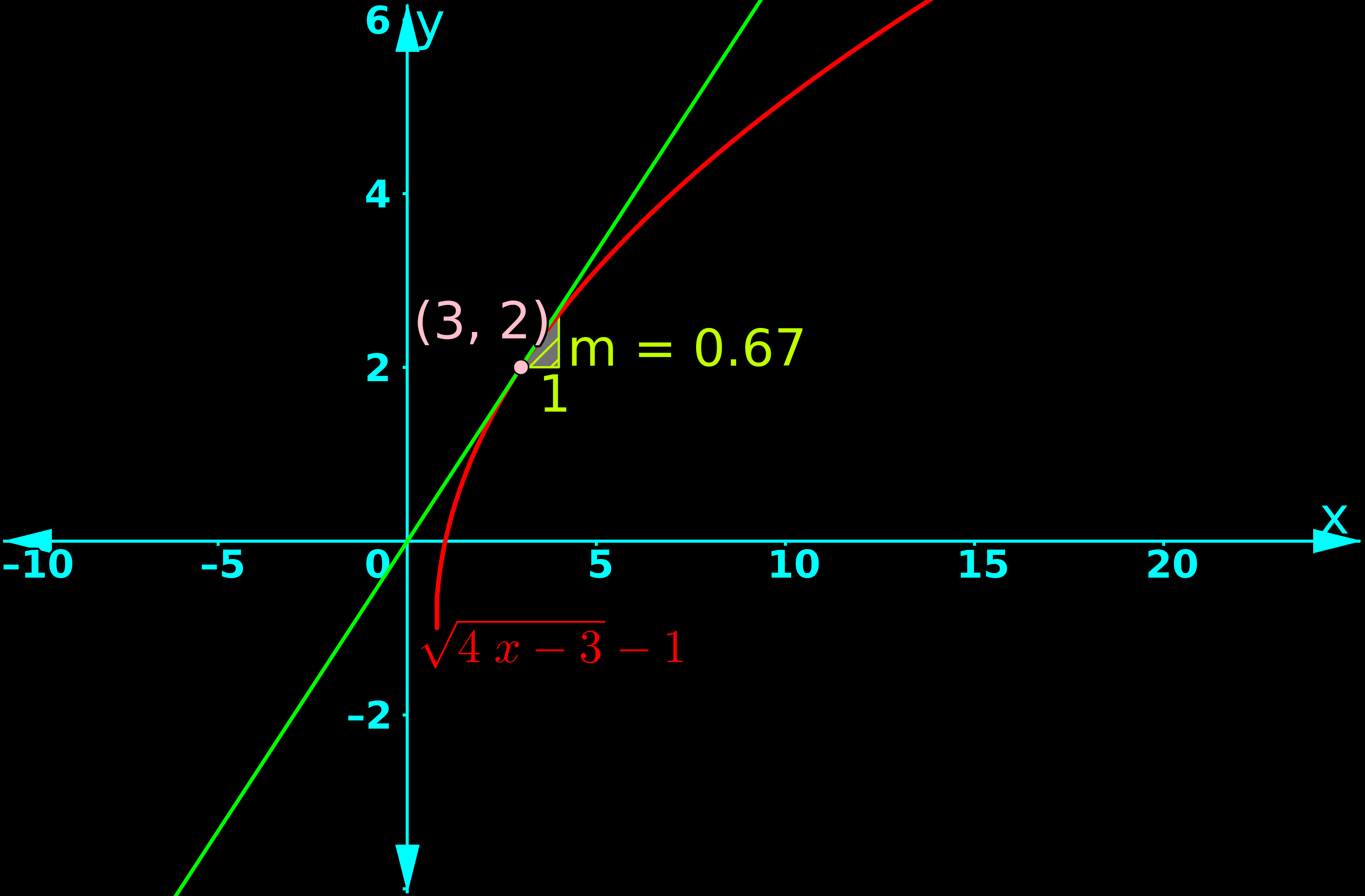
Find the point at which the tangent to the curve $\rm{y = \sqrt{4x – 3} ~-~1}$ has its slope $\rm{\frac{2}{3}}$.
Solution:
1. The derivative can be used to find the slope of tangent at any point. So we will first find the derivative.


2. The slope must be 2/3. So we can write:


3. Equation of the curve is: $\rm{y = \sqrt{4x – 3} ~-~1}$
• When x = 3, we get:
$\rm{y = \sqrt{4(3) – 3} ~-~1}~=~2$

4. Therefore, we can write:
Mark the point (3,2) on the given curve. Draw the tangent at that point. Slope of that tangent will be 2/3.

• The graph is shown in fig.22.15 below:
    ♦ The curve is drawn in red color.
    ♦ The tangent at (3,2) is drawn in green color.

Fig.22.15

• We see that, slope of the green line is 2/3 = 0.67

Note: In the above graph, we do not see much red curve below the x-axis. The reason can be written in 4 steps:
(i) When x = 3, we can write:
$\rm{y = \sqrt{4(3) – 3} ~-~1}~=~(\pm 3 -1)~=~2~\text{OR}~-4$
So (3, −4) is a possible point on the graph. But it is not plotted.
(ii) Another example:
When x = 7, we can write:
$\rm{y = \sqrt{4(7) – 3} ~-~1}~=~(\pm 5 -1)~=~4~\text{OR}~-6$
So (7, −6) is a possible point on the graph. But it is not plotted.
(iii) We do not plot such points. If we do, then it means that, for inputs like x = 3, 7 etc., there will be two outputs.
• If there are two outputs, we cannot call it a function.
(iv) So we restrict the output values (range).

Solved example 22.16
Find the equation of all lines having slope 2 and being tangent to the curve $\rm{y + \frac{2}{x - 3}~=~0}$.
Solution:
1. The derivative can be used to find the slope of tangent at any point. So we will first find the derivative.


2. The slope must be 2. So we can write:


3. Equation of the curve is: $\rm{y + \frac{2}{x - 3}~=~0}$
• When x = 4, we get:
$\rm{y = \frac{2}{3 - x}~=~\frac{2}{3 - 4}~=~-2}$
• When x = 2, we get:
$\rm{y = \frac{2}{3 - x}~=~\frac{2}{3 - 2}~=~2}$

4. Therefore, we can write:
There are two points (4,−2) and (2,2). Mark those two points on the given curve. Draw the tangent at each of those points. The two tangents will be parallel to each other with a slope of 2.

• The graph is shown in fig.22.16 below:
    ♦ The curve is drawn in red color.
    ♦ The tangents are drawn in green color.

Fig.22.16

• We see that, slope of the green lines is 2

5. Now we want the equation of the two tangents. We can use the general equation:
y – y0 = m(x – x0)
• So the equation of the tangent through (2,2) is:
y – 2 = 2(x – 2)
⇒ y − 2 = 2x − 4
⇒ y − 2x + 2 = 0
• Similarly, the equation of the tangent through (4,−2) is:
y – (−2) = 2(x – 4)
⇒ y + 2 = 2x − 8
⇒ y − 2x + 10 = 0

Solved example 22.17
Find points on the curve $\rm{\frac{x^2}{4}\,+\,\frac{y^2}{25}\,=\,1}$ at which tangents are (i) parallel to x-axis (ii) parallel to y-axis.
Solution:
• The derivative can be used to find the slope of tangent at any point. So we will first find the derivative.


Part (i): Tangents parallel to x-axis
1. Consider the points where tangents are parallel to the x-axis.
• Those tangents will have a slope of zero. So we can write:

2. When x = 0, we get:

3. So the points are: (0,5) and (0,−5)
The tangents at these points are parallel to the x-axis.

• The graph is shown in fig.22.16 below:
    ♦ The curve is drawn in red color.
    ♦ The tangents are drawn in green color.

Fig.22.17

Part (ii): Tangents parallel to y-axis
1. Consider the points where tangents are parallel to the y-axis.
• The normals at those points will have a slope of zero. Slope of normal is the negative reciprocal of that of tangent. So we can write:

2. When y = 0, we get:

3. So the points are: (2,0) and (−2,0)
• The normals at these points are parallel to the x-axis.
• Consequently, the tangents at these points are parallel to the y-axis. They are drawn in magenta color in fig.22.17 above.

In the next section, we will see a few more solved examples.

Previous

Contents

Next

Copyright©2024 Higher secondary mathematics.blogspot.com

Tuesday, May 30, 2023

Chapter 13.13 - Derivative as a Function

In the previous section, we saw an easy method to find the derivative at a point. In this section, we will see a general form.

• The general form can be obtained using the same fig.13.30 that we saw in the previous section. All we need to do is, change 'a' to 'x'.
• The steps are the same with 'x' in place of 'a'. However, we will write all those 11 steps here:
1. In fig.13.31 below, the red curve is the graph of f(x).

Fig.13.31

• Two points P and Q are marked on the red curve.
(P is an arbitrary point. An arbitrary point is chosen so that, it will be applicable for all cases. The dictionary meaning of the word "arbitrary" can be seen here
    ♦ A green horizontal line is drawn through P.
    ♦ A green vertical line is drawn through Q.
    ♦ These horizontal and vertical lines meet at R
• Thus we get a right triangle PQR
2. A green dashed vertical line is drawn through P.
• This vertical line meets the x-axis at (x,0)
[We are able to write "(x,0)" because, P is an arbitrary point. Since it is an arbitrary point, 'x' can be any point in the domain of f(x)]
• So we can write:
The x-coordinate of P is ‘x’.
• If the x-coordinate is ‘x’, then obviously, the y-coordinate will be f(x)
• Thus we get the coordinates of P: (x,f(x))
3. Another green dashed vertical line is drawn through R.
• This vertical line meets the x-axis at ((x+h),0)
• So we can write:
The x-coordinate of Q is ‘(x+h)’.
• If the x-coordinate is ‘(x+h)’, then obviously, the y-coordinate will be f(x+h)
• Thus we get the coordinates of Q: ((x+h),f(x+h))
4. Using the x-coordinates of P and Q, we can find the horizontal distance between P and Q.
• We get:
Horizontal distance between P and Q = [(x+h) – x] = h
• That means, the length PR = h.
5.  Using the y-coordinates of P and Q, we can find the vertical distance between P and Q.
• We get:
Vertical distance between P and Q = [f(x+h) – f(x)]
• That means, the length QR = [f(x+h) – f(x)].
6. Now we have the base and altitude of the right triangle PQR.
• So we can write the slope of the line PQ.
Slope of PQ = $\frac{[f(x+h) – f(x)]}{h}$
7. If Q is brought very close to P, then the slope calculated in (6) will be the slope of the tangent at P
• For bringing Q closer to P, we must decrease the length h. When h approaches zero, Q will be very close to P.
• h must become very close to zero. At the same time, it must not become exact zero. This can be written as:
$\lim_{h\rightarrow 0} h$
8. From (5), we have the length of the altitude:
[f(x+h) – f(x)]
• When h approaches zero, the base PR will become infinitesimal.
• There will be corresponding changes in the altitude also.
• When h approaches zero, the length of the altitude can be written as: $\lim_{h\rightarrow 0} {[f(x+h) – f(x)]}$
9. So now we can write the slope of the tangent at P:
$\frac{\lim_{h\rightarrow 0} {[f(x+h) – f(x)]}}{\lim_{h\rightarrow 0} h}$
• The limit is being applied to both numerator and denominator. So this can be written in a simplified form as:
Slope of tangent at P = $\lim_{h\rightarrow 0}{\left[\frac{f(x+h) – f(x)}{h} \right]}$
10. But slope of the tangent at P is the derivative at P.
• Point P corresponds to any x in the domain.
• So we can write:
The result in (9) gives the derivative of f(x) at any x in the domain.
11. The derivative of f(x) at x is denoted as: f'(x).
• So we can write:
$$f'(x)~=~\lim_{h\rightarrow 0}{\left[\frac{f(x+h) – f(x)}{h} \right]}$$


Now we will see the same solved examples of the previous section:
Solved example 13.6
Find the derivative of f(x) = 3x.
Solution:
• In our present case, f(x) = 3x. So we get:
$\begin{array}{ll}
{}&{f'(x)}
& {~=~}& {\lim_{h\rightarrow 0}{\left[\frac{f(x+h) – f(x)}{h} \right]}}
&{} \\

{}&{}
& {~=~}& {\lim_{h\rightarrow 0}{\left[\frac{3(x+h) – 3 x}{h} \right]}}
&{} \\

{}&{}
& {~=~}& {\lim_{h\rightarrow 0}{\left[\frac{3x + 3h – 3x}{h} \right]}}
&{} \\

{}&{}
& {~=~}& {\lim_{h\rightarrow 0}{\left[\frac{3h}{h} \right]}}
&{} \\

{}&{}
& {~=~}& {3 \lim_{h\rightarrow 0}{\left[\frac{h}{h} \right]}}
&{} \\

{}&{}
& {~=~}& {3 \lim_{h\rightarrow 0}{1}}
&{} \\

{}&{}
& {~=~}& {3 × 1}
&{} \\

{}&{}
& {~=~}& {3}
&{} \\

\end{array}$

Solved example 13.7
Find the derivative of f(x) = 2x2 + 3x - 5. Also prove that f'(0) + 3f'(-1) = 0
Solution:
Part (i):
• In our present case, f(x) = 2x2 + 3x - 5. So we get:
$\begin{array}{ll}
{}&{f'(x)}
& {~=~}& {\lim_{h\rightarrow 0}{\left[\frac{f(x+h) – f(x)}{h} \right]}}
&{} \\

{}&{}
& {~=~}& {\lim_{h\rightarrow 0}{\left[\frac{[2(x+h)^2 + 3(x+h) - 5] – [2×(x)^2 + 3 x ~- 5]}{h} \right]}}
&{} \\

{}&{}
& {~=~}& {\lim_{h\rightarrow 0}{\left[\frac{[2(x^2 + 2hx + h^2) + 3x +3h - 5] – [2 x^2 + 3x - 5]}{h} \right]}}
&{} \\

{}&{}
& {~=~}& {\lim_{h\rightarrow 0}{\left[\frac{2x^2 + 4hx + 2h^2 + 3x + 3h - 5 – 2 x^2 - 3x + 5}{h} \right]}}
&{} \\

{}&{}
& {~=~}& {\lim_{h\rightarrow 0}{\left[\frac{4hx + 2h^2 + 3h}{h} \right]}}
&{} \\

{}&{}
& {~=~}& {\lim_{h\rightarrow 0}{\left[\frac{h(2h +4x + 3)}{h} \right]}}
&{} \\

{}&{}
& {~=~}& {\lim_{h\rightarrow 0}{[2h + 4x +3]}}
&{} \\

{}&{}
& {~=~}& {4x + 3}
&{} \\

\end{array}$

Part (ii):
1. We have: f'(x) = 4x + 3
2. Thus we get: f'(0) = [4(0) + 3] = 3
3. Also we get: f'(-1) = [4(-1) + 3] = [-4 + 3] = -1
4. So f'(0) + 3f'(-1) = [3 + 3(-1)] = [3 - 3] = 0

◼ A graphical description can be written in 3 steps:
1. In the fig.13.32 below, f(x) = 2x2 + 3x - 5 is plotted in red color.

Fig.13.32


2. We saw that: f'(0) = 3
• That means, the "derivative of f(x)" at (x = 0) is 3.
    ♦ That means, slope of the tangent at (x = 0) is 3.
• When (x=0), f(x) is -5.
    ♦ So we mark the point (0,-5)
• If we have a point and the slope, we can draw a line through that point (recall the slope-point form that we saw in coordinate geometry lessons).
• So we draw a line through (0,-5) at a slope of 3.
    ♦ This line will be the tangent of f(x) at (x=0).
    ♦ This tangent is shown in green color.
3. We saw that: f'(-1) = -1
• That means, the "derivative of f(x)" at (x = -1) is -1.
    ♦ That means, slope of the tangent at (x = -1) is -1.
• When (x=-1), f(x) is -6.
    ♦ So we mark the point (-1,-6)
• If we have a point and the slope, we can draw a line through that point (recall the slope-point form that we saw in coordinate geometry lessons).
• So we draw a line through (-1,-5) at a slope of -1.
    ♦ This line will be the tangent of f(x) at (x=-1).
    ♦ This tangent is shown in white color.


Solved example 13.8

Find the derivative of sin x
Solution:
• In our present case, f(x) = sin x. So we get:
$\begin{array}{ll}
{}&{f'(x)}
& {~=~}& {\lim_{h\rightarrow 0}{\left[\frac{f(x+h) – f(x)}{h} \right]}}
&{} \\

{}&{}
& {~=~}& {\lim_{h\rightarrow 0}{\left[\frac{[\sin (x+h)] – [sin x]}{h} \right]}}
&{} \\

{}&{}
& {~=~}& {\lim_{h\rightarrow 0}{\left[\frac{[\sin x \cos h ~+~\cos x \sin h] – [sin x]}{h} \right]}}
&{} \\

{}&{}
& {~=~}& {\lim_{h\rightarrow 0}{\left[\frac{\sin x (\cos h - 1)~+~ \cos x \sin h}{h} \right]}}
&{} \\

{}&{}
& {~=~}& {\lim_{h\rightarrow 0}{\left[\frac{\sin x (\cos h - 1)}{h} \right]}~+~\lim_{h\rightarrow 0}{\left[\frac{\cos x \sin h}{h} \right]}}
&{} \\

{}&{}
& {~=~}& {\sin x \lim_{h\rightarrow 0}{\left[\frac{\cos h - 1}{h} \right]}~+~\cos x \lim_{h\rightarrow 0}{\left[\frac{\sin h}{h} \right]}}
&{} \\

{}&{}
& {~=~}& {\sin x × 0~+~\cos x × 1}
&{} \\

{}&{}
& {~=~}& {\cos x}
&{} \\

\end{array}$

◼ Let us find the derivatives at some convenient points:
• We have: f'(x) = cos x
• Let us find the derivative at (x = 0) and $\rm{\left(x = \frac{\pi}{3} \right)}$. We get:
    ♦ f'(0) = cos 0 = 1
    ♦ $\rm{f' \left(\frac{\pi}{3}\right)~=~\cos \left(\frac{\pi}{3}\right)~=~\frac{1}{2}}$

◼ A graphical description can be written in 3 steps:
1. In the fig.13.33 below, f(x) = sin x is plotted in red color.

Method for finding the derivative of sin x
Fig.13.33

2. We saw that: f'(0) = 1
• That means, the "derivative of f(x)" at (x = 0) is 1.
    ♦ That means, slope of the tangent at (x = 0) is 1.
• When (x=0), f(x) is sin 0 = 0.
    ♦ So we mark the point (0,0)
• If we have a point and the slope, we can draw a line through that point (recall the slope-point form that we saw in coordinate geometry lessons).
• So we draw a line through (0,0) at a slope of 1.
    ♦ This line will be the tangent of f(x) at (x=0).
    ♦ This tangent is shown in green color.
3. We saw that: $\rm{f' \left(\frac{\pi}{3}\right)~=~\frac{1}{2}}$
• That means, the "derivative of f(x)" at $\rm{\left(x = \frac{\pi}{3} \right)}$ is $\frac{1}{2}$
    ♦ That means, slope of the tangent at $\rm{\left(x = \frac{\pi}{3} \right)}$ is $\frac{1}{2}$.
• When $\rm{\left(x = \frac{\pi}{3} \right)}$, f(x) is $\frac{\sqrt3}{2}$.
    ♦ So we mark the point $\rm{\left(\frac{\pi}{3}, \frac{\sqrt3}{2} \right)}$
• If we have a point and the slope, we can draw a line through that point (recall the slope-point form that we saw in coordinate geometry lessons).
• So we draw a line through $\rm{\left(\frac{\pi}{3}, \frac{\sqrt3}{2} \right)}$ at a slope of $\frac{1}{2}$.
    ♦ This line will be the tangent of f(x) at $\rm{\left(x = \frac{\pi}{3} \right)}$.
    ♦ This tangent is shown in white color.

Solved example 13.9
Find the derivative of f(x) = 3. Also find f'(0) and f'(3). 
Solution:
Part (i):
• In our present case, f(x) = 3. So we get:

$\begin{array}{ll}
{}&{f'(0)}
& {~=~}& {\lim_{h\rightarrow 0}{\left[\frac{f(x+h) – f(x)}{h} \right]}}
&{} \\

{}&{}
& {~=~}& {\lim_{h\rightarrow 0}{\left[\frac{[3] – [3]}{h} \right]}}
&{} \\

{}&{}
& {~=~}& {\lim_{h\rightarrow 0}{\left[\frac{0}{h} \right]}}
&{} \\

{}&{}
& {~=~}& {0}
&{} \\

\end{array}$

Part (ii):
1. We have: f'(x) = 0. This is a constant function.
• So f'(0) = 0.
2. We have: f'(x) = 0. This is a constant function.
• So f'(3) = 0.

◼ In this example, we see that:
    ♦ f’(0) = 0
    ♦ f’(3) = 0
• In fact, we can put any value for a. The derivative will be zero.
• The reason can be written in 2 steps:
1. f(x) = 3 is a constant function.
• That means, whatever be the value of x, the resulting f(x) will be the same.
• If there is no change in f(x), it means that, there is no rate of change.
    ♦ That means, rate of change is zero.
    ♦ That means, derivative is zero.
2. We can think in terms of slope of tangent also.
• For a straight line, the tangent at any point, will be the line itself.
• Here, the straight line is horizontal. So the tangent at any point will also be horizontal.
• For a horizontal line, the slope is zero.


• For a given function f, we can find the derivative at every point. The derivative will be a new function denoted by f'.
• In some cases, the derivative will be a constant function.
    ♦ The derivative in solved example 13.6 above is a constant function.
    ♦ The derivative in solved example 13.9 above is a constant function.
• In some cases, the derivative will be an ordinary function.
    ♦ The derivative in solved example 13.7 above is an ordinary function.
    ♦ The derivative in solved example 13.8 above is an ordinary function.


◼ Derivative can be denoted in different ways. In the discussions above, we denoted it as f'(x)
• Five more methods are given below:
1. Derivative can be denoted as $\frac{d}{dx}\left(f(x) \right)$.
2. If y = f(x), then the derivative can be denoted as $\frac{dy}{dx}$.
• We can read it in any one of the two ways below:
(i) Derivative of y with respect to x.
(ii) "dy" by "dx"
3. Derivative can be denoted as : $D \left(f(x) \right)$.
4. Derivative of f(x) at (x=a) can be denoted in any one of the three ways below:
(i) $\left.\frac{d}{dx} f(x)\right\vert_{a}$

(ii) $\left.\frac{df}{dx}\right\vert_{a}$

(iii) $\left(\frac{df}{dx}\right)_{x=a}$


In the next section, we will see a few more solved examples.

Previous

Contents

Next

Copyright©2023 Higher secondary mathematics.blogspot.com

Sunday, May 28, 2023

Chapter 13.12 - Method to Find Derivative

In the previous section, we saw that derivative at a point, is the slope of the tangent at that point. In the section before that, we saw derivative as the rate of change. In this section, we will see an easy method to find the derivative at any given point.

It can be written in 11 steps:
1. In fig.13.30 below, the red curve is the graph of f(x).

Fig.13.30

• Two points P and Q are marked on the red curve.
    ♦ A green horizontal line is drawn through P.
    ♦ A green vertical line is drawn through Q.
    ♦ These horizontal and vertical lines meet at R
• Thus we get a right triangle PQR
2. A green dashed vertical line is drawn through P.
• This vertical line meets the x-axis at (a,0)
• So we can write:
The x-coordinate of P is ‘a’.
• If the x-coordinate is ‘a’, then obviously, the y-coordinate will be f(a)
• Thus we get the coordinates of P: (a,f(a))
3. Another green dashed vertical line is drawn through R.
• This vertical line meets the x-axis at ((a+h),0)
• So we can write:
The x-coordinate of Q is ‘(a+h)’.
• If the x-coordinate is ‘(a+h)’, then obviously, the y-coordinate will be f(a+h)
• Thus we get the coordinates of Q: ((a+h),f(a+h))
4. Using the x-coordinates of P and Q, we can find the horizontal distance between P and Q.
• We get:
Horizontal distance between P and Q = [(a+h) – a] = h
• That means, the length PR = h.
5.  Using the y-coordinates of P and Q, we can find the vertical distance between P and Q.
• We get:
Vertical distance between P and Q = [f(a+h) – f(a)]
• That means, the length QR = [f(a+h) – f(a)].
6. Now we have the base and altitude of the right triangle PQR.
• So we can write the slope of the line PQ.
Slope of PQ = $\frac{[f(a+h) – f(a)]}{h}$
7. If Q is brought very close to P, then the slope calculated in (6) will be the slope of the tangent at P
• For bringing Q closer to P, we must decrease the length h. When h approaches zero, Q will be very close to P.
• h must become very close to zero. At the same time, it must not become exact zero. This can be written as:
$\lim_{h\rightarrow 0} h$
8. From (5), we have the length of the altitude:
[f(a+h) – f(a)]
• When h approaches zero, the base PR will become infinitesimal.
• There will be corresponding changes in the altitude also.
• When h approaches zero, the length of the altitude can be written as: $\lim_{h\rightarrow 0} {[f(a+h) – f(a)]}$
9. So now we can write the slope of the tangent at P:
$\frac{\lim_{h\rightarrow 0} {[f(a+h) – f(a)]}}{\lim_{h\rightarrow 0} h}$
• The limit is being applied to both numerator and denominator. So this can be written in a simplified form as:
Slope of tangent at P = $\lim_{h\rightarrow 0}{\left[\frac{f(a+h) – f(a)}{h} \right]}$
10. But slope of the tangent at P is the derivative at P.
• Point P corresponds to (x = a)
• So we can write:
The result in (9) gives the derivative of f(x) at (x = a).
11. The derivative of f(x) at (x=a) is denoted as: f'(a).
• So we can write:
$$f'(a)~=~\lim_{h\rightarrow 0}{\left[\frac{f(a+h) – f(a)}{h} \right]}$$


Now we will see some solved examples:
Solved example 13.6
Find the derivative at x = 2 of the function f(x) = 3x.
Solution:
1. We have: $f'(a)~=~\lim_{h\rightarrow 0}{\left[\frac{f(a+h) – f(a)}{h} \right]}$
2. In our present case, a = 2 and f(x) = 3x.
• So we get:
$\begin{array}{ll}
{}&{f'(2)}
& {~=~}& {\lim_{h\rightarrow 0}{\left[\frac{f(2+h) – f(2)}{h} \right]}}
&{} \\

{}&{}
& {~=~}& {\lim_{h\rightarrow 0}{\left[\frac{3(2+h) – 3 × 2}{h} \right]}}
&{} \\

{}&{}
& {~=~}& {\lim_{h\rightarrow 0}{\left[\frac{6 + 3h – 6}{h} \right]}}
&{} \\

{}&{}
& {~=~}& {\lim_{h\rightarrow 0}{\left[\frac{3h}{h} \right]}}
&{} \\

{}&{}
& {~=~}& {3 \lim_{h\rightarrow 0}{\left[\frac{h}{h} \right]}}
&{} \\

{}&{}
& {~=~}& {3 \lim_{h\rightarrow 0}{1}}
&{} \\

{}&{}
& {~=~}& {3 × 1}
&{} \\

{}&{}
& {~=~}& {3}
&{} \\

\end{array}$

3. We see that the derivative is '3'.
• So we can write:
At the point where (x = 2), the rate of change of y with respect to x is 3.
• In fact, for this problem, the rate of change at every point will be 3.
4. We see that the derivative is '3'.
• So we can write:
At the point where (x = 2), the slope of the tangent is 3.
• In fact, for this problem, the slope of tangent at any point will be 3. The reason can be written in steps:
(i) For a straight line, the tangent at any point, will be the line itself.
(ii) Here, the slope of the line is 3. So the tangent at any point will also have the slope 3

Solved example 13.7
Find the derivative of the function f(x) = 2x2 + 3x - 5 at x = -1. Also prove that f'(0) + 3f'(-1) = 0
Solution:
Part (i):
1. We have: $f'(a)~=~\lim_{h\rightarrow 0}{\left[\frac{f(a+h) – f(a)}{h} \right]}$
2. In our present case, a = -1 and f(x) = 2x2 + 3x - 5 .
• So we get:
$\begin{array}{ll}
{}&{f'(-1)}
& {~=~}& {\lim_{h\rightarrow 0}{\left[\frac{f(-1+h) – f(-1)}{h} \right]}}
&{} \\

{}&{}
& {~=~}& {\lim_{h\rightarrow 0}{\left[\frac{[2(-1+h)^2 + 3(-1+h) - 5] – [2×(-1)^2 + 3 × -1 - 5]}{h} \right]}}
&{} \\

{}&{}
& {~=~}& {\lim_{h\rightarrow 0}{\left[\frac{[2(1 - 2h + h^2) + (-3+3h) - 5] – [2 - 3 - 5]}{h} \right]}}
&{} \\

{}&{}
& {~=~}& {\lim_{h\rightarrow 0}{\left[\frac{2 - 4h + 2h^2 -3+3h - 5 – 2 + 3 + 5}{h} \right]}}
&{} \\

{}&{}
& {~=~}& {\lim_{h\rightarrow 0}{\left[\frac{- h + 2h^2}{h} \right]}}
&{} \\

{}&{}
& {~=~}& {\lim_{h\rightarrow 0}{\left[\frac{h(2h - 1)}{h} \right]}}
&{} \\

{}&{}
& {~=~}& {\lim_{h\rightarrow 0}{[2h-1]}}
&{} \\

{}&{}
& {~=~}& {2 × 0~-~1}
&{} \\

{}&{}
& {~=~}& {-1}
&{} \\

\end{array}$

Part (ii):
1. We have: $f'(a)~=~\lim_{h\rightarrow 0}{\left[\frac{f(a+h) – f(a)}{h} \right]}$
2. In our present case, a = 0 and f(x) = 2x2 + 3x - 5.
• So we get:
$\begin{array}{ll}
{}&{f'(0)}
& {~=~}& {\lim_{h\rightarrow 0}{\left[\frac{f(0+h) – f(0)}{h} \right]}}
&{} \\

{}&{}
& {~=~}& {\lim_{h\rightarrow 0}{\left[\frac{[2(0+h)^2 + 3(0+h) - 5] – [2×(0)^2 + 3 × 0 ~- 5]}{h} \right]}}
&{} \\

{}&{}
& {~=~}& {\lim_{h\rightarrow 0}{\left[\frac{[2h^2 + 3h) - 5] – [2×0 + 3 × 0 ~- 5]}{h} \right]}}
&{} \\

{}&{}
& {~=~}& {\lim_{h\rightarrow 0}{\left[\frac{2h^2 + 3h - 5 + 5}{h} \right]}}
&{} \\

{}&{}
& {~=~}& {\lim_{h\rightarrow 0}{\left[\frac{2h^2 + 3h}{h} \right]}}
&{} \\

{}&{}
& {~=~}& {\lim_{h\rightarrow 0}{\left[\frac{h(2h + 3)}{h} \right]}}
&{} \\

{}&{}
& {~=~}& {\lim_{h\rightarrow 0}{\left[2h + 3 \right]}}
&{} \\

{}&{}
& {~=~}& {2 × 0 ~+ 3}
&{} \\

{}&{}
& {~=~}& {3}
&{} \\

\end{array}$

Part (iii):
1. From part (i), we have: f'(-1) = -1
2. From part (ii), we have: f'(0) = 3
3. So we get:
f'(0) + 3f'(-1) = [3 + (3 × -1)] = [3 - 3] = 0


At this stage, we are able to understand an important fact. It can be written in 2 steps:
(i) In the previous sections, we saw that:
Limits are subjected to various rules.
(ii) Those rules can be effectively used to evaluate the derivative.


Solved example 13.8
Find the derivative of sin x at x = 0
Solution:
1. We have: $f'(a)~=~\lim_{h\rightarrow 0}{\left[\frac{f(a+h) – f(a)}{h} \right]}$
2. In our present case, a = 0 and f(x) = sin x.
• So we get:
$\begin{array}{ll}
{}&{f'(0)}
& {~=~}& {\lim_{h\rightarrow 0}{\left[\frac{f(0+h) – f(0)}{h} \right]}}
&{} \\

{}&{}
& {~=~}& {\lim_{h\rightarrow 0}{\left[\frac{[\sin (0+h)] – [sin 0]}{h} \right]}}
&{} \\

{}&{}
& {~=~}& {\lim_{h\rightarrow 0}{\left[\frac{[\sin h] – [sin 0]}{h} \right]}}
&{} \\

{}&{}
& {~=~}& {\lim_{h\rightarrow 0}{\left[\frac{[\sin h] – [0]}{h} \right]}}
&{} \\

{}&{}
& {~=~}& {\lim_{h\rightarrow 0}{\left[\frac{\sin h}{h} \right]}}
&{} \\

{}&{}
& {~=~}& {1}
&{} \\

\end{array}$

Solved example 13.9
Find the derivative of f(x) = 3 at x = 0 and at x = 3
Solution:
Part (i):
1. We have: $f'(a)~=~\lim_{h\rightarrow 0}{\left[\frac{f(a+h) – f(a)}{h} \right]}$
2. In our present case, a = 0 and f(x) = 3.
• So we get:
$\begin{array}{ll}
{}&{f'(0)}
& {~=~}& {\lim_{h\rightarrow 0}{\left[\frac{f(0+h) – f(0)}{h} \right]}}
&{} \\

{}&{}
& {~=~}& {\lim_{h\rightarrow 0}{\left[\frac{[3] – [3]}{h} \right]}}
&{} \\

{}&{}
& {~=~}& {\lim_{h\rightarrow 0}{\left[\frac{0}{h} \right]}}
&{} \\

{}&{}
& {~=~}& {0}
&{} \\

\end{array}$

Part (ii):
1. We have: $f'(a)~=~\lim_{h\rightarrow 0}{\left[\frac{f(a+h) – f(a)}{h} \right]}$
2. In our present case, a = 3 and f(x) = 3.
• So we get:
$\begin{array}{ll}
{}&{f'(3)}
& {~=~}& {\lim_{h\rightarrow 0}{\left[\frac{f(3+h) – f(3)}{h} \right]}}
&{} \\

{}&{}
& {~=~}& {\lim_{h\rightarrow 0}{\left[\frac{[3] – [3]}{h} \right]}}
&{} \\

{}&{}
& {~=~}& {\lim_{h\rightarrow 0}{\left[\frac{0}{h} \right]}}
&{} \\

{}&{}
& {~=~}& {0}
&{} \\

\end{array}$

◼ In this example, we see that:
    ♦ f’(0) = 0
    ♦ f’(3) = 0
• In fact, we can put any value for a. The derivative will be zero.
• The reason can be written in 2 steps:
1. f(x) = 3 is a constant function.
• That means, whatever be the value of x, the resulting f(x) will be the same.
• If there is no change in f(x), it means that, there is no rate of change.
    ♦ That means, rate of change is zero.
    ♦ That means, derivative is zero.
2. We can think in terms of slope of tangent also.
• For a straight line, the tangent at any point, will be the line itself.
• Here, the straight line is horizontal. So the tangent at any point will also be horizontal.
• For a horizontal line, the slope is zero.


• Now we know how to find the derivative at any given point.
• It would be convenient if we could obtain a general form.
• For example, we saw that:
Derivative of 2x2 + 3x -5 at (x = -1) is -1
• If we are asked to find the derivative of this function at say (x = 2), we will have to repeat all the steps using ‘2’.
• If we have a general form, we will be able to quickly find the derivative at any given point.
In the next section, we will see such a general form.

Previous

Contents

Next

Copyright©2023 Higher secondary mathematics.blogspot.com