Showing posts with label rectangular coordinate system. Show all posts

Tuesday, April 25, 2023

Chapter 12.6 - Miscellaneous Examples

In the previous section, we saw some solved examples on section formula. In this section, we will see some miscellaneous examples.

Solved example 12.11
Show that the points A(1,2,3), B(-1,-2,-1), C(2,3,2) and D(4,7,6) are the vertices of a parallelogram ABCD but it is not a rectangle.
Solution:
1. A rough sketch is shown in fig.12.19 below:

Fig.12.19

2. Using the distance formula, we can find the lengths of sides.
   ♦ AB = √36 = 6
   ♦ BC = √43
   ♦ CD = √36 = 6
   ♦ DA = √43
3. We see that, both pairs of opposite sides (AB, CD) and (BC, DA) are equal. So it is a parallelogram.
4. A rectangle is a parallelogram in which both diagonals are of the same length.
• If a parallelogram is not to be a rectangle, it's diagonals should not be of the same length.
5. Using distance formula, let us write the lengths of the diagonals:
   ♦ AC = √3
   ♦ BD = √155
• We see that, diagonals are not equal. So it a parallelogram which is not a rectangle.

Solved example 12.12
Find the equation of the set of points P such that it's distances from the points A(3,4,-5) and B(-2,1,4) are equal.
Solution:
1. Let P(x,y,z) be equidistant from A and B
2. Let us use the distance formula.
• Square of the distance PA can be obtained as follows:
PA2 = (x-3)2 + (y-4)2 + (z+5)2
= x2 -6x +9 +y2 -8y +16 +z2 +10z +25
• Square of the distance PB can be obtained as follows:
PB2 = (x+2)2 + (y-1)2 + (z-4)2
= x2 +4x +4 +y2 -2y +1 +z2 -8z +16
3. Since the distances are equal, the square of the distances will also be equal. We can write:
x2 -6x +9 +y2 -8y +16 +z2 +10z +25 = x2 +4x +4 +y2 -2y +1 +z2 -8z +16
⇒ -6x +9 -8y +16 +10z +25 = +4x +4 -2y +1 -8z +16
⇒ -6x -4x +9 -8y +2y +16 +10z +8z +25 = +4  +1 +16
⇒ -10x +9 -6y +16 +18z +25 = +4  +1 +16
⇒ -10x -6y +18z +50 = 21
⇒ -10x -6y +18z +29 = 0
⇒ 10x +6y -18z -29 = 0

Solved example 12.13
The centroid of a triangle ABC is at G(1,1,1). If the coordinates of A and B are (3,-5,7) and (-1,7,-6) respectively, find the coordinates of C.
Solution:
1. Let the coordinates of C be (x,y,z)
Then we can draw a rough sketch as shown below:

Fig.12.20

2. We know that, the coordinates of the centroid of any triangle can be obtained using the expression:
$\left( \frac{x_1 + x_2 + x_3}{3},~ \frac{y_1 + y_2 + y_3}{3},~ \frac{z_1 + z_2 + z_3}{3}\right)$  

3. Substituting the known values, we get:
• $ \frac{3 -1 + x}{3}~=~1$
⇒ 2+x = 3
⇒ x = 1 
• $ \frac{-5 +7 + y}{3}~=~1$
⇒ 2+y = 3
⇒ y = 1 
• $ \frac{7 -6 + z}{3}~=~1$
⇒ 1+x = 3
⇒ z = 2

4. So the coordinates of C are: (1,1,2)


The link below gives a few more solved examples:

Miscellaneous Exercise


We have completed a disscusion on three dimensional geometry. In the next chapter, we will see limits and derivatives.

Previous

Contents

Next

Copyright©2023 Higher secondary mathematics.blogspot.com

Thursday, April 13, 2023

Chapter 12.5 - Solved Examples on Section Formula

In the previous section, we saw section formula. We also saw a solved example. In this section, we will see a few more solved examples.

Solved example 12.8
Using the section formula, prove that the three points A(-4,6,10), B(2,4,6) and C(14,0,-2) are collinear.
Solution:
1. Let us assume that, the third point C is collinear with A and B. Then two possibilities arise:
(i) C lies between A and B
(ii) C lies in the extension of AB
2. If the case is 1(i), then C will be dividing AB internally in some ratio k:1
3. If the case is 1(ii), then C will be dividing AB externally in some ratio k:1
4. For a point which divides AB (internally or externally) in the ratio k:1, the coordinates will be:
$\left(\frac{k x_2 + x_1}{1+k},~\frac{k y_2 + y_1}{1+k},~\frac{k z_2 + z_1}{1+k} \right)$
⇒ $\left(\frac{k × 2 + -4}{1+k},~\frac{k × 4 + 6}{1+k},~\frac{k × 6 + 10}{1+k} \right)$
⇒ $\left(\frac{2k - 4}{1+k},~\frac{4k + 6}{1+k},~\frac{6k + 10}{1+k} \right)$
5. Let us check whether the coordinates of C satisfy the conditions in (4).
The check can be done in 4 steps:
(i) Equating the x coordinates, we get:

$\begin{array}{ll}
{}&{\frac{2k - 4}{1+k}}
& {~=~}& {14}
&{} \\

{\Rightarrow}&{2k-4}
& {~=~}& {14 +14k }
&{} \\

{\Rightarrow}&{-12k}
& {~=~}& {18}
&{} \\

{\Rightarrow}&{-2k}
& {~=~}& {3}
&{} \\

{\Rightarrow}&{k}
& {~=~}& {- \frac{3}{2}}
&{} \\

\end{array}$

(ii) If k = -3/2, then the y-coordinate can be calculated from the result in (4). We get:

$\begin{array}{ll}
{}&{\rm{y-coordinate}}
& {~=~}& {\frac{4k + 6}{1+k}}
&{} \\

{}&{}
& {~=~}& {\frac{4(-3/2) + 6}{1+(-3/2)}}
&{} \\

{}&{}
& {~=~}& {\frac{-6+6}{1+(-3/2)}}
&{} \\

{}&{}
& {~=~}& {0}
&{} \\

\end{array}$

• Note that, the y-coordinate of C is also '0'.

(iii) If k = -3/2, then the z-coordinate can be calculated from the result in (4). We get:

$\begin{array}{ll}
{}&{\rm{z-coordinate}}
& {~=~}& {\frac{6k + 10}{1+k}}
&{} \\

{}&{}
& {~=~}& {\frac{6(-3/2) + 10}{1+(-3/2)}}
&{} \\

{}&{}
& {~=~}& {\frac{-9+10}{-(1/2)}}
&{} \\

{}&{}
& {~=~}& {\frac{1}{-(1/2)}}
&{} \\

{}&{}
& {~=~}& {-2}
&{} \\

\end{array}$

• Note that, the z-coordinate of C is also '-2'.

(iv) So the coordinates of C satisfy the conditions in (4).

6. That means, the point C indeed divides AB internally or externally in the ratio k:1
Since k (= -3/2) is a -ve value, it is an external division.
7. Point C can divide AB (internally or externally) only if A, B and C is collinear.

Solved example 12.9
Find the coordinates of the centroid of the triangle PQR whose vertices are P(x1,y1,z1), Q(x2,y2,z2), R(x3,y3,z3).
Solution:
1. Let A be the midpoint of QR. Then the coordinates of A will be:
$\left(\frac{x_2 + x_3}{2},~\frac{y_2 + y_3}{2},~\frac{z_2 + z_3}{2} \right)$
2. Let G be the centroid.
3. We have the coordinates of P and A.
• The centroid G will divide PA internally in the ratio 2:1
• So the coordinates of G will be:
$\left(\frac{m x_2 + n x_1}{m+n},~\frac{m y_2 + n y_1}{m+n},~\frac{m z_2 + n z_1}{m+n} \right)$
⇒ $\left(\frac{2 × \frac{x_2 + x_3}{2} + 1 × x_1}{2+1},~\frac{2 × \frac{y_2 + y_3}{2} + 1 × y_1}{2+1},~\frac{2 × \frac{z_2 + z_3}{2} + 1 × z_1}{2+1} \right)$
⇒ $\left(\frac{x_2 + x_3 + 1 × x_1}{2+1},~\frac{y_2 + y_3 + 1 × y_1}{2+1},~\frac{z_2 + z_3 + 1 × z_1}{2+1} \right)$
⇒ $\left(\frac{x_1 + x_2 + x_3}{3},~\frac{y_1 + y_2 + y_3}{3},~\frac{z_1 + z_2 + z_3}{3} \right)$

Solved example 12.10
Find the ratio in which the line segment joining the points A(4,8,10) and B(6,10,-8) is divided by the YZ-plane. Also find the coordinates of the point at which the division is done.
Solution:
1. Let the YZ-plane divide AB in the ratio k:1
2. Let the point of division be C.
3. We can write the coordinates of C as follows:
$\left(\frac{k x_2 + x_1}{1+k},~\frac{k y_2 + y_1}{1+k},~\frac{k z_2 + z_1}{1+k} \right)$
⇒ $\left(\frac{k × 6 + 4}{1+k},~\frac{k × 10 + 8}{1+k},~\frac{k × -8 + 10}{1+k} \right)$
⇒ $\left(\frac{6k + 4}{1+k},~\frac{10k + 8}{1+k},~\frac{-8k + 10}{1+k} \right)$
4. Consider any point on the YZ-plane. The x-coordinate of that point will be zero.
So the x-coordinate written in (3) is zero. We get:

$\begin{array}{ll}
{}&{\frac{6k + 4}{1+k}}
& {~=~}& {0}
&{} \\

{\Rightarrow}&{6k + 4}
& {~=~}& {0}
&{} \\

{\Rightarrow}&{6k}
& {~=~}& {-4}
&{} \\

{\Rightarrow}&{3k}
& {~=~}& {-2}
&{} \\

{\Rightarrow}&{k}
& {~=~}& {- \frac{2}{3}}
&{} \\

\end{array}$

5. Thus we get the value of k.
• We have seen that, k:1 is just another form of m:n. Both represent the same ratio.
So we can write:

$\begin{array}{ll}
{}&{k:1}
& {~=~}& {\frac{k}{1}}
&{} \\

{\Rightarrow}&{\frac{k}{1}}
& {~=~}& {\frac{m}{n}}
&{} \\

{\Rightarrow}&{\frac{-(2/3)}{1}}
& {~=~}& {\frac{m}{n}}
&{} \\

{\Rightarrow}&{-\frac{2}{3}}
& {~=~}& {\frac{m}{n}}
&{} \\

\end{array}$

• That means, the YZ-plane divides AB in the ratio m:n where m/n = -(2/3)

6. Now we can calculate the y-coordinate of C.
• Substituting the value of k in the expression for y-coordinate in (3), we get:

$\begin{array}{ll}
{}&{\rm{y-coordinate}}
& {~=~}& {\frac{10k + 8}{1+k}}
&{} \\

{}&{}
& {~=~}& {\frac{10(-2/3) + 8}{1+(-2/3)}}
&{} \\

{}&{}
& {~=~}& {\frac{-20+24}{3-2}}
&{} \\

{}&{}
& {~=~}& {4}
&{} \\

\end{array}$

7. Finally we can calculate the z-coordinate of C.
• Substituting the value of k in the expression for z-coordinate in (3), we get:

$\begin{array}{ll}
{}&{\rm{z-coordinate}}
& {~=~}& {\frac{-8k + 10}{1+k}}
&{} \\

{}&{}
& {~=~}& {\frac{-8(-2/3) + 10}{1+(-2/3)}}
&{} \\

{}&{}
& {~=~}& {\frac{16+30}{3-2}}
&{} \\

{}&{}
& {~=~}& {46}
&{} \\

\end{array}$

8. So the division is done at C(0,4,46)
• Fig.12.18 below shows the actual plot.

Fig.12.18

We can write 3 points:
(i) We see that:
• The YZ-plane does not divide AB
• But the YZ plane divides the extension of AB. So it is an external division. The division is done at C(0,4,46)
(ii) We have the coordinates of all three points:
A(4,8,10), B(6,10,-8) and C(0,4,46)
    ♦ Using the distance formula, BC = √2988
    ♦ Using the distance formula, AC = √1328
(iii) So we get:
$\frac{AC}{BC}~=~\frac{\sqrt{1328}}{\sqrt{2988}}~=~\sqrt{\frac{1328}{2988}}~=~\sqrt{\frac{4}{9}}~=~\frac{2}{3}$


The link below gives a few more solved examples:

Exercise 12.3


In the next section, we will see some miscellaneous examples.

Previous

Contents

Next

Copyright©2023 Higher secondary mathematics.blogspot.com

Wednesday, April 12, 2023

Chapter 12.4 - Section Formula

In the previous section, we completed a discussion on distance formula. In this section, we will see section formula.

• In our earlier classes, we have seen the application of section formula in two-dimensional problems.
• Let us recall the important points related to the section formula. It can be written in 2 steps:
1. In fig.12.13 (a) below, the line segment PQ lies in the XY-plane.    
    ♦ Point R lies between P and Q.
    ♦ Point R divides the segment PQ internally in the ratio m:n
    ♦ Coordinates of P and Q are (x1,y1) and (x2,y2) respectively.
• Then the coordinates of R will be: $\left(\frac{m x_2 + n x_1}{m+n}, \frac{m y_2 + n y_1}{m+n} \right)$.

External and internal division of lines in two-dimensional problems
Fig.12.13

2. In fig.12.13 (b) above, the line segment PQ lies in the XY-plane.    
    ♦ Point R does not lie between P and Q. It is on the extension of the line PQ.
    ♦ Point R divides the segment PQ externally in the ratio m:n
    ♦ Coordinates of P and Q are (x1,y1) and (x2,y2) respectively.
• Then the coordinates of R will be:$\left(\frac{m x_2 - n x_1}{m-n}, \frac{m y_2 - n y_1}{m-n} \right)$.


• Now we will see the section formula when P(x1,y1,z1) and Q(x2,y2,z2) are two points in three-dimensional space.
    ♦ R (x,y,z) divides PQ in the ratio m:n.
    ♦ We need to derive expressions for x, y and z.
• First, we will derive an expression for z. It can be derived in 8 steps:

1. The first step is to drop perpendiculars from P, Q and R, on to the XY-plane.
• In fig.12.14 below, the XY-plane is shown in blue color.
    ♦ L is the foot of the perpendicular from P.
    ♦ M is the foot of the perpendicular from Q.
    ♦ N is the foot of the perpendicular from R.

Derivation of section formula in three-dimensional problems
Fig.12.14

2. Draw the line LM.
    ♦ Point N will lie on LM.
3. Through R, draw a line parallel to LM.
    ♦ Let this line meet PL (actually, it is the ‘extension of PL’) at S.
    ♦ Let this line meet QM at T.
4. The points P, Q, R, S and T are on the same plane. So we can show them separately as in fig.12.15 below:

Fig.12.15

• Consider the two triangles ΔPRS and ΔQRT.
• Let us analyze the angles of the two triangles. The analysis can be written in 5 steps:
(i) PS and QT are vertical lines because, they are drawn perpendicular to the XY-plane.
(ii) ST is a horizontal line because, it is drawn parallel to the XY-plane.
(iii) So we get: ∠PSR = ∠QTR = 90o
(iv) Angle at R is common to both triangles.
(v) So we have two angles same in both triangles. Consequently, the third angles (∠SPR and ∠TQR) will also be the same.
5. Since angles are the same in the two triangles, they are similar triangles.
• Since they are similar triangles, we can take ratio of sides:

(i) $\frac{\text{Side opposite ∠R in ΔPRS}}{\text{Side opposite ∠R in ΔQRT}}~=~\frac{\text{SP}}{\text{TQ}}$

(ii) $\frac{\text{Side opposite ∠PSR in ΔPRS}}{\text{Side opposite ∠QTR in ΔQRT}}~=~\frac{\text{PR}}{\text{QR}}~=~\frac{m}{n}$

(iii) $\frac{\text{Side opposite ∠SPR in ΔPRS}}{\text{Side opposite ∠TQR in ΔQRT}}~=~\frac{\text{SR}}{\text{TR}}$

6. For similar triangles, the three ratios will be equal. So we get:

$\frac{\text{SP}}{\text{TQ}}~=~\frac{m}{n}~=~\frac{\text{SR}}{\text{TR}}$ 

• We need only the first two ratios. We can write:

$\frac{m}{n}~=~\frac{\text{SP}}{\text{TQ}}$

7. Now we can write the lengths in terms of 'z'. It can be done in two steps:
(i) From fig.12.14, we get:
SP = SL – PL
• S is at the same level as R.
So SL = RN = z
• Also, PL = height of P = z1
• Therefore, SP = z-z1
(ii) Again from Fig.12.14, we get:
TQ = QM – TM
• T is at the same level as R
So TM = RN = z
• Also, QM = height of Q = z2
• Therefore, TQ = z2 – z
8. Substituting for SP and TQ in (6), we get:

$\begin{array}{ll}
{}&{\frac{m}{n}}
& {~=~}& {\frac{z - z_1}{z_2 - z}}
&{} \\

{\Rightarrow}&{m(z_2 - z)}
& {~=~}& {n(z - z_1)}
&{} \\

{\Rightarrow}&{m z_2 ~-~m z}
& {~=~}& {n z ~-~n z_1}
&{} \\

{\Rightarrow}&{m z_2 ~+~n z_1}
& {~=~}& {n z ~+~ m z}
&{} \\

{\Rightarrow}&{(m~+~n)z}
& {~=~}& {m z_2 ~+~n z_1}
&{} \\

{\Rightarrow}&{z}
& {~=~}& {\frac{m z_2 + n z_1}{m+n}}
&{} \\

\end{array}$


• So we obtained the z-coordinate of R. We did this by dropping perpendiculars from P and Q, onto the XY-plane.
• If we drop perpendiculars from P and Q, onto the XZ-plane, we will get the y-coordinate of R.
• If we drop perpendiculars from P and Q, onto the YZ-plane, we will get the x-coordinate of R.
• The perpendiculars onto the XZ-plane is shown in fig.12.16 below:

Fig.12.16

• In the above fig.12.16, we see the two similar triangles ΔPRS and ΔQRT.
• Based on the above fig., the reader may write all the steps for the y-coordinate in his/her own notebooks.
   ♦ The result will be: $y~=~\frac{m y_2 + n y_1}{m+n}$
• Similarly, the reader may draw the diagrams and write the steps for x-coordinate also.
   ♦ The result will be: $x~=~\frac{m x_2 + n x_1}{m+n}$


So we can write a summary:

Case 1
:
   ♦ P(x1,y1,z1) and Q(x2,y2,z2) are two points in space.
   ♦ Point R divides the line segment PQ internally in the ratio m:n
   ♦ Then the coordinates of R will be: $\left(\frac{m x_2 + n x_1}{m+n},~\frac{m y_2 + n y_1}{m+n},~\frac{m z_2 + n z_1}{m+n} \right)$

Case 2
:
   ♦ P(x1,y1,z1) and Q(x2,y2,z2) are two points in space.
   ♦ Point R divides the line segment PQ externally in the ratio m:n
   ♦ Then the coordinates of R will be: $\left(\frac{m x_2 - n x_1}{m-n},~\frac{m y_2 - n y_1}{m-n},~\frac{m z_2 - n z_1}{m-n} \right)$

Case 3:
   ♦ Consider case 1.
   ♦ If R is the midpoint of PQ, then m:n will be 1:1
   ♦ So the coordinates of R will be: $\left(\frac{1 × x_2 + 1 × x_1}{1+1},~\frac{1 × y_2 + 1 × y_1}{1+1},~\frac{1 × z_2 + 1 × z_1}{1+1} \right)$
   ♦ That means: If R is the midpoint, then it's coordinates will be: $\left(\frac{x_2 + x_1}{2},~\frac{y_2 + y_1}{2},~\frac{z_2 + z_1}{2} \right)$

Case 4:
   ♦ Any ratio m:n can be written as k:1
   ♦ For that, we divide both m and n by n
   ♦ $\frac{m}{n}~=~\frac{m/n}{n/n}~=~\frac{m/n}{1}~=~\frac{k}{1}$
         ✰ So we get: $k~=~\frac{m}{n}$
   ♦ So the coordinates of R will be: $\left(\frac{k × x_2 + 1 × x_1}{k+1},~\frac{k × y_2 + 1 × y_1}{k+1},~\frac{k × z_2 + 1 × z_1}{k+1} \right)$
   ♦ That means, coordinates of R are: $\left(\frac{k x_2 + x_1}{1+k},~\frac{k y_2 + y_1}{1+k},~\frac{k z_2 + z_1}{1+k} \right)$
• This case 4 is helpful in some special problems where, we need to calculate only one unknown value 'k' instead of two unknown values 'm' and 'n'.


Now we will see a solved example:

Solved example 12.7
Find the coordinates of point R which divides the line segment joining P(1,-2,3) and Q(3,4,-5) in the ratio 2:3 (i) internally, (ii) externally.
Solution:
Part (i): Dividing internally
1. The ratio m:n is 2:3
2. Coordinates of R will be: $\left(\frac{m x_2 + n x_1}{m+n},~\frac{m y_2 + n y_1}{m+n},~\frac{m z_2 + n z_1}{m+n} \right)$
3. Substituting the values, we get:
$\left(\frac{2 × 3 + 3 × 1}{2+3},~\frac{2 × 4 + 3 × -2}{2+3},~\frac{2 × -5 + 3 × 3}{2+3} \right)$
⇒ $\left(\frac{6 + 3}{5},~\frac{8 -6}{5},~\frac{-10 + 9}{5} \right)$
⇒ $\left(\frac{9}{5},~\frac{2}{5},~\frac{-1}{5} \right)$

Part (ii): Dividing externally
1. The ratio m:n is 2:3
2. Coordinates of R' will be: $\left(\frac{m x_2 - n x_1}{m-n},~\frac{m y_2 - n y_1}{m-n},~\frac{m z_2 - n z_1}{m-n} \right)$
3. Substituting the values, we get:
$\left(\frac{2 × 3 - 3 × 1}{2-3},~\frac{2 × 4 - 3 × -2}{2-3},~\frac{2 × -5 - 3 × 3}{2-3} \right)$
⇒ $\left(\frac{6 - 3}{-1},~\frac{8 +6}{-1},~\frac{-10 - 9}{-1} \right)$
⇒ $\left(\frac{3}{-1},~\frac{14}{-1},~\frac{-19}{-1} \right)$
⇒ (-3, -14, 19)

Check:
1. Fig.12.17 below shows the actual plot:

Fig.12.17

2. We have the coordinates of all four points:
P(1,-2,3), Q(3,4,-5), R(9/5, 2/5, -1/5) and R'(-3, -14, 19)
3. First we will check the internal division:
• Using the distance formula, we can find the lengths:
    ♦ PR = 37/9 units
    ♦ QR = 49/8 units
• Thus the ratio PR/QR = $\frac{37/9}{49/8}~=~\frac{2}{3}$
4. Next we will check the external division:
• Using the distance formula, we can find the lengths:
    ♦ PR' = 102/5 units
    ♦ QR' = 153/5 units
• Thus the ratio PR'/QR' = $\frac{102/5}{153/5}~=~\frac{2}{3}$ 


In the next section, we will see a few more solved examples. 

Previous

Contents

Next

Copyright©2023 Higher secondary mathematics.blogspot.com

Friday, April 7, 2023

Chapter 12.3 - Distance Between Two Points

In the previous section, we completed a discussion on the basics of the rectangular coordinate system. In this section, we will see distance between two points.

• Consider a two-dimensional problem in which two points P(x1,y1) and Q(x2,y2) lie on the XY-plane.
   ♦ We know that, the distance PQ will be $\sqrt{(x_2 - x_1)^2~+~(y_2 - y_1)^2}$.
• Now we will derive a formula to find the distance between two points P(x1,y1,z1) and Q(x2,y2,z2) which lie in space.
• It can be derived in 10 steps:
1. In fig.12.11(a) below, P(x1,y1,z1) and Q(x2,y2,z2) are two points in space.
• To derive the formula, we need a rectangular prism in which PQ is a diagonal.

Derivation of the formula for distance between two points in three dimensional space.
Fig.12.11

2. The rectangular prism can be obtained in 5 steps:
(i) Draw two magenta planes.
   ♦ Those two planes must be parallel to the XY-plane.
         ✰ One plane must pass through P.
         ✰ The other plane must pass through Q.
(ii) Draw two yellow planes.
   ♦ Those two planes must be parallel to the XZ-plane.
         ✰ One plane must pass through P.
         ✰ The other plane must pass through Q.
(iii) Draw two gray planes.
   ♦ Those two planes must be parallel to the YZ-plane.
         ✰ One plane must pass through P.
         ✰ The other plane must pass through Q.
(iv) We have drawn six planes.
• The six planes together enclose a three-dimensional-shape.
   ♦ The planes were drawn parallel to the coordinate planes.
   ♦ So all interior angles of the three-dimensional-shape are 90o
   ♦ So the three-dimensional-shape is a rectangular prism.
• Also note that, PQ is a diagonal of this rectangular prism.
3. We want four points from the rectangular prism.
   ♦ They are: P, Q, A and N
• Remember that, our task is to find the distance PQ.
4. Let us obtain a right angled triangle inside the prism. It can be obtained in 5 steps:
(i) Consider the magenta plane in which PA lies.
(ii) Also consider the yellow plane in which AQ lies.
(iii) The magenta plane is perpendicular to the yellow plane.
   ♦ So PA is perpendicular to AQ.
(iv) Thus the angle between PA and AQ is 90o. This is shown in fig.b
(v) We can write:
PAQ is a right angled triangle. It is right angled at A
• So we get: PQ2 = PA2 + AQ2
5. Let us obtain one more right angled triangle inside the prism. It can be obtained in 5 steps:
(i) Consider the magenta plane in which AN lies.
(ii) Also consider the yellow plane in which NQ lies.
(iii) The magenta plane is perpendicular to the yellow plane.
   ♦ So AN is perpendicular to NQ
(iv) Thus the angle between AN and NQ is 90o. This is shown in fig.b
(v) We can write:
ANQ is a right angled triangle. It is right angled at N.
• So we get: AQ2 = AN2 + NQ2
6. Now we can substitute for AQ in (4). We get:
PQ2 = PA2 + AN2 + NQ2
• So to find PQ, we need PA, AN and NQ
7. First we will find PA. It can be done in 4 steps:
(i) Consider the line PA
   ♦ PA lies on the yellow plane, which is parallel to the YZ-plane.
   ♦ All points on that yellow plane will have the same x-coordinate.
   ♦ So P and A will have the same x-coordinate.
(ii) PA lies on the magenta plane, which is parallel to the XY-plane.
   ♦ All points on that magenta plane will have the same z-coordinate.
   ♦ So P and A will have the same z-coordinate.
(iii) We need to pay special attention to the y-coordinates of P and A. They will be different.
   ♦ We already know the y-coordinate of P. It is: y1
• Point A lies on the yellow plane passing through Q.
   ♦ So the y-coordinates of A and Q will be the same, which is y2
(iv) So the distance PA = y2 – y1
8. Using a similar analysis as in (7), we will get:
   ♦ AN = x2 – x1
   ♦ NQ = z2 - z1
9. Now we have the lengths PA, AN and NQ
• Substituting those lengths in (6), we get:
PQ2 = (y2 – y1)2 + (x2 – x1)2 + (z2 – z1)2
• So the distance formula is: $\rm{PQ}~=~\sqrt{(x_2 - x_1)^2~+~(y_2 - y_1)^2~+~(z_2 - z_1)^2}$
10. Suppose that, point P is the origin O
• Then we can write: x1 = 0, y1 = 0 and z1 = 0
• So the distance formula becomes:
$\rm{OQ}~=~\sqrt{x_2^2~+~y_2^2~+~z_2^2}$
   ♦ This formula gives the distance of any point Q from the origin.


Now we will see some solved examples.

Solved example 12.3
Find the distance between the points P(1, –3, 4) and Q (– 4, 1, 2).
Solution:
1. We have the distance formula:
$\rm{PQ}~=~\sqrt{(x_2 - x_1)^2~+~(y_2 - y_1)^2~+~(z_2 - z_1)^2}$
2. So we get:

$\begin{array}{ll}
{}&{\rm{PQ}}
& {~=~}& {\sqrt{(x_2 - x_1)^2~+~(y_2 - y_1)^2~+~(z_2 - z_1)^2}}
&{} \\

{}&{}
& {~=~}& {\sqrt{(-4 - 1)^2~+~(1 -~-3)^2~+~(2 - 4)^2}}
&{} \\

{}&{}
& {~=~}& {\sqrt{(-5)^2~+~(4)^2~+~(-2)^2}}
&{} \\

{}&{}
& {~=~}& {\sqrt{25~+~16~+~4}}
&{} \\

{}&{}
& {~=~}& {\sqrt{45}}
&{} \\

{}&{}
& {~=~}& {3\sqrt{5}~\rm{units}}
&{} \\

\end{array}$

Solved example 12.4
Show that the points P (–2, 3, 5), Q (1, 2, 3) and R (7, 0, –1) are collinear.
Solution:
1. We are given three points P, Q and R
• Using those three points, we can draw three line segments:
PQ, QR and PR
• Let us find the lengths of those three line segments.
2. First we will find PQ

$\begin{array}{ll}
{}&{\rm{PQ}}
& {~=~}& {\sqrt{(x_2 - x_1)^2~+~(y_2 - y_1)^2~+~(z_2 - z_1)^2}}
&{} \\

{}&{}
& {~=~}& {\sqrt{(1 -~-2)^2~+~(2 - 3)^2~+~(3 - 5)^2}}
&{} \\

{}&{}
& {~=~}& {\sqrt{(3)^2~+~(-1)^2~+~(-2)^2}}
&{} \\

{}&{}
& {~=~}& {\sqrt{9~+~1~+~4}}
&{} \\

{}&{}
& {~=~}& {\sqrt{14}~\rm{units}}
&{} \\

\end{array}$

3. Next, we will find QR

$\begin{array}{ll}
{}&{\rm{QR}}
& {~=~}& {\sqrt{(x_2 - x_1)^2~+~(y_2 - y_1)^2~+~(z_2 - z_1)^2}}
&{} \\

{}&{}
& {~=~}& {\sqrt{(7 - 1)^2~+~(0 - 2)^2~+~(-1 - 3)^2}}
&{} \\

{}&{}
& {~=~}& {\sqrt{(6)^2~+~(-2)^2~+~(-4)^2}}
&{} \\

{}&{}
& {~=~}& {\sqrt{36~+~4~+~16}}
&{} \\

{}&{}
& {~=~}& {\sqrt{56}}
&{} \\

{}&{}
& {~=~}& {2\sqrt{14}~\rm{units}}
&{} \\

\end{array}$


4. Finally, we will find PR

$\begin{array}{ll}
{}&{\rm{PR}}
& {~=~}& {\sqrt{(x_2 - x_1)^2~+~(y_2 - y_1)^2~+~(z_2 - z_1)^2}}
&{} \\

{}&{}
& {~=~}& {\sqrt{(7 - ~-2)^2~+~(0 - 3)^2~+~(-1 - 5)^2}}
&{} \\

{}&{}
& {~=~}& {\sqrt{(9)^2~+~(-3)^2~+~(-6)^2}}
&{} \\

{}&{}
& {~=~}& {\sqrt{81~+~9~+~36}}
&{} \\

{}&{}
& {~=~}& {\sqrt{136}}
&{} \\

{}&{}
& {~=~}& {3\sqrt{14}~\rm{units}}
&{} \\

\end{array}$


5. We see that: PQ + QR = (√14 + 2√14) = 3√14 = PR
• In the fig.12.12 below, PR is the shortest distance from P to R.

Fig.12.12

• If we move from P to R through Q, then the distance will be greater.
• It follows that:
If Q is not in line with P and R. the sum (PQ + QR) will be greater than PR.
• But we saw that, the sum is equal to PR.
• So we can write: P, Q and R are collinear.
6. In the above fig.12.12, it is clear that, (PQ' + Q'R) cannot be less than PR.
• That means, there are only two possibilities:
   ♦ The sum is equal to PR.
   ♦ The sum is greater than PR.
7. Based on the above step (6), we can write the general steps to check whether three points are collinear:
(i) We are given three points P, Q and R.
(ii) Find the lengths PQ, QR and PR.
(iii) Pick out the longest length.
(iv) Add the remaining two lengths.
(v) If the sum is equal to the longest length, then the three points are collinear.
(vi) If the sum is greater than the longest length, then the three points are not collinear. 

Solved example 12.5
Are the points A (3, 6, 9), B (10, 20, 30) and C (25, – 41, 5), the vertices
of a right angled triangle?
Solution:
1. We are given three points A, B and C
• Using those three points, we can draw three line segments:
AB, BC and AC
• Let us find the lengths of those three line segments.
2. First we will find AB

$\begin{array}{ll}
{}&{\rm{AB}}
& {~=~}& {\sqrt{(x_2 - x_1)^2~+~(y_2 - y_1)^2~+~(z_2 - z_1)^2}}
&{} \\

{}&{}
& {~=~}& {\sqrt{(10 -3)^2~+~(20 - 6)^2~+~(30 - 9)^2}}
&{} \\

{}&{}
& {~=~}& {\sqrt{(7)^2~+~(14)^2~+~(21)^2}}
&{} \\

{}&{}
& {~=~}& {\sqrt{49~+~196~+~441}}
&{} \\

{}&{}
& {~=~}& {\sqrt{686}~\rm{units}}
&{} \\

\end{array}$

3. Next, we will find BC

$\begin{array}{ll}
{}&{\rm{BC}}
& {~=~}& {\sqrt{(x_2 - x_1)^2~+~(y_2 - y_1)^2~+~(z_2 - z_1)^2}}
&{} \\

{}&{}
& {~=~}& {\sqrt{(25 - 10)^2~+~(-41 - 20)^2~+~(5 - 30)^2}}
&{} \\

{}&{}
& {~=~}& {\sqrt{(15)^2~+~(-61)^2~+~(-25)^2}}
&{} \\

{}&{}
& {~=~}& {\sqrt{225~+~3721~+~625}}
&{} \\

{}&{}
& {~=~}& {\sqrt{4571}}
&{} \\

\end{array}$


4. Finally, we will find AC

$\begin{array}{ll}
{}&{\rm{AC}}
& {~=~}& {\sqrt{(x_2 - x_1)^2~+~(y_2 - y_1)^2~+~(z_2 - z_1)^2}}
&{} \\

{}&{}
& {~=~}& {\sqrt{(25 - ~3)^2~+~(-41 - 6)^2~+~(5 - 9)^2}}
&{} \\

{}&{}
& {~=~}& {\sqrt{(22)^2~+~(-47)^2~+~(-4)^2}}
&{} \\

{}&{}
& {~=~}& {\sqrt{484~+~2209~+~16}}
&{} \\

{}&{}
& {~=~}& {\sqrt{2709}}
&{} \\

\end{array}$


5. Based on the above steps, we get:
AB2 = 686, BC2 = 4571 and AC2 =2709

6.Now we can check whether A, B and C are the vertices of a right angled triangle.
(i) In the above result, mark out the largest square, which is BC2
(ii) Add the remaining squares:
AB2 + AC2 = (686 + 2709) = 3395
(iii) We see that, AB2 + AC2≠ BC2
• So the vertices do not form a right angled triangle.

Solved example 12.6
Find the equation of the set of points P such that PA2 + PB2 = 2k2, where A and B are points (3,4,5) and (-1,3,-7) respectively.
Solution:
1. Let the coordinates of P be (x,y,z)
2. Then PA2 = (x-3)2 + (y-4)2 + (z-5)^2
3. Also, PB2 = (x+1)2 + (y-3)2 + (z+7)^2
4. So we can write:
PA2 + PB2 = (x-3)2 + (y-4)2 + (z-5)^2 + (x+1)2 + (y-3)2 + (z+7)^2
= x2 - 6x + 9 + y2 -8y + 16 + z2 - 10z + 25
+ x2 +2x + 2 + y2 -6y + 9 + z2 + 14z + 49

= 2x2 -4x + 11 +2y2 -14y +25 +z2 +4z +64
= 2x2 + 2y2 + 2z2 -4x -14y +4z +100
5. So the given equation becomes:
2x2 + 2y2 + 2z2 - 4x - 14y + 4z + 100 = 2k2
⇒ x2 + y2 + z2 - 2x - 7y + 2z + 50 = k2


The link below gives a few more solved examples:

Exercise 12.2


In the next section, we will see section formula. 

Previous

Contents

Next

Copyright©2023 Higher secondary mathematics.blogspot.com

Tuesday, April 4, 2023

Chapter 12.2 - Another Method to Find Coordinates of A Point In Space

In the previous section, we accomplished two tasks:

Task 1:
To find the coordinates of a point with reference to x, y and z-axes.
Task 2: To mark a point in space when the coordinates of that point are given.
(Task 2 is the converse of task 1)
• The same two tasks can be accomplished using another method. In this section, we will see this new method.

◼ First we will see task 1:
• In fig.12.7 below, P is a point in space.

Fig.12.7

• We want to write the position of P. It can be done in 4 steps:
1. The first step always is to draw a plane.
• This plane should be:
    ♦ Passing through P.
    ♦ Parallel to the YZ-plane.
• In the fig.12.7 above, this plane is shown in gray color.
• Mark the point A where this plane intersects the x-axis.
    ♦ Measure the length OA.
• This length is indicated as ‘x’.
    ♦ If A is on the +ve side of the x-axis, then x is +ve.  
    ♦ If A is on the -ve side of the x-axis, then x is -ve.
2. The second step always is to draw a second plane.
• This plane should be:
    ♦ Passing through P.
    ♦ Parallel to the XZ-plane.
• In the fig.12.7 above, this plane is shown in yellow color.
• Mark the point B where this plane intersects the y-axis.
    ♦ Measure the length OB.
• This length is indicated as ‘y’.
    ♦ If B is on the +ve side of the y-axis, then y is +ve.  
    ♦ If B is on the -ve side of the y-axis, then y is -ve.
3. The third step always is to draw a third plane.
• This plane should be:
    ♦ Passing through P.
    ♦ Parallel to the XY-plane.
• In the fig.12.7 above, this plane is shown in magenta color.
• Mark the point C where this plane intersects the z-axis.
    ♦ Measure the length OC.
• This length is indicated as ‘z’.
    ♦ If C is above the XY-plane, then z is +ve.  
    ♦ If C is below the XY-plane, then z is -ve.
4. The fourth and final step always is to write x, y and z together as an ordered triplet: (x,y,z)
• To specify the position of point P, we write: P(x,y,z)


Let us see two examples.
Example 1:
This can be written in 5 steps:
1. In fig.12.8 below, P is a point in space. Let us assume that, it's position is not known. Our task is to find it's position with reference to the three axes.

Fig.12.8

2. First we draw a plane.
• This plane is:
    ♦ Passing through P.
    ♦ Parallel to the YZ-plane.
• In the fig.12.8 above, this plane is shown in white color.
    ♦ This plane intersects the x-axis at A
    ♦ Length OA is 3 units.
    ♦ A is on the +ve side of the x-axis. So x = 3
3. Next we draw another plane.
• This plane is:
    ♦ Passing through P.
    ♦ Parallel to the XZ-plane.
• In the fig.12.8 above, this plane is shown in yellow color.
    ♦ This plane intersects the y-axis at B.
    ♦ Length OB is 4 units.
    ♦ B is on the -ve side of the y-axis. So y = -4
4. Next we draw a third plane.
• This plane is:
    ♦ Passing through P.
    ♦ Parallel to the XY-plane.
• In the fig.12.8 above, this plane is shown in magenta color.
    ♦ This plane intersects the z-axis at C.
    ♦ Length OC is 3 units.
    ♦ C is on the +ve side of the z-axis. So z = 3
5. So we can write the coordinates of P as: P(3,-4,3)

Example 2:
This can be written in 5 steps:
1. In fig.12.9 below, P is a point in space. Let us assume that, it's position is not known. Our task is to find it's position with reference to the three axes.

Fig.12.9

2. First we draw a plane.
• This plane is:
    ♦ Passing through P.
    ♦ Parallel to the YZ-plane.
• In the fig.12.9 above, this plane is shown in gray color.
    ♦ This plane intersects the x-axis at A
    ♦ Length OA is 4 units.
    ♦ A is on the -ve side of the x-axis. So x = -4
3. Next we draw another plane.
• This plane is:
    ♦ Passing through P.
    ♦ Parallel to the XZ-plane.
• In the fig.12.9 above, this plane is shown in yellow color.
    ♦ This plane intersects the y-axis at B.
    ♦ Length OB is 3 units.
    ♦ B is on the +ve side of the y-axis. So y = 3
4. Next we draw a third plane.
• This plane is:
    ♦ Passing through P.
    ♦ Parallel to the XY-plane.
• In the fig.12.9 above, this plane is shown in magenta color.
    ♦ This plane intersects the z-axis at C.
    ♦ Length OC is 5 units.
    ♦ C is on the -ve side of the z-axis. So z = -5
5. So we can write the coordinates of P as: P(-4,3,-5)


◼ Now we will see how task 2 is accomplished using this method.
• Consider fig.12.7 that we saw at the beginning of this section. For convenience, it is shown again below:

Fig.12.7

• We are given the coordinates (x,y,z) of point P. We want to mark that point P in space. It can be done in 4 steps:
1. The first step always is to start from O and move along the x-axis.
   ♦ If the given ‘x’ is +ve, we must move in the +ve x direction.
   ♦ If the given ‘x’ is -ve, we must move in the -ve x direction.
• Mark a point A in such a way that, OA = x units.
• Now draw a plane. This plane should be:
    ♦ Passing through A.
    ♦ Parallel to the YZ-plane.
• In the fig.12.7 above, this plane is shown in gray color.
2. The second step always is to start from O and move along the y-axis.
   ♦ If the given ‘y’ is +ve, we must move in the +ve y direction.
   ♦ If the given ‘y’ is -ve, we must move in the -ve y direction.
• Mark a point B in such a way that, OB = x units.
• Now draw a plane. This plane should be:
    ♦ Passing through B.
    ♦ Parallel to the XZ-plane.
• In the fig.12.7 above, this plane is shown in yellow color.
3. The third step always is to start from O and move along the z-axis.
   ♦ If the given ‘z’ is +ve, we must move in the +ve z direction.
   ♦ If the given ‘z’ is -ve, we must move in the -ve z direction.
• Mark a point C in such a way that, OA = x units.
• Now draw a plane. This plane should be:
    ♦ Passing through C.
    ♦ Parallel to the XY-plane.
• In the fig.12.7 above, this plane is shown in magenta color.
4. The point of intersection of the three planes is the position of P.


Let us see two examples.
Example 1:
This can be written in 5 steps:
1. Consider the fig.12.8 that we saw earlier. For convenience, it is shown again below:

Fig.12.8

2. First we start from O and move along the x-axis.
• Since the given x is +ve, we move along the +ve direction of x-axis.
• We mark the point A in such a way that, length of OA is 3 units.
• Now draw a plane. This plane should be:
    ♦ Passing through A.
    ♦ Parallel to the YZ-plane.
• In the fig.12.8 above, this plane is shown in white color.
3. Next we start from O and move along the y-axis.
• Since the given y is -ve, we move along the -ve direction of y-axis.
• We mark the point B in such a way that, length of OB is 4 units.
• Now draw a plane. This plane should be:
    ♦ Passing through B.
    ♦ Parallel to the XZ-plane.
• In the fig.12.8 above, this plane is shown in yellow color.
4. Next we start from O and move along the z-axis.
• Since the given z is +ve, we move along the +ve direction of z-axis.
• We mark the point C in such a way that, length of OC is 3 units.
• Now draw a plane. This plane should be:
    ♦ Passing through C.
    ♦ Parallel to the XY-plane.
• In the fig.12.8 above, this plane is shown in magenta color.
5. The point of intersection of the three planes is the position of P.       

Example 2:
This can be written in 4 steps:
1. Consider the fig.12.9 that we saw earlier. For convenience, it is shown again below:

Fig.12.9

2. First we start from O and move along the x-axis.
• Since the given x is -ve, we move along the -ve direction of x-axis.
• We mark the point A in such a way that, length of OA is 4 units.
• Now draw a plane. This plane should be:
    ♦ Passing through A.
    ♦ Parallel to the YZ-plane.
• In the fig.12.9 above, this plane is shown in gray color.
3. Next we start from O and move along the y-axis.
• Since the given y is +ve, we move along the +ve direction of y-axis.
• We mark the point B in such a way that, length of OB is 3 units.
• Now draw a plane. This plane should be:
    ♦ Passing through B.
    ♦ Parallel to the XZ-plane.
• In the fig.12.9 above, this plane is shown in yellow color.
4. Next we start from O and move along the z-axis.
• Since the given z is -ve, we move along the -ve direction of z-axis.
• We mark the point C in such a way that, length of OC is 5 units.
• Now draw a plane. This plane should be:
    ♦ Passing through C.
    ♦ Parallel to the XY-plane.
• In the fig.12.9 above, this plane is shown in magenta color.
5. The point of intersection of the three planes is the position of P.


From the above discussion, we can write three important points:
1. Consider any point P(x,y,z) in space.
    ♦ x will be the distance of P from the YZ-plane.
    ♦ y will be the distance of P from the XZ-plane.
    ♦ z will be the distance of P from the XY-plane.
2. If P is situated on any one of the three axes, then two of it’s coordinates will be zeroes.
    ♦ If P is on the x-axis, then it’s coordinates will be in the form P(x,0,0).
    ♦ If P is on the y-axis, then it’s coordinates will be in the form P(0,y,0).
    ♦ If P is on the z-axis, then it’s coordinates will be in the form P(0,0,z). 
3. If P is situated on any one of the three planes, then one of it’s coordinates will be zero.
    ♦ If P is on the XY-plane, then it’s coordinates will be in the form P(x,y,0).
    ♦ If P is on the XZ-plane, then it’s coordinates will be in the form P(x,0,z).
    ♦ If P is on the YZ-plane, then it’s coordinates will be in the form P(0,0,z).


• Using the signs of the three coordinates of a point P, we can easily write the octant in which P is situated. We mentioned this in the previous section.
• The converse is also possible. That is., if we are given any of the eight octants, we can easily write the signs of the coordinates of points in that octant.
• Let us see two examples:
Example 1:
What are the signs of the coordinates of points in octant II?
Solution:
1. Octant II is one of the first four octants.
    ♦ So we directly consider quadrant II.
    ♦ Name of quadrant II is X’OY
2. Since octant II is one of the first four octants, we can put Z.
    ♦ So the name of the octant II is X`OYZ
3. Based on this name, the signs are: -ve, +ve, +ve

Example 2:
What are the signs of the coordinates of points in octant VII?
Solution:
1. Octant VII is one of the last four octants.
• The octant occurring above octant VII is: (7-4) = octant III
    ♦ So we consider quadrant III.
    ♦ Name of quadrant III is X’OY’
2. Since octant VII is one of the last four octants, we can put Z’.
    ♦ So the name of the octant VII is X`OY’Z’
3. Based on this name, the signs are: -ve, -ve, -ve


Now we will see some solved examples. 

Solved example 12.1
In fig.12.10 below, the coordinates of P are (2,4,5). What are the coordinates of the point F ?

Fig.12.10

Solution:
1. The gray plane is parallel to the YZ-plane. So all points on the gray plane will have the same x-coordinate.
• P(2,4,5) lies on the gray plane. So all points on the gray plane will have the x-coordinate ‘2’
• The point F lies on the gray plane. So the x-coordinate of F is ‘2’.
2. The magenta plane is parallel to the XY-plane. So all points on the magenta plane will have the same z-coordinate.
• P(2,4,5) lies on the magenta plane. So all points on the magenta plane will have the z-coordinate ‘5’.
• The point F lies on the magenta plane. So the z-coordinate of F is ‘5’  
3. The point F lies on the XZ-plane.
• All points on the XZ-plane will have the y-coordinate as zero.
4. Based on the above three steps, we get the coordinates of F as: (2,0,5)

Solved example 12.2
Find the octants in which the points (-3,1,2) and (-3,1,-2) lie.
Solution:
Case 1: (-3,1,2)
1. The signs are: -ve, +ve, +ve
    ♦ Based on the first two signs, we can write: X’OY
    ♦ Based on the last sign, we get: Z
• So the name of the octant is X’OYZ
• Since Z is +ve, it is one of the first four octants.
2. The first three letters of the name are: X’OY.
• This corresponds to the quadrant II
3. Since it is one of the first four octants, the names of quadrants and octants are same.
• We get: octant II
Case 2: (-3,1,-2)
1. The signs are: -ve, +ve, -ve
    ♦ Based on the first two signs, we can write: X’OY
    ♦ Based on the last sign, we get: Z’
• So the name of the octant is X’OYZ’
• Since Z is -ve, it is one of the last four octants.
2. The first three letters of the name are: X’OY.
• This corresponds to the quadrant II
3. Since it is one of the last four octants, we must add 4.
    ♦ 2+4 = 6
• We get: octant VI


The link below gives a few more solved examples:

Exercise 12.1


In the next section, we will see distance between two points. 

Previous

Contents

Next

Copyright©2023 Higher secondary mathematics.blogspot.com

Sunday, April 2, 2023

Chapter 12.1 - Coordinates of a Point in Space

In the previous section, we saw the basics of the rectangular coordinate system. In this section, we will see how this system can be used to fix the position of any object in space.

• In fig.12.4 below, P is a point in space.

Steps to find the coordinates of a point in space.
Fig.12.4

• We want to write the position of P. It can be done in 6 steps:
1. The first step always is to drop a perpendicular from the given point, onto the XY-plane.
• In the above fig.12.4, the foot of the perpendicular is marked as M.
    ♦ We must measure the length of PM.
• PM is parallel to the z-axis. So the length of PM is denoted as ‘z’.
• ‘z’ should be given the proper sign.
    ♦ If PM is above the XY-plane, then z is +ve.
    ♦ If PM is below the XY-plane, then z is -ve.
2. The second step always is to drop a perpendicular from M onto the x-axis.
• In the above fig.12.4, the foot of the perpendicular is marked as L.
    ♦ We must measure the length of ML.
• ML is parallel to the y-axis. So the length of ML is denoted as ‘y’.
• ‘y’ should be given the proper sign.
    ♦ If ML is on the +ve side of the y-axis, then y is +ve.
    ♦ If ML is on the -ve side of the y-axis, then y is -ve.
3. The third step always is to measure OL.
• OL is on the x-axis. So the length of OL is denoted as ‘x’.
• ‘x’ should be given the proper sign.
    ♦ If OL is on the +ve side of the x-axis, then x is +ve.
    ♦ If OL is on the -ve side of the x-axis, then x is -ve.
4. The fourth and final step always is to write x, y and z together as an ordered triplet: (x,y,z)
• To specify the position of point P, we write: P(x,y,z)
5. Since x, y and z are given the proper signs, anybody can get an idea about the octant in which P is situated.
6. Anybody can get an idea about the distances also.
    ♦ The magnitude of x is the distance of P from the YZ-Plane.
    ♦ The magnitude of y is the distance of P from the XZ-Plane.
    ♦ The magnitude of z is the distance of P from the XY-Plane.


Let us see two examples.
Example 1:
This can be written in 6 steps:
1. In fig.12.5 below, P is a point in space. Let us assume that, it's position is not known. Our task is to find it's position with reference to the three axes.

Method to find the three dimensional coordinates of a point in space.
Fig.12.5

2. First we drop the perpendicular PM onto the XY-plane. Then we measure the length of PM. In our present case, the length is 3 units.
• PM is parallel to the z-axis.
• PM is above the XY-plane.
   ♦ So z is +ve. We can write: z = 3
3. Next we drop the perpendicular ML onto the x-axis. Then we measure the length of ML. In our present case, the length is 4 units.
• ML is parallel to the y-axis.
• ML is on the -ve side of the y-axis.
   ♦ So y is -ve. We can write: y = -4
4. Finally, we measure the length of OL. In our present case, the length is 3 units.
• OL lies on the x-axis.
• OL is on the +ve side of the x-axis.
   ♦ So x is +ve. We can write: x = 3
5. So we obtained the values of x, y and z.
• We write it as an ordered triplet: (3, -4, 3)
• Thus the coordinates of P are written as: P(3, -4,3)      
6. Using the sign of each coordinate, we can write the name of the octant. It can be done in 5 steps:
(i) z is +ve. So we get Z. It is one of the first four octants.
(ii)  x is +ve and y is -ve. So we get XOY’
(iii) Thus the name of the octant is XOY’Z
(iv) The first three letters are XOY’.
• Comparing this with the name of the quadrants of two-dimensional problems, we see that, XOY’ is the name of the fourth quadrant.
(v) So we can write:
The given point P is in the octant IV.

Example 2:
This can be written in 6 steps:
1. In fig.12.6 below, P is a point in space. Let us assume that, it's position is not known. Our task is to find it's position with reference to the three axes.

Fig.12.6

2. First we drop the perpendicular PM onto the XY-plane. Then we measure the length of PM. In our present case, the length is 5 units.
• PM is parallel to the z-axis.
• PM is below the XY-plane.
   ♦ So z is -ve. We can write: z = -5
3. Next we drop the perpendicular ML onto the x-axis. Then we measure the length of ML. In our present case, the length is 3 units.
• ML is parallel to the y-axis.
• ML is on the +ve side of the y-axis.
   ♦ So y is +ve. We can write: y = 3
4. Finally, we measure the length of OL. In our present case, the length is 4 units.
• OL lies on the x-axis.
• OL is on the -ve side of the x-axis.
   ♦ So x is -ve. We can write: x = -4
5. So we obtained the values of x, y and z.
• We write it as an ordered triplet: (-4, 3, -5)
• Thus the coordinates of P are written as: P(-4, 3, -5)      
6. Using the sign of each coordinate, we can write the name of the octant. It can be done in 5 steps:
(i) z is -ve. So we get Z'. It is one of the last four octants.
(ii)  x is -ve and y is +ve. So we get X’OY
(iii) Thus the name of the octant is X’OYZ'
(iv) The first three letters are X’OY.
• Comparing this with the name of the quadrants of two-dimensional problems, we see that, X’OY is the name of the second quadrant.
    ♦ The octant below second octant is (2+4) = 6
(v) So we can write:
The given point P is in the octant VI.


• So far in this section, we have been discussing this:
Given a point in space. How to find the coordinates of that point?
• We must be able to do the reverse also:
Given the coordinates of a point in space. How will we mark that point in space?
• This is similar to the task of the electrician that we saw in the previous section. He knows the measurements. His task is to use those measurements and hang the lamp at the correct position.

• Consider fig.12.4 that we saw at the beginning of this section. For convenience, it is shown again below:

Fig.12.4

• We are given the coordinates (x,y,z) of point P. We want to mark that point P in space. It can be done in 3 steps:
1. The first step always is to start from O and move along the x-axis.
   ♦ If the given ‘x’ is +ve, we must move in the +ve x direction.
   ♦ If the given ‘x’ is -ve, we must move in the -ve x direction.
• Mark a point L in such a way that, OL = x units.
2. The second step always is to draw a line LM perpendicular to the x-axis.
   ♦ If the given ‘y’ is +ve, we must draw LM towards +ve y direction.
   ♦ If the given ‘y’ is -ve, we must draw LM towards -ve y direction.
• The length of LM should be y units.
• Also, LM must lie on the XY-plane.
3. The third step always is to draw a line MP perpendicular to the XY-plane.
   ♦ If the given ‘z’ is +ve, we must draw MP upwards from the XY-plane.
   ♦ If the given ‘z’ is -ve, we must draw MP downwards from the XY-plane.
• The length of MP must be z units.
• The end P of the line MP is the required point.


Let us see two examples.
Example 1:
This can be written in 4 steps:
1. Consider the fig.12.5 that we saw earlier. For convenience, it is shown again below:

Fig.12.5

• Coordinates of P are given: (3,-4,3)
• Our task is to mark the position of P in space.   
2. First we start from O and move along the x-axis.
• Since the given x is +ve, we move along the +ve direction of x-axis.
• We mark the point L in such a way that, length of OL is 3 units.
3. Next we draw LM, perpendicular to the x-axis.
• Since the given y is -ve, we must draw LM towards the -ve y direction.
• Length of LM must be 4 units.
• Also, LM must lie on the XY-plane.
4. Finally we draw MP, perpendicular to the XY-plane.
• Since the given z is +ve, we must draw MP upwards from the XY-plane.
• Length of MP must be 3 units.
• The end P of the line MP is the required position.       

Example 2:
This can be written in 4 steps:
1. Consider the fig.12.6 that we saw earlier. For convenience, it is shown again below:

Fig.12.6

• Coordinates of P are given: (-4,3,-5)
• Our task is to mark the position of P in space.   
2. First we start from O and move along the x-axis.
• Since the given x is -ve, we move along the -ve direction of x-axis.
• We mark the point L in such a way that, length of OL is 4 units.
3. Next we draw LM, perpendicular to the x-axis.
• Since the given y is +ve, we must draw LM towards the +ve y direction.
• Length of LM must be 3 units.
• Also, LM must lie on the XY-plane.
4. Finally we draw MP, perpendicular to the XY-plane.
• Since the given z is -ve, we must draw MP downwards from the XY-plane.
• Length of MP must be 5 units.
• The end P of the line MP is the required position.


• In this section, we accomplished two tasks:
Task 1:
To find the coordinates of a point with reference to x, y and z-axes.
Task 2: To mark a point in space when the coordinates of that point are given.
(Task 2 is the converse of task 1)
• The same two tasks can be accomplished using another method. We will see it in the next section. 

Previous

Contents

Next

Copyright©2023 Higher secondary mathematics.blogspot.com

Friday, March 31, 2023

Chapter 12 - Three Dimensional Geometry

In the previous section, we completed a discussion on conic sections. In this chapter, we will see three dimensional geometry.

The importance of three dimensional geometry can be explained using two simple examples.
Example 1:
This can be written in 5 steps:
1. Consider the point marked as ‘O’ in fig.12.1 below:

Fig.12.1

• Point 'O' is the bottom corner of a large room.
• Point 'O' is formed by the intersection of three items:
   ♦ The green wall.
   ♦ The red wall.
   ♦ The blue floor.
2. The green and red walls are adjacent walls. They are perpendicular to each other. Both walls are perpendicular to the floor.
• So we can write:
The walls and the floor are mutually perpendicular to each other.
3. The electrician wants to fix a lamp.
   ♦ The lamp must be on the green wall.
   ♦ The lamp must be 4 meters away from the red wall.
   ♦ The lamp must be at a height of 3 meters above the floor.
4. To fix the position of the lamp, the electrician adopts two steps:
(i) First he marks point A
• This point is at a distance of 4 meters from O
• The distance 4 meters is measured along a line perpendicular to red wall.
(ii) Then he marks point B
• This point is at a distance of 3 meters from A.
• The distance 3 m is measured along a line perpendicular to the floor.
5. We can write:
• To fix the position of the lamp, the electrician requires the two numbers: ‘4’ and ‘3’.
• He also requires two adjacent perpendicular planes: ‘red wall’ and ‘blue floor’.
6. We are already familiar with this type of problems. The numbers ‘3’ and ‘4’ are the coordinates. They are written as an ordered pair (4,3).
• When viewed from the side of the room, the floor will appear as a line. It is the x-axis.     
• When viewed from the side of the room, the red wall will appear as a line. It is the y-axis.
• When viewed from the side of the room, the green wall will appear as a plane. It is the xy-plane.
• So this is a two-dimensional problem. Every point in a two-dimensional problem will lie in the xy-plane.

Example 2:
This can be written in steps:
1. Fig.12.2 below shows the same room that we saw in example 1.

Fig.12.2

2. The electrician wants to fix a lamp.
   ♦ The lamp must hang from the ceiling.
   ♦ The lamp must be 4 meters away from the red wall.
   ♦ The lamp must be 5 meters away from the green wall.
   ♦ The lamp must be at a height of 3 meters above the floor.
3. To fix the position of the lamp, the electrician adopts three steps:
(i) First he marks point A.
• This point is at a distance of 4 meters from O.
• The distance 4 meters is measured along a line perpendicular to red wall.
(ii) Then he marks point B.
• This point is at a distance of 5 meters from A.
• The distance 5 m is measured along a line perpendicular to the green wall.
(iii) Then he marks point C.
• This point is at a distance of 3 meters from B.
• The distance 3 m is measured along a line perpendicular to the
floor.
4. We can write:
To fix the position of the lamp, the electrician requires the three numbers '4', ‘5’ and ‘3’. He also requires three adjacent perpendicular planes ‘red wall’, ‘green wall’ and ‘blue floor’
5. This is a new type of problem for us. The numbers ‘4’, ‘5’ and ‘3’ are the coordinates. They are written as an ordered triplet (4, 5, 3).
• This is a three-dimensional problem.


Let us compare the two examples. The comparison can be written in 2 steps:
1. In the example 1, two coordinates and two adjacent perpendicular planes are sufficient to fix the position of an object.
• The two numbers are called coordinates of the object with reference to the two perpendicular planes.
• The object will lie on a third plane which is perpendicular to the first two planes.
• It is a two-dimensional problem. Since we have enough practice in two-dimensional problems, we can ignore the planes and use just the x and y axes.
2. In the example 2, three coordinates and three adjacent perpendicular planes are required to fix the position of an object.
• The three numbers are called coordinates of the object with reference to the three perpendicular planes.
• The object will not be on any of the three planes. We say that, the object is situated in ‘space’.
• It is a three-dimensional problem.


In many scientific and engineering problems, we will need three coordinates to describe the position of an object. So we must develop a three-dimensional mathematical model which can be easily set up for any given problem. Such a model can be described in 10 steps:

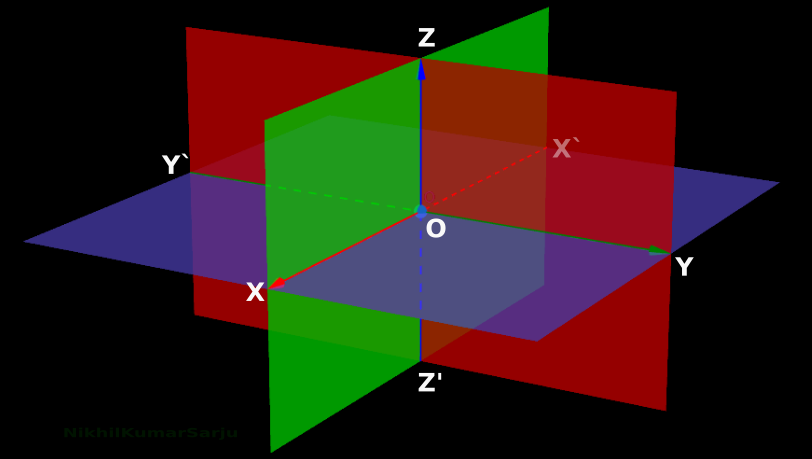
1. Fig.12.3 below shows three mutually perpendicular planes.

Three dimensional rectangular coordinate system
Fig.12.3


   ♦ One plane is red in color.
   ♦ Another plane is green in color.
   ♦ The third plane is blue in color.
2. Intersection of the three planes gives us three different lines:
   ♦ Intersection of green and blue planes give us the line X`OX.
         ✰ This line is shown in red color.
   ♦ Intersection of red and blue planes give us the line Y`OY.
         ✰ This line is shown in green color.
   ♦ Intersection of red and green planes give us the line Z`OZ.
         ✰ This line is shown in blue color.
• The three lines obtained in this way are mutually perpendicular to each other. The three lines intersect at O.
3. Now we have two items:
(i) The planes mentioned in step (1)
(ii) The lines mentioned in step (2)  
• These two items together gives us a simple but powerful system to fix the position of any point in space.
• This system is known as the rectangular coordinate system.
• We will soon see how this system can be used to fix points in space.
4. Before that, we will give specific names to each of the different components of the system.
(i) Naming the lines:
   ♦ Line X’OX is called x-axis.
   ♦ Line Y’OY is called y-axis.
   ♦ Line Z’OZ is called z-axis.
(ii) Naming the planes:
• Two axes lie on the blue plane: x-axis and y-axis.
   ♦ This plane is called XY-plane.
   ♦ z-axis is perpendicular to the XY-plane.
• Two axes lie on the green plane: x-axis and z-axis.
   ♦ This plane is called XZ-plane.
   ♦ y-axis is perpendicular to the XZ-plane.
• Two axes lie on the red plane: y-axis and z-axis.
   ♦ This plane is called YZ-plane.
   ♦ x-axis is perpendicular to the YZ-plane.
(iii) The point O is called origin.
5. The blue plane (XY-plane) is considered to be horizontal.
• So Z’OZ (z-axis) will be vertical.
6. XY-plane is considered to be the plane of the paper.
7. Positive and negative distances:
This can be explained in 3 steps.
(i) The XY-plane divides z-axis into two parts: OZ and OZ’.
• Consider the distances measured along the z-axis.
   ♦ Distances measured from O towards Z are taken as +ve.
   ♦ Distances measured from O towards Z’ are taken as -ve.
(ii) The XZ-plane divides y-axis into two parts: OY and OY’.
• Consider the distances measured along the y-axis.
   ♦ Distances measured from O towards Y are taken as +ve.
   ♦ Distances measured from O towards Y’ are taken as -ve.
(iii) The YZ-plane divides x-axis into two parts: OX and OX’.
• Consider the distances measured along the x-axis.
   ♦ Distances measured from O towards X are taken as +ve.
   ♦ Distances measured from O towards X’ are taken as -ve.
8. Naming of octants.
This can be written in 2 steps:
(i) We know that, the XY-plane is horizontal.
• We have a space above this horizontal plane.
   ♦ YZ-plane and XZ-plane together, divides this space into four compartments.
   ♦ Each of these compartments is called an octant.
• The octant formed by +ve x and +ve y axes is called octant I.
   ♦ It can be named as XOYZ.
         ✰ In two-dimensional problems, +ve x and +ve y axes give quadrant I.
         ✰ It is named XOY.
• The octant formed by -ve x and +ve y axes is called octant II.
   ♦ It can be named as X'OYZ.
         ✰ In two-dimensional problems, -ve x and +ve y axes give quadrant II.
         ✰ It is named X'OY.
• The octant formed by -ve x and -ve y axes is called octant III.
   ♦ It can be named as X'OY'Z.
         ✰ In two-dimensional problems, -ve x and -ve y axes give quadrant III.
         ✰ It is named X'OY'.
• The octant formed by +ve x and -ve y axes is called octant IV.
   ♦ It can be named as XOY`Z.
         ✰ In two-dimensional problems, +ve x and -ve y axes give quadrant IV.
         ✰ It is named XOY'.
(ii) We know that, the XY-plane is horizontal.
• We have a space below this horizontal plane.
   ♦ YZ-plane and XZ-plane together, divides this space into four compartments.
   ♦ Each of these compartments is called an octant.
• The octant formed by +ve x and +ve y axes is called octant V.
   ♦ It can be named as XOYZ'.
• The octant formed by -ve x and +ve y axes is called octant VI.
   ♦ It can be named as X`OYZ'.
• The octant formed by -ve x and -ve y axes is called octant VII.
   ♦ It can be named as X`OY`Z'.
• The octant formed by +ve x and -ve y axes is called octant VIII.
   ♦ It can be named as XOY`Z'.
9. We see a pattern in the names of the octants. It can be explained in 5 steps:
(i) Consider octant I. Adding four, we get octant V.
• Both have the same name except the ‘Z’ part.
   ♦ Name of octant I is XOYZ.
   ♦ Name of octant V is XOYZ’.
         ✰ Obviously, V is directly below I.
(ii) Consider octant II. Adding four, we get octant VI.
• Both have the same name except the ‘Z’ part.
   ♦ Name of octant II is X'OYZ.
   ♦ Name of octant V is X'OYZ’.
         ✰ Obviously, VI is directly below II.
(iii) Consider octant III. Adding four, we get octant VII.
• Both have the same name except the ‘Z’ part.
   ♦ Name of octant III is X'OY'Z.
   ♦ Name of octant VII is X'OY'Z’.
         ✰ Obviously, VII is directly below III.
(iv) Consider octant IV. Adding four, we get octant VIII.
• Both have the same name except the ‘Z’ part.
   ♦ Name of octant IV is XOY'Z.
   ♦ Name of octant VIII is XOY'Z’.
         ✰ Obviously, VIII is directly below IV.
(v) So, if we can remember the details about the first four octants, we can easily write the details about the remaining four octants.
• The good news is that, there is not much to remember about the first four octants.
• This is because:
   ♦ the names of the first four octants
   ♦ is similar to
   ♦ the names of the four quadrants in two-dimensional problems.
• This is shown below:
   ♦ Quadrant I is XOY;       Octant I is XOYZ
   ♦ Quadrant II is X'OY;     Octant II is X'OYZ
   ♦ Quadrant III is X'OY';   Octant III is X'OY'Z
   ♦ Quadrant IV is XOY';    Octant IV is XOY'Z
◼ So the bottom line is this:
   ♦ Since we are familiar with the quadrants of two-dimensional problems,
   ♦ we can easily write the details about
   ♦ the eight octants of three-dimensional problems.
• This will become clear when we do actual problems.
10. A comparison between quadrants and octants can be written in 2 steps:
(i) In two-dimensional problems, the x-axis and y-axis together, divides an area into four quadrants. Recall that, 'quad' indicates four.
(ii) In three-dimensional problems, the XY-plane, XZ-plane and YZ-plane together, divides a space into eight octants. Recall that, 'oct' indicates eight.


Now we know the basic details about the rectangular coordinate system. In the next section, we will see how this system can be used to fix the position of any object in space.

Previous

Contents

Next

Copyright©2023 Higher secondary mathematics.blogspot.com