Showing posts with label foci. Show all posts

Friday, March 24, 2023

Chapter 11.14 - Miscellaneous Examples

In the previous section, we completed a discussion on hyperbola. In this section, we will see some miscellaneous examples.

Solved example 11.18
The focus of the parabolic mirror shown in fig.11.55 below is at a distance of 5 cm from it's vertex. If the mirror is 45 cm deep, find the distance AB.
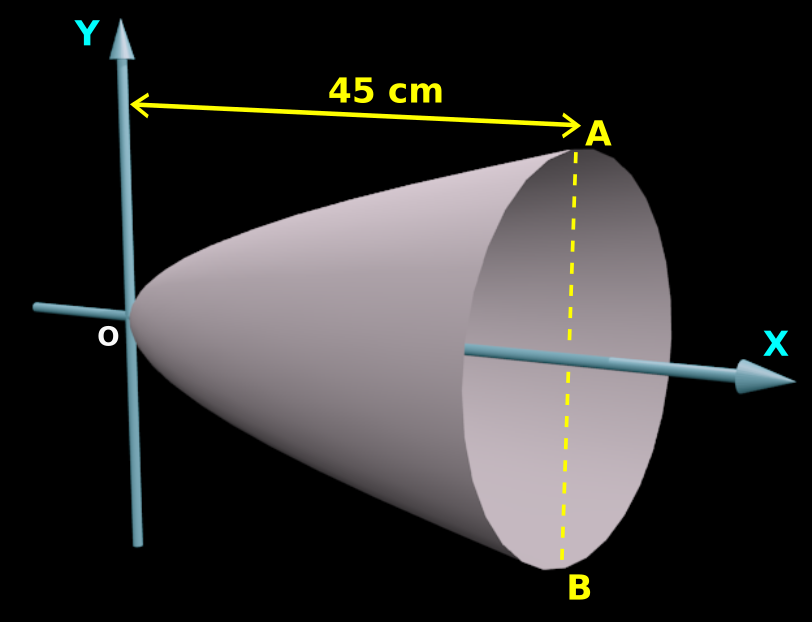
Fig.11.55

Solution:
1. From fig.11.55, it is clear that:
    ♦ Vertex of the mirror is at the origin O.
    ♦ Axis of the mirror lies along the x-axis.
    ♦ The parabola opens to the right.
2. So we can draw a rough sketch of the graph of the parabola as shown in fig.11.56 below:

Fig.11.56

3. General equation of the parabola in the above fig.11.56 is: y2 = 4ax
• Given that, F is at a distance of 5 cm from the vertex. So we get: a = 5 cm.
• So the equation of the parabola is: y2 = 4 × 5 × x = 20x
4. In fig.11.55, 'A' is a point on the parabola. It is at a horizontal distance of 45 cm from the y=axis.
• So the coordinates of 'A' can be written as (45,y) 
5. 'B' is also at a distance of 45 cm from the y-axis.
• So 'A' and 'B' are symmetrical points. The coordinates of B can be written as (45,-y)
6. Since A(45,y) is a point on the parabola, we can substitute those coordinates in the equation of the parabola obtained in (3).
• We get: y2 = 20 × 45 = 900
• From this we get: y = 30 or -30
7. So the coordinates of point A are (45,30)
• Also, the coordinates of B are (45,-30)
8. Using the coordinates, we get:
Distance AB  = $\sqrt{(45 - 45)^2 + (-30 - 30)^2}~=~\sqrt{60^2} = 60$ cm.

Solved example 11.19
The distance between the supports of a beam is 12 metres. When loads are applied on the beam, it deflects and becomes parabolic in shape. The maximum deflection of 3 cm occurs at the midpoint between the supports. At what point between the supports, does a deflection of 1 cm occur?
Solution:
1. The situation before deflection is shown in fig.11.57(a) below:

Fig.11.57

     
• The beam is represented by the red horizontal line AB.
2. After deflection, the the midpoint O of the beam is at a vertical distance of 3 cm below the horizontal line. This is shown in fig.11.57(b).
• Let C be the point where the deflection is 1 cm. Then C will be at a vertical distance of 2 cm above O
3. Given that, the deflected beam is in the shape of a parabola.
• We can consider the lowest point ‘O’ as the vertex.
4. So we can draw a rough sketch of the graph of the parabola as shown in fig.11.58 below:

Fig.11.58

• Vertex of the parabola is at the origin O. This vertex is the midpoint of the beam.
• A is at a distance of 6 m to the left of midpoint. Also, A is 3 cm (0.03 m) vertically above O.
    ♦ So the coordinates of A are: (-6,0.03)
• B is at a distance of 6 m to the right of midpoint. Also, B is 3 cm (0.03 m) vertically above O.
    ♦ So the coordinates of B are: (6,0.03)
• C is at an unknown distance. It is represented by ‘x’. Also, C is 2 cm (0.02 m) vertically above O.
    ♦ So the coordinates of C are (x,0.02)
5. The parabola in fig.11.58 is of the form x2 = 4ay
6. A(-6,0.03) is a point on the parabola. So substituting the coordinates in (5), we get:
(-6)2 = 4 × a × 0.03
⇒ 36 = 0.12a
⇒ a = 300
7. So the equation of the parabola is: x2 = 4 × 300y = 1200y
8. Substituting the coordinates of C in the above equation, we get:
x2 = 1200 × 0.02 = 24
⇒ x = √24 = 2√6
9. So we can write:
Deflection of 1 cm, occurs at a distance of 2√6 m from the midpoint of the beam.

Solved example 11.20
A rod AB of length 15 cm rests in between two coordinate axes in such a way that the end point A lies on x-axis and end point B lies on y-axis. A point P(x,y) is taken on the rod in such a way that AP = 6 cm. Show that the locus of P is an ellipse.
Solution:
1. In fig.11.59 below, the rod AB is resting between OX and OY.

Fig.11.59

• AB makes an angle 𝜃 with OX.
• End A is on OX. End B is on OY.
• P is a point on the rod.
    ♦ Distance of P from A is 6 cm.
    ♦ Distance of P from B is 9 cm.
2. Horizontal and vertical dashed lines:
• A horizontal dashed line is drawn through P. This line intersects the y-axis at Q.
• A vertical dashed line is drawn through P. This line intersects the x-axis at R.
3. Since OX and PQ are parallel, ∠ QPB = 𝜃
4. Let the coordinates of P be (x,y)
    ♦ Then PQ wil be equal to x.
    ♦ Also PR will be equal to y.
5. Now we take trigonometric ratios:
(i) Consider ⧍PBQ.
• In this triangle, cos 𝜃 = x/9.
(ii) Consider ⧍PAR.
• In this triangle, sin 𝜃 = y/6
6. We have the identity: cos2𝜃 + sin2𝜃 = 1
• Substituting the values from (5), we get:

$\begin{array}{ll}
{}&{\left(\frac{x}{9} \right)^2 + \left(\frac{x}{9} \right)^2}
& {~=~}& {1}
&{} \\

{\Rightarrow}&{\frac{x^2}{81} + \frac{y^2}{36}}
& {~=~}& {1}
&{} \\

\end{array}$
7. This is the equation of an ellipse. Any values of (x,y) which the point P takes, will fall on the ellipse.
• So we can write:
Locus of point P is the ellipse $\frac{x^2}{81} + \frac{y^2}{36} = 1$.

◼ More details can be written in 3 steps:
1. The locus is the path traced by a moving point.
• The movement of the point must satisfy one or more specified conditions.
2. In our present problem, P is the point which moves.
The conditions are:
(i) Point A must always be on the x-axis.
(ii) Point B must always be on the y-axis.
(iii) Point P must always be:
    ♦ on the line connecting A and B..
    ♦ 6 cm away from A.  
    ♦ 9 cm away from B.
3. All conditions specified in (2) are satisfied in the animation in fig.11.60 below:

Fig.11.60
• We see that:
The path traced by P is the ellipse $\frac{x^2}{81} + \frac{y^2}{36} = 1$


Link to a few more solved examples is given below:

Miscellaneous Exercise

In the next chapter, we will see Three dimensional geometry.

Previous

Contents

Next

Copyright©2023 Higher secondary mathematics.blogspot.com

Friday, March 17, 2023

Chapter 11.13 - Solved Examples on Hyperbola

In the previous section, we saw latus rectum of hyperbola. We also saw a solved example. In this section, we will see a few more solved examples.

Solved example 11.15
Find the equation of the hyperbola with foci (0,±3) and vertices $\left(0,\pm \frac{\sqrt{11}}{2} \right)$
Solution:
1. The given foci are: (0,3) and (0,-3)
   ♦ These foci lie on the y-axis.
• So the equation of the hyperbola is of the form: $\frac{y^2}{a^2}~-~\frac{x^2}{b^2}~=~1$
2. Since the foci are (0,3) and (0,-3), we get: c = 3
3. The given vertices are: $\left(0, \frac{\sqrt{11}}{2} \right),~\left(0, -\frac{\sqrt{11}}{2} \right)$
• So we get: a = $\frac{\sqrt{11}}{2}$
4. Now we have 'a' and 'c'. We can calculate 'b'.
• We have: c2 = a2 + b2.
• Substituting the known values, we get:

$\begin{array}{ll}
{}&{3^2}
& {~=~}& {\left(\frac{\sqrt{11}}{2} \right)^2~+~b^2}
&{} \\

{\Rightarrow}&{9}
& {~=~}& {\frac{11}{4}~+~b^2}
&{} \\

{\Rightarrow}&{b^2}
& {~=~}& {9~-~\frac{11}{4}}
&{} \\

{\Rightarrow}&{b^2}
& {~=~}& {\frac{25}{4}}
&{} \\

{\Rightarrow}&{b}
& {~=~}& {\frac{5}{2}}
&{} \\

\end{array}$

• So the value of b is $\frac{5}{2}$ units.

5. Now we have 'a' and 'b'.
• Based on step (1), we can write:
Equation of the hyperbola is: $\frac{y^2}{\left(\frac{\sqrt{11}}{2} \right)^2}~-~\frac{x^2}{\left(\frac{5}{2} \right)^2}~=~1$
• This can be simplified as follows:

$\begin{array}{ll}
{}&{\frac{y^2}{\left(\frac{\sqrt{11}}{2} \right)^2}~-~\frac{x^2}{\left(\frac{5}{2} \right)^2}}
& {~=~}& {1}
&{} \\

{\Rightarrow}&{\frac{y^2}{\frac{11}{4}}~-~\frac{x^2}{\frac{25}{4}}}
& {~=~}& {1}
&{} \\

{\Rightarrow}&{\frac{4 y^2}{11}~-~\frac{4 x^2}{25}}
& {~=~}& {1}
&{} \\

{\Rightarrow}&{100 y^2~-~44 x^2}
& {~=~}& {275}
&{} \\

\end{array}$

Solved example 11.16
Find the equation of the hyperbola with foci (0,±12) and length of latus rectum 36.
Solution:
1. The given foci are: (0,12) and (0,-12)
   ♦ These foci lie on the y-axis.
• So the equation of the hyperbola is of the form: $\frac{y^2}{a^2}~-~\frac{x^2}{b^2}~=~1$
2. Since the foci are (0,12) and (0,-12), we get: c = 12
3. We have: Length of latus rectum = $\frac{2 b^2}{a}$ = 36
• From this, we get:
$\begin{array}{ll}
{}&{36}
& {~=~}& {\frac{2 × b^2}{a}}
&{} \\

{\Rightarrow}&{18}
& {~=~}& {\frac{b^2}{a}}
&{} \\

{\Rightarrow}&{b^2}
& {~=~}& {18a}
&{} \\

\end{array}$

4. Now we have 'b2' in terms of 'a' . We can calculate 'a'.
• We have: c2 = a2 + b2.
• Substituting the known values, we get:

$\begin{array}{ll}
{}&{12^2}
& {~=~}& {a^2~+~18 a}
&{} \\

{\Rightarrow}&{144}
& {~=~}& {a^2~+~18a}
&{} \\

{\Rightarrow}&{a^2~+~18a~-~144}
& {~=~}& {0}
&{} \\

\end{array}$

• Solving this quadratic equation, we get: a = 6 or a = -24.
'a' is a length. It cannot be -ve. So we can write: a = 6

5. From the result in (3), we get: b2 = 18a = 18 × 6 = 108

6. Now we have 'a' and 'b2'.
• Based on step (1), we can write:
Equation of the hyperbola is: $\frac{y^2}{36}~-~\frac{x^2}{108}~=~1$

Solved example 11.17
If the foci of the ellipse $\frac{x^2}{25}~+~\frac{y^2}{k^2}~=~1$ and the hyperbola $\frac{x^2}{144}~-~\frac{y^2}{81}~=~\frac{1}{25}$ coincide, find the value of k.
Solution:
1. We are given the complete equation of the hyperbola. So we will analyze it first.
• Given equation of the hyperbola is: $\frac{x^2}{144}~-~\frac{y^2}{81}~=~\frac{1}{25}$.
• It can be rearranged as follows:
$\begin{array}{ll}
{}&{\frac{x^2}{144}~-~\frac{y^2}{81}}
& {~=~}& {\frac{1}{25}}
&{} \\

{\Rightarrow}&{\frac{25 x^2}{144}~-~\frac{25 y^2}{81}}
& {~=~}& {\frac{25}{25}}
&{} \\

{\Rightarrow}&{\frac{x^2}{144/25}~-~\frac{y^2}{81/25}}
& {~=~}& {1}
&{} \\

{\Rightarrow}&{\frac{x^2}{(12/5)^2}~-~\frac{y^2}{(9/5)^2}}
& {~=~}& {1}
&{} \\

\end{array}$

2. In the above result, x2 is the +ve term. So we can write:
The given hyperbola is of the form: $\frac{x^2}{a^2}~-~\frac{y^2}{b^2}~=~1$ 
• Thus we get: a = 12/5 and b = 9/5
3. For any hyperbola, we have: c2 = a2 + b2.
• Substituting the known values, we get:

$\begin{array}{ll}
{}&{c^2}
& {~=~}& {\left(\frac{12}{5} \right)^2~+~\left(\frac{9}{5} \right)^2}
&{} \\

{}&{}
& {~=~}& {\frac{144}{25}~+~\frac{81}{25}}
&{} \\

{}&{}
& {~=~}& {\frac{225}{25}}
&{} \\

\end{array}$

• So the value of c is 15/5 = 3

4. The foci are (-c,0) and (c,0)
• So we get: (-3,0) and (3,0)

5. Given that, foci of the ellipse and the hyperbola are the same. So we can write:
• Foci of the ellipse $\frac{x^2}{25}~+~\frac{y^2}{k^2}~=~1$ are: (-3,0) and (3,0)
• Thus we can write: Value of 'c' for the ellipse is 3.   
6. Given equation of the ellipse is: $\frac{x^2}{25}~+~\frac{y^2}{k^2}~=~1$
• This is of the form: $\frac{x^2}{a^2}~+~\frac{y^2}{b^2}~=~1$
• So we can write: a = 5 and b = k
7. For any ellipse, we have: c2 = a2 - b2.
• Substituting the known values, we get:

$\begin{array}{ll}
{}&{3^2}
& {~=~}& {5^2~-~k^2}
&{} \\

{\Rightarrow}&{k^2}
& {~=~}& {5^2~-~3^2}
&{} \\

{\Rightarrow}&{k^2}
& {~=~}& {25~-~9}
&{} \\

{\Rightarrow}&{k^2}
& {~=~}& {16}
&{} \\

{\Rightarrow}&{k}
& {~=~}& {4}
&{} \\

\end{array}$

8. So we can write:
   ♦ The ellipse $\frac{x^2}{25}~+~\frac{y^2}{4^2}~=~1$
   ♦ And the hyperbola $\frac{x^2}{144}~-~\frac{y^2}{81}~=~\frac{1}{25}$
   ♦ Have the same foci (-3,0) and (3,0).
9. The actual plot is shown in fig.11.54 below:

Fig.11.54


Link to a few more solved examples is given below:

Exercise 11.4

In the next section, we will see some miscellaneous examples.

Previous

Contents

Next

Copyright©2023 Higher secondary mathematics.blogspot.com

Sunday, March 12, 2023

Chapter 11.10 - Simplest Equation of A Hyperbola

In the previous section, we saw the basic properties of a hyperbola. In this section, we will see equation of an hyperbola.

• To write the equation of a hyperbola, we must first place it on the Cartesian plane.
• The equation will be in the simplest form when the following three conditions are satisfied:
    ♦ The center of the hyperbola is at the origin O.
    ♦ The transverse axis of the hyperbola lies along the x-axis.
    ♦ The conjugate axis of the hyperbola lies along the y-axis.
• This is shown in fig.11.45 below:

Fig.11.45

• Based on fig.11.45, we can derive the equation in 6 steps:
1. Let P(x,y) be any point on the hyperbola.
2. We know that, F1 is at a distance of ‘c’ from O.
• So the coordinates of F1 will be (-c,0)   
3. We know that, F2 is at a distance of ‘c’ from O.
• So the coordinates of F2 will be (c,0)
4. Now we have three points and their coordinates:
P(x,y), F1(-c,0), F2(c,0)
• Using the distance formula, we can write some distances:

• First we write the distance PF1:
$\begin{array}{ll}
{}&{PF_1}
& {~=~}& {\sqrt{(x~-~ -c)^2~+~(y - 0)^2}}
&{} \\

{}&{}
& {~=~}& {\sqrt{(x + c)^2~+~y^2}}
&{} \\

\end{array}$ 

• Next we write the distance PF2:
$\begin{array}{ll}
{}&{PF_2}
& {~=~}& {\sqrt{(x~-~ c)^2~+~(y - 0)^2}}
&{} \\

{}&{}
& {~=~}& {\sqrt{(x - c)^2~+~y^2}}
&{} \\

\end{array}$

• Difference of the above two distances is: $\sqrt{(x + c)^2~+~y^2}~-~\sqrt{(x - c)^2~+~y^2}$

5. We know that, the constant difference for a hyperbola is '2a'

6. Equating the results in (4) and (5), we get:

$\begin{array}{ll}
{}&{\sqrt{(x + c)^2~+~y^2}~-~\sqrt{(x - c)^2~+~y^2}}
& {~=~}& {2a}
&{} \\

{\Rightarrow}&{\sqrt{(x + c)^2~+~y^2}}
& {~=~}& {2a~+~\sqrt{(x - c)^2~+~y^2}}
&{} \\

{\Rightarrow}&{(x + c)^2~+~y^2}
& {~=~}& {4a^2~+~4a \sqrt{(x - c)^2~+~y^2}~+~(x - c)^2~+~y^2~~ \color {green} {\text{- - - (I)}}}
&{} \\

{\Rightarrow}&{x^2 + 2xc + c^2 + y^2}
& {~=~}& {4a^2~+~4a \sqrt{(x - c)^2~+~y^2}~+~x^2 - 2xc + c^2~+~y^2}
&{} \\

{\Rightarrow}&{2xc}
& {~=~}& {4a^2~+~4a \sqrt{(x - c)^2~+~y^2}- 2xc}
&{} \\

{\Rightarrow}&{4xc}
& {~=~}& {4a^2~+~4a \sqrt{(x - c)^2~+~y^2}}
&{} \\

{\Rightarrow}&{xc}
& {~=~}& {a^2~+~a \sqrt{(x - c)^2~+~y^2}~~ \color {green} {\text{- - - (II)}}}
&{} \\

{\Rightarrow}&{\frac{xc}{a}}
& {~=~}& {a~+~\sqrt{(x - c)^2~+~y^2}}
&{} \\

{\Rightarrow}&{\sqrt{(x - c)^2~+~y^2}}
& {~=~}& {\frac{xc}{a}~-~a~~ \color {green} {\text{- - - (III)}}}
&{} \\

{\Rightarrow}&{(x - c)^2~+~y^2}
& {~=~}& {\frac{x^2 c^2}{a^2}~-~\frac{2axc}{a}~+~a^2}
&{} \\

{\Rightarrow}&{(x - c)^2~+~y^2}
& {~=~}& {a^2~-~2cx~+~\frac{x^2 c^2}{a^2}}
&{} \\

{\Rightarrow}&{x^2 - 2cx + c^2~+~y^2}
& {~=~}& {a^2~-~2cx~+~\frac{x^2 c^2}{a^2}}
&{} \\

{\Rightarrow}&{x^2 + c^2~+~y^2}
& {~=~}& {a^2~+~\frac{x^2 c^2}{a^2}}
&{} \\

{\Rightarrow}&{x^2 ~+~y^2~-~\frac{x^2 c^2}{a^2}}
& {~=~}& {a^2 - c^2}
&{} \\

{\Rightarrow}&{x^2 \left(1~-~\frac{c^2}{a^2} \right)~+~y^2}
& {~=~}& {a^2 - c^2}
&{} \\

{\Rightarrow}&{x^2 \left(\frac{a^2~-~c^2}{a^2} \right)~+~y^2}
& {~=~}& {a^2 - c^2~~ \color {green} {\text{- - - (IV)}}}
&{} \\

{\Rightarrow}&{x^2 \left(\frac{c^2~-~a^2}{a^2} \right)~-~y^2}
& {~=~}& {c^2 - a^2~~ \color {green} {\text{- - - (V)}}}
&{} \\

{\Rightarrow}&{x^2 \left(\frac{b^2}{a^2} \right)~-~y^2}
& {~=~}& {b^2~~ \color {green} {\text{- - - (VI)}}}
&{} \\

{\Rightarrow}&{\frac{x^2}{a^2}~-~\frac{y^2}{b^2}}
& {~=~}& {1}
&{} \\

\end{array}$

◼ Remarks:
• Line marked as (I):
In this line, we square both sides.
• Line marked as (II):
In this line, we divide both sides by 4.
• Line marked as (III):
In this line, we square both sides.
• Line marked as (IV):
In this line, multiply both sides by -1.
• Line marked as (V):
In this line, write b2 in the place of c2 - a2.
• Line marked as (VI):
In this line, we divide both sides by b2.


Using the above 6 steps, we derived an equation. Now we will prove the converse. It can be written in 11 steps:

1. We derived an equation: $\frac{x^2}{a^2}~-~\frac{y^2}{b^2}~=~1$
2. To prove the converse, we assume a point P.
• Let P(x,y) be any point on the ellipse.
• Distance of P from F1 can be written as:

$\begin{array}{ll}
{}&{PF_1}
& {~=~}& {\sqrt{(x~-~ -c)^2~+~(y - 0)^2}}
&{} \\

{}&{}
& {~=~}& {\sqrt{(x + c)^2~+~y^2}}
&{} \\

\end{array}$

3. But based on the equation written in (1), we can write:

$\begin{array}{ll}
{}&{\frac{y^2}{b^2}}
& {~=~}& {\frac{x^2}{a^2}-1}
&{} \\

{\Rightarrow}&{y^2}
& {~=~}& {b^2\left(\frac{x^2}{a^2}~-~1 \right)}
&{} \\

\end{array}$

4. Substituting the above result in (2), we get:

$\begin{array}{ll}
{}&{PF_1}
& {~=~}& {\sqrt{(x + c)^2~+~y^2}}
&{} \\

{}&{}
& {~=~}& {\sqrt{(x + c)^2~+~b^2\left(\frac{x^2}{a^2}~-~1 \right)}}
&{} \\

{}&{}
& {~=~}& {\sqrt{(x + c)^2~+~\left(c^2 - a^2 \right) \left(\frac{x^2 }{a^2}~-~1 \right)}~~ \color {green} {\text{- - - (I)}}}
&{} \\

{}&{}
& {~=~}& {\sqrt{x^2 + 2cx + c^2~+~\frac{c^2 x^2}{a^2} - c^2 - x^2 + a^2 }}
&{} \\

{}&{}
& {~=~}& {\sqrt{2cx~+~a^2 + \frac{c^2 x^2}{a^2}}}
&{} \\

{}&{}
& {~=~}& {\sqrt{\left(a+\frac{cx}{a} \right)^2}}
&{} \\

{}&{}
& {~=~}& {a+\frac{cx}{a}}
&{} \\

\end{array}$

◼ Remarks:
• Line marked as (I):
In this line, we write c2 - a2 in the place of b2.

5. Now we consider the distance of P from F2. It can be written as:

$\begin{array}{ll}
{}&{PF_2}
& {~=~}& {\sqrt{(x~-~ c)^2~+~(y - 0)^2}}
&{} \\

{}&{}
& {~=~}& {\sqrt{(x - c)^2~+~y^2}}
&{} \\

\end{array}$

6. As we did in the case of PF1, here also, we substitute for y2. We get:

$\begin{array}{ll}
{}&{PF_2}
& {~=~}& {\sqrt{(x - c)^2~+~y^2}}
&{} \\

{}&{}
& {~=~}& {\sqrt{(x - c)^2~+~b^2\left(\frac{x^2 - a^2}{a^2} \right)}}
&{} \\

{}&{}
& {~=~}& {\sqrt{(x - c)^2~+~\left(c^2 - a^2 \right) \left(\frac{x^2 }{a^2}~-~1 \right)}~~ \color {green} {\text{- - - (I)}}}
&{} \\

{}&{}
& {~=~}& {\sqrt{x^2 - 2cx + c^2~+~\frac{c^2 x^2}{a^2} - c^2 - x^2 + a^2 }}
&{} \\

{}&{}
& {~=~}& {\sqrt{-2cx~+~a^2 + \frac{c^2 x^2}{a^2}}}
&{} \\

{}&{}
& {~=~}& {\sqrt{\left(a-\frac{cx}{a} \right)^2}}
&{} \\

{}&{}
& {~=~}& {a-\frac{cx}{a}}
&{} \\

\end{array}$

◼ Remarks:
• Line marked as (I):
In this line, we write c2 - a2 in the place of b2

7. Now we have to find the difference between PF1 and PF2. It can be calculated in 6 steps:
(i) We know that, the vertices are at a distance of 'a' from O.
• So we can draw the vertical lines x= -a and x = a through the vertices. This is shown in fig.11.46 below:

Fig.11.46

(ii) Our point P is on the right branch of the hyperbola.
• That means, P is on the right side of the line x=a
    ♦ So the x-coordinate of P will be greater than 'a'.
    ♦ We can write: x > a
(iii) Now, $\frac{c}{a}$ is greater than '1' because, 'c' is greater than 'a'.
    ♦ Since $\frac{c}{a}$ is greater than '1', and x>a, we can write: $\frac{cx}{a}$ is greater than 'a'.
(iv) So the distance PF2 = $a-\frac{cx}{a}$ will become -ve
• To make it +ve, we must write: PF2 = $\frac{cx}{a}-a$
(v) The distance PF1 = $a+\frac{cx}{a}$ need not be adjusted because, subtraction is not involved. 
(vi) Now we can write the difference:
PF1 - PF2 = $a+\frac{cx}{a}~-~\left( \frac{cx}{a}-a \right)$
= $a+\frac{cx}{a} -  \frac{cx}{a}+ a$ = 2a
8. In the step (7) above, we considered the case when the point P is on the right side branch of the hyperbola.
• Fig.11.47 below shows the case when P is on the left side branch.

Fig.11.47

• Here also, to find the difference, we must make some adjustments. It can be written in 6 steps:
(i) We know that, the vertices are at a distance of 'a' from O.
• So we can draw the vertical lines x= -a and x = a through the vertices. This is shown in fig.11.47 above.
(ii) Our point P is on the left branch of the hyperbola.
• That means, P is on the left side of the line x=-a
    ♦ So the x-coordinate of P will be lesser than '-a'.
    ♦ We can write: x will be -ve
(iii) Since x is -ve, the distance PF2 = $a-\frac{cx}{a}$ will become +ve. So there is no adjustment required for PF2
(iv) Now consider PF1 = $a+\frac{cx}{a}$
• c/a is greater than '1' because, 'c' is always greater than 'a'.
    ♦ Since $\frac{c}{a}$ is greater than '1', and 'x' is -ve, we can write: $\frac{cx}{a}$ is -ve and numerically greater than 'a'.
(v) So the distance PF1 = $a+\frac{cx}{a}$ will become -ve
• To make it +ve, we must write: PF1 = $-\left(a+\frac{cx}{a} \right)$
(vi) Now we can write the difference:
• Since PF2 is larger, we must subtract PF1 from PF2.
PF2 - PF1 = $\left(a-\frac{cx}{a}\right)~-~-\left(a+\frac{cx}{a} \right)$
= $a - \frac{cx}{a}+ a + \frac{cx}{a}$ = 2a
9. Based on steps (7) and (8), we can write:
The point P can be anywhere on the hyperbola. The difference will always be '2a'.
10. In the previous section, we saw that, the constant difference of the hyperbola is '2a'.
11. So any point P(x,y) on the hyperbola will satisfy the equation $\frac{x^2}{a^2}~-~\frac{y^2}{b^2}~=~1$
• The converse is proved.

◼ So we can write:
If the center of the hyperbola is at O, transverse axis lies along the x-axis and conjugate axis lies along the y-axis, then equation of the hyperbola is: $\frac{x^2}{a^2}~-~\frac{y^2}{b^2}~=~1$


Based on the above equation of the hyperbola, we can write an interesting fact. It can be written in 4 steps:
1. We have: $\frac{x^2}{a^2}~-~\frac{y^2}{b^2}~=~1$
2. This can be rearranged as: $\frac{x^2}{a^2}~=~1~+~\frac{y^2}{b^2}$
• So $\frac{x^2}{a^2}$ will be always greater than 1.
• That is: $\left|\frac{x}{a}\right|~\ge~1$
3. Solving the above inequality, we get:
    ♦ x should not be greater than -a.
    ♦ x should not be less than a.
• That is: $x \le -a ~\text{or}~x \ge a$
4. So we can write:
• Consider any point on the hyperbola. It will not lie between the two vertical lines:
    ♦ x = -a.
    ♦ x =  a.


• In this section, we saw a simplest equation of a hyperbola.
    ♦ The center is at O.
    ♦ The transverse axis lies along the x-axis.
    ♦ The conjugate axis lies along the y-axis.
• We will get another simplest equation also when:
    ♦ The center is at O.
    ♦ The transverse axis lies along the y-axis.
    ♦ The conjugate axis lies along the x-axis.
• We will see it in the next section.

Previous

Contents

Next

Copyright©2023 Higher secondary mathematics.blogspot.com

Saturday, March 11, 2023

Chapter 11.9 - Hyperbola

In the previous section, we completed a discussion on ellipse. In this section, we will see hyperbola.

Some basics about hyperbola can be written in 6 steps:
1. Consider the five points F1, F2, P1, P2 and P3 marked in fig.11.42 below:

Fig.11.42

2. Let us write some distances:
• Distance of P1:
   ♦ Distance of P1 from F1 is 8.6 units.
   ♦ Distance of P1 from F2 is 18.7 units.
         ✰ The difference of the two distances is (18.7 - 8.6) = 10.1 units.
• Distance of P2:
   ♦ Distance of P2 from F1 is 16.7 units.
   ♦ Distance of P2 from F2 is 6.6 units.
         ✰ The difference of the two distances is (16.7 - 6.6) = 10.1 units.
• Distance of P3:
   ♦ Distance of P3 from F1 is 14.1 units.
   ♦ Distance of P3 from F2 is 4.0 units.
         ✰ The difference of the two distances is (14.1 - 4.0) = 10.1 units.
3. So the three points P1, P2 and P3 have a specialty. It can be written in two steps:
(i) Take any one of those three points.
   ♦ Measure the distance of that point from F1.
   ♦ Measure the distance of that point from F2.
(ii) The difference of the two distances will be 10.1 units.
4. There are infinite number of points for which the difference is 10.1 units.      
• All such points will lie in the red curve.
• The red curve is called a hyperbola.
5. So we can write the definition:
A hyperbola is the set of all points in a plane difference of whose distances from two fixed points in the plane is a constant.
6. Note that, for a particular hyperbola, the two points F1 and F2 are fixed. If we change one or both of those points, we will get another hyperbola.

Now we will see some basic features of hyperbola. They can be written in 8 steps:
1. We have seen that, F1 and F2 are two fixed points.
• They are called the foci of the hyperbola.
(‘foci’ is the plural of ‘focus’)
2. Draw a line connecting the two foci.
• Let it intersect the hyperbola at A and B.
• Then the line through the foci is called the transverse axis of the hyperbola.
• This is shown in fig.11.43 below:

Fig.11.43

3. The midpoint of F1F2 is called center of the hyperbola. It is denoted by the letter O.
4. Draw a line through O and perpendicular to AB.
• This line is called the conjugate axis of the hyperbola.
5. The points A and B at which the transverse axis meets the hyperbola are called vertices of the hyperbola.
6. The length AB is written as ‘2a’. This is shown in fig.11.44 below:

Fig.11.44

• The distance between the two foci is written as ‘2c’
7. Based on the above fig.11.44, we can write:
   ♦ Distance from center to any one vertex is 'a'.
   ♦ '2a' is the length of the transverse axis.
   ♦ Distance from center to any one focus is 'c'.
8. '2b' is considered as the length of the conjugate axis.
   ♦ Where $b=\sqrt{c^2 - a^2}$


In fig.11.42, we saw that, the difference of the distances is a constant. Our next aim is to find the value of that constant. It can be written in 3 steps:
1. Consider a point P on the hyperbola.
• Let it be situated at the vertex A
• Then the distance of P from F1 = AF1 = (OF1 – OA) = c-a
• Also the distance of P from F2 = AF2 = (OA + OB + BF2)
= [a+a+(c-a)] = c + a  
2. So the difference between the distances = [(c+a) – (c-a)] = [c+a-c+a] = 2a
3. We can write:
For any point P on the hyperbola, the difference in distances from the foci will be ‘2a’          


Eccentricity of a Hyperbola

This can be explained in 5 steps:
1. Consider the distance ‘c’.
• It is the distance of the focus from the center O.
2. Consider the distance ‘a’.
• It is the distance of the vertex from the center O.
3. Eccentricity of a hyperbola is the ratio of the above two items. It is denoted by the letter ‘e’.
So we can write: $\rm{e=\frac{c}{a}}$
4. Based on this result, we can write: c = ae.
• That means, in any hyperbola, the focus is at a distance of ae from the center.
5. From fig.11.44, it is clear that, 'c' is greater than 'a'. So the eccentricity is never less than 1.


In the next section, we will see the standard equations of a hyperbola.

Previous

Contents

Next

Copyright©2023 Higher secondary mathematics.blogspot.com

Saturday, March 4, 2023

Chapter 11.8 - Solved Examples on Ellipse

In the previous section, we saw latus rectum of ellipse. We also saw a solved example. In this section, we will see a few more solved examples.

Solved example 11.10
For the ellipse 9x2 + 4y2 = 36, find the following:
(i) coordinates of the foci
(ii) coordinates of the vertices
(iii) the length of major axis
(iv) the length of minor axis
(v) the eccentricity
(vi) length of the latus rectum.
Solution:
The given equation can be rearranged as follows:

$\begin{array}{ll}
{}&{9x^2 + 4 y^2}
& {~=~}& {36}
&{} \\

{\Rightarrow}&{\frac{9 x^2}{36}~+~\frac{4 y^2}{36}}
& {~=~}& {\frac{36}{36}}
&{} \\

{\Rightarrow}&{\frac{x^2}{36/9}~+~\frac{y^2}{36/4}}
& {~=~}& {\frac{36}{36}}
&{} \\

{\Rightarrow}&{\frac{x^2}{4}~+~\frac{y^2}{9}}
& {~=~}& {1}
&{} \\

\end{array}$

• Now the equation is in the standard form of an ellipse.
1. Comparing the denominators:
    ♦ Denominator of the x2 term is 4
    ♦ Denominator of the y2 term is 9
• The larger denominator is taken as a2
• So the equation of the ellipse is of the form: $\frac{x^2}{b^2}~+~\frac{y^2}{a^2}~=~1$
• So we can write:
    ♦ Major axis of this ellipse lies along the y-axis.
    ♦ Minor axis of this ellipse lies along the x-axis.
    ♦ a2 = 9. So a = 3
    ♦ b2 = 4. So b = 2
2. We have: c2 = a2 - b2.
• Substituting the known values, we get:

$\begin{array}{ll}
{}&{c^2}
& {~=~}& {3^2~-~2^2}
&{} \\

{}&{}
& {~=~}& {9~-~4}
&{} \\

{}&{}
& {~=~}& {5}
&{} \\

\end{array}$

• So the value of c is √5

3. The coordinates of the foci are (0,c) and (0,-c)
• So in our present case, the coordinates are: (0,√5) and (0,-√5)
• This is the answer for part (i).
4. The coordinates of the vertices are (0,a) and (0,-a)
• So in our present case, the coordinates are: (0,3) and (0,-3)
• This is the answer for part (ii).
5. The length of major axis is 2a
• So in our present case, the length is: 2 × 3 = 6 units
• This is the answer for part (iii).
6. The length of minor axis is 2b
• So in our present case, the length is: 2 × 2 = 4 units
• This is the answer for part (iv).
7. Eccentricity is given by: e = c/a
• So in our present case, e = √5/3
• This is the answer for part (v).
8. We have: Length of latus rectum = $\frac{2 b^2}{a}$
• Substituting the known values, we get:

$\begin{array}{ll}
{}&{\text{Length}}
& {~=~}& {\frac{2 × 2^2}{3}}
&{} \\

{}&{}
& {~=~}& {\frac{8}{3}~\text{= 2.7 units}}
&{} \\

\end{array}$

• This is the answer for part (vi).

9. The actual plot is shown below:

Fig.11.41

Solved example 11.11
Find the equation of the ellipse whose vertices are (±13,0) and foci are (±5,0).
Solution:
1. Given that, vertices are (-13,0) and (13,0)
• Vertices are the end points of the major axis. The given vertices lie on the x-axis.
• So we can write:
The major axis of the given ellipse lies along the x-axis.
2. The given vertices are symmetric about the origin O.
• So we can write:
The center of the given ellipse is at O.
3. Based on the above two steps, we can write:
• Equation of the given ellipse is of the form: $\frac{x^2}{a^2}~+~\frac{y^2}{b^2}~=~1$
4. The vertices are (-13,0) and (13,0).
• So length of the major axis
= Distance between (-13,0) and (13,0)
= 2a = (13 + 13) = 26 
• Thus we get: a = 13 units.
5. Given that, foci are (-5,0) and (5,0).
• So distance of any one focus from center = c = 5 unit.
6. Now we have 'a' and 'c'. We can calculate 'b'.
• We have: c2 = a2 - b2.
• Substituting the known values, we get:

$\begin{array}{ll}
{}&{5^2}
& {~=~}& {13^2~-~b^2}
&{} \\

{\Rightarrow}&{25}
& {~=~}& {169~-~b^2}
&{} \\

{\Rightarrow}&{b^2}
& {~=~}& {169~-~25}
&{} \\

{\Rightarrow}&{b^2}
& {~=~}& {144}
&{} \\

{\Rightarrow}&{b}
& {~=~}& {12}
&{} \\

\end{array}$

• So the value of b is 12 units.

7. Now we have 'a' and 'b'.
• Based on step (3), we can write:
Equation of the ellipse is: $\frac{x^2}{13^2}~+~\frac{y^2}{12^2}~=~1$

Solved example 11.12
Find the equation of the ellipse whose length of the major axis is 20 and foci are (0,±5)
Solution:
1. Given that, foci are (0,5) and (0,-5)
• Both these points lie on the y-axis.
• So we can write:
Major axis of the ellipse lies along the y-axis.
2. The foci (0,5) and (0,-5) are symmetric about the origin O.
• So we can write:
Center of the given ellipse is at O.
3. Based on the above two steps, we can write:
• Equation of the given ellipse is of the form: $\frac{x^2}{b^2}~+~\frac{y^2}{a^2}~=~1$
4. Given that, foci are (0,5) and (0,-5).
• So distance of any one focus from center = c = 5 unit.
5. Given that, length of the major axis is 20 units.
• So we can write:
Length of the semi major axis = a = 10 units.
6. Now we have 'a' and 'c'. We can calculate 'b'.
• We have: c2 = a2 - b2.
• Substituting the known values, we get:

$\begin{array}{ll}
{}&{5^2}
& {~=~}& {10^2~-~b^2}
&{} \\

{\Rightarrow}&{25}
& {~=~}& {100~-~b^2}
&{} \\

{\Rightarrow}&{b^2}
& {~=~}& {100~-~25}
&{} \\

{\Rightarrow}&{b^2}
& {~=~}& {75}
&{} \\

{\Rightarrow}&{b}
& {~=~}& {5 \sqrt{3}}
&{} \\

\end{array}$

• So the value of b is $5 \sqrt{3}$ units.

7. Now we have 'a' and 'b'.
• Based on step (3), we can write:
Equation of the ellipse is: $\frac{x^2}{(5 \sqrt{3})^2}~+~\frac{y^2}{10^2}~=~1$
• Which is same as: $\frac{x^2}{75}~+~\frac{y^2}{100}~=~1$

Solved example 11.13
Find the equation of the ellipse, with major axis along the x-axis and passing through the points (4,3) and (-1,4).
Solution:
1. Given that, major axis lies along the x-axis.
• So the equation of the ellipse will be of the form: $\frac{x^2}{a^2}~+~\frac{y^2}{b^2}~=~1$
2. Since (4,3) ans (-1,4) lie on the ellipse, we can write:
(i) $\frac{4^2}{a^2}~+~\frac{3^2}{b^2}~=~1$
• Which is same as: $\frac{16}{a^2}~+~\frac{9}{b^2}~=~1$
(ii) $\frac{(-1)^2}{a^2}~+~\frac{4^2}{b^2}~=~1$
• Which is same as: $\frac{1}{a^2}~+~\frac{16}{b^2}~=~1$ 
3. Let $\frac{1}{a^2}~=~P~\text{and}~\frac{1}{b^2}~=~Q$
    ♦ Then 2(i) will become: 16P + 9Q = 1
    ♦ Also, 2(ii) will become: P + 16Q = 1
4. Solving the two equations in step (3), we get:
(i) P = $\frac{1}{a^2}~=~\frac{7}{247}$
• So $a^2 ~=~\frac{247}{7}$
(ii) Q = $\frac{1}{b^2}~=~\frac{15}{247}$
• So $b^2 ~=~\frac{247}{15}$
5. Now we have 'a' and 'b'. So based on step (1), we can write:
Equation of the given ellipse is: $\frac{x^2}{247/7}~+~\frac{y^2}{247/15}~=~1$


Link to a few more solved examples is given below:

Exercise 11.3

In the next section, we will see hyperbola.

Previous

Contents

Next

Copyright©2023 Higher secondary mathematics.blogspot.com

Friday, March 3, 2023

Chapter 11.7 - Latus Rectum of Ellipse

In the previous section, we completed a discussion on the standard equations of ellipse. In this section, we will see latus rectum.

Latus rectum of a ellipse

This can be explained in three steps:
1. Latus rectum is a line segment.
2. If a line segment is to qualify as the latus rectum of an ellipse, it must satisfy three conditions.
(i) It must pass through F1 or F2.
(ii) It must be perpendicular to the major axis.
(iii) It’s end points must lie on the ellipse.
3. Line segments AB and CD in fig.11.39 below satisfy all three conditions. So both are latus rectum of that ellipse.

Fig.11.39


Length of the latus rectum

• We have seen the two forms where the equation of ellipse is the simplest. Length of the latus rectum can be calculated very easily for those two forms.

• Let us see Form 1. It is shown in fig.11.39 above. We want the length AB. It can be calculated in 2 steps:
1. In the fig.11.39 above, let the length AF2 be l.
• Then the coordinates of A will be (c,l)
2. Point A lies on the ellipse. So we can write:

$\begin{array}{ll}
{}&{\frac{c^2}{a^2}~+~\frac{l^2}{b^2}}
& {~=~}& {1}
&{} \\

{\Rightarrow}&{\frac{l^2}{b^2}}
& {~=~}& {1~-~\frac{c^2}{a^2}}
&{} \\

{\Rightarrow}&{\frac{l^2}{b^2}}
& {~=~}& {\frac{a^2~-~c^2}{a^2}}
&{} \\

{\Rightarrow}&{\frac{l^2}{b^2}}
& {~=~}& {\frac{b^2}{a^2}}
&{} \\

{\Rightarrow}&{l^2}
& {~=~}& {\frac{b^4}{a^2}}
&{} \\

{\Rightarrow}&{l}
& {~=~}& {\frac{b^2}{a}}
&{} \\

{\Rightarrow}&{2l}
& {~=~}& {\frac{2b^2}{a}}
&{} \\

\end{array}$

• Note:
In the above calculation, first we obtained l. Then we doubled it to obtain the total length AB. This is because, the ellipse is symmetric about the major axis.

◼ So we can write:
Length of the latus rectum of the ellipse $\frac{x^2}{a^2}~+~\frac{y^2}{b^2}~=~1$ is $\frac{2 b^2}{a}$


• Let us see Form 2. It is shown in fig.11.40 below:

Fig.11.40

• We want the length AB. It can be calculated in 2 steps:
1. In the fig.11.40 above, let the length AF2 be l.
Then the coordinates of A will be (-l,c)
2. Point A lies on the ellipse. So we can write:

$\begin{array}{ll}
{}&{\frac{(-l)^2}{b^2}~+~\frac{c^2}{a^2}}
& {~=~}& {1}
&{} \\

{}&{\frac{l^2}{b^2}~+~\frac{c^2}{a^2}}
& {~=~}& {1}
&{} \\

{\Rightarrow}&{\frac{l^2}{b^2}}
& {~=~}& {1~-~\frac{c^2}{a^2}}
&{} \\

{\Rightarrow}&{\frac{l^2}{b^2}}
& {~=~}& {\frac{a^2~-~c^2}{a^2}}
&{} \\

{\Rightarrow}&{\frac{l^2}{b^2}}
& {~=~}& {\frac{b^2}{a^2}}
&{} \\

{\Rightarrow}&{l^2}
& {~=~}& {\frac{b^4}{a^2}}
&{} \\

{\Rightarrow}&{l}
& {~=~}& {\frac{b^2}{a}}
&{} \\

{\Rightarrow}&{2l}
& {~=~}& {\frac{2b^2}{a}}
&{} \\

\end{array}$

• Note:
In the above calculation, first we obtained l. Then we doubled it to obtain the total length AB. This is because, the ellipse is symmetric about the major axis.

◼ So we can write:
Length of the latus rectum of the ellipse $\frac{x^2}{b^2}~+~\frac{y^2}{a^2}~=~1$ is also $\frac{2 b^2}{a}$


Now we will see a solved example:

Solved example 11.9
For the ellipse $\frac{x^2}{25}~+~\frac{y^2}{9}~=~1$, find the following:
(i) coordinates of the foci
(ii) coordinates of the vertices
(iii) the length of major axis
(iv) the length of minor axis
(v) the eccentricity
(vi) length of the latus rectum.
Solution:
1. Comparing the denominators:
    ♦ Denominator of the x2 term is 25
    ♦ Denominator of the y2 term is 9
• The larger denominator is taken as a2
• So the equation of the ellipse is of the form: $\frac{x^2}{a^2}~+~\frac{y^2}{b^2}~=~1$
• So we can write:
    ♦ Major axis of this ellipse lies along the x-axis.
    ♦ Minor axis of this ellipse lies along the y-axis.
    ♦ a2 = 25. So a = 5
    ♦ b2 = 9. So b = 3
2. We have: c2 = a2 - b2.
• Substituting the known values, we get:

$\begin{array}{ll}
{}&{c^2}
& {~=~}& {5^2~-~3^2}
&{} \\

{}&{}
& {~=~}& {25~-~9}
&{} \\

{}&{}
& {~=~}& {16}
&{} \\

\end{array}$

• So the value of c is 4

3. The coordinates of the foci are (-c,0) and (c,0)
• So in our present case, the coordinates are: (-4,0) and (4,0)
• This is the answer for part (i).
4. The coordinates of the vertices are (-a,0) and (a,0)
• So in our present case, the coordinates are: (-5,0) and (5,0)
• This is the answer for part (ii).
5. The length of major axis is 2a
• So in our present case, the length is: 2 × 5 = 10 units
• This is the answer for part (iii).
6. The length of minor axis is 2b
• So in our present case, the length is: 2 × 3 = 6 units
• This is the answer for part (iv).
7. Eccentricity is given by: e = c/a
• So in our present case, e = 4/5
• This is the answer for part (v).
8. We have: Length of latus rectum = $\frac{2 b^2}{a}$
• Substituting the known values, we get:

$\begin{array}{ll}
{}&{\text{Length}}
& {~=~}& {\frac{2 × 3^2}{5}}
&{} \\

{}&{}
& {~=~}& {\frac{18}{5}~\text{units}}
&{} \\

\end{array}$

• This is the answer for part (vi).


In the next section, we will see a few more solved examples.

Previous

Contents

Next

Copyright©2023 Higher secondary mathematics.blogspot.com

Chapter 11.6 - Another Simplest Equation of Ellipse

In the previous section, we saw the simplest equation of an ellipse.
    ♦ The major axis was along the x-axis.
    ♦ The minor axis was along the y-axis.
• We will get another simplest equation also when:
    ♦ The major axis lies along the y-axis.
    ♦ The minor axis lies along the x-axis.
• We will see it in this section.

• To write the equation of an ellipse, we must first place it on the Cartesian plane.
• The equation will be in the simplest form also when the following three conditions are satisfied:
    ♦ The center of the ellipse is at the origin O.
    ♦ The major axis of the ellipse lies along the y-axis.
    ♦ The minor axis of the ellipse lies along the x-axis.
• This is shown in fig.13.36 below:

Fig.11.36

• Based on fig.13.36, we can derive the equation in 6 steps:
1. Let P(x,y) be any point on the ellipse.
2. We know that, F1 is at a distance of ‘c’ from O.
• So the coordinates of F1 will be (0,c)   
3. We know that, F2 is at a distance of ‘c’ from O.
• So the coordinates of F2 will be (0,-c)
4. Now we have three points and their coordinates:
P(x,y), F1(0,c), F2(0,-c)
• Using the distance formula, we can write some distances:

• First we write the distance PF1:
$\begin{array}{ll}
{}&{PF_1}
& {~=~}& {\sqrt{(x~-~ 0)^2~+~(y - c)^2}}
&{} \\

{}&{}
& {~=~}& {\sqrt{x^2~+~(y-c)^2}}
&{} \\

\end{array}$ 

• Next we write the distance PF2:
$\begin{array}{ll}
{}&{PF_2}
& {~=~}& {\sqrt{(x~-~ 0)^2~+~(y~-~-c)^2}}
&{} \\

{}&{}
& {~=~}& {\sqrt{x^2~+~(y+c)^2}}
&{} \\

\end{array}$

• Sum of the above two distances is: $\sqrt{x^2~+~(y-c)^2}~+~\sqrt{x^2~+~(y+c)^2}$

5. We know that, B is at a distance of 'a' from O. So the coordinates of B will be (0,-a).
• Now we have three points and their coordinates:
B(0,-a), F1(0,c), F2(0,-c)
• Using the distance formula, we can write some distances:

• First we write the distance BF1:
$\begin{array}{ll}
{}&{BF_1}
& {~=~}& {\sqrt{(0 - 0)^2~+~(-a~-~c)^2}}
&{} \\

{}&{}
& {~=~}& {\sqrt{(a + c)^2}}
&{} \\

{}&{}
& {~=~}& {a + c}
&{} \\

\end{array}$ 

• Next we write the distance BF2:
$\begin{array}{ll}
{}&{BF_2}
& {~=~}& {\sqrt{(0 - 0)^2~+~(-a~-~ -c)^2}}
&{} \\

{}&{}
& {~=~}& {\sqrt{(a - c)^2}}
&{} \\

{}&{}
& {~=~}& {a - c}
&{} \\

\end{array}$

• Sum of the above two distances is: (a+c) + (a-c) = 2a

6. Both P and B are points on the same ellipse. So the sum of the distances must be equal.
Equating the results in (4) and (5), we get:

$\begin{array}{ll}
{}&{\sqrt{x^2~+~(y-c)^2}~+~\sqrt{x^2~+~(y+c)^2}}
& {~=~}& {2a}
&{} \\

{\Rightarrow}&{\sqrt{x^2~+~(y+c)^2}}
& {~=~}& {2a~-~\sqrt{x^2~+~(y-c)^2}}
&{} \\

{\Rightarrow}&{x^2~+~(y+c)^2}
& {~=~}& {4a^2~-~4a \sqrt{x^2~+~(y-c)^2}~+~x^2~+~(y-c)^2~~ \color {green} {\text{- - - (I)}}}
&{} \\

{\Rightarrow}&{x^2 + y^2 + 2yc + c^2}
& {~=~}& {4a^2~-~4a \sqrt{x^2~+~(y-c)^2}~+~x^2 + y^2 - 2yc + c^2}
&{} \\

{\Rightarrow}&{2yc}
& {~=~}& {4a^2~-~4a \sqrt{x^2~+~(y-c)^2} - 2yc}
&{} \\

{\Rightarrow}&{4yc}
& {~=~}& {4a^2~-~4a \sqrt{x^2~+~(y-c)^2}}
&{} \\

{\Rightarrow}&{yc}
& {~=~}& {a^2~-~a \sqrt{x^2~+~(y-c)^2}~~ \color {green} {\text{- - - (II)}}}
&{} \\

{\Rightarrow}&{\frac{yc}{a}}
& {~=~}& {a~-~\sqrt{x^2~+~(y-c)^2}}
&{} \\

{\Rightarrow}&{\sqrt{x^2~+~(y-c)^2}}
& {~=~}& {a~-~\frac{yc}{a}~~ \color {green} {\text{- - - (III)}}}
&{} \\

{\Rightarrow}&{x^2~+~(y-c)^2}
& {~=~}& {a^2~-~\frac{2ayc}{a}~+~\frac{y^2 c^2}{a^2}}
&{} \\

{\Rightarrow}&{x^2~+~(y-c)^2}
& {~=~}& {a^2~-~2yc~+~\frac{y^2 c^2}{a^2}}
&{} \\

{\Rightarrow}&{x^2 + y^2 - 2yc + c^2}
& {~=~}& {a^2~-~2yc~+~\frac{y^2 c^2}{a^2}}
&{} \\

{\Rightarrow}&{x^2 + y^2 + c^2}
& {~=~}& {a^2 + \frac{y^2 c^2}{a^2}}
&{} \\

{\Rightarrow}&{x^2 ~+~y^2~-~\frac{y^2 c^2}{a^2}}
& {~=~}& {a^2 - c^2}
&{} \\

{\Rightarrow}&{x^2 ~+~y^2 \left(1~-~\frac{c^2}{a^2} \right)}
& {~=~}& {a^2 - c^2}
&{} \\

{\Rightarrow}&{x^2 ~+~y^2 \left(\frac{a^2~-~c^2}{a^2} \right)}
& {~=~}& {a^2 - c^2~~ \color {green} {\text{- - - (IV)}}}
&{} \\

{\Rightarrow}&{x^2 ~+~y^2 \left(\frac{b^2}{a^2} \right)}
& {~=~}& {b^2~~ \color {green} {\text{- - - (V)}}}
&{} \\

{\Rightarrow}&{\frac{x^2}{b^2}~+~\frac{y^2}{a^2}}
& {~=~}& {1}
&{} \\

\end{array}$

◼ Remarks:
• Line marked as (I):
In this line, we square both sides.
• Line marked as (II):
In this line, we divide both sides by 4.
• Line marked as (III):
In this line, we square both sides.
• Line marked as (IV):
In this line, write b2 in the place of a2 - c2.
• Line marked as (V):
In this line, we divide both sides by b2.


Using the above 6 steps, we derived an equation. Now we will prove the converse. It can be written in 8 steps:

1. We derived an equation: $\frac{x^2}{b^2}~+~\frac{y^2}{a^2}~=~1$
2. To prove the converse, we assume a point P.
• Let P(x,y) be any point on the ellipse.
• Distance of P from F1 can be written as:

$\begin{array}{ll}
{}&{PF_1}
& {~=~}& {\sqrt{(x~-~ 0)^2~+~(y - c)^2}}
&{} \\

{}&{}
& {~=~}& {\sqrt{x^2~+~(y-c)^2}}
&{} \\

\end{array}$

3. But based on the equation written in (1), we can write:

$\begin{array}{ll}
{}&{\frac{x^2}{b^2}}
& {~=~}& {1-\frac{y^2}{a^2}}
&{} \\

{\Rightarrow}&{x^2}
& {~=~}& {b^2\left(1-\frac{y^2}{a^2} \right)}
&{} \\

\end{array}$

4. Substituting the above result in (2), we get:

$\begin{array}{ll}
{}&{PF_1}
& {~=~}& {\sqrt{x^2~+~(y-c)^2}}
&{} \\

{}&{}
& {~=~}& {\sqrt{b^2\left(1-\frac{y^2}{a^2} \right)~+~(y-c)^2}}
&{} \\

{}&{}
& {~=~}& {\sqrt{\left(a^2 - c^2 \right)  \left(1-\frac{y^2}{a^2} \right)~+~(y-c)^2}~~ \color {green} {\text{- - - (I)}}}
&{} \\

{}&{}
& {~=~}& {\sqrt{a^2 - y^2 - c^2 + \frac{c^2 y^2}{a^2}~+~y^2 - 2yc + c^2}}
&{} \\

{}&{}
& {~=~}& {\sqrt{a^2 + \frac{c^2 y^2}{a^2} - 2yc}}
&{} \\

{}&{}
& {~=~}& {\sqrt{\left( a - \frac{cy}{a} \right)^2}}
&{} \\

{}&{}
& {~=~}& {a - \frac{cy}{a}}
&{} \\

\end{array}$

◼ Remarks:
• Line marked as (I):
In this line, we write a2 - c2 in the place of b2.

5. Now we consider the distance of P from F2. It can be written as:

$\begin{array}{ll}
{}&{PF_2}
& {~=~}& {\sqrt{(x~-~ 0)^2~+~(y~-~-c)^2}}
&{} \\

{}&{}
& {~=~}& {\sqrt{x^2~+~(y+c)^2}}
&{} \\

\end{array}$

6. As we did in the case of PF1, here also, we substitute for x2. We get:

$\begin{array}{ll}
{}&{PF_2}
& {~=~}& {\sqrt{x^2~+~(y+c)^2}}
&{} \\

{}&{}
& {~=~}& {\sqrt{b^2\left(1-\frac{y^2}{a^2} \right)~+~(y+c)^2}}
&{} \\

{}&{}
& {~=~}& {\sqrt{\left(a^2 - c^2 \right)  \left(1-\frac{y^2}{a^2} \right)~+~(y+c)^2}~~ \color {green} {\text{- - - (I)}}}
&{} \\

{}&{}
& {~=~}& {\sqrt{a^2 - y^2 - c^2 + \frac{c^2 y^2}{a^2}~+~y^2 + 2yc + c^2}}
&{} \\

{}&{}
& {~=~}& {\sqrt{a^2 + \frac{c^2 y^2}{a^2} + 2yc}}
&{} \\

{}&{}
& {~=~}& {\sqrt{\left( a + \frac{cy}{a} \right)^2}}
&{} \\

{}&{}
& {~=~}& {a + \frac{cy}{a}}
&{} \\

\end{array}$

◼ Remarks:
• Line marked as (I):
In this line, we write a2 - c2 in the place of b2

7. So the sum of the distances of P from F1 and F2 is:
(Pf1 + PF2) = (a - cy/a) + (a + cy/a) = 2a

8. Consider step (5) below fig.11.36 at the beginning of this section. We saw that, sum of the distances of point B from the foci is '2a'.

9. So any point P(x,y) on the ellipse will satisfy the equation $\frac{x^2}{b^2}~+~\frac{y^2}{a^2}~=~1$
• The converse is proved.

◼ So we can write:
If the center of the ellipse is at O, major axis lies along the y-axis and minor axis lies along the x-axis, then equation of the ellipse is: $\frac{x^2}{b^2}~+~\frac{y^2}{a^2}~=~1$


Based on the above equation of the ellipse, we can write two interesting facts:
Fact 1:
This can be written in 5 steps:
1. We have: $\frac{x^2}{b^2}~+~\frac{y^2}{a^2}~=~1$
2. This can be rearranged as: $\frac{x^2}{b^2}~=~1~-~\frac{y^2}{a^2}$
So $\frac{x^2}{b^2}$ will be always less than 1.
That is: $\frac{x^2}{b^2}~\le~1$
⇒ $x^2 ~\le~b^2$
3. Solving the above inequality, we get:
    ♦ x should not be less than -b.
    ♦ x should not be greater than b.
• That is: $-b~\le~x~\le~b$
4. So we can write:
• Consider any point on the ellipse.
    ♦ The x-coordinate of that point will be greater than -b.
    ♦ The x-coordinate of that point will be less than b.
5. So the ellipse will lie between two vertical lines.
    ♦ The left vertical line is x = -b.
    ♦ The right vertical line is x = b.

Fact 2:
This can be written in 5 steps:
1. We have: $\frac{x^2}{b^2}~+~\frac{y^2}{a^2}~=~1$
2. This can be rearranged as: $\frac{y^2}{a^2}~=~1~-~\frac{x^2}{b^2}$
So $\frac{y^2}{a^2}$ will be always less than 1.
That is: $\frac{y^2}{a^2}~\le~1$
⇒ $y^2 ~\le~a^2$
3. Solving the above inequality, we get:
    ♦ y should not be less than -a.
    ♦ y should not be greater than a.
• That is: $-a~\le~y~\le~a$
4. So we can write:
• Consider any point on the ellipse.
    ♦ The y-coordinate of that point will be greater than -a.
    ♦ The y-coordinate of that point will be less than a.
5. So the ellipse will lie between two horizontal lines.
    ♦ The upper horizontal line is y = a.
    ♦ The lower horizontal line is y = -a.

• The ellipse and the lines in fig.11.37 below, demonstrates the two facts:

Fig.11.37

• Equation of the ellipse in the above fig. is: $\frac{x^2}{3^2}~+~\frac{y^2}{5^2}~=~1$
• We see that:
    ♦ Value of 'a' is 5.
        ✰ The horizontal lines are related to 5.
    ♦ Value of 'b' is 3.
        ✰ The vertical lines are related to 3.


• So we have seen the two simplest forms of the ellipse. Let us write a comparison between the two forms:
A. Comparison based on orientation:
• This can be written in 5 steps:
1. In the first form,
    ♦ Major axis lies along the x-axis.
    ♦ Minor axis lies along the y-axis.
2. In the second form,
    ♦ Major axis lies along the y-axis.
    ♦ Minor axis lies along the x-axis.
3. Whatever be the orientation,
    ♦ Major axis is the longer axis.
    ♦ Minor axis is the shorter axis.
4. Whatever be the orientation,
    ♦ Length of major axis is denoted by the letter ‘a’.
    ♦ Length of minor axis is denoted by the letter ‘b
5. Equations of the two orientations:
    ♦ For the first form, the equation is: $\frac{x^2}{a^2}~+~\frac{y^2}{b^2}~=~1$
    ♦ For the second form, the equation is: $\frac{x^2}{b^2}~+~\frac{y^2}{a^2}~=~1$
• These are known as the standard equations of the ellipse.
B. Comparison of coefficients:
• This can be written in 3 steps:
1. For the first form, $\frac{1}{a^2}$ is the coefficient of x2
2. For the second form, $\frac{1}{a^2}$ is the coefficient of y2
3. We have seen that, ‘a’ is always larger.
◼ So in the given equation,    
• If "denominator of the coefficient" of x2 is larger, then the ellipse belongs to the first form.
• If "denominator of the coefficient" of y2 is larger, then the ellipse belongs to the second form.
C. Comparison based on symmetry:
• This can be written in 3 steps:
1. Whatever be the orientation, the ellipse will be symmetric about the major axis and minor axis.
2. This is because, the x and y values are being squared.
    ♦ +ve x and -ve x give the same result.
    ♦ +ve y and -ve y give the same result.
3. So four symmetric combinations are possible:
(x,y), (-x,y), (x,-y) and (-x,-y).
• An example is shown in fig.11.38 below:

Fig.11.38


So we have seen the standard equations of the ellipse. In the next section, we will see latus rectum of ellipse.

Previous

Contents

Next

Copyright©2023 Higher secondary mathematics.blogspot.com

Tuesday, February 28, 2023

Chapter 11.5 - Simplest Equation of Ellipse

In the previous section, we saw the basic properties of an ellipse. In this section, we will see equation of an ellipse.

• To write the equation of an ellipse, we must first place it on the Cartesian plane.
• The equation will be in the simplest form when the following three conditions are satisfied:
    ♦ The center of the ellipse is at the origin O.
    ♦ The major axis of the ellipse lies along the x-axis.
    ♦ The minor axis of the ellipse lies along the y-axis.
• This is shown in fig.11.34 below:

Fig.11.34

• Based on fig.11.34, we can derive the equation in 6 steps:
1. Let P(x,y) be any point on the ellipse.
2. We know that, F1 is at a distance of ‘c’ from O.
• So the coordinates of F1 will be (-c,0)   
3. We know that, F2 is at a distance of ‘c’ from O.
• So the coordinates of F2 will be (c,0)
4. Now we have three points and their coordinates:
P(x,y), F1(-c,0), F2(c,0)
• Using the distance formula, we can write some distances:

• First we write the distance PF1:
$\begin{array}{ll}
{}&{PF_1}
& {~=~}& {\sqrt{(x~-~ -c)^2~+~(y - 0)^2}}
&{} \\

{}&{}
& {~=~}& {\sqrt{(x + c)^2~+~y^2}}
&{} \\

\end{array}$ 

• Next we write the distance PF2:
$\begin{array}{ll}
{}&{PF_2}
& {~=~}& {\sqrt{(x~-~ c)^2~+~(y - 0)^2}}
&{} \\

{}&{}
& {~=~}& {\sqrt{(x - c)^2~+~y^2}}
&{} \\

\end{array}$

• Sum of the above two distances is: $\sqrt{(x + c)^2~+~y^2}~+~\sqrt{(x - c)^2~+~y^2}$

5. We know that, B is at a distance of 'a' from O. So the coordinates of B will be (a,0).
• Now we have three points and their coordinates:
B(a,0), F1(-c,0), F2(c,0)
• Using the distance formula, we can write some distances:

• First we write the distance BF1:
$\begin{array}{ll}
{}&{BF_1}
& {~=~}& {\sqrt{(a~-~ -c)^2~+~(0 - 0)^2}}
&{} \\

{}&{}
& {~=~}& {\sqrt{(a + c)^2}}
&{} \\

{}&{}
& {~=~}& {a + c}
&{} \\

\end{array}$ 

• Next we write the distance BF2:
$\begin{array}{ll}
{}&{BF_2}
& {~=~}& {\sqrt{(a~-~ c)^2~+~(0 - 0)^2}}
&{} \\

{}&{}
& {~=~}& {\sqrt{(a - c)^2}}
&{} \\

{}&{}
& {~=~}& {a - c}
&{} \\

\end{array}$

• Sum of the above two distances is: (a+c) + (a-c) = 2a

6. Both P and B are points on the same ellipse. So the sum of the distances must be equal.
Equating the results in (4) and (5), we get:

$\begin{array}{ll}
{}&{\sqrt{(x + c)^2~+~y^2}~+~\sqrt{(x - c)^2~+~y^2}}
& {~=~}& {2a}
&{} \\

{\Rightarrow}&{\sqrt{(x + c)^2~+~y^2}}
& {~=~}& {2a~-~\sqrt{(x - c)^2~+~y^2}}
&{} \\

{\Rightarrow}&{(x + c)^2~+~y^2}
& {~=~}& {4a^2~-~4a \sqrt{(x - c)^2~+~y^2}~+~(x - c)^2~+~y^2~~ \color {green} {\text{- - - (I)}}}
&{} \\

{\Rightarrow}&{x^2 + 2xc + c^2 + y^2}
& {~=~}& {4a^2~-~4a \sqrt{(x - c)^2~+~y^2}~+~x^2 - 2xc + c^2~+~y^2}
&{} \\

{\Rightarrow}&{2xc}
& {~=~}& {4a^2~-~4a \sqrt{(x - c)^2~+~y^2}- 2xc}
&{} \\

{\Rightarrow}&{4xc}
& {~=~}& {4a^2~-~4a \sqrt{(x - c)^2~+~y^2}}
&{} \\

{\Rightarrow}&{xc}
& {~=~}& {a^2~-~a \sqrt{(x - c)^2~+~y^2}~~ \color {green} {\text{- - - (II)}}}
&{} \\

{\Rightarrow}&{\frac{xc}{a}}
& {~=~}& {a~-~\sqrt{(x - c)^2~+~y^2}}
&{} \\

{\Rightarrow}&{\sqrt{(x - c)^2~+~y^2}}
& {~=~}& {a~-~\frac{xc}{a}~~ \color {green} {\text{- - - (III)}}}
&{} \\

{\Rightarrow}&{(x - c)^2~+~y^2}
& {~=~}& {a^2~-~\frac{2axc}{a}~+~\frac{x^2 c^2}{a^2}}
&{} \\

{\Rightarrow}&{(x - c)^2~+~y^2}
& {~=~}& {a^2~-~2cx~+~\frac{x^2 c^2}{a^2}}
&{} \\

{\Rightarrow}&{x^2 - 2cx + c^2~+~y^2}
& {~=~}& {a^2~-~2cx~+~\frac{x^2 c^2}{a^2}}
&{} \\

{\Rightarrow}&{x^2 + c^2~+~y^2}
& {~=~}& {a^2~+~\frac{x^2 c^2}{a^2}}
&{} \\

{\Rightarrow}&{x^2 ~+~y^2~-~\frac{x^2 c^2}{a^2}}
& {~=~}& {a^2 - c^2}
&{} \\

{\Rightarrow}&{x^2 \left(1~-~\frac{c^2}{a^2} \right)~+~y^2}
& {~=~}& {a^2 - c^2}
&{} \\

{\Rightarrow}&{x^2 \left(\frac{a^2~-~c^2}{a^2} \right)~+~y^2}
& {~=~}& {a^2 - c^2~~ \color {green} {\text{- - - (IV)}}}
&{} \\

{\Rightarrow}&{x^2 \left(\frac{b^2}{a^2} \right)~+~y^2}
& {~=~}& {b^2~~ \color {green} {\text{- - - (V)}}}
&{} \\

{\Rightarrow}&{\frac{x^2}{a^2}~+~\frac{y^2}{b^2}}
& {~=~}& {1}
&{} \\

\end{array}$

◼ Remarks:
• Line marked as (I):
In this line, we square both sides.
• Line marked as (II):
In this line, we divide both sides by 4.
• Line marked as (III):
In this line, we square both sides.
• Line marked as (IV):
In this line, write b2 in the place of a2 - c2.
• Line marked as (V):
In this line, we divide both sides by b2.


Using the above 6 steps, we derived an equation. Now we will prove the converse. It can be written in 9 steps:

1. We derived an equation: $\frac{x^2}{a^2}~+~\frac{y^2}{b^2}~=~1$
2. To prove the converse, we assume a point P.
• Let P(x,y) be any point on the ellipse.
• Distance of P from F1 can be written as:

$\begin{array}{ll}
{}&{PF_1}
& {~=~}& {\sqrt{(x~-~ -c)^2~+~(y - 0)^2}}
&{} \\

{}&{}
& {~=~}& {\sqrt{(x + c)^2~+~y^2}}
&{} \\

\end{array}$

3. But based on the equation written in (1), we can write:

$\begin{array}{ll}
{}&{\frac{y^2}{b^2}}
& {~=~}& {1-\frac{x^2}{a^2}}
&{} \\

{\Rightarrow}&{y^2}
& {~=~}& {b^2\left(1-\frac{x^2}{a^2} \right)}
&{} \\

\end{array}$

4. Substituting the above result in (2), we get:

$\begin{array}{ll}
{}&{PF_1}
& {~=~}& {\sqrt{(x + c)^2~+~y^2}}
&{} \\

{}&{}
& {~=~}& {\sqrt{(x + c)^2~+~b^2\left(1-\frac{x^2}{a^2} \right)}}
&{} \\

{}&{}
& {~=~}& {\sqrt{(x + c)^2~+~\left(a^2 - c^2 \right) \left(1-\frac{x^2}{a^2} \right)}~~ \color {green} {\text{- - - (I)}}}
&{} \\

{}&{}
& {~=~}& {\sqrt{x^2 + 2cx + c^2~+~a^2 - x^2 - c^2 + \frac{c^2 x^2}{a^2}}}
&{} \\

{}&{}
& {~=~}& {\sqrt{2cx~+~a^2 + \frac{c^2 x^2}{a^2}}}
&{} \\

{}&{}
& {~=~}& {\sqrt{\left(a+\frac{cx}{a} \right)^2}}
&{} \\

{}&{}
& {~=~}& {a+\frac{cx}{a}}
&{} \\

\end{array}$

◼ Remarks:
• Line marked as (I):
In this line, we write a2 - c2 in the place of b2.

5. Now we consider the distance of P from F2. It can be written as:

$\begin{array}{ll}
{}&{PF_2}
& {~=~}& {\sqrt{(x~-~ c)^2~+~(y - 0)^2}}
&{} \\

{}&{}
& {~=~}& {\sqrt{(x - c)^2~+~y^2}}
&{} \\

\end{array}$

6. As we did in the case of PF1, here also, we substitute for y2. We get:

$\begin{array}{ll}
{}&{PF_2}
& {~=~}& {\sqrt{(x - c)^2~+~y^2}}
&{} \\

{}&{}
& {~=~}& {\sqrt{(x - c)^2~+~b^2\left(1-\frac{x^2}{a^2} \right)}}
&{} \\

{}&{}
& {~=~}& {\sqrt{(x - c)^2~+~\left(a^2 - c^2 \right) \left(1-\frac{x^2}{a^2} \right)}~~ \color {green} {\text{- - - (I)}}}
&{} \\

{}&{}
& {~=~}& {\sqrt{x^2 - 2cx + c^2~+~a^2 - x^2 - c^2 + \frac{c^2 x^2}{a^2}}}
&{} \\

{}&{}
& {~=~}& {\sqrt{-2cx~+~a^2 + \frac{c^2 x^2}{a^2}}}
&{} \\

{}&{}
& {~=~}& {\sqrt{\left(a - \frac{cx}{a} \right)^2}}
&{} \\

{}&{}
& {~=~}& {a - \frac{cx}{a}}
&{} \\

\end{array}$

◼ Remarks:
• Line marked as (I):
In this line, we write a2 - c2 in the place of b2

7. So the sum of the distances of P from F1 and F2 is:
(PF1 + PF2) = (a + xc/a) + (a - xc/a) = 2a.

8. Consider step (5) below fig.11.34 at the beginning of this section. We saw that, sum of the distances of point B from the foci is '2a'.

9. So any point P(x,y) on the ellipse will satisfy the equation $\frac{x^2}{a^2}~+~\frac{y^2}{b^2}~=~1$
• The converse is proved.

◼ So we can write:
If the center of the ellipse is at O, major axis lies along the x-axis and minor axis lies along the y-axis, then equation of the ellipse is: $\frac{x^2}{a^2}~+~\frac{y^2}{b^2}~=~1$


Based on the above equation of the ellipse, we can write two interesting facts:
Fact 1:
This can be written in 5 steps:
1. We have: $\frac{x^2}{a^2}~+~\frac{y^2}{b^2}~=~1$
2. This can be rearranged as: $\frac{x^2}{a^2}~=~1~-~\frac{y^2}{b^2}$
• So $\frac{x^2}{a^2}$ will be always less than 1.
• That is: $\frac{x^2}{a^2}~\le~1$
⇒ $x^2 ~\le~a^2$
3. Solving the above inequality, we get:
    ♦ x should not be less than -a.
    ♦ x should not be greater than a.
• That is: $-a~\le~x~\le~a$
4. So we can write:
• Consider any point on the ellipse.
    ♦ The x-coordinate of that point will be greater than -a.
    ♦ The x-coordinate of that point will be less than a.
5. So the ellipse will lie between two vertical lines.
    ♦ The left vertical line is x = -a.
    ♦ The right vertical line is x = a.

Fact 2:
This can be written in 5 steps:
1. We have: $\frac{x^2}{a^2}~+~\frac{y^2}{b^2}~=~1$
2. This can be rearranged as: $\frac{y^2}{b^2}~=~1~-~\frac{x^2}{a^2}$
• So $\frac{y^2}{b^2}$ will be always less than 1.
• That is: $\frac{y^2}{b^2}~\le~1$
⇒ $y^2 ~\le~b^2$
3. Solving the above inequality, we get:
    ♦ y should not be less than -b.
    ♦ y should not be greater than b.
• That is: $-b~\le~y~\le~a$
4. So we can write:
• Consider any point on the ellipse.
    ♦ The y-coordinate of that point will be greater than -b.
    ♦ The y-coordinate of that point will be less than b.
5. So the ellipse will lie between two horizontal lines.
    ♦ The upper horizontal line is y = b.
    ♦ The lower horizontal line is y = -b.

• The ellipse and the lines in fig.11.35 below, demonstrates the two facts:

Fig.11.35

• Equation of the ellipse in the above fig. is: $\frac{x^2}{5^2}~+~\frac{y^2}{3^2}~=~1$
• We see that:
    ♦ Value of 'a' is 5.
        ✰ The vertical lines are related to 5.
    ♦ Value of 'b' is 3.
        ✰ The horizontal lines are related to 3.


• In this section, we saw a simplest equation of an ellipse.
    ♦ The major axis lies along the x-axis.
    ♦ The minor axis lies along the y-axis.
• We will get another simplest equation also when:
    ♦ The major axis lies along the y-axis.
    ♦ The minor axis lies along the x-axis.
• We will see it in the next section.

Previous

Contents

Next

Copyright©2023 Higher secondary mathematics.blogspot.com