Showing posts with label solution set. Show all posts

Tuesday, June 21, 2022

Chapter 6.4 - Solved Examples on Linear Inequalities In Two Variables

In the previous section, we saw the basics of linear inequalities in two variables. We saw a solved example also. In this section, we will see a few more solved examples.

Solved example 6.10
Solve 3x+2y>6 graphically
Solution:
1. We want to solve the inequality 3x+2y > 6
• Let us first compare it with the standard form: ax +by < c
   ♦ We see that, b is +ve. And the sign before c is '>'
   ♦ So based on table 6.1, we get: Upper plane II
• The table 6.1 is shown again below for easy reference:

Table 6.1


2. In fig.6.12 below, the red dashed line is the graph of 3x + 2y = 6

Fig.6.12

• Dashed line is used instead of bold line because, the sign in the given inequality is is '>' not '≥'
• This line divides the Cartesian plane into Lower half plane I and upper half plane II
• Based on the result in (1), all points in the upper plane II will satisfy the inequality 3x+2y > 6
3. We can check this using any convenient point. The point O(0,0) is convenient for calculations. So we will use that point.
• If we input (0,0) in the inequality, we will get:
   ♦ (3 × 0) + (2 × 0) > 6
   ♦ ⇒ 0 + 0 > 6
   ♦ ⇒ 0 > 6, which is not true.
4. O(0,0) lies in the lower half plane I. So the check in (3) confirms that, none of the points in the lower half plane I will satisfy the inequality 3x+2y > 6
• So it is clear that the other half plane II is the required area. We hatch that area using green lines. The result that we obtained in (2), using table 6.1 is correct.
5. We see that, the upper half plane II is hatched. All points in that half plane will satisfy the given inequality.
• But any half plane will be an infinite area. We cannot hatch it completely on a sheet of paper or on a computer screen.
• So we write:
Graph of 3x+2y > 6 is the upper half plane. Points on the line 3x+2y=6 are not included.

Solved example 6.11
Solve 3x-6 ≥ 0 graphically
Solution:
1. We want to solve the inequality 3x-6 ≥ 0
• Let us first write it in the standard form: ax +by ≥ c
We get: 3x + 0y ≥ 6
   ♦ We see that, b is neither +ve nor -ve.
   ♦ So we cannot use table 6.1
   ♦ We must check using a convenient point.
2. In fig.6.13 below, the red line is the graph of 3x = 6

Fig.6.13

• This line divides the Cartesian plane into left half plane I and right half plane II
3. We can find the appropriate plane by using any convenient point. The point O(0,0) is convenient for calculations. So we will use that point.
• If we input (0,0) in the inequality, we will get:
   ♦ (3 × 0) ≥ 6
   ♦ ⇒ 0 ≥ 6, which is not true.
4. O(0,0) lies in the left half plane I. So the check in (3) confirms that, none of the points in the left half plane I will satisfy the inequality 3x ≥ 6
• So it is clear that the other half plane II is the required area. We hatch that area using green lines.
5. We see that, the right half plane II is hatched. All points in that half plane will satisfy the given inequality.
• But any half plane will be an infinite area. We cannot hatch it completely on a sheet of paper or on a computer screen.
• So we write:
Graph of 3x-6 ≥ 0 is the right half plane. Points on the line 3x=6 are also included.

Solved example 6.12
Solve y < 2 graphically
Solution:
1. We want to solve the inequality y < 2
• Let us first write it in the standard form: ax +by < c
We get: 0x + y < 2
   ♦ We see that, b is +ve. And the sign before c is '<'
   ♦ So based on table 6.1, we get: Lower plane I
2. In fig.6.14 below, the red dashed line is the graph of y = 2

Fig.6.14

• Dashed line is used instead of bold line because, the sign in the given inequality is '<' not '≤'
• This line divides the Cartesian plane into Lower half plane I and upper half plane II
• Based on the result in (1), all points in the lower half plane I will satisfy the inequality y < 2
3. We can check this using any convenient point. The point O(0,0) is convenient for calculations. So we will use that point.
• If we input (0,0) in the inequality, we will get:
   ♦ 0 < 2, which is true.
4. O(0,0) lies in the lower half plane I. So the check in (3) confirms that, all points in the lower half plane I will satisfy the inequality y < 2. We hatch that area using green lines. The result that we obtained in (2), using table 6.1 is correct.
5. We see that, the lower half plane I is hatched. All points in that half plane will satisfy the given inequality.
• But any half plane will be an infinite area. We cannot hatch it completely on a sheet of paper or on a computer screen.
• So we write:
Graph of y < 2 is the lower half plane I. Points on the line y = 2 are not included.


The link below gives some more solved examples:

Exercise 6.2


• In the next section, we will see system of linear inequalities.

Previous

Contents

Next

Copyright©2022 Higher secondary mathematics.blogspot.com

Saturday, June 18, 2022

Chapter 6.3 - Linear Inequalities in Two Variables

In the previous section, we completed a discussion on solving linear inequalities in one variable. We saw some solved examples also. In this section, we will see linear inequalities in two variables.

• In the previous sections, we saw that graphical method is very effective to show all the acceptable values for linear inequalities in one variable. Graphical method is effective for two variables also. Some basics can be written in 5 steps:
1. In fig.6.7(a) below, the vertical red line divides the Cartesian plane into two parts.
• Each part is known as a half plane.
   ♦ Half plane on the left is known as the left half plane I.  
   ♦ Half plane on the right is known as the right half plane II.

Fig.6.7

2. In fig.6.7(b) above, the red line is a sloping line. It slopes upwards as we move from left to right along the x axis. This sloping line divides the Cartesian plane into two parts. Here also, each part is known as a half plane.
   ♦ Half plane on the lower side is known as the lower half plane I. 
   ♦ Half plane on the upper side is known as the upper half plane II. 
3. In fig.6.7(c) above, the red line is a sloping line. It slopes downwards as we move from left to right along the x axis. This sloping line divides the Cartesian plane into two parts. Here also, each part is known as a half plane.
   ♦ Half plane on the lower side is known as the lower half plane I.
   ♦ Half plane on the upper side is known as the upper half plane II.
4. Consider the equation ax + by = c
• There will be a large number of ordered pairs (x,y) which will satisfy this equation.
• We know that ‘ordered pairs’ are points on the Cartesian plane.
   ♦ All points which satisfy the above equation will lie on a line.
   ♦ That line is the graph of the above equation.
5. So when we consider the infinite number of points in the Cartesian plane, there are three possibilities:
(i) A large number of those points will satisfy the equation ax + by = c
(ii) Another large number of points will satisfy the inequality ax + by < c
(iii) The remaining points will satisfy the inequality ax + by > c


◼ So now we can think about solving the inequalities:
• We want to be able to mark those points which satisfy the inequality ax + by < c.
    ♦ Those points will form the solution set of this inequality.  
• We want to be able to mark those points also which satisfy the inequality ax + by > c.
    ♦ Those points will form the solution set of this inequality.
• The following 18 steps will help us to mark the required points.
1. Consider the equation ax + by = c
• We know that, the general form of a line is: y = mx +c
• We can transform ax + by = c into the general form:
$\begin{array}{ll}
{}&ax+by &{}={}& {c} &{} \\
\Rightarrow &ax+by-ax&{}={}& c-ax &{} \\
\Rightarrow &by&{}={}& -ax+c &{} \\
\Rightarrow &\frac{by}{b}&{}={}& \frac{-ax+c}{b} &{} \\
\Rightarrow &y&{}={}& {\frac{-a}{b}}x+\frac{c}{b} &{} \\
\Rightarrow &y&{}={}& {\frac{-a}{b}}x+c &{} \\
{} &{}&{}& \color {green}{\frac{c}{b}~\text{is a constant. So it can be denoted by 'c'}}&{} \\
\Rightarrow &y&{}={}& -mx+c &{} \\
{} &{}&{}& \color {green}{\frac{a}{b}~\text{is a constant. So it can be denoted by 'm'}}&{} \\
\end{array}$
2. Consider the equation ax - by = c
• We know that, the general form of a line is: y = mx +c
• We can transform ax - by = c into the general form:
$\begin{array}{ll}
{}&ax-by &{}={}& {c} &{} \\
\Rightarrow &ax-by-ax&{}={}& c-ax &{} \\
\Rightarrow &-by&{}={}& -ax+c &{} \\
\Rightarrow &\frac{-by}{-b}&{}={}& \frac{ax+c}{-b} &{} \\
\Rightarrow &y&{}={}& {\frac{-a}{-b}}x + \frac{c}{-b}&{} \\
\Rightarrow &y&{}={}& {\frac{a}{b}}x - \frac{c}{b}&{} \\
\Rightarrow &y&{}={}& {\frac{a}{b}}x-c &{} \\
{} &{}&{}& \color {green}{\frac{c}{b}~\text{is a constant. So it can be denoted by 'c'}}&{} \\
\Rightarrow &y&{}={}& mx-c &{} \\
{} &{}&{}& \color {green}{\frac{a}{b}~\text{is a constant. So it can be denoted by 'm'}}&{} \\
\end{array}$
3. We can write:
   ♦ ax + by = c in general form is: y = -mx - c
   ♦ ax - by = c in general form is: y = mx + c
• We see that, the sign of b will determine the sign of m.
• From our earlier classes, we know that:
   ♦ If m is +ve, the line will slope upwards.
   ♦ If m is -ve, the line will slope downwards. (Details here)
• Thus we get:
   ♦ If b is +ve, the line will slope downwards.
   ♦ If b is -ve, the line will slope upwards.
• What about the signs of a and c?
The answer can be written in 2 steps:
(i) The sign of 'a' can be always made +ve. This is by multiplying the whole equation by -1 if necessary.
(ii) The sign of 'c' can be +ve or -ve. It will not affect the slope of the line.
• Now we have a good knowledge about the shape of the line. We can proceed to investigate inequalities.
• The steps from (4) to (9) will help us to understand the inequality when b is +ve. That is, b > 0
• The steps from (10) to (16) will help us to understand the inequality when b is -ve. That is, b < 0
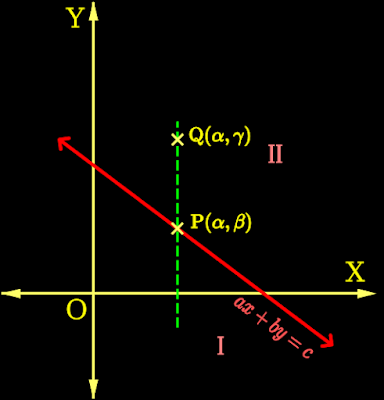
4. Consider the equation ax + by = c
• Since 'b' is +ve, the line will slope downwards. This is shown in fig.6.8 below:
Graphical solution of linear inequality in two variables.
Fig.6.8

• Let P(𝛼,β) be a point on the line. Then both 𝛼 and β will satisfy the equation ax+by = c
We can write: a𝛼 + bβ = c
5. Now consider a point Q in such a way that:
   ♦ Q lies in the vertical line through P
   ♦ Q is in the half plane II
• Since Q and P are in the same vertical line, both of them will have the same x coordinate .
   ♦ Let the y coordinate be 𝛾
   ♦ Then the coordinates of Q will be (𝛼,𝛾)
6. Since Q is in the half plane II, it is at a higher level than P.
   ♦ So the y coordinate of Q
   ♦ will be greater than
   ♦ the y coordinate of P
• We can write: 𝛾 > β 
   ♦ Multiplying both sides by b, we get: b𝛾 > bβ (Rule 2) 
   ♦ Adding a𝛼 on both sides we get: a𝛼+b𝛾 > a𝛼+bβ (Rule 1)
7. But from step (4), we have: a𝛼+bβ = c
• So the result in (6) becomes: a𝛼+b𝛾 > c
• That means:
The point Q(𝛼,𝛾) will satisfy the inequality ax + by > c
• Q(𝛼,𝛾) is a general point that we took in half plane II
• So we can write:
All points that lie in the half plane II will satisfy the inequality ax + by > c, where b >0
8. Now we have to prove the converse:
If a point Q(𝛼,𝛾) satisfies the inequality ax+by > c, where b>0, then Q(𝛼,𝛾) will be on the half plane II.
This can be done in 4 steps:
(i) Given that: Q(𝛼,𝛾) satisfies the inequality ax+by >c
Then we can write: a𝛼 + b𝛾 > c
(ii) But from step (4), we have: a𝛼+bβ = c
• So the result in (i) becomes: a𝛼+b𝛾 > a𝛼+bβ
• Subtracting a𝛼 from both sides, we get: 
b𝛾 > bβ (Rule 1)
(iii) Dividing both sides by b, we get: 𝛾 > β (Rule 2)
• The sign will not reverse because b is greater than zero.
(iv) Since P and Q are on the same vertical line, 𝛾 > β implies that Q lies in the half plane II.
9. So when b > 0, we have the details about all three regions:
(i) The region which lies exactly on the line ax+by=c,
   ♦ will contain all those points
   ♦ which satisfy the equation ax+by=c
(ii) The region of half plane II,
   ♦ will contain all those points
   ♦ which satisfy the inequality ax+by > c
(iii) Obviously the remaining region of half plane I,
   ♦ will contain all those points
   ♦ which satisfy the inequality ax+by < c


10. Now we can investigate the case when b < 0
• Consider the equation ax + by = c
• Since 'b' is -ve, the line will slope upwards. This is shown in fig.6.9 below:

Fig.6.9


• Let P(𝛼,β) be a point on the line. Then both 𝛼 and β will satisfy the equation ax+by = c
We can write: a𝛼 + bβ = c
11. Now consider a point Q in such a way that:
   ♦ Q lies in the vertical line through P
   ♦ Q is in the half plane II
• Since Q and P are in the same vertical line, both of them will have the same x coordinate .
   ♦ Let the y coordinate be 𝛾
   ♦ Then the coordinates of Q will be (𝛼,𝛾)
12. Since Q is in the half plane II, it is at a higher level than P.
   ♦ So the y coordinate of Q
   ♦ will be greater than
   ♦ the y coordinate of P
• We can write: 𝛾 > β 
   ♦ Multiplying both sides by b, we get: b𝛾 < bβ (Rule 3) 
• The sign will reverse because b is less than zero.
   ♦ Adding a𝛼 on both sides we get: a𝛼+b𝛾 < a𝛼+bβ (Rule 1)
13. But from step (4), we have: a𝛼+bβ = c
• So the result in (12) becomes: a𝛼+b𝛾 < c
• That means:
The point Q(𝛼,𝛾) will satisfy the inequality ax + by < c
• Q(𝛼,𝛾) is a general point that we took in half plane II
• So we can write:
All points that lie in the half plane II will satisfy the inequality ax + by < c, where b < 0
14. Now we have to prove the converse:
If a point Q(𝛼,𝛾) satisfies the inequality ax+by < c, where b<0, then Q(𝛼,𝛾) will be on the half plane II.
• This can be done in 4 steps:
(i) Given that: Q(𝛼,𝛾) satisfies the inequality ax+by < c
Then we can write: a𝛼 + b𝛾 < c
(ii) But from step (4), we have: a𝛼+bβ = c
• So the result in (i) becomes: a𝛼+b𝛾 < a𝛼+bβ
• Subtracting a𝛼 from both sides, we get: 
b𝛾 < bβ (Rule 1)
(iii) Dividing both sides by b, we get: 𝛾 > β (Rule 3)
• The sign will reverse because b is less than zero.
(iv) Since P and Q are on the same vertical line, 𝛾 > β implies that Q lies in the half plane II.
15. So when b < 0, we have the details about all three regions:
(i) The region which lies exactly on the line ax+by=c,
   ♦ will contain all those points
   ♦ which satisfy the equation ax+by=c
(ii) The region of half plane II,
   ♦ will contain all those points
   ♦ which satisfy the inequality ax+by < c
(iii) Obviously the remaining region of half plane I,
   ♦ will contain all those points
   ♦ which satisfy the inequality ax+by > c
16. Based on the results in steps (9) and (15), we can prepare a table:

Table 6.1

• Let us see a sample application of this table. We will consider the same inequality that we saw at the beginning of this chapter.
Example 4: 20x + 8y ≤ 120 
It can be written in 4 steps:
(i) Suppose we want to solve the inequality 20x+8y < 120
• Let us first compare it with the standard form: ax +by < c
   ♦ We see that, b is +ve. And the sign before c is '<'
   ♦ So from the table, we get: Lower plane I
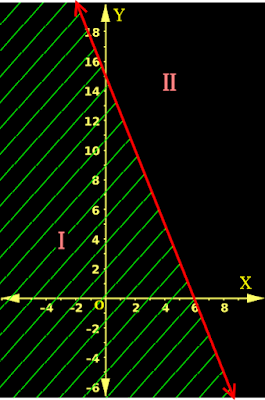
(ii) In fig.6.10 below, the red line is the graph of 20x + 8y = 120
When the variables represent real numbers, the graph of inequality can be drawn by shading or hatching the entire area of the appropriate half plane.
Fig.6.10

• This line divides the Cartesian plane into Lower half plane I and upper half plane II
• All points in the lower half plane I will satisfy the inequality 20x+8y < 120
• We can check this using any convenient point. O(0,0) is convenient for calculations. So we will use that point.
• If we input (0,0) in the inequality, we will get:
   ♦ (20 × 0) + (8 × 0) < 120
   ♦ ⇒ 0 + 0 < 120
   ♦ ⇒ 0 < 120, which is true.
(iii) O(0,0) lies in the lower half plane I. The check confirms that, all points in the lower half plane I will satisfy the inequality 20x+8y < 120
• So we hatch the entire lower half plane I using green lines.
• The area hatched using green lines is the graph of the inequality 20x+8y < 120
• Note that:
   ♦ Graph of an "inequality in one variable" is a line.
   ♦ Graph of an "inequality in two variables" is not a line, but an area.
(iv) On a sheet of paper or on the computer screen, we can hatch only a limited area.
◼ But the actual hatched area extends up to infinity.
• The red line goes upwards up to (-∞,∞)
   ♦ So the left boundary of the hatched area is -∞
   ♦ Also the top boundary of the hatched area is ∞
• The red line goes downwards up to (∞,-∞)
   ♦ So the right boundary of the hatched area is ∞
   ♦ Also the bottom boundary of the hatched area is -∞
(v) Now let us consider the fact that the sign of our present inequality is '≤' not '<'. For simplicity we ignored '≤' in step (i)
• Since the sign to be considered is '≤', the points on the red line representing 20x + 8y = 120 are also acceptable.
• So we draw the line of the equation using a bold red line.
• If the sign is '<', we would draw the line of the equation using a dashed red line.
◼ The rule is:
   ♦ Bold line for '≤' and '≥'
   ♦ Dashed line for '<' and '>'
17. So now we have a basic idea about how to draw the graph of an inequality.
• In the above step (16), we saw that,
   ♦ all points in the hatched area
   ♦ and all point in the red line
   ♦ are solutions of the inequality 20x+8y ≤ 120
For example, (-√2,1) is a point in the hatched area.
• If we input (-√2,1) in the inequality, we will get:
   ♦ (20 × -√2) + (8 × 1) < 120
   ♦ ⇒ (20 × -1.414) + (8 × 1) < 120
   ♦ ⇒ -28.284 + 8 < -20.284, which is true
• For our particular problem, we need to make an adjustment. It can be written in 5 steps:
(i) For our particular problem, x and y are to be whole numbers. Because they represent the numbers of books and pens that are purchased.
(ii) So we have to:
   ♦ pick out those points from the hatched area
   ♦ in such a way that,
   ♦ both x and y coordinates of those points are whole numbers.
• Such points are shown as magenta dots in fig.6.11 below:

Fig.6.11

(iii) All points in the graph of 20x+8y = 120 are not formed by x and y whole numbers. So we cannot draw it as a bold line. We must draw it as a dashed line.
(iv) All magenta dots in fig.6.11 will satisfy the inequality 20x+8y ≤ 120
For example, consider (3,6)
• If we input (0,0) in the inequality, we will get:
   ♦ (20 × 3) + (8 × 6) ≤ 120
   ♦ ⇒ 60 + 24 ≤ 120
   ♦ ⇒ 84 ≤ 120, which is true.
(v) Only five points on the dashed red line satisfy the inequality.
They are: (6,0), (4,5), (2,10) and (0,15)
18. Based on the above step (17), we can write:
• If x and y are real numbers, graph of the inequality can be drawn by hatching the entire area of the appropriate half plane.
• If x and y are integers or whole numbers, graph of the inequality can be drawn by putting dots at the appropriate points.


• In the next section, we will see a few more examples.

Previous

Contents

Next

Copyright©2022 Higher secondary mathematics.blogspot.com

Saturday, June 11, 2022

Chapter 6.2 - Solved Examples on Linear Inequalities in One Variable

In the previous section, we saw the rules for solving linear inequalities in one variable. We saw some solved examples also. In this section, we will see a few more solved examples.

Solved example 6.5
Solve 7x+3 < 5x+9
Solution:
• Given inequality is: 7x+3 < 5x+9
• This can be simplified as follows:
$\begin{array}{ll}
{}&7x+3 &{}<{}& {5x+9} &{} \\
\Rightarrow &7x+3-3&{}<{}& 5x+9-3 &\color {green}{\text{(Rule 1)}} \\
\Rightarrow &7x&{}<{}& 5x+6 &{} \\
\Rightarrow &7x-5x&{}<{}& 5x+6-5x &\color {green}{\text{(Rule 1)}} \\
\Rightarrow &2x&{}<{}& 6 &{} \\
\Rightarrow &\frac{2x}{2}&{}<{}& \frac{6}{2} &\color {green}{\text{(Rule 2)}} \\
\Rightarrow &x&{}<{}& 3 &{} \\
\end{array}$
• So all real numbers less than 3 are the solutions of this inequality.
• The solution set is: (-∞,3)
• The graph is shown in fig.6.4 below:

Fig.6.4

Solved example 6.6
Solve $\frac{3x-4}{2}\ge\frac{x+1}{4} -1$
Solution:
• Given inequality is: $\frac{3x-4}{2}\ge\frac{x+1}{4} -1$
• This can be simplified as follows:
$\begin{array}{ll}
{}&\frac{3x-4}{2}&{}\ge{}& \frac{x+1}{4} -1 &{} \\
\Rightarrow &4 \left(\frac{3x-4}{2}\right)&{}\ge{}& 4\left(\frac{x+1}{4} -1\right) &\color {green}{\text{(Rule 2)}} \\
\Rightarrow &2 \left(3x-4 \right)&{}\ge{}& x+1-4 &{} \\
\Rightarrow &6x-8&{}\ge{}& x-3 &{} \\
\Rightarrow &6x-8+8&{}\ge{}& x-3+8 &\color {green}{\text{(Rule 1)}} \\
\Rightarrow &6x&{}\ge{}& x+5 &{} \\
\Rightarrow &6x-x&{}\ge{}& x+5-x &\color {green}{\text{(Rule 1)}} \\
\Rightarrow &5x&{}\ge{}& 5 &{} \\
\Rightarrow &x&{}\ge{}& 1 &{} \\
\end{array}$
• So all real numbers greater than or equal to 1 are the solutions of this inequality.
• The solution set is: [1,∞)
• The graph is shown in fig.6.5 below:

Fig.6.5

Solved example 6.7
The marks obtained by a student of class XI in first and second terminal examination are 62 and 48 respectively. Find the minimum marks he should get in the annual examination to have an average of at least 60 marks.
Solution:
1. Let x be the marks in the annual examination. Then we can write:
$\frac{62+48+x}{3} \ge 60$
• Given inequality is: $\frac{3x-4}{2}\ge\frac{x+1}{4} -1$
• This can be simplified as follows:
$\begin{array}{ll}
{}&\frac{62+48+x}{3}&{}\ge{}&60 &{} \\
\Rightarrow &3 \left(\frac{62+48+x}{3}\right)&{}\ge{}& 3 × 60 &\color {green}{\text{(Rule 2)}} \\
\Rightarrow &62+48+x&{}\ge{}& 180 &{} \\
\Rightarrow &110+x&{}\ge{}& 180 &{} \\
\Rightarrow &110+x-110&{}\ge{}& 180-110 &\color {green}{\text{(Rule 1)}} \\
\Rightarrow &x&{}\ge{}& 70 &{} \\
\end{array}$
• So the student must obtain at least 70 marks.
• If the maximum marks is 100, the solution set will be: [70,100]
• The graph is shown in fig.6.6 below:

Fig.6.6

Solved example 6.8
Find all pairs of consecutive odd natural numbers, both of which are larger than 10, such that their sum is less than 40.
Solution:
1. The consecutive odd numbers starting from 1 are: 1, 3, 5, 7, . . .
2. The consecutive odd numbers greater than 10 are: 11, 13, 15, 17, . . .
• We have to pick out pairs from this list.
• Some of the possible pairs are: (11,13), (13,15) etc.,
• The sum of the two members of any pair that we pick, must be less than 40
3. If x is the first member of a pair, the second member will be (x+2)
• So we can write: x+(x+2) < 40
4. Given that both members of the pairs are to be greater than 10.
• So the smaller one which is x, must be larger than 10. This will ensure that, the larger one which is (x+2) will also be greater than 10.
• We can write: x > 10
5. From step (3) we get: 2x +2 < 40
• This can be simplified as follows:
$\begin{array}{ll}
{}&2x+2 &{}<{}& 40 &{} \\
\Rightarrow &2x+2-2&{}<{}& 40-2 &\color {green}{\text{(Rule 1)}} \\
\Rightarrow &2x&{}<{}& 38 &{} \\
\Rightarrow &\frac{2x}{2}&{}<{}& \frac{38}{2} &\color {green}{\text{(Rule 2)}} \\
\Rightarrow &x&{}<{}& 19 &{} \\
\end{array}$
6. So if the sum is to be less than 40, x must be less than 19
• Also from step (4), we have: x must be greater than 10
• The consecutive odd natural numbers satisfying both the above conditions are:
11, 13, 15 and 17
• So the possible pairs are:
(11, 11+2), (13, 13+2), (15, 15+2), (17, 17+2)
• That is: (11,13), (13,15), (15,17) and (17,19)

Solved example 6.9
Find all pairs of consecutive odd natural numbers, both of which are smaller than 18, such that their sum is more than 20.
Solution:
1. The consecutive odd natural numbers starting from 1 and smaller than 18 are:
1, 3, 5, 7, . . . , 17
2. Let x and x+2 form the pair.
• Given that both of them must be smaller than 18.
• So the larger one which is (x+2), must be smaller than 18. This will ensure that, the smaller one x will also be smaller than 18
• Thus we can write: x+2 < 18
• This can be simplified as follows:
$\begin{array}{ll}
{}&x+2 &{}<{}& 18 &{} \\
\Rightarrow &x+2-2&{}<{}& 18-2 &\color {green}{\text{(Rule 1)}} \\
\Rightarrow &x&{}<{}& 16 &{} \\
\end{array}$
• So first member of all pairs must be less than 16
3. Given that, the sum must be larger than 20.
So we can write: x+(x+2) > 20
• This can be simplified as follows:
$\begin{array}{ll}
{}&2x+2 &{}>{}& 20 &{} \\
\Rightarrow &2x+2-2&{}<>{}& 20-2 &\color {green}{\text{(Rule 1)}} \\
\Rightarrow &2x&{}>{}& 18 &{} \\
\Rightarrow &\frac{2x}{2}&{}>{}& \frac{18}{2} &\color {green}{\text{(Rule 2)}} \\
\Rightarrow&x&{}>{}& 9 &{} \\
\end{array}$
4. So if the sum is to be greater than 40, x must be greater than 9
• Also from step (2), we have: x must be less than 16
• The consecutive odd natural numbers satisfying both the above conditions are:
11, 13, and 15
• So the possible pairs are:
(11, 11+2), (13, 13+2) and (15, 15+2)
• That is: (11,13), (13,15) and (15,17)


The link below gives some more solved examples:

Exercise 6.1


• In the next section, we will see linear inequalities in two variables.

Previous

Contents

Next

Copyright©2022 Higher secondary mathematics.blogspot.com

Friday, June 10, 2022

Chapter 6.1 - Linear Inequalities in One Variable

In the previous section, we saw the disadvantages of using trial and error method for solving inequalities. In this section, we will see a systematic method.

For developing a systematic method, we must first learn some basic properties of inequalities. We can use those basic properties as rules for solving inequalities. This can be explained in 7 steps:

1. Let us recall the two rules that we used while solving linear equations:
First rule:
• Any number can be added to any side of the equation. The same number should be added to the other side also.
• Any number can be subtracted from any side of the equation. The same number should be subtracted from the other side also.
Second rule:
• Any side of the equation can be multiplied by a non-zero number. The other side also should be multiplied by the same number.  
• Any side of the equation can be divided by a non-zero number. The other side also should be divided by the same number.
2. In the same way, three rules can be developed for inequalities.
• If we add the same number to both sides of the inequality, there will be no change for the sign.
    ♦ For example, consider the inequality 2 < 8.
    ♦ Let us add 7 on both sides. We get 9 < 15.
    ♦ The ‘<’ sign has not changed.   
• If we subtract the same number from both sides of the inequality, there will be no change for the sign.
    ♦ For example, consider the inequality 12 < 21.
    ♦ Let us subtract 4 from both sides. We get 8 < 17.
    ♦ The ‘<’ sign has not changed.
3. So we can write the first rule for solving inequalities.
Rule 1 for solving inequalities:
• Any number can be added to any side of the inequality. The same number should be added to the other side also. Then the sign will not change.
• Any number can be subtracted from any side of the inequality. The same number should be subtracted from the other side also. Then the sign will not change.
4. If we multiply both sides of an inequality by the same +ve number, there will be no change for the sign.
    ♦ For example, consider the inequality 2 < 8.
    ♦ Let us multiply both sides by 3. We get 6 < 24.
    ♦ The ‘<’ sign has not changed.
• If we divide both sides of an inequality by the same +ve number, there will be no change for the sign.
    ♦ For example, consider the inequality 9 < 12.
    ♦ Let us divide both sides by 4. We get 2.25 < 3.
    ♦ The ‘<’ sign has not changed.
5. So we can write the second rule for solving inequalities.
Rule 2 for solving inequalities:
• Any side of the inequality can be multiplied by a +ve number. The other side also should be multiplied by the same number. The sign will not change.  
• Any side of the inequality can be divided by a +ve number. The other side also should be divided by the same number. The sign will not change.
6. If we multiply both sides of an inequality by the same -ve number, the sign will be reversed.
    ♦ For example, consider the inequality 2 < 8.
    ♦ Let us multiply both sides by -3. We get -6 > -24.
    ♦ The ‘<’ sign has become ‘>’.
• If we divide both sides of an inequality by the same -ve number, the sign will be reversed.
    ♦ For example, consider the inequality 9 < 12.
    ♦ Let us divide both sides by -4. We get -2.25 > -3.
    ♦ The ‘<’ sign has become ‘>'.
7. So we can write the third rule for solving inequalities.
Rule 3 for solving inequalities:
• Any side of the inequality can be multiplied by a -ve number. The other side also should be multiplied by the same number. The sign will be reversed.  
• Any side of the inequality can be divided by a -ve number. The other side also should be divided by the same number. The sign will be reversed.
• Reversal of sign means:
    ♦ < will become >      
    ♦ > will become <
    ♦ ≤ will become ≥     
    ♦ ≥ will become ≤


Now we will see some solved examples

Solved example 6.1
Solve 30x < 200 when (i) x is a natural number  (ii) x is an integer
Solution:
• Given inequality is: 30x < 200
• Applying Rule 2, we get:
$\frac{30x}{30}~<~\frac{200}{30}$
$\Rightarrow x~<~\frac{20}{3}$
$\Rightarrow~x~<~6.667$
• So whichever value we select for x, must be less than 6.667
Part (i):
• The set of natural number is {1, 2, 3, 4, . . .}
• We must select the appropriate values from this set. The solution set will contain those appropriate values.
• So the solution set is {1, 2, 3, 4, 5, 6}
Part (ii):
• The set of integers is {. . . , -4, -3, -2, -1, 0, 1, 2, 3, . . .}
• We must select the appropriate values from this set. The solution set will contain those appropriate values.
• So the solution set is {. . . , -4, -3, -2, -1, 0, 1, 2, 3, 4, 5, 6}


Why do we specifically say natural numbers, integers etc.,?
The answer can be written in 2 steps:
1. In some problems, x may represent number of pens, number of books, number of cars etc., In such cases, x must be a natural number (or whole number).
2. In some problems, x may represent the floor level of a building.
    ♦ The floor immediately below the ground level is indicated by -1
    ♦ The floor below that is indicated by -2 and so on . . .
• In such cases, x must be an integer.


Solved example 6.2
Solve 5x-3 < 3x+1 when (i) x is an integer  (ii) x is a real number
Solution:
• Given inequality is: 5x-3 < 3x+1
• This can be simplified as follows:
$\begin{array}{ll}
{}&5x-3 &{}<{}& {3x+1} &{} \\
\Rightarrow &5x-3+3&{}<{}& 3x+1+3 &\color {green}{\text{(Rule 1)}} \\
\Rightarrow &5x&{}<{}& 3x+4 &{} \\
\Rightarrow &5x-3x&{}<{}& 3x+4-3x &\color {green}{\text{(Rule 1)}} \\
\Rightarrow &2x&{}<{}& 4 &{} \\
\Rightarrow &\frac{2x}{2}&{}<{}& \frac{4}{2} &\color {green}{\text{(Rule 2)}} \\
\Rightarrow &x&{}<{}& 2 &{} \\
\end{array}$

Part (i):
• The set of integers is {. . . , -4, -3, -2, -1, 0, 1, 2, 3, . . .}
• We must select the appropriate values from this set. The solution set will contain those appropriate values.
• So the solution set is {. . . , -4, -3, -2, -1, 0, 1}
Part (ii):
• We know that the set of real numbers contain all types of numbers.
    ♦ They include natural numbers, whole numbers, integers
    ♦ They also include rational numbers and irrational numbers.
    ♦ So there will be numbers like -√3, -√2, √3, √2, -π, π etc.,
• Since they do not occur at regular intervals, we pick out the "relevant portion of the number line" and write it as an interval.
• In our present case, the interval will be: (-∞,2)
• That means, the relevant portion on the number line in our case, begins from -∞ at the extreme left end. It extends upto +2.
• But the exact +2 should not be included. Numbers like 1.999, 1.9999 etc., are allowed. This is indicated by the ')' on the right side of 2.
• This interval can be shown graphically as in fig.6.1 below:

Method for representing linear inequality in one variable graphically.
Fig.6.1

• The yellow line represents the number line. The red line is the graph.
• The arrow at the left end of the red line indicates that, the left boundary of the interval is at -∞.
• The circle at the right end of the red line indicates that, the right boundary of the interval is at 2.
   ♦ Since 2 is not included in the interval, it is an ordinary circle.
   ♦ If 2 is also included, we give a filled circle.
• All points on the red line is a solution of the inequality. We can write:
When x is a real number, the solution set is: (-∞,2)


Why do we specifically say integers, real numbers etc.,?
The answer can be written in 2 steps:
1. In solved example 6.1 above, we saw the situations where integers are specified. So we need not discuss about it again.
2. In some problems, x may represent lengths or distances. Such quantities are not always available as integers.
• We may encounter lengths like 3.5 cm, 121.667 meter etc.,
• Some times distances towards the left are considered -ve and those towards the right are considered +ve
   ♦ Then we may encounter lengths like -3.5 cm, -121.667 meter etc.,
• Also it is possible to encounter lengths like -2√3 meter, 5√2 meter, -3π cm etc.,
• In some problems, x may represent temperature.
• In some problems, x may represent volume.
• In all such cases, x must be a real number.


We have seen the significance of specifying whether x is natural number, integer or real number. For the rest of our discussion in this chapter, the variables x, y etc., will be considered as representing real numbers.


Solved example 6.3
Solve 4x+3 < 6x+7
Solution:
• Given inequality is: 4x+3 < 6x+7
• This can be simplified as follows:
$\begin{array}{ll}
{}&4x+3 &{}<{}& {6x+7} &{} \\
\Rightarrow &4x+3-3&{}<{}& 6x+7-3 &\color {green}{\text{(Rule 1)}} \\
\Rightarrow &4x&{}<{}& 6x+4 &{} \\
\Rightarrow &4x-6x&{}<{}& 6x+4-6x &\color {green}{\text{(Rule 1)}} \\
\Rightarrow &-2x&{}<{}& 4 &{} \\
\Rightarrow &\frac{-2x}{-2}&{}<{}& \frac{4}{-2} &\color {green}{\text{(Rule 3)}} \\
\Rightarrow &x&{}>{}& -2 &{} \\
\end{array}$
• So all real numbers greater than -2 are the solutions of this inequality.
• The solution set is: (-2,∞)
• The graph is shown in fig.6.2 below:

Fig.6.2

Solved example 6.4
Solve $\frac{5-2x}{3}\le\frac{x}{6} -5$
Solution:
• Given inequality is: $\frac{5-2x}{3}\le\frac{x}{6} -5$
• This can be simplified as follows:
$\begin{array}{ll}
{}&\frac{5-2x}{3}&{}\le{}& \frac{x}{6} -5 &{} \\
\Rightarrow &6 \left(\frac{5-2x}{3}\right)&{}\le{}& 6\left(\frac{x}{6} -5\right) &\color {green}{\text{(Rule 2)}} \\
\Rightarrow &2 \left(5-2x \right)&{}\le{}& x-30 &{} \\
\Rightarrow &10-4x&{}\le{}& x-30 &{} \\
\Rightarrow &10-4x+4x&{}\le{}& x-30+4x &\color {green}{\text{(Rule 1)}} \\
\Rightarrow &10&{}\le{}& 5x-30 &{} \\
\Rightarrow &10+30&{}\le{}& 5x-30+30 &\color {green}{\text{(Rule 1)}} \\
\Rightarrow &40&{}\le{}& 5x &{} \\
\Rightarrow &\frac{40}{5}&{}\le{}& \frac{5x}{5} &\color {green}{\text{(Rule 2)}} \\
\Rightarrow &8&{}\le{}& x &{} \\
\Rightarrow &x&{}\ge{}& 8 &{} \\
\end{array}$
• So all real numbers greater than or equal to 8 are the solutions of this inequality.
• The solution set is: [8,∞)
• The graph is shown in fig.6.3 below:

Fig.6.3


• In the next section, we will see a few more solved examples.

Previous

Contents

Next

Copyright©2022 Higher secondary mathematics.blogspot.com

