Showing posts with label derivative test. Show all posts

Wednesday, January 1, 2025

22.22 - Miscellaneous Examples on Applications of Derivatives - Part 4

In the previous section, we saw some miscellaneous examples. In this section, we will see a few more miscellaneous examples.

Solved example 22.82
A circular disc of radius 3 cm is being heated. Due to expansion, it's radius increases at the rate of 0.05 cm/s. Find the rate at which its area is increasing when radius is 3.2 cm.
Solution:
1. We have the formula for area of a circle: A = πr2.
2. The radius increases at the rate of 0.05 cm/s.
• So radius at time t will be 0.05t
4. So area A at time t = π(0.05t)2 = 0.0025πt2 cm2
• Now the rate of change of area w.r.t radius can be obtained as:
dA/dt = 0.0025π(2t) = 0.005 πt cm2/s
• This result can be used to find the rate of change of area at any instant.
5. We want the rate when radius is 3.2 cm. So we want the instant at which the radius is 3.2 cm. For that, we can use the result in (2). We get:
3.2 = 0.05t
⇒ t = 64
6. So from (4) we get:
(dA/dt)t=64 = 0.005π(64) = 0.320π cm2/s

Solved example 22.83
An open topped box is to be constructed by removing equal squares from each corner of a 3 metre by 8 metre rectangular sheet of aluminium and folding up the sides. Find the volume of the largest such box.
Solution:
Step I: Writing the problem as a function
1. In fig.22.77 below, the original rectangular sheet is shown in yellow color. Red squares are cut off from the corners.

Fig.22.77

• So when the flaps are folded up, we will get a box with:
   ♦ base a rectangle (8 − 2x) × (3 − 2x) m2
   ♦ height x m
• Then the volume of the box = x(8 − 2x)(3 − 2x) m3

2. It is clear that, V depends on x. That means, V is a function of x. So we can write:
V = f(x) = x(8 − 2x)(3 − 2x) m3

3. We want V to be as large as possible. That means, we want the largest of all local maxima of f. That means, we need to find all local maxima and compare them.

Step II: Finding the critical points
1. Write the first two derivatives:
• f '(x) =12x2 − 44x + 24

• f ''(x) = 24x − 44

2. Equate the first derivative to zero and solve for x:
12x2 − 44x + 24 = 0
⇒ x = 2/3, x = 3 

3. So the only two points in category I are: x = 2/3 and x = 3
4. We obtained f '(x) = 12x2 − 44x + 24
• This function is defined for all real numbers. That means, there is no input x at which f '(x) is not defined.
• Therefore, there will be no points in category II.
5. So the only two critical points are: x = 2/3 and x = 3

Step III: Find f ''(x) at the critical points
1. f ''(2/3) = 24(2/3) − 44 = −28
2. f ''(3) =  24(3) − 44 = 28

Step IV: Applying the second derivative test
1. Since f ''(2/3) is −ve, there is a local maximum at x = 2/3
2. Since f ''(3) is +ve, there is a local minimum at x = 3

Step V: Finding the actual maximum value:
• The local maximum value at x = 2/3 is given by:
f(2/3) = (2/3)[8 − 2(2/3)][3 − 2(2/3)] = 200/27 m3.

Solved example 22.84
Manufacturer can sell x items at a price of rupees $\rm{5 - \frac{x}{100}}$ each. The cost price of x items is Rs $\rm{\frac{x}{5} + 500}$. Find the number of items he should sell to earn maximum profit.
Solution:
Step I: Writing the problem as a function
1. When the manufacturer sells x items, he will get an income of: Rs $\rm{x\left(5 - \frac{x}{100} \right)}$
2. To produce those x items, he would have spent:
Rs $\rm{\frac{x}{5} + 500}$
3. So the profit P can be obtained as:
$\rm{P\,=\, x\left(5 - \frac{x}{100} \right)~-~\frac{x}{5} + 500}$
4. It is clear that, P depends on x. That means, P is a function of x. So we can write:
$\rm{P\,=\, f(x)\,=\,x\left(5 - \frac{x}{100} \right)~-~\frac{x}{5} + 500}$
5. We want P to be as large as possible. That means, we want the largest of all local maxima of f. That means, we need to find all local maxima and compare them.

Step II: Finding the critical points
1. Write the first two derivatives:
• f '(x) = $\rm{\frac{-x}{50} + \frac{24}{5}}$

• f ''(x) = $\rm{\frac{-1}{50}}$

2. Equate the first derivative to zero and solve for x:
$\rm{\frac{-x}{50} + \frac{25}{4} \,=\, 0}$
⇒ x = 240

3. So the only one point in category I is: x = 240
4. We obtained f '(x) = $\rm{\frac{-x}{50} + \frac{24}{5}}$
• This function is defined for all real numbers. That means, there is no input x at which f '(x) is not defined.
• Therefore, there will be no points in category II.
5. So the only one critical point is: x = 240

Step III: Find f ''(x) at the critical points
• f ''(x) is a constant: $\rm{\frac{-1}{50}}$

Step IV: Applying the second derivative test
• Since f ''(240) is −ve, there is a local maximum at x = 240

Step V: Final result:
• For maximum profit, the manufacturer must sell 240 items.

Solved example 22.85
Find the maximum area of an isosceles triangle inscribed in the ellipse $\rm{\frac{x^2}{a^2}\,+\,\frac{y^2}{b^2}\,=\,1}$ with it's vertex at one end of the major axis.
Solution:
Step I: Writing the problem as a function
1. The given ellipse is: $\rm{\frac{x^2}{a^2}\,+\,\frac{y^2}{b^2}\,=\,1}$
• So it is clear that:
    ♦ Major axis lies along the x-axis.
    ♦ Minor axis lies along the y-axis.
    ♦ Center of ellipse is at the origin O.
2. Thus we get fig.22.78 below:

Fig.22.78

• The vertex A of the isosceles triangle is at one end of the major axis.
3. Let the base of the isosceles triangle intersect the x-axis at D(h,0).
• Then the y-coordinates of B and C can be obtained as shown below:

$\begin{array}{ll} {~\color{magenta}    1    }    &{{}}    &{\frac{x^2}{a^2}\,+\,\frac{y^2}{b^2}}    & {~=~}    &{1}    \\
{~\color{magenta}    2    }    &{\implies}    &{\frac{h^2}{a^2}\,+\,\frac{y^2}{b^2}}    & {~=~}    &{1}    \\
{~\color{magenta}    3    }    &{\implies}    &{\frac{y^2}{b^2}}    & {~=~}    &{1~-~\frac{h^2}{a^2}}    \\
{~\color{magenta}    4    }    &{\implies}    &{y^2}    & {~=~}    &{b^2 \left(1~-~\frac{h^2}{a^2} \right)}    \\
{~\color{magenta}    5    }    &{\implies}    &{y}    & {~=~}    &{\pm \sqrt{b^2 \left(1~-~\frac{h^2}{a^2} \right)}}    \\
\end{array}$

• So the y-coordinate of B is $\sqrt{b^2 \left(1~-~\frac{h^2}{a^2} \right)}$
• And the y-coordinate of C is $-\sqrt{b^2 \left(1~-~\frac{h^2}{a^2} \right)}$
• Then the distance BC will be $2 \sqrt{b^2 \left(1~-~\frac{h^2}{a^2} \right)}$
4. Next we want the coordinates of A. It can be calculated as shown below:

$\begin{array}{ll} {~\color{magenta}    1    }    &{{}}    &{\frac{x^2}{a^2}\,+\,\frac{y^2}{b^2}}    & {~=~}    &{1}    \\
{~\color{magenta}    2    }    &{\implies}    &{\frac{x^2}{a^2}\,+\,\frac{0^2}{b^2}}    & {~=~}    &{1}    \\
{~\color{magenta}    3    }    &{\implies}    &{\frac{x^2}{a^2}}    & {~=~}    &{1}    \\
{~\color{magenta}    4    }    &{\implies}    &{x^2}    & {~=~}    &{a^2}    \\
{~\color{magenta}    5    }    &{\implies}    &{x}    & {~=~}    &{\pm a}    \\
\end{array}$

• So the coordinates of A are: (a,0).
• Then the altitude AD = (h+a)
5. Now we can write the expression for the area of triangle ABC:
Area = 1/2 × Base × Altitude = 1/2 × BC × AD
= $\frac{1}{2} × 2 \sqrt{b^2 \left(1~-~\frac{h^2}{a^2} \right)} × (h+a)$
• This can be simplified as:

$\begin{array}{ll} {~\color{magenta}    1    }    &{{}}    &{\text{Area}}    & {~=~}    &{\frac{1}{2} × 2 \sqrt{b^2 \left(1~-~\frac{h^2}{a^2} \right)} × (h+a)}    \\
{~\color{magenta}    2    }    &{{}}    &{{}}    & {~=~}    &{b \sqrt{\left(1~-~\frac{h^2}{a^2} \right)} × (h+a)}    \\
{~\color{magenta}    3    }    &{{}}    &{{}}    & {~=~}    &{b \sqrt{\left(\frac{a^2 – h^2}{a^2} \right)} × (h+a)}    \\
{~\color{magenta}    4    }    &{{}}    &{{}}    & {~=~}    &{\frac{b}{a} \sqrt{\left(a^2 – h^2 \right)} × (h+a)}    \\
\end{array}$

6. It is clear that, Area A depends on h. That means, A is a function of h. So we can write:
$\rm{A\,=\, f(x)\,=\,\frac{b}{a} \sqrt{\left(a^2 – h^2 \right)} × (h+a)}$
5. We want A to be as large as possible. That means, we want the largest of all local maxima of f. That means, we need to find all local maxima and compare them.

Step II: Finding the critical points
1. Write the first two derivatives:

$\begin{array}{ll} {~\color{magenta}    1    }    &{{}}    &{f(h)}    & {~=~}    &{\frac{b}{a} \sqrt{\left(a^2 – h^2 \right)} × (h+a)}    \\
{~\color{magenta}    2    }    &{\implies}    &{f'(h)}    & {~=~}    &{\frac{b}{a} \left[\sqrt{\left(a^2 – h^2 \right)} × (1) ~+~(h+a) (1/2) \left(a^2 – h^2 \right)^{-1/2} (-2h) \right]}    \\
{~\color{magenta}    3    }    &{{}}    &{{}}    & {~=~}    &{\frac{b}{a} \left[\sqrt{\left(a^2 – h^2 \right)}  ~-~ \frac{h(h+a)}{\sqrt{\left(a^2 – h^2 \right)}} \right]}    \\
{~\color{magenta}    4    }    &{{}}    &{{}}    & {~=~}    &{\frac{b}{a} \left[\frac{a^2 – h^2 ~-~h(h+a)}{\sqrt{\left(a^2 – h^2 \right)}} \right]}    \\
{~\color{magenta}    5    }    &{{}}    &{{}}    & {~=~}    &{\frac{b}{a} \left[\frac{a^2 – h^2 – h^2 – ha}{\sqrt{\left(a^2 – h^2 \right)}} \right]}    \\
{~\color{magenta}    6    }    &{{}}    &{{}}    & {~=~}    &{\frac{b}{a} \left[\frac{a^2 – 2 h^2  – ha}{\sqrt{\left(a^2 – h^2 \right)}} \right]}    \\
\end{array}$                           

• In this problem, calculation of f ''(h) will be a lengthy process. So we will use the first derivative test

2. Equate the first derivative to zero and solve for h:
$\rm{a^2 – 2 h^2  – ha \,=\, 0}$
⇒ $\rm{2 h^2 + ha - a^2 \,=\, 0}$
• Using quadratic formula, we get:
h = a/2 and h = −a
• h cannot be −a. Because, then in fig.22.78 above, D will coincide with the left end of the major axis. Parts of the triangle will fall outside the ellipse.

3. So the only one point in category I is: x = a/2
4. We obtained f '(h) = $\frac{b}{a} \left[\frac{a^2 – 2 h^2  – ha}{\sqrt{\left(a^2 – h^2 \right)}} \right]$
• This function is not defined when h = a. But when h = a, the function itself becomes invalid because there will be no inscribed triangle.
• Therefore, there will be no points in category II.
5. So the only one critical point is: h = a/2
6. The domain is (−a,a).
• Based on the critical point, the domain can be divided into two intervals: (−a, a/2) and (a/2, a)

Step III: Analyzing the signs of f '(x) in the two intervals
1. Consider the first interval. Zero is a convenient point.
• We get:
$\begin{array}{ll} {~\color{magenta}    1    }    &{{}}    &{f'(h)}    & {~=~}    &{\frac{b}{a} \left[\frac{a^2 – 2 h^2  – ha}{\sqrt{\left(a^2 – h^2 \right)}} \right]}    \\
{~\color{magenta}    2    }    &{\implies}    &{f'(0)}    & {~=~}    &{\frac{b}{a} \left[\frac{a^2 – 2 (0)^2  – (0)a}{\sqrt{\left(a^2 – (0)^2 \right)}} \right]}    \\
{~\color{magenta}    3    }    &{{}}    &{{}}    & {~=~}    &{\frac{b}{a} \left[\frac{a^2}{\sqrt{\left(a^2 \right)}} \right]}    \\
{~\color{magenta}    4    }    &{{}}    &{{}}    & {~=~}    &{b}    \\
\end{array}$

• So in the first interval. f '(x) is +ve.

2. Consider the second interval. $\frac{3a}{4}$  is a convenient point.
• We get:
$\begin{array}{ll} {~\color{magenta}    1    }    &{{}}    &{f'(h)}    & {~=~}    &{\frac{b}{a} \left[\frac{a^2 – 2 h^2  – ha}{\sqrt{\left(a^2 – h^2 \right)}} \right]}    \\
{~\color{magenta}    2    }    &{\implies}    &{f'(3a/4)}    & {~=~}    &{\frac{b}{a} \left[\frac{a^2 – 2 (3a/4)^2  – (3a/4)a}{\sqrt{\left(a^2 – (3a/4)^2 \right)}} \right]}    \\
{~\color{magenta}    3    }    &{{}}    &{{}}    & {~=~}    &{\frac{b}{a} \left[\frac{a^2 – 2 \left(\frac{9 a^2}{16} \right)  – \frac{3 a^2}{4}}{\sqrt{\left(a^2 – \frac{9 a^2}{16} \right)}} \right]}    \\
{~\color{magenta}    4    }    &{{}}    &{{}}    & {~=~}    &{\frac{b}{a} \left[\frac{\frac{16 a^2 - 18 a^2 – 12 a^2}{16}}{\sqrt{\left(\frac{16 a^2 – 9 a^2}{16} \right)}} \right]}    \\
{~\color{magenta}    5    }    &{{}}    &{{}}    & {~=~}    &{\frac{b}{a} \left[\frac{\frac{16 a^2 - 30 a^2}{16}}{\sqrt{\left(\frac{7 a^2}{16} \right)}} \right]}    \\
{~\color{magenta}    6    }    &{{}}    &{{}}    & {~=~}    &{\frac{b}{a} \left[\frac{\frac{- 14 a^2}{16}}{\sqrt{\left(\frac{7 a^2}{16} \right)}} \right]}    \\
\end{array}$

• So in the second interval. f '(x) is −ve.

Step IV: Applying the first derivative test
• Since f '(x) changes sign from +ve to −ve at the critical point, we have a maximum at that critical point.

Step V: Final result:
• For maximum area, h = a/2
So from step I, we get:

$\begin{array}{ll} {~\color{magenta}    1    }    &{{}}    &{\text{Area}}    & {~=~}    &{\frac{1}{2} × 2 \sqrt{b^2 \left(1~-~\frac{h^2}{a^2} \right)} × (h+a)}    \\
{~\color{magenta}    2    }    &{\implies}    &{\text{Area (max)}}    & {~=~}    &{\sqrt{b^2 \left(1~-~\frac{(a/2)^2}{a^2} \right)} × ((a/2)+a)}    \\
{~\color{magenta}    3    }    &{{}}    &{{}}    & {~=~}    &{\sqrt{b^2 \left(1~-~\frac{a^2 / 4}{a^2} \right)} × (3a/2)}    \\
{~\color{magenta}    4    }    &{{}}    &{{}}    & {~=~}    &{\sqrt{3 b^2 / 4} × (3a/2)}    \\
{~\color{magenta}    5    }    &{{}}    &{{}}    & {~=~}    &{\frac{\sqrt{3} b}{2} × \frac{3a}{2}}    \\
{~\color{magenta}    6    }    &{{}}    &{{}}    & {~=~}    &{\frac{3 \sqrt{3} \,ab}{4}}    \\
\end{array}$


The link below gives a few more miscellaneous examples:

Miscellaneous Exercise


We have completed this chapter on applications of derivatives. In the next chapter, we will see Integrals.

Previous

Contents

Next

Copyright©2024 Higher secondary mathematics.blogspot.com

Sunday, December 29, 2024

22.21 - Miscellaneous Examples on Applications of Derivatives - Part 3

In the previous section, we saw some miscellaneous examples. In this section, we will see a few more miscellaneous examples.

Solved example 22.77
Find the intervals in which the function given by
$\rm{f(x)\,=\,\frac{3}{10} x^4 - \frac{4}{5} x^3 - 3 x^2 + \frac{36}{5} x + 11}$
is (a) strictly increasing (b) strictly decreasing.
Solution:
1. First we write the derivative:

$\begin{array}{ll} {~\color{magenta}    1    }    &{{}}    &{f(x)}    & {~=~}    &{\frac{3}{10} x^4 - \frac{4}{5} x^3 - 3 x^2 + \frac{36}{5} x + 11}    \\
{~\color{magenta}    2    }    &{\implies}    &{f'(x)}    & {~=~}    &{\frac{3(4)}{10} x^3 - \frac{4(3)}{5} x^2 - 3(2) x + \frac{36}{5} + 0}    \\
{~\color{magenta}    3    }    &{{}}    &{{}}    & {~=~}    &{\frac{6}{5} x^3 - \frac{12}{5} x^2 - 6 x + \frac{36}{5}}    \\
\end{array}$

2. Equating the above result to zero, we get:

$\begin{array}{ll} {~\color{magenta}    1    }    &{{}}    &{f'(x)}    & {~=~}    &{0}    \\
{~\color{magenta}    2    }    &{\implies}    &{\frac{6}{5} x^3 - \frac{12}{5} x^2 - 6 x + \frac{36}{5}}    & {~=~}    &{0}    \\
{~\color{magenta}    3    }    &{\implies}    &{6 x^3 - 12 x^2 - 30 x + 36}    & {~=~}    &{0}    \\
{~\color{magenta}    4    }    &{\implies}    &{x^3 - 2 x^2 - 5 x + 6}    & {~=~}    &{0}    \\
\end{array}$

3. Solving the above third degree equation, we get:
x = −2, x = 1 and x = 3

• So the domain R can be divided into four intervals:
(−∞,−2), (−2,1), (1,3) and (3,∞)

4. Consider the first interval (−∞,−2)
−3 is a convenient point in this interval.

$\begin{array}{ll} {~\color{magenta}    1    }    &{{}}    &{f'(-3)}    & {~=~}    &{\frac{6}{5} (-3)^3 - \frac{12}{5} (-3)^2 - 6 (-3) + \frac{36}{5}}    \\
{~\color{magenta}    2    }    &{{}}    &{{}}    & {~=~}    &{-28.8}    \\
\end{array}$                           

• So f '(x) is −ve in this interval. That means, f(x) is decreasing in this interval.
• Note that, f '(−2) will be zero. But −2 is not an input value. So we can write:
The given f is strictly decreasing in (−∞,−2)

5. Consider the second interval (−2,1)
0 is a convenient point in this interval.

$\begin{array}{ll} {~\color{magenta}    1    }    &{{}}    &{f'(0)}    & {~=~}    &{\frac{6}{5} (0)^3 - \frac{12}{5} (0)^2 - 6 (0) + \frac{36}{5}}    \\
{~\color{magenta}    2    }    &{{}}    &{{}}    & {~=~}    &{7.2}    \\
\end{array}$                           

• So f '(x) is +ve in this interval. That means, f(x) is increasing in this interval.
• Note that, f '(−2) and f '(0) will be zero. But −2 and 1 are not an input values. So we can write:
The given f is strictly increasing in (−2,1)

6. Consider the third interval (1,3)
2 is a convenient point in this interval.

$\begin{array}{ll} {~\color{magenta}    1    }    &{{}}    &{f'(2)}    & {~=~}    &{\frac{6}{5} (2)^3 - \frac{12}{5} (2)^2 - 6 (2) + \frac{36}{5}}    \\
{~\color{magenta}    2    }    &{{}}    &{{}}    & {~=~}    &{-4.8}    \\
\end{array}$                           

• So f '(x) is −ve in this interval. That means, f(x) is decreasing in this interval.
• Note that, f '(1) and f '(3) will be zero. But 1 and 3 are not an input values. So we can write:
The given f is strictly decreasing in (1,3)

7. Consider the fourth interval (3,∞)
4 is a convenient point in this interval.

$\begin{array}{ll} {~\color{magenta}    1    }    &{{}}    &{f'(4)}    & {~=~}    &{\frac{6}{5} (4)^3 - \frac{12}{5} (4)^2 - 6 (4) + \frac{36}{5}}    \\
{~\color{magenta}    2    }    &{{}}    &{{}}    & {~=~}    &{21.6}    \\
\end{array}$                           

• So f '(x) is +ve in this interval. That means, f(x) is increasing in this interval.
• Note that, f '(3) will be zero. But 3 is not an input value. So we can write:
The given f is strictly increasing in (3,∞)

Solved example 22.78
Show that the function f given by
f(x) = tan−1(sin x + cos x), x > 0 is always a strictly increasing function in (0, π/4).
Solution:
1. First we write the derivative:

$\begin{array}{ll} {~\color{magenta}    1    }    &{{}}    &{f(x)}    & {~=~}    &{\tan^{-1}(\sin x + \cos x)}    \\
{~\color{magenta}    2    }    &{\implies}    &{f'(x)}    & {~=~}    &{\left(\frac{1}{1 + (\sin x + \cos x)^2} \right) (\cos x - \sin x)}    \\
{~\color{magenta}    3    }    &{{}}    &{{}}    & {~=~}    &{\left(\frac{1}{1 + \sin^2 x + 2 \sin x \cos x + \cos^2 x} \right) (\cos x - \sin x)}    \\
{~\color{magenta}    4    }    &{{}}    &{{}}    & {~=~}    &{\left(\frac{1}{2 + \sin(2 x)} \right) (\cos x - \sin x)}    \\
{~\color{magenta}    5    }    &{{}}    &{{}}    & {~=~}    &{\frac{\cos x - \sin x}{2 + \sin(2 x)}}    \\
\end{array}$

2. In this problem, there is no need to equate f'(x) to zero and find the intervals. This is because, we are already given an interval. We are asked to show that, the function is always strictly increasing in that interval.
• The given interval is (0, π/4). The boundaries of this interval may not be consecutive critical points. So the usual method of checking using a 'convenient number' cannot be used. We must show the general case.

3. We obtained the derivative as: $\frac{\cos x - \sin x}{2 + \sin(2 x)}$
• The largest input possible from the given interval is a value just below π/4.
• Even if the input is π/4, sin(2x) will be in the first quadrant. Sine is always +ve in the first quadrant. So (2 + sin(2x)) is +ve in the given interval.
• That means, denominator of the derivative is +ve in the given interval.

4. Now we can write, the derivative will be +ve if the numerator is also +ve.
That means: Derivative will be +ve if cos x − sin x > 0.
⇒ cos x / sin x  − sin x / sin x > 0
⇒ cot x  − 1 > 0
⇒ cot x  > 1

• In the given interval (0, π/4), tan x is always less than 1. So cot x is always greater than 1.
• So we can write: the numerator is also +ve.

5. We see that, f '(x) is +ve in the interval (0, π/4).
Therefore, f(x) is increasing in this interval.

6. Note that,
   ♦ f '(0) is 1/2. It is +ve.
   ♦ f '(π/4) is zero.
• But π/4 is not an input value. So we can write:
The given f is strictly increasing in (0, π/4)

7. Fig.22.75 below shows the graph.

Fig.22.75

Solved example 22.79
Find the intervals in which the function f given by
$f(x)\,=\,\frac{4 \sin x - 2x - x \cos x}{2 + \cos x}$
is (i) increasing (ii) decreasing.
Solution:
1. First we write the derivative:
Using quotient rule, we get:
• $f'(x)\,=\,-{\frac{\cos x(\cos x - 4)}{(2 + \cos x)^2}}$

2. Next, we equate the above result to zero:
• The denominator cannot be zero. So we get:
cos x (cos x − 4) = 0
• cos x cannot be 4. So we get: cos x = 0

3. Solving the equation cos x = 0, we get:
x = π/2 and x = 3π/2 as the principal solutions

• So the angle of the unit circle can be divided into three intervals:
(0, π/2), (π/2, 3π/2) and (3π/2, 2π)

4. Consider the first interval (0, π/2)
• π/4 is a convenient point in this interval.
$f'(\pi/4)\,=\,-{\frac{\cos (\pi/4)(\cos (\pi/4) - 4)}{(2 + \cos (\pi/4))^2}}$
• Here, the only −ve term is (cos(π/4) − 4).
• So f '(x) is +ve in this interval. That means, f(x) is increasing in this interval.

5. Consider the second interval (π/2, 3π/2)
• π is a convenient point in this interval.
$f'(\pi)\,=\,\frac{\cos (\pi)(\cos (\pi) - 4)}{(2 + \cos (\pi))^2}$
• Here, both terms in the numerator are −ve. The denominator is +ve.
• So f '(x) is −ve in this interval. That means, f(x) is decreasing in this interval.

6. Consider the third interval (3π/2, 2π)
• 7π/4 is a convenient point in this interval.
$f'(7 \pi/4)\,=\,\frac{\cos (7\pi/4)(\cos (7\pi/4) - 4)}{(2 + \cos (7\pi/4))^2}$
• cos(7π/4) = cos(π + 3π/4) = −cos(3π/4)
= −[cos(π/2 + π/4)] = −[−sin(π/4)] = sin(π/4)

• So here, the only −ve term is (cos(7π/4) − 4).
• Thus f '(x) is +ve in this interval. That means, f(x) is increasing in this interval.

7. Now we can write about the intervals.
• f is:
   ♦ Increasing in (0, π/2) and (3π/2, 2π)
   ♦ Decreasing in (π/2, 3π/2)

8. Fig.22.76 below shows the graph.

Fig.22.76

• Note that:
   ♦ π/2 = 1.57
   ♦ 3π/2 = 4.71

Solved example 22.80
Find the intervals in which the function f given by
$f(x)\,=\,x^3 + \frac{1}{x^3}$
is (i) increasing (ii) decreasing.
Solution:
1. First we write the derivative:
$f'(x)\,=\,3x^2 \,-\, \frac{3}{x^4}$

2. Next, we equate the above result to zero:
$3x^2 \,-\, \frac{3}{x^4}~=~0$
⇒ $x^2 \,-\, \frac{1}{x^4}~=~0$
⇒ $x^2 ~=~\frac{1}{x^4}$
⇒ $x^6 ~=~1$
⇒ $x\,=\,1~\text{and}~x\,=\,-1$

3. So the domain can be divided into three intervals:
(−∞, −1), (−1, 1) and (1, ∞)

4. Consider the first interval (−∞, −1)
• −2 is a convenient point in this interval.
$f'(-2)\,=\,3(-2)^2 \,-\, \frac{3}{(-2)^4}$
= $12\,-\, \frac{3}{16}$
• So f '(x) is +ve in this interval. That means, f(x) is increasing in this interval.

5. Consider the second interval (−1, 1)
• 0.5 is a convenient point in this interval.
$f'(0.5)\,=\,3(0.5)^2 \,-\, \frac{3}{(0.5)^4}$
= $\frac{3}{4}\,-\, \frac{30000}{625}$
• So f '(x) is −ve in this interval. That means, f(x) is decreasing in this interval.

6. Consider the third interval (1, ∞)
• 2 is a convenient point in this interval.
$f'(2)\,=\,3(2)^2 \,-\, \frac{3}{(2)^4}$
= $12\,-\, \frac{3}{16}$
• So f '(x) is +ve in this interval. That means, f(x) is increasing in this interval.

7. Now we can write about the intervals.
• f is:
   ♦ Increasing in (−∞, −1) (1, ∞)
   ♦ Decreasing in (−1, 1)

Solved example 22.81
Let f be a function defined on [a,b] such that f '(x) > 0 for all x ∈ (a,b). Then prove that f is an increasing function on (a,b).
Solution:
1. Let x1, x2 ∈ (a,b) such that x1 < x2.
2. f is defined on [a,b]. Also, [x1,x2] is a subset of [a,b].
So f is continuous and differentiable in [x1,x2]
3. By mean value theorem,
There exists a number c in (x1,x2) such that:
$f'(c)\,=\,\frac{f(x_2) - f(x_1)}{x_2 - x_1}$
4. Given that, f '(x) > 0 for all x ∈ (a,b).
• So f '(c) > 0
⇒ $\frac{f(x_2) - f(x_1)}{x_2 - x_1}~>~0$
⇒ f(x2) − f(x1) > 0
⇒ f(x2) > f(x1)
5. So we can write:
When x2 > x1, we will obtain: f(x2) > f(x1)
• That means, f is an increasing function on (a,b).


In the next section, we will see a few more miscellaneous examples.

Previous

Contents

Next

Copyright©2024 Higher secondary mathematics.blogspot.com

Friday, November 22, 2024

22.18 - Solved Examples on Second Derivative Test

In the previous section, we completed a discussion on second derivative test. We saw some solved examples also. In this section, we will see a few more solved examples.

Solved example 22.60
Find the shortest distance of the point (0,c) from the parabola y = x2, where 0 ≤ c ≤ 5.
Solution:
Step I: Writing the problem as a function
1. Let (h,k) be any point on the parabola.
• Let D be the distance between (0,c) and (h,k).
• Then we can write:
$\rm{D = \sqrt{(h-0)^2+(k-c)^2} = \sqrt{h^2+(k-c)^2}}$
2. (h,k) is a point on the parabola y = x2. So we can write: k = h2
• Substituting this in (1), we get:
$\rm{D = \sqrt{k+(k-c)^2}}$
3. (0,c) is a constant point on the y-axis. It's distance D from (h,k) will depend on the position of (h,k).
• We want such a position for (h,k) that, D is minimum.
4. From (2), it is clear that, D depends on k. So D is a function of k.
We can write: $\rm{D = f(k) = \sqrt{k+(k-c)^2}}$
5. We want D to have the minimum possible value. That means, we want the least of all the local minima of f. That means, we need to find all local minima and compare them.

Step II: Finding the critical points
1. Write the first two derivatives:
$\begin{array}{ll} {~\color{magenta}    1    }    &{{}}    &{f(k)}    & {~=~}    &{\sqrt{k+(k-c)^2}}    \\
{~\color{magenta}    2    }    &{\implies}    &{f'(k)}    & {~=~}    &{(1/2)[k+(k-c)^2]^{(-1/2)} [1+2(k-c)]}    \\
{~\color{magenta}    3    }    &{{}}    &{{}}    & {~=~}    &{\frac{1+2(k-c)}{2 \sqrt{k+(k-c)^2}}}    \\
\end{array}$                           

• After examining f '(k), we know that, calculation of f ''(k) will be a lengthy process. So we will use the first derivative test for this problem.
2. Equate the first derivative to zero and solve for k:
$\begin{array}{ll} {~\color{magenta}    1    }    &{{}}    &{\frac{1+2(k-c)}{2 \sqrt{k+(k-c)^2}}}    & {~=~}    &{0}    \\
{~\color{magenta}    2    }    &{\implies}    &{1 + 2(k-c)}    & {~=~}    &{0}    \\
{~\color{magenta}    3    }    &{\implies}    &{k-c}    & {~=~}    &{-(1/2)}    \\
{~\color{magenta}    4    }    &{\implies}    &{k}    & {~=~}    &{c-(1/2)}    \\
{~\color{magenta}    5    }    &{\implies}    &{k}    & {~=~}    &{\frac{2c - 1}{2}}    \\
\end{array}$                           
3. So the only one point in category I is: k = c − (1/2)
4. We obtained $\rm{f'(k) = \frac{1+2(k-c)}{2 \sqrt{k+(k-c)^2}}}$
• k will be always +ve because, it is the square of h. So f '(k) is defined for all real numbers. That means, there is no input k at which f '(k) is not defined.
• Therefore, there will be no points in category II.
5. So the only one critical point is: k = c − (1/2)

Step III: Dividing the number line
• The critical point is x = 1. Therefore, the number line can be divided into two intervals:
(−∞, c − (1/2)) and (c − (1/2),∞)

Step IV: Finding the sign of f '(x) in each interval
1. First interval:
When k is from the first interval (−∞, c − (1/2)), we have:
$\begin{array}{ll} {~\color{magenta}    1    }    &{{}}    &{k}    & {~<~}    &{c-(1/2)}    \\
{~\color{magenta}    2    }    &{\implies}    &{k}    & {~<~}    &{\frac{2c - 1}{2}}    \\
{~\color{magenta}    3    }    &{\implies}    &{2k}    & {~<~}    &{2c - 1}    \\
{~\color{magenta}    4    }    &{\implies}    &{2k - 2c +1}    & {~<~}    &{0}    \\
{~\color{magenta}    5    }    &{\implies}    &{2(k - c) +1}    & {~<~}    &{0}    \\
\end{array}$
• We obtained: 2(k−c) + 1 < 0
That means, the numerator of f '(k) is −ve
• The denominator of f '(k) is +ve because, it is twice the distance D. Distance is always +ve.
• So we get:
In the first interval, f '(k) is −ve

2. Second interval:
When k is from the second interval (c − (1/2),∞), we have:
$\begin{array}{ll} {~\color{magenta}    1    }    &{{}}    &{k}    &{~>~}    &{c-(1/2)}    \\
{~\color{magenta}    2    }    &{\implies}    &{k}    & {~>~}    &{\frac{2c - 1}{2}}    \\
{~\color{magenta}    3    }    &{\implies}    &{2k}    & {~>~}    &{2c - 1}    \\
{~\color{magenta}    4    }    &{\implies}    &{2k - 2c +1}    & {~>~}    &{0}    \\
{~\color{magenta}    5    }    &{\implies}    &{2(k - c) +1}    & {~>~}    &{0}    \\
\end{array}$                           
• We obtained: 2(k−c) + 1 > 0
That means, the numerator of f '(k) is +ve
• The denominator of f '(k) is +ve because, it is twice the distance D. Distance is always +ve.
• So we get:
In the second interval, f '(k) is +ve

Step V: Analyzing the change of signs at critical point
• At the critical point, the sign of f '(k) changes from −ve to +ve. So this critical point is a point of local minimum.
• That means, if we put k = c −(1/2), f(k) will be minimum.
• That means, if we put k = c −(1/2), D will be minimum.

Step VI: Final result
• We have: $\rm{D = f(k) = \sqrt{k+(k-c)^2}}$
• So minimum distance can be obtained as:
$\begin{array}{ll} {~\color{magenta}    1    }    &{{}}    &{f(c-(1/2))}    & {~=~}    &{\sqrt{c-(1/2)+[c-(1/2)-c]^2}}    \\
{~\color{magenta}    2    }    &{{}}    &{{}}    & {~=~}    &{\sqrt{c-(1/2)+[-(1/2)]^2}}    \\
{~\color{magenta}    3    }    &{{}}    &{{}}    & {~=~}    &{\sqrt{c-\frac{1}{2}+\frac{1}{4}}}    \\
{~\color{magenta}    4    }    &{{}}    &{{}}    & {~=~}    &{\sqrt{c-\frac{1}{4}}}    \\
{~\color{magenta}    5    }    &{{}}    &{{}}    & {~=~}    &{\sqrt{\frac{4c - 1}{4}}}    \\
{~\color{magenta}    6    }    &{{}}    &{{}}    & {~=~}    &{\frac{\sqrt{4c - 1}}{2}}    \\
\end{array}$

Check: This can be written in 4 steps.
1. Assume that, c = 4.5. Then the constant point on the y-axis is (0,4.5). It is marked as A in the fig.22.60 below:

Fig.22.60

2. Based on the above solution, we can write:
k = c − (1/2) = 4.5 − (1/2) = 4
• So h = √4 = 2
• So (h,k) is (2,4). This is marked as B in the fig.22.60 above.

3. We must prove that, the distance AB is the minimum possible distance.
• To prove that, we draw a tangent at B (green line). Then we draw AB (yellow dashed line).
• We see that, AB is perpendicular to the tangent. So AB is the minimum possible distance from A to any point on the parabola.

4. We can draw a line from A to any other point B' of the positive side of the parabola. Then AB' will not be perpendicular to the tangent at B'

Solved example 22.61
Let AP and BQ be two vertical poles at points A and B respectively. If AP = 16 m, BQ = 22 m and AB = 20 m, find the distance of a point R on AB from the point A such that RP2 +RQ2 is minimum.
Solution:
Step I: Writing the problem as a function
1. We want the distance of R from A. Let this distance be x. It is marked in fig.22.61 below:

Fig.22.61

2. Applying Pythagoras theorem,we get:
• RP2 = AR2 + AP2
• RQ2 = RB2 + BQ2
⇒ RP2 + RQ2 = AR2 + AP2 + RB2 + BQ2
= x2 + 162 + (20-x)2 + 222
= x2 + 162 + 202 − 40x + x2 + 222
= 2x2  − 40x + 162 + 202+ 222
3. We want the above sum to be a minimum.
4. From (2), it is clear that, the sum S depends on x. So S is a function of x.
We can write: S = f(x) = 2x2  − 40x + 162 + 202+ 222
5. We want S to have the minimum possible value. That means, we want the least of all the local minima of f. That means, we need to find all local minima and compare them.

Step II: Finding the critical points
1. Write the first two derivatives:
• f '(x) = 4x − 40
• f ''(x) = 4
2. Equate the first derivative to zero and solve for x:
4x −40 = 0
⇒ 4x = 40
⇒ x = 10
3. So the only one point in category I is: x = 10
4. We obtained f '(x) = 4x −40
• This function is defined for all real numbers. That means, there is no input x at which f '(x) is not defined.
• Therefore, there will be no points in category II.
5. So the only one critical point is: x = 10

Step III: Find f '' at the critical point
• f ''(10) =  4. This is because, f ''(x) is a constant 

Step IV: Applying the second derivative test
• Since f ''(10) is +ve, there is a local minimum at x = 10
• Since there is only one critical point, there are no other points to compare. We can write:
The minimum point of the function occurs at x = 10

Step V: Finding the actual minimum value:
• The local minimum value at x = 10 is given by:
f(10) = 2(10)2  − 40(10) + 162 + 202+ 222 = 940

Step VI: Final result:
• The distance AR should be 10 m. Then we will get the minimum sum of squares.
• The minimum sum of squares = 940

Check:
• Let us put x = 8.
• Then S = f(8) = 2(8)2  − 40(8) + 162 + 202+ 222 = 948
• So, even if we decrease the distance AR, the sum of squares will increase.

Step VI (optional): Drawing the graph

• The graph is shown in fig.22.62 below:

Fig.22.62

   ♦ f is drawn in red color.
   ♦ (10,940) is a local minimum.
   ♦ So when x = 10, the function will have the minimum value, which is 940

Solved example 22.62
If length of three sides of a trapezium other than the base are equal to 10 cm, then find the area of the trapezium when it is maximum.
Solution:
Step I: Writing the problem as a function
1. Fig.22.63 below is drawn based on the given data.

Fig.22.63

• The trapezium will have two identical triangles on the sides. The base of the triangles is the unknown quantity. It is marked as x.
• Note that, as x increases, the area of the trapezium will increase. But x cannot increase indefinitely because, the side 10 cm is a constant. If x go on increasing, the height of the trapezium will have to be reduced. This will decrease the area. So we must find the optimum value of x.
2. Area A of the trapezium is given by:
$\rm{A = \text{Average length of parallel sides × height} = \frac{10+(10+2x)}{2}  × PD}$
3. Applying Pythagoras theorem, we have:
PD = QC = √(102 − x2)
4. So from (2), we get:
$\rm{A = \frac{10+(10+2x)}{2}  × \sqrt{10^2 - x^2} = (10+x)  × \sqrt{10^2 - x^2}}$
5. We want the above area to be maximum.
6. From (4), it is clear that, A depends on x. So A is a function of x.
• We can write: $\rm{A = f(x) = (10+x)  × \sqrt{10^2 - x^2}}$
7. We want A to have the maximum possible value. That means, we want the largest of all the local maxima of f. That means, we need to find all local maxima and compare them.

Step II: Finding the critical points
1. Write the first two derivatives:
$\begin{array}{ll} {~\color{magenta}    1    }    &{{}}    &{f(x)}    & {~=~}    &{ (10+x)  × \sqrt{10^2 - x^2}}    \\
{~\color{magenta}    2    }    &{\implies}    &{f'(x)}    & {~=~}    &{(10+x) × \frac{1}{2 \sqrt{10^2 - x^2}} (-2x)~+~\sqrt{10^2 - x^2}(1)}    \\
{~\color{magenta}    3    }    &{{}}    &{{}}    & {~=~}    &{\frac{-2x(10+x)}{2 \sqrt{10^2 - x^2}}~+~\sqrt{10^2 - x^2}}    \\
{~\color{magenta}    4    }    &{{}}    &{{}}    & {~=~}    &{\frac{-x(10+x)}{\sqrt{10^2 - x^2}}~+~\sqrt{10^2 - x^2}}    \\
\end{array}$                           

• After examining f '(x), we know that, calculation of f ''(x) will be a lengthy process. So we will use the first derivative test.

2. Equate the first derivative to zero and solve for x:
$\begin{array}{ll} {~\color{magenta}    1    }    &{{}}    &{\frac{-x(10+x)}{\sqrt{10^2 - x^2}}~+~\sqrt{10^2 - x^2}}    & {~=~}    &{0}    \\
{~\color{magenta}    2    }    &{\implies}    &{-x(10+x)~+~10^2 - x^2}    & {~=~}    &{0}    \\
{~\color{magenta}    3    }    &{\implies}    &{-10 x - x^2~+~10^2 - x^2}    & {~=~}    &{0}    \\
{~\color{magenta}    4    }    &{\implies}    &{-10 x -2 x^2 +100}    & {~=~}    &{0}    \\
{~\color{magenta}    5    }    &{\implies}    &{2 x^2 + 10 x - 100}    & {~=~}    &{0}    \\
{~\color{magenta}    6    }    &{\implies}    &{x^2 + 5 x - 50}    & {~=~}    &{0}    \\
\end{array}$                           

• Solving the quadratic equation, we get:
x = 5 and x = −10
3. So the only two points in category I are: x = 5 and x = −10
4. We obtained $\rm{f'(x) = \frac{-x(10+x)}{\sqrt{10^2 - x^2}}~+~\sqrt{10^2 - x^2}}$
• This function is not defined at x = 10.
• Therefore, there is one point in category II, which is x = 10
5. So the three critical points are:
x = 5, x = −10 and x = 10

Step III: Finding the f values at the critical points
Normally, in the first derivative test, we divide the number line into various intervals and then find the sign of f ' in each interval. But in this problem, since there are only three critical points, it is easier to find the actual f values and then to compare them.
1. $\rm{f(5) = (10+5)  × \sqrt{10^2 - 5^2} = 15 \sqrt{75}}$
2. $\rm{f(-10) = (10+(-10))  × \sqrt{10^2 - (-10)^2} = 0}$
3. $\rm{f(10) = (10+10)  × \sqrt{10^2 - 10^2} = 0}$

Step IV: Comparing the f values:
We see that, f is maximum at x = 5 and the maximum area is 15√75 cm2.

Step VI (optional): Drawing the graph

• The graph is shown in fig.22.64 below:

Fig.22.64

   ♦ f is drawn in red color.
   ♦ (5,129.9) is a local maximum.
   ♦ So when x = 5, the function will have the maximum value, which is 15√75 = 129.9 cm2
   ♦ f is not defined in the intervals (−∞, −10) and (10,∞).
        ✰ This is because, the square root in f will then give complex numbers.

Solved example 22.63
Prove that the radius of the right circular cylinder of greatest curved surface area which can be inscribed in a given cone is half of that of the cone.
Solution:
Step I: Writing the problem as a function
1. Fig.22.65 below is drawn based on the given data.
 

Fig.22.65

    ♦ OE = x = radius of the cylinder
    ♦ OC = r = radius of the cone
    ♦ OA = h = height of the cone
• The triangles AOC and QEC are similar triangles.
So we can write:
$\rm{\frac{QE}{OA} = \frac{EC}{OC}}$
⇒ $\rm{\frac{QE}{h} = \frac{r-x}{r}}$
⇒ $\rm{QE = \frac{h(r-x)}{r}}$
• Curved surface area of the cylinder, S = Perimeter × height = 2π × OE × QE
⇒ $\rm{S = 2 \pi \times x \times \frac{h(r-x)}{r}}$
⇒ $\rm{S = \frac{2 \pi x h(r-x)}{r}}$
2. We want the above area to be maximum.
3. From (1), it is clear that, S depends on x. So S is a function of x.
• We can write: $\rm{S = f(x) = \frac{2 \pi x h(r-x)}{r}}$
7. We want S to have the maximum possible value. That means, we want the largest of all the local maxima of f. That means, we need to find all local maxima and compare them.

Step II: Finding the critical points
1. Write the first two derivatives:
$\begin{array}{ll} {~\color{magenta}    1    }    &{{}}    &{f(x)}    & {~=~}    &{\frac{2 \pi x h(r-x)}{r}}    \\
{~\color{magenta}    2    }    &{\implies}    &{f'(x)}    & {~=~}    &{\frac{2 \pi h}{r} . \frac{d}{dx} [x(r-x)]}    \\
{~\color{magenta}    3    }    &{{}}    &{{}}    & {~=~}    &{\frac{2 \pi h}{r} .[x(-1) ~+~(r-x)]}    \\
{~\color{magenta}    4    }    &{{}}    &{{}}    & {~=~}    &{\frac{2 \pi h}{r} .[r – 2x]}    \\
{~\color{magenta}    5    }    &{\implies}    &{f''(x)}    & {~=~}    &{\frac{2 \pi h}{r} .[ – 2]}    \\
{~\color{magenta}    6    }    &{{}}    &{{}}    & {~=~}    &{\frac{-4 \pi h}{r}}    \\
\end{array}$                           

2. Equate the first derivative to zero and solve for x:
$\begin{array}{ll} {~\color{magenta}    1    }    &{{}}    &{\frac{2 \pi h}{r} .[r – 2x]}    & {~=~}    &{0}    \\
{~\color{magenta}    2    }    &{\implies}    &{r-2x}    & {~=~}    &{0}    \\
{~\color{magenta}    3    }    &{{}}    &{2x}    & {~=~}    &{r}    \\
{~\color{magenta}    4    }    &{{}}    &{x}    & {~=~}    &{\frac{r}{2}}    \\
\end{array}$                           

3. So the only one point in category I is: x = r/2
4. We obtained $\rm{f'(x) = \frac{2 \pi h}{r} .[r – 2x]}$
• This function is defined at all x.
• Therefore, there is no point in category II.
5. So the only one critical point is:
x = r/2

Step III: Applying the second derivative test
1. We obtained f ''(x) = $\rm{\frac{-4 \pi h}{r}}$
h and r are +ve constants. So f '' is always −ve
2. Therefore, f '' is −ve at the critical point.
⇒ f has a local maximum at the critical point.

Step IV: Final result:
The curved surface area will be maximum when x = r/2.
That is when radius of the cylinder is half of that of the cone.

Step V (optional): Drawing the graph

• The graph is shown in fig.22.66 below:
    ♦ h is assumed to be 10 cm.
    ♦ r is assumed to be 4 cm.

Fig.22.66


   ♦ f is drawn in red color.
   ♦ (2,64.8) is a local maximum.
   ♦ So when x = 2, the function will have the minimum value, which is 62.8 cm2.

Solved example 22.64
An Apache helicopter of enemy is flying along the curve given by y = x2 + 7. A soldier placed at (3,7), wants to shoot down the helicopter when it is nearest to him. Find the nearest distance.
Solution:
Step I: Writing the problem as a function
1. Let (h,k) be any point on the curve.
• Let D be the distance between (3,7) and (h,k).
• Then we can write:
$\rm{D = \sqrt{(h-3)^2+(k-7)^2}}$
2. (h,k) is a point on the curve y = x2 + 7. So we can write: k = h2 + 7
• Substituting this in (1), we get:
$\rm{D = \sqrt{(h-3)^2+(h^2 + 7-7)^2}= \sqrt{(h-3)^2+ h^4}}$
3. (3,7) is a constant point. It's distance D from (h,k) will depend on the position of (h,k).
• We want such a position for (h,k) that, D is minimum.
4. From (2), it is clear that, D depends on h.
• D is minimum when $\rm{\sqrt{(h-3)^2+ h^4}}$ is minimum.
⇒ D is minimum when $\rm{(h-3)^2+ h^4}$ is minimum.
• $\rm{(h-3)^2+ h^4}$ can be considered as a function of h. We can write:
f(h) = (h−3)2 + h4.
5. We want D to have the minimum possible value. That means, we want the least of all the local minima of f. That means, we need to find all local minima and compare them.

Step II: Finding the critical points
1. Write the first two derivatives:
$\begin{array}{ll} {~\color{magenta}    1    }    &{{}}    &{f(k)}    & {~=~}    &{(h-3)^2+ h^4}    \\
{~\color{magenta}    2    }    &{\implies}    &{f'(k)}    & {~=~}    &{2(h-3)+ 4h^3}    \\
{~\color{magenta}    3    }    &{\implies}    &{f''(k)}    & {~=~}    &{2+ 12h^2}    \\
\end{array}$                           

2. Equate the first derivative to zero and solve for h:
$\rm{2(h-3)+ 4h^3 = 0}$
• This is a cubic equation. The only real solution is h = 1                  
3. So the only one point in category I is: k = 1
4. We obtained $\rm{f'(h) = 2(h-3)+ 4h^3}$
• So f '(k) is defined for all real numbers. That means, there is no input h at which f '(h) is not defined.
• Therefore, there will be no points in category II.
5. So the only one critical point is: h = 1

Step III: Applying the second derivative test
• f ''(1) = 2 + 12(1)2 = 2 + 12 = 14
• f ''(1) is +ve. That means, the critical point h = 1 is a local minimum.

Step IV: Final result:
• f is minimum when h = 1
⇒ D is minimum when h = 1
• When h = 1, k = 12 + 7 = 8
⇒ D is minimum when the helicopter is at (1,8)
⇒ The minimum value of D = $\rm{\sqrt{(1-3)^2+(8-7)^2} = \sqrt{4 + 1} = \sqrt{5}}$

Check: This can be written in 4 steps.
1. The constant point is (3,7). It is marked as A in the fig.22.67 below:

Fig.22.67

2. We obtained the point of minimum distance (h,k) as: (1,8). This is marked as B in the fig.22.67 above.

3. We must prove that, the distance AB is the minimum possible distance.
• To prove that, we draw a tangent at B (green line). Then we draw AB (yellow dashed line).
• We see that, AB is perpendicular to the tangent. So AB is the minimum possible distance from A to any point on the curve.

4. We can draw a line from A to any other point B' of the positive side of the parabola. Then AB' will not be perpendicular to the tangent at B'.


The link below gives a few more solved examples:

Exercise 22.5


In the next section, we will see some miscellaneous examples.

Previous

Contents

Next

Copyright©2024 Higher secondary mathematics.blogspot.com

Sunday, November 17, 2024

22.17 - The Second Derivative Test

In the previous section, we saw the concavity test. In this section, we will see the second derivative test for finding local extrema.

1. Consider the graph in fig.22.55 of the previous section. With some modifications, it is shown again below as fig.22.57.
• Two modifications are made to the earlier fig.22.55
(i) The point (0,0) is specially marked because, it is a local maximum.
(ii) The vertical white dashed line is drawn through the local minimum. This is for getting a better understanding about the change of sign of f ' on either sides of the local minimum. Such a line should have to be drawn through the local maximum also. But there, we already have the y-axis.

Fig.22.57

• The vertical magenta dashed line divides the graph into two portions: concave down portion and concave up portion.

2. Consider the concave down portion. Any concave down portion will contain a peak point. This peak point will be a local maximum. We want a relation between this local maximum and the second derivative f ''. The relation can be established in 4 steps:
(i) We see that, in the concave down portion:
   ♦ The green line is below the x-axis.
   ♦ This happens because, in this portion, all f '' values are −ve. We have seen the reason in the previous section 22.16.
(ii) We see that, in the concave down portion:
• The yellow curve is above x-axis up to the local maximum.
   ♦ This happens because, in this portion, all f ' values are +ve upto the local maximum. We have seen the reason in a previous section. See fig.22.46(b) of section 22.15.
• The yellow curve is below x-axis after the local maximum.
   ♦ This happens because, in this portion, all f ' values are −ve after the local maximum. We have seen the reason in a previous section. See fig.22.46(b) of section 22.15.
(iii) We see that, in the concave down portion:
• The yellow curve changes sign at the local maximum. That means, f ' changes sign at the local maximum.
(We know that, at the point where the "change in sign" occurs, f ' will be zero)
(iv) Based on the above three steps, we can establish the relation:
• At the local maximum:
   ♦ f ' will be zero.
   ♦ f '' will be −ve.

3. Consider the concave up region. Any concave up region will contain a valley point. This valley point will be a local minimum . We want a relation between this local minimum and the second derivative f ''. The relation can be established in 4 steps:
(i) We see that, in the concave up portion:
   ♦ The green line is above the x-axis.
   ♦ This is because, in this portion, all f '' values are +ve. We have seen the reason in the previous section 22.16.
(ii) We see that, in the concave up portion:
• The yellow curve is below x-axis up to the local minimum.
   ♦ This happens because, in this portion, all f ' values are −ve up to the local minimum. We have seen the reason in a previous section. See fig.22.46(a) of section 22.15.
• The yellow curve is above x-axis after the local maximum.
   ♦ This happens because, in this portion, all f ' values are +ve after the local maximum. We have seen the reason in a previous section. See fig.22.46(a) of section 22.15.
(iii) We see that, in the concave up portion:
• The yellow curve changes sign at the local minimum. That means, f ' changes sign at the local minimum.
(We know that, at the point where the "change in sign" occurs, f ' will be zero)
(iv) Based on the above three steps, we can establish the relation:
• At the local minimum:
   ♦ f ' will be zero.
   ♦ f '' will be +ve.
4. So now we have an effective test to determine whether a critical point is a local maximum or a local minimum. The test can be done in 2 steps:
Step I: Determine all critical points
Step II: Determine the sign of f '' at each of those points.
   ♦ If f '' is −ve at a critical point, then that point is a local maximum.
   ♦ If f '' is +ve at a critical point, then that point is a local minimum.
◼ This test is known as the second derivative test.


• Note that, the second derivative test does not tell us anything about the case when f '' = 0
• That means, the test is not applicable at points where f '' = 0. At such a point, we must use the first derivative test to find whether that point is a local maximum or local minimum. It is also possible that, such a point is neither a local maximum nor a local minimum.


Solved example 22.56
Find local extrema of the function f given by f(x) = 3x4 + 4x3 − 12x2 + 12
Solution:
Step I: Finding the critical points
1. Write the first two derivatives:
f '(x) = 12x3 + 12x2 − 24x
f ''(x) = 36x2 + 24x − 24
2. Equate the first derivative to zero and solve for x:
12x3 + 12x2 − 24x = 0
⇒ 12x(x2 + x − 2) = 0
⇒ x(x2 + 2x − x − 2) = 0
⇒ x[x(x + 2) − (x + 2)] = 0
⇒ x[(x + 2) (x − 1)] = 0
⇒ x = 0, x = −2 and x = 1
3. So the points in category I are: x = 0, x = −2 and x = 1
4. We obtained f '(x) = 12x3 + 12x2 − 24x
• This function is defined for all real numbers. That means, there is no input x at which f '(x) is not defined.
• Therefore, there will be no points in category II.
5. So the only three critical points are: x = 0, x = −2 and x = 1 

Step II: Find f '' at the critical points
1. f ''(0) =  36(0)2 + 24(0) − 24 = −24
2. f ''(−2) =  36(−2)2 + 24(−2) − 24 = 36(4) − 48 −24 = 144 − 72 = 72
3. f ''(1) =  36(1)2 + 24(1) − 24 = 36(1) + 24 −24 = 36

Step III: Applying the second derivative test
1. Since f ''(0) is −ve, there is a local maximum at x = 0.
2. Since f ''(−2) is +ve, there is a local minimum at x = −2.
3. Since f ''(1) is +ve, there is a local minimum at x = 1.

Step IV: Finding the actual extrema values:
1. The local maximum value at x = 0 is given by:
f(0) = 3(0)4 + 4(0)3 − 12(0)2 + 12 = 12
2. The local minimum value at x = −2 is given by:
f(−2) = 3(−2)4 + 4(−2)3 − 12(−2)2 + 12 = −20
3. The local minimum value at x = 1 is given by:
f(1) = 3(1)4 + 4(1)3 − 12(1)2 + 12 = 7

Step V (optional): Drawing the graph

• The graph is shown in fig.22.58 below:

Fig.22.56

   ♦ f is drawn in red color.
   ♦ (−1,7) is a local minimum.
   ♦ (0,12) is a local maximum.
   ♦ (2,20) is a local minimum.

Solved example 22.57
Find all points of local extrema of the function f given by f(x) = 2x3 − 6x2 + 6x + 5
Solution:
Step I: Finding the critical points
1. Write the first two derivatives:
f '(x) = 6x2 − 12x + 6
f ''(x) = 12x − 12
2. Equate the first derivative to zero and solve for x:
6x2 − 12x + 6 = 0
⇒ 6(x2 −2x + 1) = 0
⇒ x2 −2x + 1 = 0
⇒ (x − 1)2 = 0
⇒ x = 1
3. So the only one point in category I is: x = 1
4. We obtained f '(x) = 6x2 − 12x + 6
• This function is defined for all real numbers. That means, there is no input x at which f '(x) is not defined.
• Therefore, there will be no points in category II.
5. So the only one critical point is: x = 1 

Step II: Find f '' at the critical points
• f ''(1) = 12(1) − 12 = 0

Step III: Applying the second derivative test
1. The second derivative test is not applicable at the point where f '' = 0.
2. So we have to apply the first derivative test for this problem
(We have already solved this problem by applying the first derivative test. See solved example 22.52 in section 22.15. So we can use those steps to complete this problem)

Step IV: Dividing the number line
• The critical point is x = 1. Therefore, the number line can be divided into two intervals:
(−∞, 1) and (1,∞)

Step V: Finding the sign of f '(x) in each interval
First interval:
• A convenient number in the first interval is −1.
• f '(−1) = 6(−1)2 − 12(−1) + 6 = 6 + 12 + 6 = 24
• Therefore, the sign of f '(x) in the first interval is +ve.

Second interval:
• A convenient number in the second interval is 2.
• f '(2) = 6(2)2 − 12(2) + 6 = 24 − 24 + 6 = 6
• Therefore, the sign of f '(x) in the second interval is +ve.

Step VI: Analyzing the change of signs at critical point
• At the critical point 1, there is no change of sign for f '(x). So this critical point is neither a point of local maximum nor a point of local minimum.

Step VII (optional): Drawing the graph

• The graph is drawn for the solved example 22.52 in section 22.15.

Solved example 22.58
Find all points of local extrema of the function f given by f(x) =x5− 5x3
Solution:
Step I: Finding the critical points
1. Write the first two derivatives:
f '(x) = 5x4 − 15x2
f ''(x) = 20x3 − 30x
2. Equate the first derivative to zero and solve for x:
5x4 − 15x2 = 0
⇒ 5x2(x2 − 3) = 0
⇒ 5x2 = 0 and (x2 − 3) = 0
⇒ x = 0, x = √3 and x = −√3
3. So the three points in category I are:
x = 0, x = √3 and x = −√3
4. We obtained f '(x) = 5x4 − 15x2
• This function is defined for all real numbers. That means, there is no input x at which f '(x) is not defined.
• Therefore, there will be no points in category II.
5. So the only three critical points are:
x = 0, x = √3 and x = −√3

Step II: Find f '' at the critical points
• f ''(0) = 20(0)3 − 30(0) = 0
• f ''(√3) = 20(√3)3 − 30(√3) = √3[20(√3)2 − 30]
= √3[20(3) − 30] = √3[60 − 30] = 30√3
• f ''(−√3) = 20(−√3)3 − 30(−√3) = −√3[20(−√3)2 − 30]
= −√3[20(3) − 30] = −√3[60 − 30] = −30√3

Step III: Applying the second derivative test
1. Since f ''(0) is zero, the second derivative test is not applicable at x = 0.
2. Since f ''(√3) is +ve, there is a local minimum at x = √3.
3. Since f ''(−√3) is −ve, there is a local maximum at x = −√3.

Step IV: Since the second derivative is zero at x = 0, we have to apply the first derivative test at that point. For that, we divide the number line
• The critical points are x = 0, x = √3 and x = −√3. Therefore, the number line can be divided into four intervals:
(−∞, −√3), (−√3,0), (0,√3) and (√3,∞)
• Since we are checking x = 0, we need to consider only two intervals: (−√3,0) and (0,√3)

Step V: Finding the sign of f '(x) in each interval
First interval: (−√3,0)
• A convenient number in the first interval is −1.
• f '(−1) = 5(−1)4 − 15(−1)2 = 5 − 15 = −10
• Therefore, the sign of f '(x) in the first interval is −ve.

Second interval: (0,√3)
• A convenient number in the second interval is 1.
• f '(1) = 5(1)4 − 15(1)2 = 5 − 15 = −10
• Therefore, the sign of f '(x) in the second interval is −ve.

Step VI: Analyzing the change of signs at critical point
• At the critical point 0, there is no change of sign for f '(x). So this critical point is neither a point of local maximum nor a point of local minimum.

Step VII (optional): Drawing the graph

Fig.22.58

   ♦ f is drawn in red color.
   ♦ (−1.73,10.39) is a local maximum.
   ♦ (0,0) is neither a local maximum nor a local minimum.
         ✰ This is a point of inflection.
   ♦ (1.73,−10.39) is a local minimum.

Solved example 22.59
Find two positive numbers whose sum is 15 and the sum of whose squares is minimum.
Solution:
Step I: Writing the problem as a function
1. Sum of two positive numbers is to be 15
So if one number is x, then the other number is (15−x)
2. If S is the sum of the squares, then we can write:
S = x2 + (15 − x)2
3. The value of S varies depending on the value of x. So S is a function of x. We can write:
S = f(x) = x2 + (15 − x)2
4. We want S to have the minimum possible value. That means, we want the least of all the local extrema of f. That means, we need to find all local extrema and compare them.

Step II: Finding the critical points
1. Write the first two derivatives:
• f '(x) = 2x + 2(15 − x)(−1)
= 2x − 2(15 − x)
= 2x −30 + 2x
= 4x −30
• f ''(x) = 4
2. Equate the first derivative to zero and solve for x:
4x −30 = 0
⇒ 4x = 30
⇒ x = 7.5
3. So the only one point in category I is: x = 7.5
4. We obtained f '(x) = 4x −30
• This function is defined for all real numbers. That means, there is no input x at which f '(x) is not defined.
• Therefore, there will be no points in category II.
5. So the only one critical point is: x = 7.5

Step III: Find f '' at the critical point
• f ''(7.5) =  4. This is because, f ''(x) is a constant 

Step IV: Applying the second derivative test
• Since f ''(7.5) is +ve, there is a local minimum at x = 7.5
• Since there is only one critical point, there are no other points to compare. We can write:
The minimum value of the function occurs at x = 7.5

Step V: Finding the actual minimum value:
• The local maximum value at x = 7.5 is given by:
f(7.5) = (7.5)2 + (15 − 7.5)2 = 2(7.5)2 = 112.5

Step VI: Final result:
• Out of the two numbers, the first number x = 7.5
• So second number (15 − x) = 7.5
• The minimum sum = (7.5)2 + (7.5)2 = 2(7.5)2 = 112.5 

Check:
• Let us put x = 8. Then (x − 8) = 7
• Then S = 82 + 72 = 113. This is greater than 112.5

Step VI (optional): Drawing the graph

• The graph is shown in fig.22.59 below:

Fig.22.59

   ♦ f is drawn in red color.
   ♦ (7.5,112.5) is the local minimum.

◼ In general, if sum of two positive numbers is k and sum of their squares is to be minimum, then there is only one option:
Both numbers must be equal to k/2.


Based on the above solved examples, we can write a comparison between first derivative test and second derivative test. It can be written in 2 steps:
1. In the first derivative test, we check the sign of f ' on either sides of each critical point. Based on the signs, we decide whether that critical point is a local maximum or a local minimum.
2. In the second derivative test, we check the sign of f '' at each critical point. Based on the sign, we decide whether that critical point is a local maximum or a local minimum.
3. So in many cases, the second derivative test will be easier to apply.


In the next section, we will see a few more solved examples.

Previous

Contents

Next

Copyright©2024 Higher secondary mathematics.blogspot.com 

Tuesday, November 12, 2024

22.16 - Concavity Test For Finding The Shape of Graph

In the previous section, we we saw the first derivative test for finding local extrema. In this section, we will see the concavity test for finding shape of graph.

First we will see upward concavity. It can be written in 5 steps:
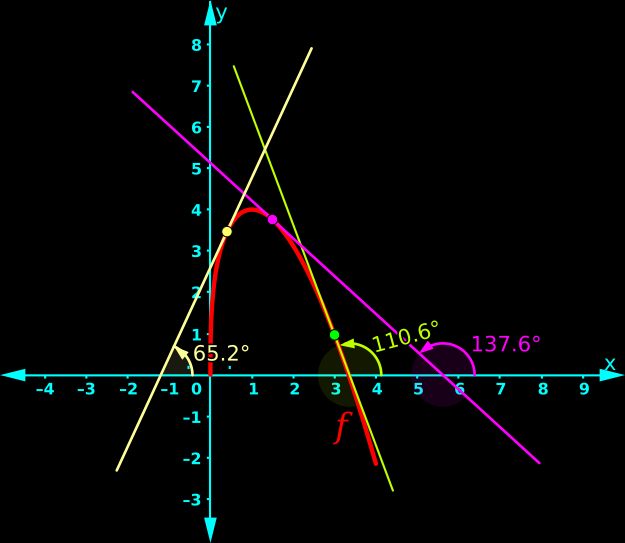
1. The red curve in fig.22.52 below shows the graph of a function f.

Fig.22.52

• We see that, the graph has an upward concavity. In such a situation, we say: f is concave up.

2. Let us analyze three random tangents of f.
Three random points are marked on f. They are: green, magenta and yellow.
• Consider the tangent at the green point.
   ♦ This tangent is drawn in green color.
   ♦ This tangent makes an angle of 110.6o with the +ve side of the x-axis.
• Consider the tangent at the magenta point.
   ♦ This tangent is drawn in magenta color.
   ♦ This tangent makes an angle of 137.6o with the +ve side of the x-axis.
• Consider the tangent at the yellow point.
   ♦ This tangent is drawn in yellow color.
   ♦ This tangent makes an angle of 65.2o with the +ve side of the x-axis.

3. We know that, slope of a line is equal to the tangent of the angle which the line makes with the +ve side of the x-axis.
• So let us write the slopes:
   ♦ Slope of green tangent = tan(110.6) = −2.66
   ♦ Slope of magenta tangent = tan(137.6) = −0.913
   ♦ Slope of yellow tangent = tan(65.2) = 2.16
• We see that:
   ♦ Magenta has a larger slope than green.
   ♦ Yellow has a larger slope than magenta.
• So the slope increases in the order:
Green < Magenta < Yellow

4. Now consider the green, magenta and yellow points.
   ♦ yellow is at the right side of magenta.
   ♦ magenta is at the right side of green.
• So we can write:
For a function which is concave up, the slope of tangent increases as we move from left to right.

5. Recall that, slope of the tangent is given by f '. This f ' is also a function.
• So, if f ' is increasing, the second derivative f '' must be +ve.
• Therefore we can write:
A function f is concave up in an interval (a,b), if f '' is +ve at all points in that interval.


Now we will see downward concavity. It can be written in 5 steps:
1.The red curve in fig.22.53 below shows the graph of a function f.

Relation between sign of second derivative and the concavity of the function.
Fig.22.53

• We see that, the graph has a downward concavity. In such a situation, we say: f is concave down.

2. Let us analyze three random tangents of f.
Three random points are marked on f. They are: yellow, magenta and green.
• Consider the tangent at the yellow point.
   ♦ This tangent is drawn in yellow color.
   ♦ This tangent makes an angle of 65.2o with the +ve side of the x-axis.
• Consider the tangent at the magenta point.
   ♦ This tangent is drawn in magenta color.
   ♦ This tangent makes an angle of 137.6o with the +ve side of the x-axis.
• Consider the tangent at the green point.
   ♦ This tangent is drawn in green color.
   ♦ This tangent makes an angle of 110.6o with the +ve side of the x-axis.

3. We know that, slope of a line is equal to the tangent of the angle which the line makes with the +ve side of the x-axis.
• So let us write the slopes:
   ♦ Slope of yellow tangent = tan(65.2) = 2.16
   ♦ Slope of magenta tangent = tan(137.6) = −0.913
   ♦ Slope of green tangent = tan(110.6) = −2.66

• We see that:
   ♦ Magenta has a smaller slope than yellow.
   ♦ Green has a smaller slope than magenta.
• So the slope decreases in the order:
Yellow < Magenta < Green

4. Now consider the green, magenta and yellow points.
   ♦ yellow is at the left side of magenta.
   ♦ magenta is at the left side of green.
• So we can write:
For a function which is concave down, the slope of tangent decreases as we move from left to right.

5. Recall that, slope of the tangent is given by f '. This f ' is also a function.
• So, if f ' is decreasing, the second derivative f '' must be −ve.
• Therefore we can write:
A function f is concave down in an interval (a,b), if f '' is −ve at all points in that interval.


Based on the above two examples, we can write the test for concavity:
Let f be a twice differentiable function in the interval (a,b).
(i) If f '' > 0 for all points in (a,b), then f is concave up.
(ii) If f '' < 0 for all points in (a,b), then f is concave down.


Now we can learn about inflection point. It can be written in 3 steps:
1. Fig.22.54 below, shows the graph of a function f.

The concavitychanges at the inflection point. The second derivative will be zero.
Fig.22.54

• We see that:
   ♦ f is concave up in the interval (a,c)
   ♦ f is concave down in the interval (c,a)
2. Let us analyze the change in sign of f '':
(i) We know that, if f is concave up, all f '' will be +ve.
• So all f '' in (a,c), will be +ve.
(ii) We also know that, if f is concave down, all f '' will be −ve.
• So all f '' in (c,a), will be −ve.
(iii) Such a change in sign for f '' is possible only if:
f '' becomes zero at some point.
(iv) Obviously, that zero point will be at the junction between "concave up portion" and "concave down portion".
• That means, f ''(c) = 0
3. So we can write the definition of inflection point:
Inflection point of a function f is the point at which f changes concavity.
4. Based on the above definition, we can write:
The inflection point in our present case is (c,f(c)).


Now we will see a solved example
Solved example 22.54
For the function f(x) = x3 − 6x2, determine all intervals where f is concave up and all intervals where f is concave down.
Solution:
Step I: Finding the inflection points and dividing the number line
1. First we will write f '(x):
f '(x) = 3x2 − 12x

2. Next we will write f ''(x):
f '' = 6x − 12

3. Equating f''(x) to zero, we get:
6x − 12 = 0
⇒ 6x = 12
⇒ x = 2

4. So the only one inflection point is at x = 2

5. Now the number line can be divided into two intervals:
(−∞,2) and (2,∞)

Step II: Finding the sign of f '' in each interval and assessing the concavity
First interval: (−∞,2)
• A convenient number in the first interval is 0.
• f ''(0) = 6(0) − 12 =  −12
• Therefore, the sign of f ''(x) in the first interval is −ve.
• Then f is concave down in the first interval.

Second interval: (2,∞)
• A convenient number in the second interval is 3.
• f ''(3) = 6(3) − 12 = 18 −12 = 6
• Therefore, the sign of f ''(x) in the second interval is +ve.
• Then f is concave up in the second interval.

Step III (optional): Drawing the graph

• The graph is shown in fig.22.55 below:

Fig.22.55

   ♦ f is drawn in red color.
   ♦ f ' is drawn in yellow color
   ♦ f '' is drawn in green color
• The vertical magenta dashed line divides the number line into the two intervals (−∞,2) and (2,∞). The following five facts are in agreement with our discussion on concavity test:
(i) For all inputs from the left of this vertical line, f is concave down.
(ii) For all inputs from the right of this vertical line, f is concave up.
(iii) For all inputs from the left of this vertical line, f ' is decreasing.
(iv) For all inputs from the right of this vertical line, f ' is increasing.
(v) f '' and this vertical line intersects at the x-axis. That means, value of f '' at x = 2 (the point of inflection), is zero.

Solved example 22.55
For the function f(x) = x + sin(2x), x ∈ [−π/2,π/2], determine all intervals where f is concave up and all intervals where f is concave down.
Solution:
Step I: Finding the inflection points and dividing the number line
1. First we will write f '(x):
f '(x) = 1 + 2 cos(2x)

2. Next we will write f ''(x):
f '' = −4 sin(2x)

3. Equating f''(x) to zero, we get:
−4 sin(2x) = 0
⇒ −8 sin x cos x = 0
⇒ sin x = 0 or cos x = 0
• For the equation sin x = 0, the only one solution in [−π/2,π/2], is x = 0
• For the equation cos x = 0, the only two solutions in [−π/2,π/2], are x = −π/2 and x = π/2


4. So the three inflection points are:
x = −π/2, x = 0 and x = π/2
5. Now the given domain [−π/2,π/2] can be divided into two intervals:
[−π/2,0] and [0,π/2]

Step II: Finding the sign of f '' in each interval and assessing the concavity
First interval: [−π/2,0]
• A convenient number in the first interval is −π/8.
• f ''(−π/8) = −4 sin(2(−π/8))
= −4 sin (−π/4) = 4 sin (π/4) = 4/(√2) 
• Therefore, the sign of f ''(x) in the first interval is +ve.
• Then f is concave up in the first interval.

Second interval: [0,π/2]
• A convenient number in the second interval is π/8.
• f ''(π/8) = −4 sin(2(π/8))
= −4 sin (π/4) = −4/(√2) 
• Therefore, the sign of f ''(x) in the second interval is −ve.
• Then f is concave down in the second interval.

Step III (optional): Drawing the graph

• The graph is shown in fig.22.56 below:

Fig.22.56
   ♦ f is drawn in red color.
   ♦ f ' is drawn in yellow color
   ♦ f '' is drawn in green color
• The two vertical magenta dashed lines are the boundaries of the domain [−π/2,π/2]. Those two vertical lines indicate the position of two inflection points x = −π/2 and x = π/2 also. Position of the third inflection point x = 0, is indicated by the y-axis. The following five facts are in agreement with our discussion on concavity test:
(i) For all inputs from between the left vertical line and y-axis, f is concave up.
(ii) For all inputs from between y-axis and the right vertical line, f is concave down.
(iii) For all inputs from between the left vertical line and y-axis, f ' is increasing.
(iv) For all inputs from between y-axis and the right vertical line, f ' is decreasing.
(v) Consider the point of intersection of  f '' with the two vertical lines and the y-axis. All those three points of intersection are at the x-axis. That means, value of f '' at those points (the points of inflection), is zero.


In the next section, we will see the second derivative test.

Previous

Contents

Next

Copyright©2024 Higher secondary mathematics.blogspot.com